1-Page Summary
Because the world is increasingly dependent on technology, being competent in technical subjects like math and science is beneficial for both your career and life in general.
Some people find math and science intimidating, and Barbara Oakley, the author of A Mind for Numbers, used to be one of those people. However, she overcame her technophobia, eventually earning a doctorate degree in engineering. Her purpose in writing this book is to help you learn math and science by showing you how you learn and how to build effective study habits.
In this guide, we’ll discuss the principles that Oakley presents, often examining their scientific basis or comparing them to the ideas of other experts. We’ll begin by discussing Oakley’s exposition of how your brain works, which lays a foundation for understanding how you learn. We’ll then discuss Oakley’s strategies for remembering information and developing good habits, both keys to long-term success in learning math and science. Finally, we’ll consider how to overcome the problem of procrastination, which is a special kind of habit, and one that Oakley warns can severely hinder your academic success if it is not dealt with.
Brain Basics: How You Learn
The Two Modes of Thinking
A key theme of A Mind for Numbers is that alternating between modes of thinking can help you learn new things and problem-solve effectively. Oakley explains that your brain naturally alternates between two modes of thinking: focused and diffuse.
According to Oakley, focused-mode thinking occurs when your attention is focused on something, and it allows you to process detailed information. However, she notes that it’s susceptible to the “Einstellung effect,” which occurs when you are unable to solve a problem because the solution is outside the scope of where you are looking for it.
Oakley asserts that diffuse-mode thinking occurs when you relax your focus or let your mind wander. She explains that it continues to subconsciously process information from previous focused-mode thinking, but in a different way: It can circumvent the Einstellung effect by allowing you to mentally step away from detailed problems and see the big picture, or generate creative solutions by making connections between diverse concepts.
Thus, Oakley explains that solving any difficult problem requires an exchange of information between your brain’s focused-mode and diffuse-mode functions. She recommends that you start by deliberately focusing on the problem and then deliberately divert your attention, allowing your brain to switch to diffuse mode. Repeat as needed, alternating between modes until you solve the problem.
Comparing Perspectives on the Two Modes of Thinking
Other writers have used a variety of terms for what Oakley calls “focused-mode thinking” and “diffuse-mode thinking.”
Edward de Bono coined the terms “Lateral Thinking” and “Vertical Thinking” for what Oakley calls diffuse mode and focused mode, respectively. He emphasizes that lateral thinking (diffuse mode) generates new ideas or solutions, while vertical thinking (focused mode) down-selects between possibilities. Thus, in de Bono’s view, you should switch to diffuse mode to generate new ideas, and switch to focused mode to select and implement a solution.
Malcolm Gladwell contrasted “conscious thinking” with “unconscious thinking.” These modes of thinking can be loosely mapped to Oakley’s focused and diffuse mode thinking, respectively. Gladwell presents conscious thinking as a tool for rational decision making and unconscious thinking as a tool for intuitive decision making. He emphasizes that unconscious thinking operates quickly and that trained intuition can be highly accurate. Thus, he advocates using unconscious thinking to solve certain types of problems directly, although he doesn’t directly address the kind of academic problems that Oakley focuses on.
Daniel Kahneman wrote about “System 1” and “System 2” thinking, defining them similarly to Gladwell’s “unconscious” and “conscious” thinking modes, respectively. However, he highlighted the many types of bias that can cause intuition to be wrong to emphasize the importance of System 2 to catch System 1’s errors. As such, he seemed to assume you operate in “System 1” by default, and emphasized the need to invoke “System 2” to analyze the output of “System 1” rationally whenever the consequences of an error are significant. This theme resonates with Oakley’s observation that once you identify a possible solution with diffuse mode, you still have to switch back to focused mode to work out the details and make sure the solution actually works.
How to Switch Between Modes of Thinking
Oakley lists a number of ways you can give your diffuse mode time to operate on problems you are trying to solve:
- Go for a walk or do something athletic.
(Shortform note: This method can be doubly effective, as health psychologist Kelly McGonigal reports that during physical exercise, your muscles secrete chemicals called myokines that stimulate your brain, increasing cognitive performance and alleviating depression.)
- Take care of routine tasks, such as housework or laundry.
(Shortform note: This helps make efficient use of your time while studying, but as an added benefit, a recent study concluded housework is a feasible means for workers with sedentary jobs and limited time to get the health benefits of physical activity.)
- Get some rest. Oakley asserts that your brain cannot function normally without enough sleep.
(Shortform note: Other authors echo this assertion. Matthew Walker reports that sleep improves long-term memory of important facts while eliminating trivial information, and warns that lack of sleep impairs your ability to focus.)
The Two Types of Memory
To learn anything, you have to store it in your memory. Oakley explains that your brain has two types of memory:
- Working memory is your brain’s workspace: It holds the information that your mind is actively processing. Your working memory has limited capacity. Oakley asserts that, on average, it can only hold about four units or “chunks” of information at a time, although this varies from person to person.
(Shortform note: Not all sources agree as to exactly how many “chunks'' of information an average person’s working memory can hold. The number four comes from Cowan’s research, which was published in 2001, and largely supplanted an estimate of seven based on Miller’s work in 1956. In 2003, Gobet and Clarkson published a study revising the estimate to between two and three. In any case, your working memory can only hold a few units of information.)
- Long-term memory is your brain’s library. It stores information for future reference. According to Oakley, it can store billions of pieces of information, although information that you don’t access repeatedly may get buried under other information and become difficult to retrieve.
Diffuse Mode Memory
Oakley doesn’t fully discuss how long-term memory might relate to the two modes of thinking. Focused mode can retrieve information from long-term memory and load it into working memory where it makes use of it. Does diffuse mode operate directly on data in your long-term memory? Or does diffuse mode have its own unconscious version of working memory that absorbs information from your focused-mode working memory so diffuse mode can operate on it later?
Given Oakley’s assertion that diffuse mode eventually runs out of information to process, the second explanation seems to fit better. Furthermore, Gilchrist and Cowan have identified that there are both conscious and unconscious aspects of working memory.
Chunking: Your Brain’s File Management System
According to Oakley, as you take in information, your brain tries to assemble it such that it makes sense. This process of assembling the information into coherent concepts is called “chunking,” and the concepts it assembles are called “chunks.”
Oakley explains that, as you study, your working memory quickly fills up with information. But once your brain processes this information into a coherent chunk, it takes up only one slot in your working memory instead of all four available slots. She asserts that the more deeply chunked something is in your mind, the more intuitive it becomes.
As an example of the chunking process, think about learning to drive a stick-shift. Many small tasks go into shifting gears: You have to move the shifter to the right position, let out the clutch while keeping the engine RPMs in the right range, and so on. However, once your brain has condensed all this information into a single chunk, you can shift gears intuitively, without thinking individually about all the little tasks that go into it.
(Shortform note: Oakley describes chunking as a mental process that occurs naturally as part of the learning process. However, others have explored applications of artificial chunking. For example, in his book, Moonwalking with Einstein, Joshua Foer describes chunking as a mnemonic device: You can remember longer strings of numbers by breaking them up into groups of digits. This could be called “arbitrary chunking,” since you arbitrarily impose the grouping and artificially create a unifying meaning for each chunk of numbers.)
Remember What You Learn
Oakley explains that the more connections the chunk has, the more memorable it is, and the more often you access it, the stronger the connections become. More connections and stronger connections both make a chunk more accessible. Thus, there are two factors that determine how well a concept will stick in your memory: how memorable it is, and how often you recall it. Let’s explore strategies for making information memorable and recalling information.
Make Information More Memorable
Factors That Affect Memorability
According to Oakley, something will generally be more memorable if it possesses one or more of the following factors:
- You write it out long-hand (Writing Factor).
- You say it out loud (Speech Factor).
- It has more connections, literal or metaphorical, to other concepts (Association Factor).
- It involves moving your body (Movement Factor).
- It makes you laugh (Humor Factor).
- It tells a story or connects concepts through cause and effect (Story Factor).
- It invokes multiple senses (Sensory Factor).
- It connects visual and spatial data to form visuospatial map chunks (Spatial Factor).
Additional Memorability Factors from Joshua Foer
In Moonwalking with Einstein, Joshua Foer also identifies factors that make information more memorable. He corroborates Oakley on the sensory, humor, and spatial factors, emphasizing the importance of the spatial factor. Additionally, he includes four factors that Oakley doesn’t consider:
The information stands out as novel or unique (Novelty Factor).
You can relate the information to your own experiences (Personal Factor).
It’s concrete rather than abstract (Concreteness Factor).
It displays patterns or structure, like rhyme or repetition (Structure Factor).
Techniques for Making Information More Memorable
But what if you need to remember something that, by itself, isn’t all that memorable? As Oakley explains, you could come up with an acronym or a sentence composed of words that symbolize the ideas you need to remember. Oakley notes that if you say it out loud or set it to music and sing it, you can also take advantage of the speech and song factors.
Another technique that Oakley discusses consists of developing a “visual metaphor,” or mental image that represents what you need to remember. She also discusses the “memory palace,” which is a powerful extension of visual metaphors to take advantage of the spatial factor and potentially the story factor. As Oakley explains, you first think of a place that you know well, such as your home or college campus. Then you imagine yourself moving through the place, interacting with objects. Each object is a visual metaphor for something you need to remember.
For example, suppose you need to memorize the hierarchy of taxonomy for biology class: Kingdom>Phylum>Class>Order>Family>Genus>Species. In your mind’s eye, you are walking across campus when you suddenly bump into the King of England, who happens to be visiting your college that day (Kingdom). Next, you stop at the cafeteria, where you order a Philly steak-and-cheese sandwich (phylum). Then you go to class (class).
After class, you head back to your dorm room, but you have to take a detour because a drill sergeant is parading his troops on the campus lawn and shouting a lot of orders (order). When you arrive at your dorm room, you discover your family has come to visit (family). After your family leaves, you notice that your laundry basket is full of jeans, so you head over to the campus laundry room to wash your jeans (genus). However, in the laundry room, you discover that your jeans are covered with tiny yellow specks (species) that won’t wash off.
Foer’s Techniques for Making Information More Memorable
Unlike Oakley, Foer doesn’t discuss singing or speaking out loud as a way of making information more memorable. Perhaps this is because when you’re taking an exam and need to remember something, you’re generally not allowed to break out in song or get up and dance around the classroom.
However, Foer does discuss the use of visual metaphors and the memory palace. He explains that the term “memory palace” is a modern name, while earlier sources refer to it as the “method of loci.” In these early descriptions, each imaginary location where you place a visual metaphor was called a locus (and loci is the plural of locus).
In Foer’s description, the memory palace is the master technique to which all other methods are subservient. You populate your memory palace with visual metaphors, and in some cases, you may use symbolic sentences to generate visual metaphors for abstract concepts or develop more memorable images.
For example, if you are building a memory palace for your biology class and you want to consolidate the hierarchy of taxonomy into a single image, you could symbolize it with the sentence, “King Phillip cleaned orange fungus off Jenny’s spectacles,” where King = Kingdom, Phillip = Phylum, cleaned = class, orange = order, Jenny = genus, spectacles = species. You then place the mental image of this scene at one location in your memory palace.
Review Information to Keep it Accessible
Now, let’s discuss strategies for recalling information. Oakley cautions that even a memorable fact may soon become unretrievable if it is not reviewed. She presents some strategies you can use to make your review sessions more effective:
- Test yourself with intentional recall. If you just finished a reading assignment, Oakley recommends closing the book and trying to recall the essence of what you just read. She asserts that this is the most effective way to embed the content in your memory.
(Shortform note: William James documented that active repetition (or intentional recall) is more effective for learning than methods of passive repetition, such as rereading the material, over a hundred years ago. Numerous studies since then have confirmed this effect.)
- Oakley suggests practicing “spaced repetition,” where you repeatedly revisit material at designated intervals. She recommends revisiting any new information within one day, so you don’t forget it completely.
(Shortform note: Psychological studies have determined that students who practice intermediate spacing between study sessions tend to perform better than those who do all their studying at once, and also better than those who break it up into smaller sessions and study too frequently. Other experts assert that the optimal time for a recall session is when the information in your mind gets fuzzy—it’s no longer fresh, but it’s not gone yet either.)
Take Control of Your Habits to Make the Most of Study Time
Understand the Habit Chunk
According to Oakley, your study habits (good or bad) will have a strong impact on your ability to learn math and science. She explains that habits develop via the same chunking process that condenses information in your brain and facilitates storage in your memory. A habit chunk consists of four pieces of information:
- The Cue: Oakley identifies this as the stimulus that your brain responds to by performing the habitual action. She notes that cues can be linked to people, places, time, feelings, or events.
- The Routine: This is the action or sequence of actions that you perform when the habit is triggered by the cue.
- The Reward: Oakley asserts that you have to derive some kind of benefit from executing the routine for a habit to develop. Your brain executes the routine in response to the cue because it expects the reward. She also points out that only immediate consequences of the routine are stored as part of the habit chunk. This is why bad habits are possible: The reward is immediate but transient and the long-term consequences are negative, but the long-term consequences are not processed as part of the habit chunk, and thus do not automatically cancel out the reward.
- The Belief: According to Oakley, your habits are grounded in your perception of reality and of your own identity.
For example, suppose you make a habit of reading your text messages immediately:
- The cue is the ringtone your phone plays when you get a text.
- The routine might consist of retrieving your phone from your pocket and accessing the text-messaging app.
- The reward is the pleasure that you derive from reading text messages.
- The underlying belief could vary: Maybe you believe responding promptly to communications is an important part of being respectful toward others, or maybe you identify as a social person and believe in staying connected with others through text.
Comparing Habit Models
Charles Duhigg, author of The Power of Habit, and James Clear, author of Atomic Habits, offer descriptions of the make-up of a habit that are similar to Oakley’s model (although both omit the “belief” element of Oakley’s model). However, BJ Fogg, author of Tiny Habits, provides an alternative model.
According to Fogg’s behavioral model, you perform an action or behavior when a prompt alerts you to the opportunity to do so, and the combination of your ability to complete that action and motivation to do so is above a certain threshold. Fogg’s model applies both to habits and to non-habitual actions.
Fogg conceives habits as self-perpetuating. The more often you do something, the better you get at doing it, so your ability to do it increases. Further, the habit reward provides motivation to keep doing it. This combination of increasing ability and increasing motivation makes a behavior more likely to exceed the threshold the next time you receive the prompt—thus making you more likely to engage in the habit again.
Strategies for Changing Habits
As Oakley explains, you can modify your habits by making changes to any part of the habit chunk:
1) Oakley suggests that you can prevent bad habits from triggering by isolating yourself from their cues. For instance, if hearing a certain song while driving triggers you to habitually speed, remove this song from your driving playlist.
(Shortform note: Clear corroborates this suggestion of Oakley’s. He proposes four “laws” of forming new habits, each with an inverse form for breaking bad habits. His first law is to make cues obvious, and inversely, to prevent bad habits from triggering by making their cues invisible.)
2) Overwrite the habit routine by changing how you react to the cue. Oakley notes that this strategy requires a deliberate plan and an exertion of willpower, but that it plays a key role in optimizing your study habits.
(Shortform note: Fogg identifies this same strategy of changing the behavior associated with a certain prompt. However, instead of highlighting the need for willpower, he advises designing the replacement behavior to take as little willpower as possible. To do this, he advises you to make the replacement behavior easier and more desirable (higher ability and motivation) than the old one.)
3) According to Oakley, sometimes you can modify the habit by manipulating the reward. If you understand what reward is tied to a certain habit, you may be able to change the reward to either reinforce or dismantle the habit. For instance, creating rewards for sticking to good habits can keep you on the right track.
(Shortform note: In Fogg’s model, rewards primarily influence motivation. He cautions you to avoid basing habit changes too much on motivation, because motivation is often complex and can be fickle. Nevertheless, he presents celebrating small victories as a key strategy for reinforcing changes that you are trying to make to your habits.)
4) Address underlying beliefs fueling the habit. Oakley asserts that to change a habit, you must believe that you can change and that the change will be an improvement.
(Shortform note: Clear observes that it is particularly easy to pick up habits from people you are close to or look up to because these people influence your beliefs. This implies that you can sometimes prompt a change in your habits by changing the company you keep and thus changing your beliefs.)
Overcome Procrastination
Understand the Procrastination Chunk
Oakley asserts that habitual procrastination is often your most significant barrier to learning math and science. She explains that procrastination is a special kind of habit, but it has the same basic components as any habit chunk:
- The Cue: According to Oakley, the procrastination cue comes in two parts. The first part is the unpleasant feeling that you get from anticipating an activity that makes you uncomfortable. The second part is the “distraction,” which is any stimulus that you can shift your focus to in order to escape the pain of anticipation.
- The Routine: Oakley explains that the procrastination chunk in your brain generally doesn’t have just one routine, but rather several sub-routines. The type of distraction that completes the cue determines which sub-routine gets triggered. For example, if the distraction is a new email from an online retailer, maybe the sub-routine consists of following the link in the email and mindlessly browsing the retailer’s website.
- The Reward: According to Oakley, the reward that allows a procrastination habit to develop is temporary relief from the pain of anticipation.
- The Belief: Oakley reiterates that one of the keys to changing any habit is believing that you can change. If you’ve been procrastinating habitually for a long time, it might be tempting to believe procrastination is an innate part of who you are, but understanding the makeup of the procrastination habit can help you change this belief.
Oakley and Eyal: Procrastination vs Distraction
Some authors discuss a process similar to Oakley’s “procrastination” using different terms. For instance, Nir Eyal uses the term “distraction” to define any behavior that draws you away from the tasks that you need to focus on to accomplish your goals. He asserts that we are all fundamentally motivated to free ourselves from discomfort, and we get distracted because distractions offer temporary relief from mental discomfort.
Furthermore, he states that distractions start with “triggers” and distinguishes between internal and external triggers. He equates internal triggers to the sense of discomfort or dissatisfaction that prompts you to look for an escape. External triggers, then, are environmental stimuli that interrupt your concentration and/or offer an opportunity for escape.
Thus, “distraction” as used by Eyal seems to be functionally synonymous with “procrastination” as used by Oakley, and Eyal’s description of the root cause of distraction is compatible with Oakley’s description of the procrastination habit model. As such, we can compare Oakley’s strategies for avoiding procrastination to Eyal’s for additional perspective. We’ll discuss both Oakley’s and Eyal’s strategies in the next section.
Strategies for Overcoming Procrastination
In addition to her general strategies for changing habits, Oakley provides strategies specifically for combating procrastination:
1) Plan your time. According to Oakley, just having a plan for how to spend your time can reduce the temptation to procrastinate, and tracking your time can help you identify specific procrastination habits. To this end, she recommends keeping a daily to-do list in a journal planner or on a conspicuous whiteboard.
(Shortform note: Eyal also identifies building the right schedule as one of the key strategies for overcoming distraction. However, he asserts that just making a to-do list of daily tasks is not enough, because it’s too easy to move uncompleted tasks to tomorrow’s list if you slip into distraction. Instead, he prescribes “timeboxing,” where you split up your entire day into blocks (or boxes) of time, all of which are allocated to specific activities. This way, if you find yourself doing anything other than what you planned to be doing at that time of the day or night, you can identify exactly when you were distracted. Eyal recommends scheduling one 20-minute box each week to reflect on the times you got distracted and consider how you could adjust your schedule to avoid such distractions in the future.)
2) Eliminate distractions. Oakley points out that avoiding distractions can prevent your procrastination sub-routines from triggering.
(Shortform note: Eyal likewise identifies “eliminating triggers'' as one of the keys to conquering distraction. He presents a list of triggers to manage, including in-person interruptions, incoming email, text, or social media media, and desktop clutter. By letting people know when you are and are not available, disabling notifications for most incoming communications, establishing set time-boxes for responding to communications, and keeping an organized desktop, Eyal says you can greatly reduce distractions.)
3) Ignore distractions. Oakley acknowledges that this requires an exertion of willpower, much like overwriting a habit routine, but she says this is a key strategy for overcoming procrastination habits. She notes that you can use meditation techniques to let distractions pass.
(Shortform note: Author Bhante Gunaratana describes “mindfulness” meditation as a state of mental awareness in which you listen to your thoughts without getting caught up in them. You just observe what’s going on in your mind, without expecting, reacting, pondering, analyzing, or passing judgment on any of it. Medical studies affirm that this meditation technique tends to reduce susceptibility to distraction. Presumably, every time you observe a distraction without responding to it, the association between the distraction and its procrastination sub-routine grows weaker.)
Shortform Introduction
Because the world is increasingly dependent on technology, being competent in technical subjects like math and science is beneficial both for your career and life in general.
You may not realize it, but your brain has an extraordinary capacity for complex calculations: Tasks like stepping over a garden hose as you walk across your lawn require tremendously complex computations, and yet they seem easy because your brain does them intuitively. Barbara Oakley wrote A Mind for Numbers to help you learn math and science well enough that they, too, become intuitive. In this book, Oakley presents principles about how your brain works and builds strategies for learning and studying upon these principles.
About the Author
Barbara Oakley is a professor of engineering at Oakland University who also teaches a MOOC (massive open online course) called “Learning How to Learn: Powerful Mental Tools to Help You Master Tough Subjects” through Coursera. To date, this class has reached over two million students.
Oakley grew up thinking she was technically inept. From childhood through her career in the US Army, she struggled with technical subjects. However, recognizing the benefits of technical competence, she determined to overcome her technophobia and eventually earned a doctorate in systems engineering.
Since 2007, Oakley has authored or co-authored numerous books and articles on the relationship between neuroscience, social behavior, and learning, including Learn Like a Pro, Mindshift, and Uncommon Sense Teaching.
Connect With the Author
The Book’s Publication
A Mind for Numbers was Oakley’s seventh book, published in July 2014 under the TarcherPerigee imprint of the Penguin Random House Network. However, it was her first book on the subject of study skills, which would become the subject of her most popular books. Significantly, it was published the month before Oakley’s online class, “Learning How to Learn,” debuted: The content of the course and the book closely parallel one another, and thus reinforce each other if taken together. That said, the book can also stand by itself.
In 2014, A Mind for Numbers ranked 14th on the New York Times’ list of best-selling science books. Based on Amazon’s best-seller rankings, it’s Oakley’s most popular book to date.
The Book’s Context
Intellectual Context
A Mind for Numbers is primarily a synthesis of established neuroscience and study techniques. It brings relevant information together and makes it actionable for students, rather than disclosing original research or new discoveries. Nevertheless, Oakley also provides original insight into the subjects that she synthesizes.
In this guide, we will briefly explore the origins of many of the concepts Oakley presents, and compare the way she develops them to the way others have used them, if applicable. For example, we’ll discuss how Oakley’s “focused-mode” and “diffuse-mode” thinking correlate to the concepts of “vertical” and “lateral” thinking proposed by Edward de Bono half a century earlier.
The Book’s Strengths and Weaknesses
Critical Reception
Most book reviewers praised A Mind for Numbers for its applicability, saying either that it helped them in their studies or that they wished they had read it when they were in school. It holds an average rating of four stars or more on platforms such as Amazon and Goodreads.
However, the book was not without its critics. Both positive and critical reviewers pointed out that A Mind for Numbers is about learning techniques that can be applied to any field of study, rather than just math and science. This led positive reviewers to praise the book for its wide applicability, while critical reviewers expressed disappointment that it did not delve into math and science more deeply.
Commentary on the Book’s Approach
Oakley’s overall approach in the book is as follows:
- First, she presents principles of neuroscience.
- Then, she builds strategies for effective studying based on these principles.
- Next, she illustrates and substantiates these strategies with examples and testimonials.
- Finally, she challenges the reader to apply these strategies with exercise questions.
Within each chapter, the principles and strategies are often interspersed with anecdotes and testimonials. This led some critical reviewers to accuse the book of being sloppy in its organization and full of tangential information that doesn’t contribute significantly to the book’s main principles or purpose.
However, it’s possible that Oakley intentionally buffered the book’s weightier content with lighter anecdotes. One of the book’s main points is the importance of alternating between focused and diffuse thinking when learning new things or solving difficult problems. Focused thinking involves focusing intently on something to understand it in detail, while diffuse thinking corresponds to a more relaxed mental state. The handoff between the two modes plays an important role in the learning process. In this light, Oakley’s organization allows the reader to alternate naturally between focused and diffuse thinking while reading the book, and thereby learn the material better.
Commentary on the Book’s Organization
One theme that Oakley stresses in A Mind for Numbers is the importance of revisiting a concept repeatedly to engrain it in your memory. Consistent with this principle, she repeatedly revisits topics throughout the book. For example, she introduces her discussion of habitual procrastination (and how to avoid it) in Chapter 5, reiterates and expands upon it in Chapter 6, moves on to other topics in Chapters 7 and 8, and then returns to the subject of procrastination again in Chapter 9.
This cyclical approach to the organization of the book has its pros and cons. On the one hand, if you read the book from front to back, the repetition ensures that you will remember the key concepts better than if you were only exposed to them once. On the other hand, the cyclical repetition can make it more difficult to find something again if you wish to refer back to it. The progression of logic might also be easier to follow if the book were more linear, and the repetition makes the book less concise.
Our Approach in This Guide
We’ve organized our discussion of the book’s material into thematic sections to aid the flow of logic and make topics easier to find. Here’s a mapping of the parts of this guide to the chapters of the book:
- Part 1 → Chapters 2, 3, 12
- Part 2 → Chapters 3, 4, 7, 14
- Part 3 → Chapters 10, 11
- Part 4 → Chapters 4, 6
- Part 5 → Chapters 5, 6
- Part 6 → Chapters 5, 6, 8, 9
- Part 7 → Chapter 17
- Part 8 → Chapters 13, 14, 15, 16, 18
To understand the study strategies that Oakley recommends, we first need to discuss how we learn and how we remember what we learn. In the first two parts, we’ll also examine how Oakley’s principles compare to Edward De Bono’s, Malcolm Gladwell’s, and Daniel Kahneman’s.
After laying this foundation, Parts 3 and 4 will discuss Oakley’s two general strategies for remembering information: making it memorable, and repeating it. We’ll also compare and contrast Oakley’s strategies to those of other learning and memory experts, such as Joshua Foer and Scott Young.
Part 5 focuses on habits, because your study habits arguably play the most significant role in your long-term success at learning math and science. We’ll compare Oakley’s model of how habits work to the models described by James Clear, Charles Duhigg, and BJ Fogg. Part 6 focuses on a special kind of habit, procrastination, which can severely hinder your academic success if you don’t deal with it.
To ensure that you can demonstrate what you’ve learned in an exam setting, it’s important to know how to manage test-taking anxiety, which is the theme of Part 7. Finally, in Part 8, we’ll discuss some of Oakley’s additional tips for achieving your full potential, such as how to get the most out of study groups and how to maximize your creativity.
To focus on the central principles of these themes while keeping this guide as concise as possible, we have largely omitted discussion of the anecdotes and testimonials that appeared in A Mind for Numbers.
Part 1: Understand How You Think
A key theme of A Mind for Numbers is that alternating between modes of thinking can help you learn new things and problem-solve effectively. To understand how to do this and why it works, you first need to understand a few things about how your brain works. In this section, we’ll first discuss your brain’s two modes of thinking. Then we’ll comment on switching between them to solve problems.
The Two Basic Modes of Thinking
Oakley explains that your brain naturally alternates between two modes of thinking: focused and diffuse.
As an analogy for these two modes of thinking, imagine a camera with a variable lens. If you zoom in on the subject, details are clearly visible, but the surroundings are cut off: This is like focused-mode thinking. If you zoom out, the big picture comes into view, but details are obscured: This is like diffuse-mode thinking.
Oakley notes that in nature, animals must alternate between detail-oriented tasks, such as eating berries off a bush (focused mode), and general awareness, such as scanning their environment for predators (diffuse mode). She suggests that this could explain the origin of the two modes.
(Shortform note: This may be an original insight on Oakley’s part. The concept of these two thinking modes was probably first recognized by Edward de Bono, but it appears he studied the modes without delving into their evolutionary origins. Other researchers have suggested that the different functions of the left and right brain hemispheres provide an evolutionary advantage for balancing general awareness with specific tasks. However, Oakley might be the first to connect this concept to the origin of the two thinking modes.)
Based on Oakley’s exposition, let’s compare the two modes in terms of when they are triggered, how they operate in your brain, why you would use them, and the limitations of each that make it necessary to use both.
Focused Mode
When: According to Oakley, focused mode thinking occurs when you focus your attention on something.
How: Focused-mode thinking is associated more with the left hemisphere of the brain than the right (although both are involved), with elevated activity in the prefrontal cortex (the part of your brain just under your forehead). Oakley explains that in focused mode, your thoughts progress rapidly along short pathways between concepts that are closely connected in your mind. The more these pathways are used, the more developed they become, and the more quickly and easily your thoughts traverse them.
Why: Focused-mode thinking allows you to take in detailed information or solve simple problems immediately by applying the steps of a solution method that you are familiar with.
Limitations: Oakley notes that focused-mode thinking is susceptible to the “Einstellung effect,” which occurs when you are unable to solve a problem because the solution is outside the range of ideas where you are looking for it.
(Shortform note: “Einstellung'' is a German word that Abraham Luchins used to describe this effect in 1942. The German word does not have an exact English synonym. In this context, it could be translated as “setting” (you get set in your ways) or “stopping” (you get stuck or stop making progress).)
For example, imagine that upon returning to your dorm room one day, you find that your roommate has bolted your car keys to a large, heavy object, and welded the nut onto the bolt. How do you get your keys back? Unless you are already familiar with this puzzle or prank from shop class, you will probably only be able to come up with brute-force solutions by focused-mode thinking: You think you’ll need a bolt cutter to retrieve your keys.
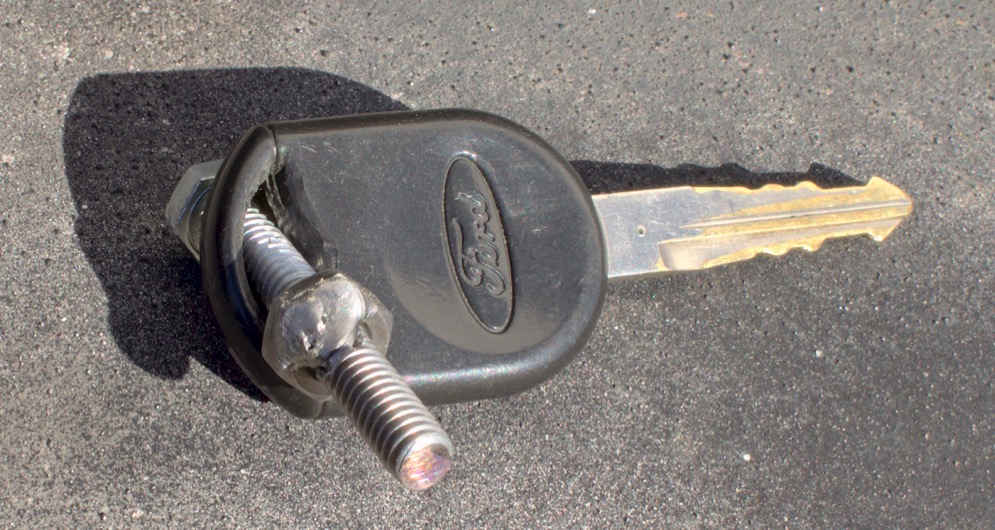
However, there is an easier solution: The bolt that your friend used is already cut in the middle, inside the nut. All you have to do is unscrew the bottom half of the bolt from the top half. However, the Einstellung effect may prevent you from recognizing this upfront.

Diffuse Mode
When: According to Oakley, diffuse-mode thinking happens whenever focused mode-thinking is not happening, such as when you relax or just let your mind wander.
How: Diffuse-mode thinking is associated more with the right hemisphere of the brain than the left (although both are involved), and with a resting state, where activity is not significantly elevated in any particular area of the brain. Oakley explains that during diffuse mode thinking, your thoughts traverse longer neural pathways between more diverse concepts.
(Shortform note: Researchers such as Raichle have identified a “default mode network”(DMN) in the brain that activates whenever it goes into a resting state. This DMN is where diffuse-mode operates. The DMN runs throughout the major structures of the brain and is not localized to any one part.)
Why: Diffuse mode thinking continues to subconsciously process information from previous focused-mode thinking but in a different way. It can generate creative ideas and creative solutions to difficult problems, circumventing the Einstellung effect by allowing you to mentally step away from detailed problems and see the big picture.
Oakley points out that this is particularly useful in math and science because creativity and problem-solving are closely related: You can often approach a problem in a variety of ways, but a certain approach may offer advantages for a certain problem. Thinking up alternative solutions can help you find the best method of solving the problem.
Limitation: Oakley also notes that once you devise a creative solution with diffuse mode, you still have to switch to focused mode to carry out the solution, because diffuse-mode thinking doesn’t process information in enough detail for full implementation. Furthermore, to keep the diffuse mode working on a given problem, you have to keep the problem in your mind by periodically revisiting it with focused-mode thinking.
Perspectives on the Two Modes of Thinking
Other writers have used a variety of terms for what Oakley calls “focused-mode thinking” and “diffuse-mode thinking.”
Edward de Bono
Edward de Bono coined the terms “Lateral Thinking” and “Vertical Thinking” for what Oakley calls diffuse mode and focused mode, respectively. According to de Bono, lateral thinking is a mechanism for generating new possibilities, while vertical thinking is a mechanism for analyzing possibilities and selecting between them. Thus, Oakley’s emphasis on using diffuse mode to generate creative solutions is consistent with de Bono’s presentation, as is her description of the analytical nature of focused mode. However, there is a subtle difference in how they distinguish between the two modes: To Oakley, the distinction is the difference between focusing on something and letting your mind wander. To de Bono, it’s the difference between creatively generating new possibilities and analytically eliminating possibilities.
Malcolm Gladwell
Malcolm Gladwell contrasted “conscious thinking” with “unconscious thinking” in Blink. Gladwell presents “conscious thinking” as a tool for rational decision-making. He points out that it follows a logical path: We can retrace our thought process if we need to explain our reasoning. He also points out that it is easily disrupted in stressful situations. These characteristics tend to imply that it requires focused attention. Thus, Gladwell’s “conscious thinking” closely resembles Oakley’s focused mode.
Gladwell presents a different application for unconscious thinking than Oakley does for diffuse mode: While Oakley recommends using diffuse mode to generate a solution to a technical problem by taking a break from focusing on the problem, Gladwell recommends using unconscious thinking to make assessments and decisions quickly. He presents it as a tool for intuitive decision-making. He also emphasizes that unconscious thinking operates quickly, automatically sorts through sensory information to pick out what’s relevant in the big picture, and follows a “mysterious” path in the sense that we can’t consciously retrace it.
The common threads that tie Oakley’s diffuse mode to Gladwell’s unconscious thinking are that they both involve stepping back from the details to see the big picture and they both operate unconsciously.
Daniel Kahneman
Daniel Kahneman wrote about “System 1” and “System 2” thinking in Thinking, Fast and Slow. He defined “System 1” essentially the same as Gladwell defined “unconscious thinking.” He then defined “System 2” as a conscious, rational, analytical mode of thinking that operates on the intuitive insights and suggestions generated by System 1. According to Kahneman, System 2 can either accept these insights, reject them, or further analyze them. He also states that System 2 has limited capacity, and any task that requires mental energy uses up some of this capacity. Thus, Kahneman’s System 1 is similar to Oakley’s diffuse mode, and Kahneman’s System 2 is similar to Oakley’s focused mode.
Kahneman’s description and application of thinking systems is more like Gladwell’s, but from almost the opposite perspective: Gladwell acknowledges that biases can introduce errors in unconscious thinking, but he points out that unconscious thinking can also be remarkably accurate. As such, he teaches you how to take advantage of it. Kahneman acknowledges System 1 as a natural and necessary mental function, but he focuses on the many types of biases that can cause System 1 to be wrong. As such, he teaches you to recognize System 1’s vulnerabilities and use System 2 to compensate for them.
Although the types of bias that Kahneman describes are less applicable to technical problems, this theme resonates with Oakley’s observation that once you identify a possible solution with diffuse mode, you still have to switch back to focused mode to work out the details and make sure the solution actually works.
Alternate Between Thinking Modes to Solve Difficult Problems
According to Oakley, solving any difficult problem requires an exchange of information between your brain’s focused-mode and diffuse-mode functions. Sometimes multiple cycles are required. So start by deliberately focusing on the problem and then deliberately divert your attention, allowing your brain to switch to diffuse mode. Repeat as needed, alternating between modes until you solve the problem.
Perspectives on Alternating Between Modes of Thinking
Other authors echo Oakley’s imperative to alternate between modes of thinking, but each seems to offer a different rationale for it:
To Oakley, it’s a matter of detail. Your diffuse mode can see the big picture and generate creative solutions to the problem at hand, but only your focused mode can flesh it out with enough detail to make it work.
To De Bono, it’s a matter of selection. Use lateral thinking (diffuse mode) to generate possible solutions, then use vertical thinking (focused mode) to analytically select the best one.
To Kahneman, it’s a matter of consequences and mental resources. System 1 (diffuse mode) operates automatically, but is prone to bias errors. System 2 (focused mode) consumes your limited mental energy, but can correct these errors. Thus, you operate in diffuse mode by default and switch to focused mode to analyze your diffuse mode’s suggestions, investing more mental resources in your analysis when the consequences of the decision are more significant.
Gladwell might argue that, at least in some cases, you don’t need to switch back to conscious thinking (focused mode) to solve a problem if you’ve adequately conditioned your brain’s unconscious (diffuse) mode for that type of problem. A case study supporting this assertion is that of Hyram Rickover, an engineer with remarkable intuition.
In The Rickover Effect, Theodore Rockwell describes Rickover’s involvement in the design of the cooling system for the first nuclear-powered submarine. Engineers initially performed a detailed analysis to determine the size of the cooling system, but when Rickover saw the result, he insisted it was too small. Based on his intuition, he ordered them to quadruple the capacity of the cooling system. When the submarine was finished, the cooling system proved adequate but not excessive: In this case, Rickover’s engineering intuition was more accurate than the detailed thermodynamic analysis.
That said, A Mind for Numbers focuses on learning subjects like engineering, not applying that subject knowledge later. Rickover’s intuition had been conditioned by many years of experience, which you typically don’t have when you enroll in your first thermodynamics class. And professors usually expect you to show your work, so writing down an answer based on intuition may not get you many points on an exam, even if your answer is close enough for practical purposes. Thus, Oakley and Gladwell would probably agree that, as a student, working out solutions in focused mode is a safer bet. Plus, it provides a good starting point for calibrating your intuition on those kinds of problems.
When to Switch From Focused to Diffuse Mode
Oakley recommends that you continue to focus on the problem as long as you are making progress, whether in solving it or just in understanding it. When you cease to make progress or become frustrated, switch to diffuse mode.
Oakley points out that sometimes people around you can sense nuances of your behavior and measure your level of frustration more accurately than you can. For example, maybe your spouse notices that you are typing more forcefully as you try to finish a report and invites you to take a break. Or maybe your study partner sees the tension rising in your facial expression and suggests a run to the cafeteria for a snack before tackling the rest of your physics homework. Listen to them.
(Shortform note: Turning this around, sometimes, you can help your study partners by suggesting a break when you see them becoming frustrated. In Emotional Intelligence 2.0, Bradberry and Greaves present tactics for reading people’s emotions. In particular, they note that raised shoulders or fidgety hand movements can be signs of distress or frustration.)
Is there ever a time when you should switch to diffuse-mode thinking before you stop making progress or start to become frustrated? Oakley would probably say yes: Although she doesn’t bring it up in the context of alternating between thinking modes, elsewhere in the book, she does highlight the importance of avoiding burnout by scheduling time for rest and relaxation. She points out that you can accomplish more by working at a sustainable pace and giving your diffuse mode time to operate than by spending too much time in focused mode and then suffering reduced productivity because you’re mentally exhausted.
When to Alternate Between Modes of Thinking
Oakley notes that the interval over which you alternate modes also affects your problem-solving. On the one hand, since diffuse-mode problem solving only operates on information leftover from focused-mode thinking, it can run out of information if you go too long between focused-mode sessions. Oakley recommends that, as a rule of thumb, you should refocus on the problem at least once a day.
Rapid Transitions to Diffuse Mode
To take full advantage of diffuse mode, you need to divert your attention from the problem until it no longer lingers in your conscious mind. How long does this take? Oakley says it typically takes several hours. This seems reasonable for many situations, but it seems like there could be exceptions. For example, suppose you have been studying physics in your dorm room for some time when suddenly you hear a gunshot outside. The subject of physics vanishes instantly from your mind.
Does a sudden shift in mental focus like this result in more time-efficient alternation between focused and diffuse thinking modes? Or does it purge the information from your conscious mind too fast for your diffuse mode to absorb it, making the diffuse-mode processing ineffective? Oakley does not address this question, and it is unclear to what extent this possibility has been investigated by the scientific community.
Either way, your diffuse mode would finish processing the data sooner, whether because it received less information or got a head start on processing it. According to Oakley, once your diffuse mode has finished processing, it’s time to switch back to focused mode. Thus, we infer that you should refocus on the problem sooner after a sudden transition to diffuse mode than after a gradual one.
How to Switch Between Modes of Thinking
Oakley doesn’t provide instructions for switching your brain to focused-mode thinking. She doesn’t need to, because, as she points out, focused mode activates automatically when you focus on something.
Deliberately switching to diffuse mode is a bit less intuitive, but Oakley presents several practical methods for diverting your focus so that your diffuse mode can operate. Here are a few methods from her list:
Go for a walk or do something athletic. Oakley states that physical activity is particularly effective for stimulating diffuse-mode thinking, and also promotes the generation of new neurons and neural pathways in your brain.
The Body-Brain Connection
The connection between physical exercise and mental health is a common theme among many self-help authors. While Oakley applies this principle to academics, Brenden Burchard applies it to professional productivity in High Performance Habits. Improving your health is one of the six habits Burchard identifies that contribute to improving your performance. He asserts that regular exercise, combined with a healthy diet and adequate sleep, will give you greater mental energy and mental clarity.
Meanwhile, Robin Sharma applies this principle to man’s quest for happiness, balance, and fulfillment in The Monk Who Sold His Ferrari. On the grounds that improving your mind will improve your body and improving your body will improve your mind, Sharma develops his “Ritual of Physicality” as one of his “Ten Rituals for Radiant Living.” This ritual consists of exercising for at least five hours per week, plus practicing deep-breathing exercises for a few minutes a few times each day.
Kelly McGonigal expands upon how exercise benefits mental health, happiness, and even relationships in The Joy of Movement. She observes that during physical exercise, your muscles produce chemicals called myokines, which circulate through your bloodstream. These myokines stimulate various parts of your body, including your brain. They increase your cognitive performance, as well as alleviating both physical pain and emotional depression.
Take care of routine tasks. Do housework or yard work, take a bath or do laundry, feed your pets, or work on other chores that don’t require intensive focus. Oakley notes that this approach is especially useful because we all have limited time: It allows you to apply diffuse mode thinking to complex problems and simultaneously make progress on other tasks that you need to complete.
(Shortform note: There are other benefits of this tactic as well. A recent study by Smith, Ng, and Popkin concluded that housework is a feasible means for workers with sedentary jobs and limited time to get the health benefits of physical activity. And psychologists such as Vivian Wolsk assert that these chores can also serve a therapeutic purpose by relieving stress and providing a sense of accomplishment.)
Rest and reflect. Reflection includes prayer, meditation, listening to music, and so on. As to rest, Oakley suggests that if you’re pressed for time, just close your eyes for a moment to avert your attention and avoid the Einstellung effect. She bases this suggestion on research by Nakano et al that suggests just blinking may involve a momentary break in focus that allows your brain to reevaluate your situation.
If you’re not pressed for time, get some sleep. According to Oakley, diffuse-mode thinking continues to operate while you sleep, so it’s a great way to give your diffuse mode time to operate. Sleep also plays an essential role in your brain’s ability to function: Oakley explains that when you’re awake, metabolic processes in your brain generate toxins that are expelled from the cells. When you sleep, your brain cells contract, increasing the space between cells. This allows the toxins to be washed out of the brain by cerebrospinal fluid and ultimately eliminated from the body.
Thus, Oakley cautions that if you don’t get enough sleep, the toxins in your brain can build up to the point where your brain can’t make all of the neural connections necessary for you to think normally. Consequently, one hour of studying with a well-rested brain will allow you to learn more than three hours of studying with a tired brain.
The Importance of Sleep
The importance of sleep for neurological health is echoed by numerous other authors.
In Moonwalking with Einstein, Joshua Foer points out that sleep is important for consolidating information in your brain. He cites studies performed on rats, where the rats’ neurons fired identical patterns during a maze exercise and when sleeping after the maze exercise.
Matthew Walker echoes this observation in Why We Sleep, asserting that sleep improves long-term memory of important facts, eliminates trivial information that would otherwise clutter up your memory, and enhances your motor-task proficiency. He also warns that lack of sleep impairs your ability to focus and to control your emotions, and increases your risk of Alzheimer’s disease.
In Essentialism, Greg McKeown stresses that getting enough sleep makes you more productive because it allows you to perform at your highest level. He asserts that sleep enhances your creativity and problem-solving abilities.
Exercise: Alternate Between Focused and Diffuse Thinking
Alternating between focused-mode and diffuse-mode thinking is important for stimulating creativity and problem-solving. In this exercise, you’ll optimize your schedule to promote alternating between modes of thinking and reflect on symptoms of the Einstellung effect that can alert you it’s time to switch to diffuse mode.
Of the things on your to-do list this week, which ones will require intensive focus? (For example, doing your taxes.)
Which tasks on your to-do list do not require intensive focus? (For example, doing the laundry).
How can you optimize your schedule to alternate between focused-mode and diffuse-mode thinking this week?
Exercise: Circumvent the Einstellung Effect
You can overcome the Einstellung effect (that is, the inability to solve a problem or to recognize a better solution because the solution lies outside the scope of the ideas you are focusing on) by switching to diffuse-mode thinking. In this exercise, you’ll analyze a recent experience with Einstellung and formulate a plan to overcome it.
Recall the last time you were stumped by a problem (at least temporarily). What were your symptoms of the Einstellung effect? At about the time you stopped making progress, how did you feel? If there were other people around you at the time, did they advise you to take a break or comment about how you looked/acted at the time?
Next time you experience these symptoms, what will you do to switch to diffuse-mode thinking? (Consider strategies like rest and reflection, routine tasks, or athletic activity.)
Part 2: Understanding Memory and Information Chunking
Continuing our discussion of your brain’s capabilities, in this section, we’ll focus on memory and the learning process. According to Oakley, you use both your working memory and your long-term memory to learn math and science, so we’ll start by discussing the distinction between them.
Then, we’ll discuss “chunking.” According to Oakley, chunking is the process in which your memories get consolidated into “chunks” of related information in your brain. From Oakley’s writing, we infer that chunking helps lay the foundation for understanding how your memory works because your working and long-term memory depend on your brain’s ability to organize information into chunks. We’ll build practical study habits on this foundation in later parts.
Working Memory Is Your Brain’s Workspace
As Oakley points out, working memory holds the information that your mind is actively processing. You use it to solve problems in math and science when you focus on the problem and think about the principles you would use to solve it. You also use it when you take in new information and try to make sense of it.
While Oakley doesn’t address this explicitly, there seems to be a strong connection between working memory and focused-mode thinking, since working memory holds information that you are focusing on. She does mention that people who have larger working memories tend to be more naturally disposed to focused-mode thinking, which reinforces this idea.
Your working memory has a limited capacity. On average, it can only hold about four “chunks'' of information at a time, although this varies from person to person.
(Shortform note: Not all sources agree as to exactly how many “chunks'' of information an average person’s working memory can hold. The number four comes from Cowan’s research, which was published in 2001, and largely supplanted an estimate of seven based on Miller’s work in 1956. Another study by Gilchrist and Cowan determined working memory capacity varies from about two to about six units of information, depending on the person. In 2003, Gobet and Clarkson published a study revising the estimate to between two and three. The important takeaway is that your working memory can only hold a few units of information.)
Oakley asserts that if your working memory cannot hold all the information it needs to solve a problem, mental “choking” occurs, preventing you from solving the problem. The “chunking” process (which we will discuss later in Part 2) helps to reduce your risk of choking by condensing information, leaving room for your brain to load all the concepts you need at once.
Oakley also points out that your working memory requires continual input of energy to retain information. She explains that chemical reactions in your brain continually clear your working memory to prevent it from filling up with trivial information, and they eventually erase anything your mind isn’t using.
She does not discuss whether these reactions play any role in alternating between focused and diffuse modes of thinking. However, if focused mode operates on the information in your working memory, and switching to diffuse mode is complete when the thought disappears from your working memory, then the speed of these reactions arguably determines how fast you can switch from focused mode to diffuse mode.
Perspectives on Choking
In cognitive psychology, most research on “choking” has focused on “choking under pressure,” where your working memory cannot hold enough information because one or more of your working memory slots are filled up with anxiety.
New research suggests that only people with higher-than-average working memory capacity are subject to choking under pressure. It is as if these people have an extra working memory bank that gets filled up or cannot be accessed under stress, while regular working memory remains accessible, both for them and for people who don’t have the extra memory bank.
Can your brain still choke if you’re not under pressure? In principle, yes. Based on Oakley’s description of choking, some problems might simply require enough information to solve that you can’t comprehend the whole solution until your brain has had a chance to condense some of the information into more compact chunks.
In practice, studies of information overload have proved inconclusive: It seems that your brain is naturally capable of sorting through large amounts of information to pick out what is relevant for solving a problem, provided you have time to do so.
Long-Term Memory Is Your Brain’s Library
Oakley explains that long-term memory stores information for future reference. To learn math and science, you have to take the new concepts that you’ve received into working memory and save them to your long-term memory so you can recall them when you need them (such as on an exam). We’ll talk more about how you transfer new information from working to long-term memory in the next two parts, but for now, let’s go over your long-term memory’s capabilities.
Oakley explains that, unlike your working memory, your long-term memory can store billions of chunks of information. Furthermore, the information does not dissipate as it does in working memory. However, chunks that you don’t access repeatedly may get buried under other chunks and become difficult to retrieve.
Diffuse Mode Memory
In light of this contrast with working memory, how does long-term memory relate to the two modes of thinking? Oakley doesn’t discuss this. Focused mode can retrieve information from long-term memory and load it into working memory where it makes use of it. Does diffuse mode operate directly on data in your long-term memory? Or does diffuse mode have its own unconscious version of working memory that absorbs information from your focused-mode working memory so diffuse mode can operate on it later?
Given Oakley’s assertion that diffuse mode eventually runs out of information to process, the second explanation seems to fit better. Furthermore, Gilchrist and Cowan have identified that there are both conscious and unconscious aspects of working memory.
Knowledge Collapse
Oakley explains that long-term memory is susceptible to a phenomenon called “knowledge collapse.” This happens when your brain has to reorganize the chunks in your long-term memory to restructure your understanding of something. As you learn a subject, you’ll reach certain points where some restructuring is necessary for your understanding to continue to grow. While the restructuring is going on, you may feel as though everything you knew about the subject has suddenly evaporated, but once it is complete, your understanding will be stronger than ever.
As an analogy for knowledge collapse, picture a warehouse where boxes are stacked on top of each other in orderly piles. Then the warehouse manager decides to install shelving. The boxes have to be taken down and moved out of the way to install the shelves, and so the inside of the warehouse looks like complete chaos during the installation. Yet once the shelves are installed and the boxes are stacked on the shelves, they are more orderly and more accessible than ever.
Elsewhere in the book, Oakley affirms that persistence is more important than innate intelligence when it comes to learning a difficult subject. If carried to its logical conclusion, the concept of knowledge collapse reinforces this: Since knowledge collapse is a natural part of the learning process, it’s normal to struggle with new material and periodically feel like you don’t understand it. Persevere through periods of knowledge collapse.
The Origins of Knowledge Collapse Theory
Oakley may have coined the phrase “knowledge collapse,” as it does not appear in other available literature about this phenomenon. However, she didn’t originate the theory of knowledge levels temporarily declining at certain points of the learning process. She cites the work of Fischer and Bidell, who discuss in detail the different phases of learning.
Fischer and Bidell observed that when you learn a skill, your progress follows a pattern that depends on your initial level of proficiency. If you’re completely new to the subject, chances are your knowledge of it will require such frequent restructuring that your progress seems chaotic: As soon as you think you are starting to understand it, you learn something new that shatters your current understanding of the concept. For example, suppose you are suddenly transported to a foreign country where nobody speaks English and you don’t know the local language. At first, you’ll just be guessing blindly to figure out what words mean as you try to communicate with people.
Fischer and Bidell report that as you reach an intermediate skill level, your progress follows a “scalloped pattern” where growth is repeatedly followed by sudden decline and then rapid regrowth. This is the phase of learning where their study best fits Oakley’s description of knowledge collapse.
Finally, according to Fischer and Bidell, once you become an expert in something, your progress hits a plateau, where your proficiency is high and remains relatively constant over time. At this point, you no longer experience knowledge collapse in the sense that Oakley describes it, although Fisher and Bidell still observed occasional tiny dips in the plateau of proficiency. Turning back to our language example, let’s say you now speak the language fluently. One of these knowledge dips might be hearing a word that you don’t know and having to look it up in the dictionary.
Chunking Is Your Brain’s File Management System
Oakley explains that everything you know is stored in your memory as “chunks” of information. The chunking process condenses information so that it will fit in your working memory, and gives it structure so that it can be organized in your long-term memory. Let’s look at what a chunk is, and then we will discuss how your brain builds chunks.
According to Oakley, a “chunk” physiologically consists of a group of neurons connected by synapses that fire in sync with each other. Learning is the process of forming these neural connections.
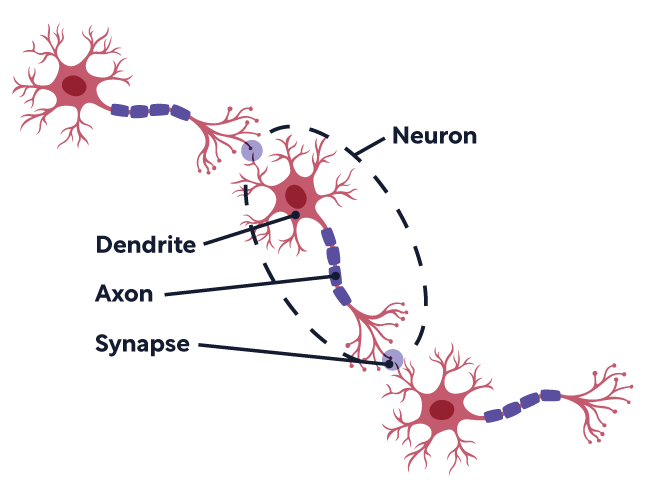
(Shortform note: Oakley references a study by Guida et al in which scientists used neuroimaging to study both novices and experts learning or performing certain tasks. They observed distinct patterns in brain activity that were different for the novices versus the experts: In the case of novices, researchers correlated these patterns to chunks forming in working memory; in the case of experts, they correlated these patterns to chunks being retrieved from long-term memory. By mapping the synchronized activity of the neurons that made up these chunks, this study appears to provide the basis for Oakley’s physiological description of a “chunk.”)
Conceptually, a “chunk” consists of a group of ideas or bits of information that are bound together in your mind through meaning. As you take in information, your brain tries to assemble it such that it makes sense: If the new information relates to something you already know, your brain makes the connection. If not, it still looks for unifying themes that make the facts easier to keep track of. Oakley asserts that the more deeply chunked something is in your mind, the more intuitive it becomes, and the less space it takes up in your memory.
As an example of the chunking process, think about learning to drive a car with a manual transmission: To shift gears, you have to push in the clutch, move the stick to the right position, and keep the engine RPMs in the right range while you let the clutch back out. You also have to control the steering wheel, operate the brake, keep track of your speed, and so forth. However, once you learn to drive a stick-shift, you don’t think specifically about all these little tasks. You just think, “I need to drive to the grocery store,” and pretty soon you’re cruising down the road in third gear, without any conscious recollection of how you shifted from first gear into second or second into third. This is because your brain has condensed all the little tasks into a single chunk of information that you can use intuitively.
The Discovery of Chunking
The discovery of chunking is generally attributed to George Miller, who studied working memory capacity in the 1950s. Miller observed that people could only distinguish between sensory inputs to a finite degree of precision. Specifically, most people could only distinguish between about seven levels of a given stimulus, such as tones of sound or shades of color.
Miller initially tried to describe his results in terms of digital information theory. When a computer measures a sensor input, it uses a series of electronic comparators wired to a digital memory bank. This generates a binary number in the memory bank that corresponds to the value of the measurement. The larger the memory bank, the more comparators we can wire to it and the more precise the measurement can be.
The size of a digital memory bank is expressed in “bits,” where a “bit” is a memory slot that can hold either a one or a zero. When Miller applied this analogy to humans’ working memory, he calculated that our brain’s sensory memory bank needed to hold about 2.8 bits of information to distinguish between seven levels of sensory input (since the limit of precision is equal to two raised to the power of the number of bits, and 22.8=7).
Miller also observed that people could only keep about seven items in mind at once, such as a string of seven numbers, letters, or words. This provided another measure of working memory capacity that gave the same result. However, in this case, Miller could not say that working memory had a capacity of “2.8 bits,” because letters and words take more bits than this to encode in binary.
Moreover, a string of seven words is made up of more than seven letters, and contains more information than a string of seven letters. Thus, if measured in terms of binary bits, the capacity of working memory seemed to vary, depending on what kind of information it held.
Miller coined the term “chunks” to describe the units of information in working memory, since “bits” didn’t provide a consistent measure: Based on Miller’s observations, your working memory could hold about seven chunks, but an almost unlimited number of bits.
To explain this, Miller theorized that your brain could organize information into increasingly complex chunks over time. As you learn something, your working memory quickly fills up with information, but once you process this information into a coherent chunk, it takes up only one slot in your working memory instead of all of them. Then, you can take in more new information and append it to the same chunk. In this respect, Oakley reiterates Miller’s description of how chunking makes room for more information in your working memory.
Artificial Chunking
Oakley and Miller both describe chunking as a mental process that occurs naturally as part of the learning process. However, others have explored applications of artificial chunking, both for humans and for computers.
In his book, Moonwalking with Einstein, Joshua Foer describes chunking as a mnemonic device: You can remember longer strings of numbers by breaking them up into groups of digits. This could be called “arbitrary chunking,” since you arbitrarily impose the grouping and artificially create a unifying meaning for each chunk of numbers.
Meanwhile, computer scientists Laird, Rosenbloom, and Newell took the concept of chunking and applied it to the problem of developing machine learning and artificial intelligence. They started with a problem-solving algorithm that was able to process specified goals and generate sub-goals that it could solve. They then programmed the computer to save “chunks” consisting of subgoals that it solved, packaged with their solutions. The computer could refer back to these chunks when solving new problems that had similar goals or subgoals, instead of generating the same solutions all over again.
Without chunking, the problem solver took 1731 processor operations to solve a certain benchmark problem. With their chunking algorithm, the computer was able to solve the same problem with only 485 operations on the first run, and only 7 operations when they ran the same problem again. Thus, it looks like artificial chunking has the potential to dramatically improve computers’ problem-solving capabilities, especially for repetitive problem solving.
Simplify Concepts to Expedite Chunking
Oakley explains that the more you distill a concept down to its essence, or figure out what it means at an intuitive level, the more tightly that meaning binds the chunk together in your mind. To help this process along, Oakley recommends trying to simplify concepts that you’re learning enough that you could explain them to someone who has little background in the subject. Because it helps with the chunking process, this exercise often enhances your own understanding. She notes that many teachers of her acquaintance say they didn’t really understand their subjects until they began preparing to teach them, and consequently simplified the subjects for the benefit of their students.
(Shortform note: In Ultralearning, Scott Young describes a similar technique for learning a new concept by pretending to explain it to someone else, which he attributes to physicist Richard Feynman. According to Young, the “Feynman Technique'' consists of writing out an explanation of the concept you are trying to understand as if you are explaining it to someone else. If, at any point, you don’t feel you can explain it clearly, you review your sources to clarify your understanding, and then finish writing your explanation.)
The Link Between Teaching and Recall
Four years after Oakley wrote A Mind for Numbers, a study determined that the effectiveness of teaching as a learning tool is closely related to the practice of intentional recall. Researchers concluded that the element of recall involved in teaching may be what makes teaching so effective for learning.
Given the results of this study, perhaps the act of teaching improves your understanding of something by making it more accessible in your memory, rather than by simplifying it.
Build Chunks From the Bottom Up
According to Oakley, chunking is a “bottom-up” learning process because it starts with the details and progresses towards the big picture: First you take in the information. Then you connect the information by understanding the underlying concept. Finally, you establish the context of the chunk, so your memory can file it where it will be most relevant. As Oakley points out, the more you understand why something works, the more easily you can understand how it works. Understanding whether or not the chunk is applicable in a variety of different situations also establishes multiple neural pathways to it, making it accessible when you need it.
As an illustration of the bottom-up chunking process, consider our example of learning to drive a stick-shift. The different gear positions and the method of letting out the clutch so you don’t stall the engine are pieces of information. As you develop these skills and learn to coordinate them, they become united in a chunk embodying the concept of shifting gears. As you gain experience, you develop a better understanding of when to shift into what gear (the context of the chunk). For example, you might normally go 55 mph in fifth gear, but use fourth gear at this speed if you’re driving uphill or pulling a trailer.
(Shortform note: Joshua Foer’s use of chunking to remember longer strings of numbers by breaking them down into groups of digits illustrates that “bottom-up” does not always mean continually building up. Sometimes, you have to disassemble information before you can start making connections between pieces of it and building the chunks back up. This is still part of the bottom-up chunking process.)
Chunking Strategy
When you learn a new problem-solving technique, Oakley suggests following these steps to make sure the new technique is strongly chunked in your memory:
- Step 1: Work through a representative problem, making sure you understand the purpose of each step.
- Step 2: Work the same problem again. Repetition is important for the learning process.
- Step 3: Switch to diffuse-mode thinking by taking a break.
- Step 4: Work the same problem again before going to bed.
- Step 5: Get some sleep.
- Step 6: Work the same problem again as soon as possible after you wake up.
- Step 7: Go for a walk or do something physically active and mentally review the key steps involved in the problem while you walk.
- Repeat these steps for a few other problems to further strengthen the chunk and build context.
Chunking Strategy: A New Approach to Homework?
Oakley’s process as outlined above emphasizes learning a technique thoroughly by completing just a few problems, each of which you work through four times. By contrast, many math and science curriculums teach problem-solving techniques through a larger number of problems that you only solve once.
If Oakley’s technique represents the most efficient way to learn problem-solving skills, then perhaps many math and science professors could simultaneously help their students learn better and reduce their own workload by assigning about a fourth as many homework problems, and advising their students to revisit each problem as Oakley does. As yet, it seems this approach to homework has not been formally studied, or at least conclusive studies have not yet been published.
Build Context for Chunks With Top-Down Learning
As we’ve noted, chunking is a bottom-up learning process, but top-down learning also contributes to building your brain’s library of chunks. Oakley explains that top-down learning follows a similar sequence to the chunking process, but from the opposite direction: First, you learn the context in which a concept applies, then, you learn the concept, and finally, you flesh out the concept with detailed information. In other words, you progress from the big picture down to the details.
For example, Oakley suggests skimming a book or chapter before you read it in detail so that your mind organizes your expectations of what you will be learning before you fill in the details of each new concept. This is analogous to building a mental filing cabinet with a separate drawer where your brain can file each new piece of information when you go back and read it in detail. You absorb information better when your brain already has a place to put the chunk or an existing chunk to append it to.
(Shortform note: For this reason, skimming a book before you read it in detail is a common strategy taught in speed reading courses. In How to Read a Book, 20th-century philosopher Mortimer Adler presents it as a way to understand the crux of a book within 15 minutes and better remember what you read.)
When should you use top-down versus bottom-up learning strategies? Oakley doesn’t say, but she does emphasize that both are important for learning math and science. From this, and the advantages she lists for top-down learning, we infer that it is efficient to use top-down learning whenever possible, but that a top-down approach is not always available.
Metalearning: An Extended Form of Top-Down Learning
In Ultralearning, Scott Young takes the concept of top-down learning to a higher level. He discusses “metalearning,” a method for learning a specific subject. Metalearning is a form of top-down learning that starts at the highest level, building context for the subject itself and for the major concepts that make it up before working down to any of the details.
To practice metalearning, Young recommends you do the following before you begin to study a subject:
Understand your motivation for learning it.
Investigate the approaches that other people have used to gain proficiency in it.
Make a list of the concepts and skills that you will need to learn to master the subject.
Part 3: Making Information More Memorable
In the previous part, we discussed how your memory works and how it depends on “chunked'' information. Oakley explains that the more connections the chunk has, the more memorable it is, and the more often you access it, the stronger the connections become. More connections and stronger connections both make a chunk more accessible. Thus, there are two factors that determine how well a concept will stick in your memory: how memorable it is, and how often you recall it.
In this section, we’ll cover Oakley’s discussion of techniques for making information more memorable by connecting it to more parts of your brain, starting with an overview of the factors that make things more memorable and then presenting some specific techniques for remembering things. Then, in the next part, we’ll discuss recall strategies.
What Makes Information Memorable
From Oakley’s discussion, we can identify a number of factors that determine how intrinsically memorable a piece of information is. In Moonwalking with Einstein, Joshua Foer similarly identifies factors that make information more memorable. The factors that Oakley and Foer identify are similar, but not identical. For comparison, we have extracted the following list of memorability factors from both A Mind for Numbers and Moonwalking with Einstein:
The Sensory Factor: According to Oakley, the more sensations (smell, feel, sound, visual appearance) you attribute to a concept, the easier it will be for you to remember.
- (Shortform note: Foer echoes this assertion, pointing out that every sense you connect an idea to provides one more possible cue to help you remember it. Suppose you’re memorizing your grocery list, and the first thing on your list is garlic. If you take time to picture what the garlic looks like, smells like, and tastes like, you have a much better chance of remembering it than if you just try to remember the word “garlic.”)
The Association Factor: According to Oakley, the more existing chunks of information you can associate a new piece of information with, the easier it will be for you to remember. Oakley further asserts that this holds, regardless of whether the associations are actual or metaphorical.
- (Shortform note: Foer implies this in his discussion of the sensory factor, but doesn’t generalize it quite as much as Oakley does. By way of illustration, he says that if you’re shown a picture of a person and told that her last name is Baker, you won’t remember “baker” as well as if you’re told she is a baker. This is because “Baker,” as a name, is an abstract concept without much to associate with it. As a profession, however, “baker” has more associations with other information in your brain, like the feel of kneading dough, the smell of cookies, the heat of an oven, and so on. Therefore, you should aim to associate anything you want to remember, even something as abstract as a person’s last name, with as many sensations as you can. This example serves to illustrate the association factor, even though the associations it presents are primarily sensory.)
The Movement Factor: According to Oakley, you are more likely to remember something if it involves moving your body.
- (Shortform note: Foer does not mention this factor. As Drazdzewski points out in a recent study of the relationship between memory and motion, this factor has been studied less than many of the other memorability factors.)
The Humor Factor: According to Oakley, the more something makes you laugh, the easier it is for you to remember it.
- (Shortform note: Foer reiterates this principle, and relates it to the novelty factor (which we will discuss shortly), saying that we naturally find humor interesting, and that makes it easier to remember.)
The Story Factor: According to Oakley, stories are notoriously memorable, perhaps because they promote chunking by weaving events or concepts together through cause and effect.
- (Shortform note: In presenting the history of memory techniques, Foer discusses oral traditions of storytelling in ancient cultures, but he focuses on the mnemonic devices that were built into the stories to make them more memorable. He doesn’t seem to have considered the possibility that the narrative itself could serve a mnemonic function. However, formal studies substantiate Oakley’s assertion that stories are more memorable, and most researchers corroborate her suggestion that cause and effect is what makes them memorable. Other researchers suggest that stories are memorable because the social interaction between characters makes them more personal.)
The Writing Factor: Oakley asserts that you are more likely to remember something if you write it down by hand than if you type it or only read it. Thus, she recommends hand-writing your notes in class, to make them more memorable.
- (Shortform note: Foer does not mention this factor. He seems to see writing as harmful to memory, at least indirectly: He asserts that the modern trend of writing down every fact we need to keep track of causes us to depend less on our memories, which allows our memory capabilities to atrophy.)
The Speech Factor: According to Oakley, if you say something out loud, you are more likely to remember it than if you don’t.
- (Shortform note: Foer doesn’t address this factor directly. He recounts that ancient cultures used songs and poetry extensively for transmitting information, because mnemonic devices like rhyme, rhythm, and alliteration make songs easier to remember. These devices are more obvious when you sing a song or read a poem out loud than if you read it silently. This could provide a partial basis for Oakley’s assertion that saying something out loud helps you remember it. However, other researchers attribute both the writing factor and the speech factor to the production effect: The more you participate in producing something (such as by writing it out or giving an oral performance of it), the more deeply it gets ingrained in your memory.)
The Spatial Factor: According to Oakley, your memory is naturally wired to connect visual information with spatial information, forming visuospatial map chunks. For example, think about how easy it is to learn the layout of a new apartment.
- (Shortform note: To Foer, this is the most important of all the memorability factors, because it provides the basis for the memory palace technique, which is the primary strategy that he focuses on. We will discuss the memory palace technique later in Part 3.)
Foer’s Other Factors for Memorability
Foer also identifies several factors affecting memorability that Oakley does not include:
The Novelty Factor: According to Foer, things that stand out as novel or unique are easier to remember than things that seem mundane or blend in with other similar ideas.
The Personal Factor: According to Foer, it’s easier to remember things that relate to your own experiences. Although Oakley doesn’t list this factor explicitly, her discussion of the personification technique (which we’ll discuss later in this section) implies its existence.
The Concreteness Factor: According to Foer, concepts that are more abstract are more difficult to remember than information that is more concrete. In the context of knowledge transfer, Oakley discusses how abstract concepts are often harder to learn at first, but then are more transferable to other applications once you understand them. However, she doesn’t relate this to the memorability of information as Foer does.
The Structure Factor: According to Foer, information that is more structured is easier to remember. For example, poetic devices like rhyme and alliteration make phrases easier to remember, and a black-and-white checkerboard pattern is easier to remember than an arbitrary arrangement of black blotches on a white background.
How to Make Information Memorable
We’ve looked at the factors that make facts easier to remember, but what if you need to remember something that, by itself, isn’t all that memorable? Oakley presents a number of tactics to make almost any piece of information easier to remember. We’ll examine these tactics and contrast them with Joshua Foer’s from Moonwalking with Einstein.
Visual Metaphor Technique
When you want to remember something, Oakley recommends developing a mental image that symbolizes it. The more vivid you make the mental picture by adding both visual details and other sensory details (sounds, smells, feel, or taste), the more memorable it will be, because of the sensory factor. She suggests making the image comical to leverage the humor factor as well.
For example, suppose you are trying to remember the expression F=ma (Newton’s second law, which states that the force acting on an accelerating object is equal to the object’s mass multiplied by its acceleration). Suppose you also dislike eating asparagus, so you create a metaphorical version of the equation: “filth = moldy asparagus.” Now you visualize a plate of moldy asparagus, complete with the color and texture of the mold, its revolting smell, and the slurping sound that it makes as you scrape it off the plate into the garbage. The more asparagus is on the plate, and the moldier the asparagus is, the more filthy the plate is, so the relationship expressed by F=ma is preserved in the metaphor.
(Shortform note: Foer echoes Oakley’s description of this technique and recommendations for making images more memorable with sensory details and humor. While Oakley presents the visual metaphor as one of several techniques, Foer presents it as the primary basis on which mnemonic techniques are built.)
Memory Palace Technique
According to Oakley, the “memory palace” is a powerful extension of the visual metaphor technique that takes advantage of the spatial factor, and potentially also the story factor, allowing you to memorize lists or whole groups of concepts. First, picture a place that you know well, such as your home or college campus. Imagine yourself moving through the place, interacting with objects. Each object is a visual metaphor for something you need to remember.
For example, suppose you need to memorize the hierarchy of taxonomy for biology class: Kingdom>Phylum>Class>Order>Family>Genus>Species. In your mind’s eye, you are walking across campus when you suddenly bump into the King of England, who happens to be visiting your college that day (Kingdom). Next, you stop at the cafeteria, where you order a Philly steak-and-cheese sandwich (phylum). Then you go to class (class).
After class, you head back to your dorm room, but you have to take a detour because a drill sergeant is parading his troops on the campus lawn and shouting a lot of orders (order). When you arrive at your dorm room, you discover your family has come to visit (family). After your family leaves, you notice that your laundry basket is full of jeans, so you head over to the campus laundry room to wash your jeans (genus). However, in the laundry room, you discover that your jeans are covered with tiny yellow specks (species) that won’t wash off.
Memory Palace: The King of Mnemonic Devices
Foer discusses this tactic extensively, referring to it both as the memory palace technique and the “method of loci.” He explains that the term “memory palace” is a modern name for the method, while in the earliest descriptions of this technique, each imaginary location where you place a visual metaphor was called a locus (loci is the plural of locus).
In Foer’s description, this method seems to be the master technique to which all other methods are subservient. Visual metaphors serve mostly to populate the memory palace, and other techniques can be applied to make the individual metaphors within the palace more memorable, but they all reside within the memory palace.
In recent years, a modernized television adaptation of the Sherlock Holmes novels raised public awareness of the memory palace technique, sometimes referring to it as the “mind palace.”
Symbolic Sentences Technique
If you need to remember a list or sequence, Oakley suggests making up an acronym or a sentence composed of words that start with the same letter as each item in the list. If possible, make the sentence tell a story and/or make it funny, so you can take advantage of the story factor and the humor factor.
For example, suppose you need to memorize the hierarchy of taxonomy for biology class: Kingdom>Phylum>Class>Order>Family>Genus>Species. You could symbolize this hierarchy with the sentence, “King Phillip cleaned orange fungus off Jenny’s spectacles,” where King = Kingdom, Phillip = Phylum, cleaned = class, orange = order, Jenny = genus, spectacles = species.
Symbolic Sentences as an Aid to Visualization
Foer doesn’t mention this technique explicitly. Instead, he focuses on imagery that can be used with the memory palace technique. Even when you need to memorize exact wording, Foer recommends replacing the words with images that you can place in your memory palace. For abstract words that you can’t visualize directly, he discusses techniques such as punning, where you create a play-on-words and visualize something that sounds similar to the word you want to remember.
In practice, this has a similar effect to Oakley’s symbolic sentences technique. In our taxonomy example, ‘King Phillip cleaning orange fungus off Jenny’s spectacles’ is a scene you could visualize (and place within a memory palace) more easily than the abstract concept of biological taxonomy.
Song Technique
Oakley notes that another way to remember something is to make up a song about it.
For example, suppose you know a lot of hymns by heart, including one that begins, “Praise my soul the King of Heaven: To His feet thy tribute bring!” Now you need to remember Newton’s second law of motion for physics class. You could sing, “Force equals mass times acceleration: I shall to class my homework bring!” to the same tune.
According to Oakley, you can use this technique by itself, or in conjunction with the symbolic sentences technique by setting a symbolic sentence to music. If you add hand motions or dance moves to the song, you can make it even more memorable by taking advantage of the movement factor.
(Shortform note: Oakley also notes that many songs for remembering mathematical formulas have already been written and posted on the internet. We did a quick search and found a few of them:
- A Song for the Quadratic Equation
- A Song About the Law of Sines
- A Song About Avagadro’s Number
- A Song About Surface Area)
Limitations of the Song Technique
In discussing the history of memory techniques, Foer points out that songs and poetry were the default method of passing on information for future reference in the ancient world. In this context, he also acknowledges that songs are the most structured form of speech, and therefore the most memorable. However, he does not discuss the use of songs for memorization in the modern world, nor the addition of movements to a song, as Oakley does.
Perhaps Foer’s omission of this method highlights one of its limitations: If you’re taking an exam (or competing in a memory tournament, as Foer was), you’re generally not allowed to break out in song or get up and dance around the classroom. Once you learn a song, you may be able to review it silently in your mind, but visual metaphors and memory palaces might be a more natural choice for silent recall.
Personification Technique
To better understand or remember something, Oakley recommends that you imagine yourself in its place, either literally or metaphorically.
Suppose you are taking a class in fluid dynamics and learning about pipe flow. Try to imagine yourself in the water flowing through the pipe, experiencing changes in pressure, velocity, and elevation in accordance with Bernoulli’s Law.
As a way of personifying numbers, Oakley says she likes to imagine herself at that age. So, imagine you want to remember that the acceleration of gravity is 9.8 m/s2. You start by picturing yourself as a nine-year-old. Then you picture yourself falling down and pointing accusingly at the eight-year-old who tripped you. If you associate falling with gravity, this mental image could help you associate gravity with “nine-point-eight.”
Personification vs the Major System for Memorizing Numbers
Foer describes personification as a sub-tactic of creating visual metaphors: The more personal your mental images, the easier they are to remember. When used solely for memorization, personification is indeed difficult to distinguish from other ways of implementing the visual metaphor technique. However, as a tool for learning, that is, for understanding new concepts as well as remembering them, personification arguably goes beyond visual metaphors: You don’t just visualize the concept, you relate it to somehow, and that helps you understand it at a deeper level.
Foer describes several systems for memorizing numbers, but he doesn’t mention Oakley’s method of personifying a number by mapping it to your age. It could be that Oakley originated this particular tactic, and Foer (who published Moonwalking with Einstein a few years before A Mind for Numbers was published) was not aware of it.
The techniques that Foer presents for memorizing numbers involve mapping digits or blocks of digits to mental images that you can place in your memory palace. For example, in the “major system,” first, you memorize a mapping of numerals 0 through 9 to certain consonant sounds, and then you use this mapping to convert numbers into words that you can visualize, adding vowels as needed. Suppose you need to remember that the zip code for North Pole, Alaska is 99705. In the major system, 9 = P, 7 = G, 0 = S, and 5 = L, so 99705 could be represented by the phrase “pipe guys lie.” Now you imagine a bunch of guys lying around at the north pole smoking pipes and telling lies. If you already have the major system memorized, then you can use this mental image to regenerate the number 99705 from the phrase “pipe guys lie.”
Compared to this approach, age-based personification may be a little imprecise, at least in certain cases. For example, suppose you need to remember that the density of freshwater is 62 pounds per cubic foot, while the density of seawater is 64 pounds per cubic foot. In your mind’s eye, how much different do you feel at age 64 than at age 62? Or was it 65 and 63? In your imagination, you might feel nearly the same at these ages, and that might make it difficult to recall the exact number when you need it.
Exercise: Make a Visual Metaphor
The visual metaphor method is a particularly powerful way to make information more memorable. In this exercise, you will create a visual metaphor for yourself.
Think of a fact or principle that you need to remember, and type it in the box below. If you can’t think of one, pick one of the following:
- The circumference of a circle is equal to its diameter multiplied by “pi,” a constant equal to about 3.14.
- The “kinetic energy” of an object is equal to its mass multiplied by one-half the square of its velocity.
- The density of concrete is 2.4 metric tons per cubic meter.
What metaphors can you use to turn parts of the principle that are not visible objects into visible objects in your mind’s eye?
Now put the parts together and describe your mental image. In addition to its visual appearance, what does it sound like, smell like, or feel like?
Part 4: Repetition Strategy
We’ve discussed how your memory works and some strategies for making facts more memorable. However, recall that your brain has natural processes for clearing information from your working memory. Thus, Oakley warns that even a memorable fact may soon become unretrievable if you don’t review it. According to Oakley, repetition helps to ensure that your brain recognizes facts as important and stores them in long-term memory. In this section, we’ll present several strategies for effective repetition.
How does your brain differentiate between trivial information to purge and important information to save? At present, we don’t know: As Joshua Foer points out in Moonwalking with Einstein, scientists can measure which parts of the brain are more active during prescribed activities, but they have not yet been able to determine how memories are stored in your brain, or how human thought actually works.
Someday, if scientists solve this mystery, we may discover new and more efficient ways of flagging certain memories for retention and others for deletion. But until then, we must rely on the tried-and-true, if somewhat old-fashioned method of recalling information over and over again to cement it in our memories.
Test Yourself With Intentional Recall
According to Oakley, every time you recall something from memory, your brain’s retrieval process strengthens the neural pathways to that chunk of information. ‘Intentional recall’ is the act of retrieving information from memory to deliberately strengthen the neural pathways to it and thereby ensure that it remains accessible in your memory. Oakley asserts that of all the common study methods that have been researched, intentional recall is the most effective.
Why does intentional recall work? Oakley references a study by Jeffrey Karpicke, which argues that “active retrieval practice,” or intentional recall, refines the knowledge that you recall, making it more meaningful, as well as more easily retrievable in the future. Karpicke goes on to assert that intentional recall is under-valued and under-utilized because its benefits are not sufficiently well known.
In explaining the basis for intentional recall practice, Oakley also brings up the “testing effect:” You are more likely to remember something you have learned if you are tested on it. She points out that when you practice intentional recall, you are basically testing yourself, so intentional recall allows you to take advantage of the testing effect in your own study.
(Shortform note: The connection between intentional recall and the testing effect seems to be widely accepted in psychological studies, or rather, there is little distinction between the testing effect and intentional recall in these studies. This is because experimental studies typically use tests to standardize recall practice. Karpicke states that recall activities do not need to look like tests to be effective. However, in the study he cites to exemplify this, students were asked to write down as many ideas as they could recall either as paragraphs or concept maps. In practice, this still looks a lot like an essay-format test without feedback.)
In her discussion of the testing effect, Oakley asserts that even if you do poorly on the test or don’t know how you did because you didn’t get any feedback, you still remember more than if you aren’t tested at all. (Shortform note: Oakley is probably referring to the results of a study that described a “pre-test effect,” in which students who gave incorrect answers on a pre-test did better on subsequent tests than students who did not take a pre-test.)
Intentional Recall: Present and Past Academic Interest
A few years after Oakley published A Mind for Numbers, Karpicke compiled a report on recent progress in retrieval-based learning studies. He reported that between 2005 and 2015, the number of papers on the subject had increased ten-fold. Based on his synthesis, the results from all this new research continued to support the claim that intentional recall is the most effective method of studying, regardless of the subject being studied or the method of testing.
However, despite this recent surge of interest, intentional recall is not a new idea. Over a hundred years ago, William James wrote that active repetition, that is, recalling information from memory, is more effective for learning than methods of passive repetition, such as rereading the material.
Practicing Intentional Recall
How should you practice intentional recall? Oakley suggests that if you just finished a reading assignment, close the book and try to recall the essence of what you just read. Later on, if you’re reviewing the material, try to recall it from memory before you open the book.
Additional Methods of Practicing Intentional Recall
In Ultralearning, Scott Young presents some additional methods for practicing intentional recall:
Flashcards: Write a question on one side and an answer on the other. Try to answer the questions from memory before looking at the answer.
Free recall: Take a blank sheet of paper and try to write out the material you’re studying from memory, without referring to your textbook or other resources.
Question taking: When taking notes, write them in the form of questions that you have to answer from memory. For example, when you learn about matrix multiplication in math class, instead of writing out the whole process, just write, “How do you multiply two matrices?” Then, when you review your notes, you have to recall the information from memory.
Self-assigned challenges: Identify a task that you should be able to complete once you’ve mastered the material you are learning, and try to complete it. For example, if you’re taking a class in computer science, try to create your own flash-card app that you can use in your other classes.
Optimize Your Studying With Spaced Repetition
“Spaced repetition” is when you repeatedly revisit material at designated intervals. Oakley advises using this strategy with intentional recall because it will engrain the information in your memory better than the same amount of study crammed into a single session. For example, studying a list of vocabulary words once a day for two weeks will engrain them in your memory much better than going over the list 14 consecutive times in one sitting. This allows you to make the best use of your time while studying.
(Shortform note: This recommendation is not unique to Oakley. The importance of study sessions separated by a time delay is echoed by Scott Young in Ultralearning, and by Brown, Roediger, and McDaniel in Make it Stick. The idea has also been substantiated by studies. For example, Nate Kornell conducted a study to determine the optimal program for studying with flashcards. He observed that students who practiced intermediate spacing between study sessions performed better than those who did all their studying at once, and also better than those who broke it up into smaller sessions and studied too frequently.)
Set the Duration of Your Study Sessions
To practice spaced repetition as Oakley recommends, first determine the duration of your study sessions. This varies depending on the subject you are studying and how much of it you can absorb at once. However, Oakley suggests 25 minutes at a time is a good starting point. The more you study a given subject, the more efficient your brain will become at chunking that type of information, allowing you to learn more at a time.
(Shortform note: Spaced repetition has been the subject of many psychological studies, but relatively few of these studies address the duration of study sessions. Acknowledging this, one study concluded that your ideal study session should be long enough for you to master the material, but no longer. So, if you’re studying with flashcards, set aside each card that you answer correctly from memory, and wrap up your study session as soon as you’ve set aside the last card.)
Set the Spacing of Your Study Sessions
Next, determine the interval between study sessions. According to Oakley, this, too, depends on the subject and varies from person to person, but as a rule of thumb, you should revisit any new information within one day of first receiving it. Otherwise, you may be starting over from scratch. She explains that after a few repetitions, the neural pathways in your brain will be strong enough that you can go progressively longer between study sessions. As you continue studying, eventually, the pathways will become essentially permanent.
Other Perspectives on Spacing
In Ultralearning, Scott Young argues that if you revisit material too frequently, while the information is still fresh in your mind, your studying will be less effective than if you wait long enough that you have to regenerate the ideas from memory. He also points out, as Oakley does, that if you wait too long between study sessions, you will forget the information and have to relearn it from scratch. Thus, for efficient studying, it is important to find the optimal spacing between study sessions.
In Make it Stick, Brown, Roediger, and McDaniel elaborate on this principle. They say that the harder your brain has to work to retrieve information, the more effective the recall exercise will be (provided that you successfully recall it without looking it up or otherwise re-learning it). They point out that there are two ways you can make recall more mentally strenuous: The less of a cue you give yourself to remember something, the harder it will be to recall, and the longer you wait to review the material, the harder it will be to recall. Thus, they assert that the optimal time for a recall session is when the information in your mind gets fuzzy—it’s no longer fresh, but it’s not gone yet either.
Vary the Setting of Your Study Sessions
Oakley explains that, sometimes, your brain draws a subconscious connection between something you are learning and the place where you learn it, making that chunk of information easier to remember in that setting, but harder anywhere else. Thus, she recommends that, after the first few repetitions, you practice recalling the information in a variety of settings to ensure that it will be retrievable, regardless of where you are when you need it.
(Shortform note: One study showed that objects that seem out of place in a given setting are more likely to be remembered than objects that fit the setting. This doesn’t fully substantiate Oakley’s assertion that your brain stores information about your surroundings in the same chunk as the information you learn there, but it does support the premise that the environment in which you learn or encounter something influences how your brain stores it in memory. It also implies that studying math or science in a setting where you wouldn’t normally encounter these subjects may help you remember them, supporting Oakley’s recommendation, irrespective of the reason behind it.)
Oakley also says that when you recall a chunk of information in a different setting, your brain retrieves it using a slightly different pathway, allowing you to see the information from a slightly different perspective. Thus, studying in a different setting may help to deepen your understanding, as well as helping you remember.
The Psychological Basis for the Influence of Setting on Perspective
Oakley’s premise that reviewing information in a different setting allows you to see it from a different perspective might be difficult to rigorously substantiate by means of psychological studies: A researcher can have you study something and then take you to a different setting, but how can they measure the degree to which you see it from a different perspective? Nevertheless, we can subjectively support Oakley’s idea using an illustration that makes it more concrete:
Suppose you learn in chemistry class that the “specific gravity” of a substance is the ratio of its density to the density of water. Then you go camping at a lake and decide to try building a log raft. How many logs do you need to tie together for the raft to support your weight? You could calculate that if you knew the specific gravity of wood, but out at the lake you don’t have internet access or other references to look it up.
That’s when you realize that the specific gravity of a floating object is also equal to the fraction of the object below the waterline. You toss a stick in the water and observe that it floats about half in and half out of the water, so you conclude that the specific gravity of the wood is about 0.5. Armed with this knowledge, you build your raft, paddle around the lake, and ultimately return home with a better understanding of the concept of specific gravity.
Practice Overlearning With Caution
“Overlearning'' is when you continue to practice something after you have attained competence with it. Oakley acknowledges that overlearning a skill can enable you to perform it automatically, but she cautions that overlearning can be counterproductive, especially when combined with poor study or teaching methods.
According to Oakley, excessive repetition becomes tedious, and tedium can produce emotional stress, which prevents your brain from making certain types of neural connections. As an example, she recounts how her seventh-grade math teacher forced her to endlessly recite multiplication tables, largely without explaining the underlying concept of multiplication. She resented this so much that she couldn’t learn the tables, despite all the repetition.
(Shortform note: It’s easy to see why Oakley would have reservations about overlearning that are specifically tied to its emotional impact based on her experience, but other researchers criticize overlearning simply from an efficiency standpoint. In one study, researchers compared retention over time between students who overlearned material and students who didn’t. They found that the overlearners retained more information for about one week, but after that, the difference diminished. Nine weeks later, students who practiced overlearning couldn’t remember the material any better than students who didn’t practice overlearning. Based on this result, the researchers argued that overlearning is inefficient because it takes significant time and doesn’t provide long-term benefits.)
Use Interleaving to Connect Content With Context
To avoid the potential pitfalls of overlearning, Oakley recommends you practice interleaving instead of overlearning. “Interleaving” is when you practice solving a variety of problems requiring different solution methods to contrast them with a solution method you have just learned. According to Oakley, this promotes mastery of a technique because the use of contrasting techniques for other problems teaches you when to use the new technique, instead of only learning how to use it.
For example, suppose you have just learned the “trigonometric substitution” technique for finding the integral of a function. This technique works well on certain types of functions, but not on others. As you practice your integration skills, you mix in a few problems that lend themselves better to “integration by parts'' or other integration methods that you have learned, in addition to practicing trig substitution. As a consequence, you gain a greater understanding of when to use trig substitution versus other techniques.
The “interleaving effect” that Oakley describes was first discovered around 1986, based on studies of techniques for teaching badminton serves. It was soon applied to other sports, but the effects of interleaving on academic performance were not studied until the 21st century.
In 2015, a study of the effectiveness of interleaving for learning mathematics concluded that interleaved study promotes better retention, especially in the long term: Specifically, students who were assigned interleaved review problems scored better on tests than students whose review assignments did not include interleaving. And if the test was delayed for 30 days, average test scores dropped about eighteen percentage points for students who did not practice interleaving, but only six percentage points for students who practiced interleaving. These researchers attributed the effectiveness of interleaving to the fact that it gave students more practice identifying different types of problems and matching them to the appropriate solution methods. This is consistent with Oakley’s assertion that interleaving promotes mastery of a technique by teaching you when to use it.
Exercise: Practice Intentional Recall
In this chapter, we discussed how you can use the technique of “intentional recall” to solidify concepts in memory. To practice intentional recall on the chapter you’ve just read, try to answer the following questions from memory.
What is spaced repetition?
What is overlearning?
What is interleaving?
Part 5: Understanding Habits
According to Oakley, your study habits (good or bad) have a strong impact on your ability to learn math and science. Earlier, we discussed Oakley’s exposition of chunking. In this section, we’ll discuss her explanation of how chunking facilitates habits and the strategies she presents for changing habits.
Anatomy of a Habit
Oakley defines a habit as a pre-programmed activity that you perform without conscious input of mental energy. She explains that habits allow your brain to operate more efficiently, because exercising willpower takes a lot of neural resources, and habits allow you to act without using willpower. Tasks that you can perform automatically also give your brain a chance to operate in diffuse mode.
(Shortform note: In The Power of Habit, Charles Duhigg asserts that more than 40% of your actions each day are habitual. By extension, according to Oakley’s logic, that’s a large chunk of your day that can be dedicated to diffuse mode thinking. Duhigg also agrees with Oakley’s assertion that habits eventually become unconscious actions, adding that once a habit is fully developed, you do it on autopilot, with little to no control over that behavior. However, he clarifies that habits begin with a conscious choice to do something. It’s only when you repeat that choice again and again that the habit becomes unconscious.)
According to Oakley, habits develop via the same chunking process that condenses information in your brain and facilitates storage in your memory. A habit chunk in your brain consists of four pieces of information:
- The Cue: This is what stimulates your brain to execute the habit. Cues can be linked to people, places, times, feelings, or events.
- The Routine: This is the sequence of actions for you to execute when the habit is triggered by the cue.
- The Reward: You have to derive some kind of benefit from executing the routine for a habit to develop. Your brain executes the routine in response to the cue because it expects the reward. Only immediate consequences of the routine are stored as part of the habit chunk. This is why bad habits are possible: The reward is immediate but transient and the long-term consequences are negative, but the long-term consequences are not processed as part of the habit chunk, and thus do not automatically cancel out the reward.
- The Belief: Your habits are grounded in your perception of reality and of your own identity.
As an example, suppose you make a habit of reading your text messages immediately upon receipt. Let’s break this habit down into its four components:
- The cue is the ringtone your phone plays when you get a text.
- The routine might consist of reaching over to retrieve your phone from your pocket, entering your passcode to unlock your phone, and accessing the text-messaging app.
- The reward is the pleasure that you derive from reading text messages.
- The underlying belief could vary: Maybe you identify as a very respectful individual, and you believe that responding promptly to communications is an important part of showing respect. Or maybe you are a very social person and you believe in staying connected through text messaging.
Comparing Habit Models
Oakley’s habit model, consisting of cue, routine, reward, and belief, is similar to the models proposed by most other studies and books on the subject, but there are subtle differences and certain exceptions.
Duhigg and Clear’s Models
In The Power of Habit, Charles Duhigg asserts that habits are composed of three parts: the cue, the routine, and the reward. He describes these components in the same way Oakley does and echoes her assertion that habits form to conserve mental energy. Thus, Duhigg’s model is identical to Oakley’s except that he omits the belief component entirely.
In Atomic Habits, James Clear says that habits are composed of four parts: the cue, the craving, the response, and the reward. Like Duhigg, Clear also omits the belief component from his habit model. Clear’s “response” is defined identically to Oakley’s “routine,” so the only other difference here is that Clear adds a new component: the craving. According to Clear, the cue doesn’t trigger the routine directly. Instead, the cue simply alerts your brain to the opportunity to obtain the reward. This creates a craving for the reward, and your brain executes the routine in response to the craving so that you obtain the reward.
Oakley mentions in passing that habits can create cravings because your brain anticipates the reward as soon as it identifies the cue. Duhigg elaborates on this, and describes the role of cravings almost identically to Clear, even though he doesn’t include the craving as a component of his basic habit model.
BJ Fogg’s Model
In Tiny Habits, BJ Fogg presents a completely different model, which doesn’t distinguish between habits and other actions. The Fogg behavioral model consists of four components: the behavior, the prompt, the motivation, and the ability.
Fogg’s “behavior” is the action that you perform. This correlates loosely to Oakley’s “routine,” but where Oakley’s habit routine is an action that is pre-programmed in your mind as part of the habit chunk, Fogg’s behavior could be any action that you know how to perform.
Fogg’s “prompt” is anything that alerts you to an opportunity to perform a given behavior. This correlates reasonably well with Oakley’s cue.
Fogg’s “motivation” is your desire to perform the behavior. This could correlate loosely with cravings, as described by Duhigg and Clear, but a craving stemming from your brain’s expectation of an immediate reward is only one of many factors that can contribute to your motivation. In Fogg’s model, conscious beliefs about the long-term consequences of the behavior, as well as your current level of willpower to act on those beliefs, affect your motivation. So do peer pressure and other external factors. Thus, Fogg’s “motivation” captures elements of the craving, reward, and belief in Oakley’s and others’ models, but it doesn’t exactly correspond to any of them.
Fogg’s “ability” is how easy the behavior is for you to perform. The ease with which you can perform a behavior is affected both by your skill and by environmental factors. This doesn’t correlate closely to any component of Oakley’s model.
In Fogg’s model, the prompt only causes you to perform the behavior if the combination of your ability and motivation is above a certain threshold. However, with most behaviors, the more you do it, the easier it gets. And if there’s an immediate reward that creates a craving, that increases your motivation as well. This combination of increasing ability and increasing motivation makes a behavior more likely to exceed the threshold the next time you receive the prompt. This provides an explanation of habit formation.
Strategies for Changing Habits
Oakley describes a number of strategies to help you cultivate good habits or change bad ones. Now that we’ve discussed how Oakley and others describe the nature of habits, let’s look at the strategies Oakley presents and compare them to others’ recommendations.
Picking Your Battles
As an overarching strategy, Oakley cautions you not to overhaul all your habits at once. She notes that changing your habits takes about three months, on average, during which time you will have to exercise significant willpower to make the changes. If you try to change too many habits at once, you may become discouraged before your new habits have a chance to become established.
Oakley’s recommendation to change your habits a little at a time is corroborated by others. For instance, Clear points out that more than half of the actions you perform in a day are habit-driven, and goes on to assert that small changes in your habits get compounded over time, ultimately producing significant changes in your behavior.
Although Fogg bases his strategies on a different model of habit behavior, the principle of making tiny changes to your habits that build up into significant improvements is a central theme of Tiny Habits: Tiny steps toward positive change are much easier to take than big steps. Since your ability to perform them is much higher, they are much more likely to fall above the action threshold when you get a prompt to do them.
Cue-Based Strategies
Strategy 1: Oakley advises you to isolate yourself from cues that trigger bad habits. For example, maybe back when you were driving for NASCAR, you always listened to a certain song while you were racing. Now you realize that you have developed a habit of speeding whenever that song comes on the radio. Make a point of tuning the radio to a station that doesn’t play that song when you’re driving.
Strategy 2: Create a new cue for a new routine. Oakley points out that this is usually easier than overwriting the routine associated with an existing cue. For example, pick a certain table in a certain study lounge and make a habit of doing your homework there. That place can become the cue that triggers your habit of getting started on your homework.
Comparing Perspectives on Cue-Based Strategies
Despite starting with a different model of habits, Fogg describes these two strategies almost exactly as Oakley does. He emphasizes that without a prompt, the behavior won’t happen, so you can shed bad habits if you can escape the prompts that trigger them.
When creating a new habit, Fogg says you have to choose a prompt that will be an effective reminder. He notes that prompts can be external events (such as an alarm clock ringing), or internal stimuli (such as feeling happy), but he places special emphasis on “anchor” prompts. Fogg defines an “anchor” as an action that acts as a prompt for another action. For example, you might decide to do exercises right after lunch. In this case, eating lunch is the anchor for your new exercise habit.
Similarly, Clear proposes four “laws” of forming new habits, each with an inverse form for breaking bad habits. His first law is to make cues obvious, and inversely, to prevent bad habits from triggering by making their cues invisible. He points out that for cue-based strategies to be effective, you need to be aware of the cues that trigger your habits.
Clear also discusses “habit stacking,” where the reward of one habit becomes the cue for another habit, triggering the second habit as soon as the first one has run its course. Clear’s habit stacking is similar to Fogg’s anchors. When creating a new cue for a new routine, Clear recommends habit stacking as a method of making the cue obvious, at least if you can stack your new habit on a habit that is already well-established.
Routine-Based Strategies
Strategy 3: Overwrite the routine. Oakley asserts that when your brain receives the cue that’s associated with a certain habit, changing your reaction to that cue requires a deliberate plan and an exertion of willpower. However, she also says that every time you do it should get a little easier, until the new routine becomes integral to the habit. In our NASCAR driver example, instead of (or in addition to) trying to avoid hearing the song that triggers your speeding habit, you could make a point of turning on the cruise control and taking your foot off the gas pedal whenever your cue song comes on.
(Shortform note: Fogg identifies this same strategy of changing the behavior associated with a certain prompt, but instead of highlighting the need for willpower, he advises designing the replacement habit to take as little willpower as possible to develop. Specifically, he says that the key to success with this strategy is making the new behavior both easier and more motivating than the habit you are trying to break. According to Fogg’s behavior model, if the prompt reminds you of multiple possible behaviors, you’ll naturally tend to perform the one that has the highest combination of motivation and ability. In Fogg’s model, willpower influences motivation, but the less your new habit depends on having strong willpower when you receive the prompt, the more likely you will succeed.)
Building Willpower
Oakley notes that this strategy requires willpower to apply, but she doesn’t spend much of the book discussing how to build willpower. In The Willpower Instinct, Kelly McGonigal discusses a variety of strategies for building willpower:
Practicing meditation strengthens the part of your brain that controls willpower.
Stress drains willpower, so managing your stress makes more willpower available to you.
Your willpower is usually stronger in the morning, so you can optimize your schedule to take advantage of this.
There is a social dimension to willpower: For better or worse, it’s always easier to do things that your friends are doing. Thus, you can manipulate your willpower by managing your social connections.
Reward-Based Strategies
Strategy 4: Modify the habit by manipulating the reward. As Oakley explains, the rewards that reinforce habits can create neurological cravings. If you understand what reward is tied to a certain habit, you may be able to change the reward to either reinforce or dismantle the habit.
What mental rewards motivate you? Sticking to your study routine can give you a sense of pride, and tracking your progress through an assignment can give you a sense of accomplishment. Maybe that provides an adequate reward. Then again, maybe you will need to bribe your brain with an arrangement along the lines of, “for every 25 minutes of focused study, I’ll let myself watch 15 minutes of YouTube videos without feeling guilty.”
Strategy 5: Oakley recommends establishing motivational rewards for yourself, with larger rewards for larger achievements. Perhaps you indulge in a rootbeer float after you finish your Physics homework, or buy a new hat to celebrate finishing an important project.
The Significance of Reward Timing in Different Habit Models
The distinction between strategies four and five is when you receive the reward. According to Oakley’s habit model, only immediate rewards are included in the habit chunk. Thus, to modify the habit itself, you must address the rewards that your brain receives immediately or automatically when it executes the habit routine. This is the essence of strategy four.
The motivational rewards that you establish with strategy five often come too late to affect the habit chunk directly. However, their motivating effects can help you summon up the willpower to make positive changes to your habits, for example, by overwriting the routine of a bad habit.
In Fogg’s behavior model, both immediate and long-term rewards influence your motivation, so he might consider these two strategies the same. Moreover, he cautions you to avoid basing habit changes too much on motivation, because motivation is often complex and can be fickle.
Nevertheless, celebrating small victories is one of the key strategies that Fogg sets forth in Tiny Habits. The purpose of this celebration is to create a feeling of triumph, or “shine,” as Fogg calls it. Whether by dancing a jig, or humming an upbeat tune, or some other method, Fogg says you should immediately celebrate every successful completion of a new habit that you are trying to cultivate.
If your celebrations succeed in producing a triumphant feeling whenever you complete your new habit routine, then, according to Oakley’s habit model, that feeling of triumph will become the habit reward, or can augment the reward. Thus, in practice, Fogg’s celebration strategy is essentially a form of Oakley’s strategy for manipulating the habit by manipulating the reward.
Strategy 6: “Mental contrasting” is the process of reflecting on the differences between your life as it is now and the way you want it to be. It can provide a powerful source of motivation to make changes. Oakley suggests strategically placing pictures or other reminders of where you want to be around your workspace to influence your diffuse-mode thinking to reinforce this motivation.
As an example of mental contrasting, let’s say you’re taking a few classes in a pre-med program, but to make ends meet, you’re working for Larry’s Lawn Service. Some of Larry’s wealthiest clients are doctors. As you trudge around a doctor’s spacious lawn lugging a weedeater, thinking about the difference between the doctor’s lifestyle and yours, you resolve to finish your classes and go on to get an MD.
(Shortform note: Neither Duhigg, Clear, nor Fogg mention the term “mental contrasting.” However, according to Clear, the contrast between who you are now and who you want to be is the driving force behind changing your habits, because your habits make up a large portion of your identity. This is essentially the same as Oakley’s “mental contrasting” strategy, with a special focus on your sense of identity. Fogg similarly invites you to pinpoint your aspirations as a starting point for refining your behaviors.)
Belief-Based Strategies
Strategy 7: Address underlying beliefs. Oakley argues that to change a habit, you must believe that you can change and that the change will be an improvement. In this regard, a change of company can sometimes be helpful: Associate with friends or colleagues who believe in the same kinds of study habits that you are trying to cultivate.
For example, suppose one day you brought a bottle of caffeinated soda to class to help you stay awake during the lecture, and it worked so well that you made a habit of it. Now you are trying to break that habit. But to break it, you need to believe that you can stay awake without drinking caffeinated soda. Maybe reading up on how caffeine disrupts sleep and ultimately makes you more tired is enough to establish your new belief. Or maybe you make friends with some health-conscious people who don’t drink soda and yet have no trouble staying awake in class, and their example solidifies your new belief.
Contrasting Perspectives on Belief-Based Strategies
The belief component of habits seems to be unique to Oakley’s habit model, so other writers, such as Clear and Fogg, do not address it directly. However, some of them do address it indirectly.
In Fogg’s model, your beliefs would influence your motivation. Fogg cautions not to rely too much on motivation for changing habits, and thus does not present any belief-based strategies, per se. But, in explaining how to design a habit, he advises you to select something that you are already motivated to work on. If you genuinely want to change a certain habit, this implies that you believe the change will be beneficial.
In Clear’s model, cravings drive habit responses, and Clear discusses the relationship between cravings and underlying motives or beliefs. In the course of this discussion, he notes that it is particularly easy to pick up a habit (good or bad) from:
People who are particularly close to you,
People you look up to as being successful or powerful,
The mainstream culture around you.
This reinforces Oakley’s recommendation to associate with people who practice the kind of habits you want to cultivate.
Exercise: Analyze a Habit
Think about the last time you caught yourself in a bad habit. In this exercise, you’ll analyze the parts of this habit and what you could do to change it. Recall that a habit has four parts:
- The cue is what triggers the habit.
- The routine is what you do when the habit is triggered.
- The reward is the benefit you derive from the routine. (For bad habits, the benefit is short-lived and the long-term consequences are negative, but your brain only processes the immediate results as part of the habit chunk.)
- The belief is what makes the habit powerful by linking it to what you believe about reality or your own identity.
What were you doing before the habit took over? What do you think was the cue that triggered the habit?
What did the routine consist of?
What was the reward?
How does this habit relate to what you believe about reality or yourself?
What is one specific thing you could do to change this habit? (Consider strategies like avoiding the cue, changing the routine, modifying the reward, or addressing the belief.)
Part 6: The Problem of Procrastination
According to Oakley, habitual procrastination is often your most significant barrier to learning math and science. In this section, we’ll discuss Oakley’s model of the procrastination habit and her recommended strategies for avoiding procrastination, and compare them to others’ recommendations.
Why Is Procrastination a Problem?
Oakley acknowledges that procrastination, in the strictest sense, is not always a problem: Sometimes you can make better use of your time by deferring certain tasks until later. Rushing into a task with unfounded assumptions may necessitate rework, while pausing to reflect gives you a chance to apply lessons from previous tasks to new projects.
However, Oakley also asserts that habitual procrastination is a problem because you need to make conscious decisions about how to spend your time in order to spend it productively. She cautions that, like any habit, you can slip into procrastination without thinking, or even without realizing you are doing it.
A Corroborating Perspective on Creative and Destructive Procrastination
In Eat That Frog, Brian Tracy argues that there will always be more things you could do than you have time for. Thus, according to Tracy, the key to success is to continually identify what’s most important for you to work on at the moment, and work on it. That means putting off everything else. He calls this practice of putting off less-important tasks “creative procrastination.”
However, since it takes conscious thought to identify your most important task, Tracy would probably agree with Oakley that habitual procrastination is problematic. Moreover, although he advocates “creative procrastination,” he also says that overcoming procrastination on your most important tasks is one of the keys to success.
Although Tracy doesn’t identify procrastination as a habit, Tracy does prescribe “success habits” as the antidote to procrastination. He says that completing difficult, important tasks gives you a sense of satisfaction that can be addictive: You can use this as the reward to cultivate a habit of tackling your most important tasks first.
Don’t Try to Cram
According to Oakley, you cannot learn math and science by cramming at the last minute. She explains that when procrastination encroaches on your study time, you’re left with only enough time for superficial focused-mode thinking. But the diffuse-mode thinking that happens between deeply focused study sessions is what establishes the neural patterns in your brain, and so superficial focused-mode studying is not very effective.
(Shortform note: Scientific studies corroborate these assertions. One study established that procrastination on academic assignments results in poorer performance for accounting students, and another experiment found similar results for students assigned to write essays. A separate neurological study observed elevated activity in the brain’s “default mode network” when subjects performed activities requiring introspective thought. Since the brain’s “default mode network” is associated with diffuse-mode thinking, this implies that the diffuse mode is involved in storing and retrieving ideas, just as Oakley says.)
Anatomy of the Procrastination Habit
Oakley explains that habitual procrastination has the same four components as other habits:
1. The Cue: According to Oakley, the procrastination cue comes in two parts. The first part is the “pain of anticipation,” the unpleasant feeling you get from anticipating an activity makes you uncomfortable.
(Shortform note: Oakley references a neurological study where researchers monitored the brain activity of “HMAs,” that is, people who suffer high math anxiety. The study found that when these people thought about working on math problems, their brains showed increased activity in regions associated with identifying danger and experiencing pain. However, these regions did not show elevated activity when the HMAs were actually working on math problems. This establishes that “pain of anticipation” is a real, physical sensation. It also implies that, at least in the case of math, the pain of anticipation is much worse than the discomfort of actually doing the math.)
Oakley notes that the second part of the procrastination cue is the “distraction,” which is any stimulus that you can shift your focus to in order to escape the pain of anticipation. For example, the distraction could be receiving an email, or catching a whiff of your roommate’s lunch.
2. The Routine: Oakley explains that the procrastination chunk in your brain generally doesn’t have just one routine, but rather several sub-routines. The type of distraction that completes the cue determines which sub-routine gets triggered. For example, if the distraction is a new email from an online retailer, maybe the sub-routine consists of following the link in the email and mindlessly browsing the retailer’s website.
3. The Reward: According to Oakley, the reward that allows a procrastination habit to develop is temporary relief from the pain of anticipation.
4. The Belief: Oakley reiterates that one of the keys to changing any habit is believing that you can change. If you’ve been procrastinating habitually for a long time, it might be tempting to believe procrastination is an innate part of who you are, but understanding the makeup of the procrastination habit can help you change this belief.
Comparison of Procrastination Models
Procrastination was first identified as a habit in the early 1900s. Before that, it was widely regarded as a form of laziness. Treating procrastination as a habit, Clear and Duhigg would probably model it similarly to Oakley. Meanwhile in Fogg’s model:
The distraction would serve as the prompt.
The behavior would be the sub-routine for that particular distraction.
Ability would be high because the actions involved in procrastination sub-routines are so easy to perform.
The pain of anticipation would provide motivation.
Since ability and motivation both tend to be high in the case of procrastination, Fogg’s model seems to predict that you would almost always perform the behavior when presented with the prompt. This could help to explain procrastination habits are so pervasive.
However, not all researchers agree that procrastination should be modeled as a habit. One study found that procrastination correlated more strongly with conditions like depression and low-self esteem than with aversion to the task, that is, with the pain of anticipation. From this, the researchers concluded that procrastination often stems from cognitive-behavioral issues, and not just from deficient study habits.
Furthermore, according to Dan Ariely, procrastination is the result of irrational decisions that we make when emotionally aroused. He asserts that we all naturally alternate between two states of mind: One is the “cool state” where we make rational plans and decisions. The other is an “aroused state” brought on by emotional stimuli such as anger, fear, or desire, in which we often make irrational decisions and tend to set aside our rational goals in favor of instant gratification.
Procrastination vs Distraction
Meanwhile, other authors address equivalent behaviors using different words. For example, in Indistractable, Nir Eyal defines “distraction” as any behavior that draws you away from the tasks that you need to focus on to accomplish your goals. He asserts that we are all fundamentally motivated to free ourselves from discomfort, and we get distracted because distractions offer temporary relief from mental discomfort.
Furthermore, Eyal states that distractions start with “triggers” and distinguishes between internal and external triggers. He equates internal triggers to the sense of discomfort or dissatisfaction that prompts you to look for an escape. External triggers, then, are environmental stimuli that interrupt your concentration and/or offer an opportunity for escape.
Thus, “distraction” as used by Eyal seems to be functionally synonymous with “procrastination” as used by Oakley, and Eyal’s description of the root cause of distraction is compatible with Oakley’s description of the procrastination habit model. Eyal’s internal and external triggers correlate closely to the two parts of the procrastination cue that Oakley identifies.
Strategies for Overcoming Habitual Procrastination
Strategy 1: Plan Your Time
Why Planning Your Time Is Important
According to Oakley, planning your time is a powerful strategy for taking control of habits like procrastination. There are two benefits to having a plan:
First, Oakley says the act of planning out how to spend your time can reduce the temptation to procrastinate. She explains that having a written to-do list frees up your working memory, allowing you to focus on the task at hand, instead of having to mentally keep track of what you need to do next. She also says that breaking down distant deadlines into manageable tasks makes them less tempting to put off.
We infer that this works by reducing the pain of anticipation: If you rely on your to-do list instead of thinking about upcoming tasks, then you won’t think about them in advance enough for the anticipation to cause you discomfort. Furthermore, breaking down projects into manageable tasks makes them less daunting, and thus, less likely to cause pain of anticipation.
Second, Oakley notes that your plan allows you to track how you spend your time so you can identify specific procrastination habits. If you catch yourself procrastinating and make a note of it, you may be able to pin down specific cues, routines, rewards, and beliefs that you can target with additional tactics.
(Shortform note: James Clear also recommends tracking your habits with a journal or calendar. Not only does tracking help you identify habits you may need to change, but, as Clear emphasizes, it also allows you to see your progress, which can become a source of encouragement to keep improving.)
How to Plan Your Time
How should you go about planning your time? Oakley recommends keeping a journal planner in which you identify your important deadlines, key tasks for each week, and specific tasks for each day, as well as your intended quitting time. She advises you to write out your tasks for each day the evening before, so your brain’s diffuse mode can process the list while you sleep, making it easier to comprehend and complete your tasks.
Then, use your planner to track what tasks you actually complete and what time you actually quit each day. Oakley notes that it is easy to overestimate how much you can get done in a day, especially when you first start keeping a planner. However, once you calibrate your expectations, working later than expected or leaving tasks unfinished can alert you to procrastination habits that you might not have been aware of.
Oakley also suggests that if you have trouble keeping track of a journal-type planner, try hanging a whiteboard conspicuously on your front door to keep track of your daily tasks. This is not as good for long-term tracking, but it’s better than nothing.
(Shortform note: If you’re already in the habit of carrying a smartphone, a scheduling app can provide all the functionality of a journal planner and then some, without the need to keep track of anything you don’t already carry. A smartphone can also provide automatic reminders to help cue your study habits, unlike a traditional journal. Most phones come with pre-installed time-management apps such as Google Calendar or Apple Calendar, but there are also third-party apps such as MyStudyLife that are designed for students.)
Timeboxing
According to Eyal, building the right schedule is one of the four key components of overcoming distraction. He emphasizes that your schedule needs to accurately reflect your values: If you build a schedule that doesn’t support what you really care about, you’re only setting yourself up for getting distracted. This connects planning your time with the belief component of Oakley’s habit model: As we noted in Part 5, according to Oakley, to change a habit, you must believe that the change will be an improvement. The more the change helps to align your schedule with what you value, the more you will see it as an improvement.
Eyal also asserts that just making a to-do list of daily tasks is not effective for overcoming distraction. He argues that it’s too easy to move uncompleted tasks to tomorrow’s list, allowing you to slip into distracting activities. To remedy this problem, he advocates a strategy called “timeboxing.”
Timeboxing consists of splitting up your entire day into blocks (or boxes) of time, all of which are allocated to specific activities. This implies that you schedule not only your academic assignments and work-related tasks, but also your meals, sleep, housework, recreation, and blocks of time for administrative tasks like checking and responding to email.
This way, if you find yourself doing anything other than what you planned to be doing at that time of the day or night, you can identify exactly when you were distracted. Eyal recommends scheduling one 20-minute time block each week to reflect on the times you got distracted and consider how you could adjust your schedule to avoid such distractions in the future.
Thus, Eyal’s practice of timeboxing has the potential to amplify the benefits of scheduling your daily tasks and specifying your quitting time as Oakley suggested.
Furthermore, Eyal argues that timeboxing creates a psychological “implementation intention” that makes you more likely to work on your planned tasks, and less likely to procrastinate or get distracted. (Psychologists define “implementation intentions” as plans of the form “If/When X happens, then I will do Y,” and contrast them with “goal intentions,” which take the form, “I want to achieve Z.” Studies affirm that you are more likely to achieve implementation intentions than goal intentions.)
Strategy 2: Avoid Getting Burnt Out
Oakley warns that, as you tire out, the anticipation of more work becomes more painful. This amplifies the first part of the procrastination cue. Thus, to guard against procrastination, she advises tackling your most difficult tasks first each day, while you’re still fresh, and scheduling time for rest and recreation in addition to your work or studies.
She also notes that for this to work, you need a schedule that you can trust: If you add a couple of hours of relaxation to a schedule that is already optimistic, it will only put you further behind. Or, if you don’t know whether your schedule is achievable or not, then you may not be able to relax because you’re worried about finishing your tasks.
Avoiding Burnout With Timeboxing and Positive Associations
If you take Eyal’s approach to planning your time, this strategy gets built into the previous one automatically: Since you schedule everything, you naturally include blocks of time for rest and relaxation.
Whether we treat this as another strategy for avoiding procrastination, or a sub-strategy of planning your time, the essence of this approach is to prevent fatigue from amplifying the pain of anticipation.
But what if you could eliminate the pain altogether, or even turn it into pleasure? Ariely proposes an anti-procrastination strategy that amounts to exactly that. By creating positive associations between tasks that you tend to put off and pleasurable situations, you can sometimes overpower the pain of anticipation and turn the task as a whole into something you look forward to.
For example, maybe you hate washing dishes, but you love listening to a certain genre of music. So, whenever you need to wash the dishes, you turn on your sound system and crank up the music. And you only let yourself listen to your music while you’re washing dishes. Pretty soon, you may find yourself throwing dinner parties just so you have more dishes to wash, but more importantly, the positive association makes the overall task pleasurable, eliminating the pain of anticipation.
Strategy 3: Reframe Negative Thoughts
As another antidote for the pain of anticipation, Oakley recommends reframing any negative thoughts you have about your work so you can view it in a more positive light.
For example, suppose you’re overdue for a dental checkup, but you’ve been putting it off because going to the dentist is unpleasant. Try reminding yourself that regular dental visits can prevent tooth decay, and tooth decay can cause a lot more pain than a dental visit does. By keeping up on your dental plan, you’d be minimizing your suffering in the long run.
Digging Deeper and Creating Play
Eyal echoes Oakley's recommendation to reframe negative perceptions of your work, and elaborates on it: He suggests that you can make tasks more interesting, meaningful, or even fun by digging deeper into them and/or playing games with them.
Digging deeper could involve considering the purpose of the activity, as in our dental example, or it could involve going above and beyond the minimum requirements of the task. For example, maybe you’re dreading writing your lab report because writing that kind of documentation is dull, so you ask the question, “What would make this the ultimate lab report, instead of just a boring write-up?” Maybe you’re interested in art, and you realize that a few good sketches of the experiential set-up would make it a lot easier to explain. Or maybe you’re into computer programming, and you realize that you could write a python script to analyze the experiment data more precisely. In some sense, you might be making more work for yourself, but now writing your lab report becomes something you can be proud of, which makes it easier to work on.
Playing games involves imposing limitations or constraints that create a sense of challenge to make the task more engaging. This could be as simple as setting a “par time” for each of your homework assignments and then trying to beat that time. Or it could be as challenging as organizing a study group where, for each of the assigned homework problems, two participants are selected at random, blindfolded, and given a blank sheet of paper. Then it’s a race to see who can solve the problem and write out the solution first, without being able to refer to their notes or even see what they’re writing.
Strategy 4: Eliminate Distractions
Oakley points out that eliminating distractions eliminates cues, and thus keeps your procrastination habit from triggering. She also notes that different people are sensitive to different types of distractions. If you’re sensitive to auditory distractions, Oakley suggests using noise-canceling headphones to block them out. Hunger can also be a distraction, so she advises against tackling difficult tasks on an empty stomach.
Depending on your personality, Oakley suggests that your distraction-free zone might be an isolated study room in the library basement where there’s no cellphone reception, or it might be a table in a busy restaurant with music playing in the background.
Types of Distractions and What to Do About Them
According to Eyal, reducing “external triggers'' is another one of the four keys to becoming indistractable. He breaks down external distraction triggers into categories and offers guidance on how to deal with them. First, he observes that most external triggers stem from one of two sources: people and technology.
People-Based Distractions
Eyal further sorts people-based distraction triggers into four categories:
In-person interruptions. To minimize these, Eyal suggests a two-step process: First, communicate with the people you normally interact with so they understand your time-management system and know when you are and are not available. Then, create an obvious visual indicator that you are not available for interruption, such as a “Do Not Disturb” sign that you hang on your door or the back of your chair.
Email communications. Eyal recommends establishing blocks of time in your daily schedule to check your inbox and respond to emails in batches, rather than reacting to every email when it arrives.
Chatrooms. Eyal discusses mostly group-chat apps used in the workplace, but this category could include almost any real-time text-based messaging service, such as text messages on your phone. Again, he proposes to limit the scope of this distraction with timeboxing. Because the real-time aspect of chat is what sets it apart from email, he suggests getting the people you want to have group chat-room discussions with to agree mutually on a timebox for chat or text meetings, if possible. He notes that limiting the number of people that you correspond with on these platforms also helps to mitigate their potential for distraction.
Meetings. In the workplace, meetings can be useful for problem solving, but they can also become counterproductive as a cause of distraction. The same can be said of academic study groups. We will contrast Eyal’s advice for avoiding distraction in meetings with Oakley’s advice for keeping study groups productive in Part 8.
Technology-Based Distractions
Eyal likewise sorts technology-based distraction triggers into four categories:
Your smartphone. Depending on what apps you have and what notifications or disturbances they generate, your phone can be a powerful tool for helping you stay on track or for distracting you. Eyal emphasizes the importance of considering each feature and function to see whether it supports or sabotages your schedule and values. He suggests deleting apps you don’t need and disabling most auto-notifications.
Desktop clutter. According to Eyal, when you’re trying to work on something, seeing files for unfinished assignments, or other things that demand your attention in the background, acts as a constant distraction trigger. Resisting this trigger can drain your cognitive ability. Thus, he recommends organizing all your files and projects into folders that are out-of-sight when you’re not working on them. He discusses this mostly in regards to your computer desktop, but the same principle could apply to your physical desk as well.
Articles. Eyal notes that there is a wealth of information available on the internet, but it is all too easy to be pulled from one article to the next and get distracted from what you need to get done. He recommends using an app or extension to archive select articles for reading later, without the distracting context of the web browser, rather than reading them when you find them or keeping them open where they can act as a distraction trigger.
Social media. Eyal recommends installing apps or browser extensions that block newsfeed and algorithm-suggested content so that you can view the content you want to on social media, without getting distracted by other content.
Strategy 5: Focus on the Process
According to Oakley, the pain of anticipating a distasteful assignment is more strongly connected with the “product,” that is, the assignment you need to complete, than it is with the “process” of working on the assignment. She says you can circumvent the first part of the procrastination cue by focusing on the work itself rather than the necessity of getting it done.
Further, Oakley notes that shifting your focus from product to process can help to address the belief component of a procrastination habit. For example, suppose you have a lab report due in one week. You may be able to rationalize putting it off until the evening before it’s due by assuming you can get it done in one evening. However, if you allocate two hours a day for working on your lab report, then it’s obvious that you can’t compress 14 hours of work into one evening.
Corroborating Perspectives on Process Versus Product
It appears that little if any of the neurological research on the pain of anticipation differentiates between process and product. Oakley may be basing her assertion that the pain of anticipation is associated more with the product than the process more on personal experience than formal research.
However, she is not the only author to make this assertion or to advocate focusing on process over product. Francesco Cirillo states that “becoming” (as in the need to achieve or become something, especially by a certain deadline) is a significant source of anxiety for students and others, while the “succession of events,” or process that would get us there is not a significant source of anxiety.
James Clear also advocates focusing on processes rather than goals, and his discussion suggests a psychological mechanism to explain why the pain of anticipation is more closely linked to goals than processes. Specifically, goals can delay the sense of gratification that motivates us to achieve them, and this can erode our motivation. Goals don’t provide any gratification until you achieve them, while processes can provide a sense of fulfillment just from working on them.
For example, suppose you have a lab report to write. Finishing the report is your goal. Writing it is the process. Suppose you spend an hour each day working on writing your lab report. After four days, you've spent a total of four hours working on it, but you’re still not finished. If you’re focusing on the goal, you might be getting discouraged, because you’ve spent so much time on it, and you still haven’t achieved your goal. However, if you’re focused on the process, then you can take pride in the fact that you dedicated an hour each day to writing your lab report. And if you continue to focus on the process of writing your lab report, eventually you’ll finish it.
As such, we infer that your brain tends to associate goals that took a long time to achieve with a sense of frustration, while processes that took the same amount of time to complete would not have that association. This would explain why it’s more painful to anticipate new, similar goals than their associated processes.
The Pomodoro Technique
Oakley advocates using the “Pomodoro technique” because it naturally shifts your focus from the product (finishing your assignment) to the process (working on the assignment). The Pomodoro technique consists of setting a timer for 25 minutes and giving the task in question your undivided attention until the timer goes off. When the timer goes off, you take a break, and then repeat as needed. Oakley says you can vary the length of your breaks from five minutes to half an hour or more, depending on how urgently you need to finish your work.
According to Oakley, the Pomodoro technique is effective for building good study habits because the breaks allow you to reward yourself, and the length of time is attainable. You can focus for 25 minutes.
Origins of the Pomodoro Technique
Francesco Cirillo developed the Pomodoro technique while he was a university student in Italy. He went through a period where he felt confused and unproductive, and traced the cause to lack of focus. As he began to remedy the problem, he made a bet with himself that he could study for ten minutes without losing focus. He used a kitchen timer that was styled to look like a tomato, or “pomodoro” (Italian for “tomato”) to time himself for the bet. He found this exercise useful and refined it as he improved his study habits.
Cirillo asserts that practicing the Pomodoro technique elevates your consciousness, clears your thoughts, and sharpens your focus. In his standard technique, a Pomodoro session consists of an indivisible, uninterruptible 25-minute work period, followed by a five-minute break, with a 30-minute break after four consecutive sessions.
Strategy 6: Ignore Distractions
Ignoring a distraction amounts to overwriting the sub-routine associated with that cue. As such, it requires willpower, but Oakley says it is a key strategy for overcoming procrastination.
Oakley says the Pomodoro technique can be helpful for this, implying a connection between ignoring distractions and focusing on the process: If your focus is strong enough, distractions won’t be able to break it. However, there are other ways to ignore distractions. Oakley asserts that you can use meditation techniques to dismiss distracting thoughts.
Using Mindfulness to Ignore Distractions
What is mindfulness? In Mindfulness in Plain English, Gunaratana defines it as a state of mental awareness in which you listen to your thoughts without getting caught up in them. You assume a relaxed position, close your eyes, and just observe what’s going on in your mind, without expecting or reacting to anything, without pondering or analyzing anything, and without passing judgment on anything.
Presumably, this practice has a decoupling effect on the cue element of procrastination: Every time you mentally observe a certain distraction without reacting to it, its connection to the sub-routine becomes weaker.
Strategy 7: Leverage Others’ Motivation
To help circumvent procrastination, Oakley advises you to study where other people are studying. It is easier to do things that you see other people doing, so doing your homework in a study hall where other people are working on theirs makes it easier to get started.
The Power of Precommitments
If other people expect you to do something, their expectations can be even more motivating than just watching them do something similar. Eyal asserts that creating precommitments is one of the four keys to overcoming distraction or procrastination.
One form of precommitment that Eyal describes is the “effort pact,” where you make a mutual commitment with someone else to do something together. For example, you might commit to meeting a classmate at the library, where you’ll both work on your homework for a set period of time.
Exercise: Apply Anti-Procrastination Strategies to Your To-Do List
Think about the tasks on your current to-do list. In this exercise, we will review a few strategies for avoiding procrastination and you will apply them to your tasks.
Eliminate Distractions: Describe one specific distraction that could hinder you from completing the tasks on your list. What could you do to avoid this distraction?
Reframe Negative Thoughts: Describe one task that you have negative feelings about. How could you reframe your thoughts about the task to feel more positively about it?
Work Around Others: Sometimes it’s easier to do things that you see other people doing. What is one task on your list that you could do in a setting where other people are doing the same thing? Where would you go to do it?
Positive procrastination: Deferring a task until later isn’t always bad. What is one task that could benefit from “positive procrastination,” that is, something that you shouldn’t rush into?
Part 7: How to Take Tests
In school, you periodically have to demonstrate what you have learned by taking an exam. To do well on an exam, you need to know the material. In the preceding parts, we’ve discussed Oakley’s recommendations for studying effectively and remembering information. In this section, we’ll discuss Oakley’s other test-taking tips and techniques.
Aside from studying effectively, we’ve extracted three general rules for test-taking from A Mind for Numbers: get enough sleep, take a strategic approach to solving the test questions, and manage your test anxiety. We’ve already discussed the importance of sleep for memory and brain function in earlier parts, so we’ll devote Part 7 to discussing Oakley’s strategies for test-taking and managing test anxiety.
Strategy for Taking a Test
Oakley recommends using the “hard-start-jump-to-easy” test-taking strategy:
- First, skim the test and identify which questions look the hardest and which ones look easy.
- Work the hardest problems first.
- If you get stuck on a problem, Oakley says to stop working on it and switch to an easy problem.
- When you finish the easy problem, come back to the problem you got stuck on and try to make some more progress.
- Repeat as needed until you finish all the problems.
According to Oakley, other parts of your brain can continue to process the difficult problem in diffuse mode while you’re working the easy one. This can help you overcome the Einstellung effect and find the solution to the problem you got stuck on, while also saving time by getting the easy problems out of the way while the diffuse mode is working on the hard ones.
Given Oakley’s rationale for the hard-start-jump-to-easy method, we might infer that its effectiveness would depend at least partially on whether the easiest problems on the exam are easy enough that your brain can relax and shift into diffuse mode while you work on them.
Comparison of Test-Taking Strategies
There are differences of opinion as to the best overall test-taking strategy. Oakley appears to have originated or at least formalized the hard-start-jump-to-easy approach.
Like Oakley, memory psychologist William Wadsworth advises getting the hardest thinking done first, while you’re still fresh, to make the best use of your mental resources. However, he suggests a somewhat different method of doing so: Outline the solution to all of the difficult problems first, then go back and finish implementing each solution.
Meanwhile, authors Judi Kesselman-Turkel and Franklynn Peterson suggest solving the easy problems first. They argue that starting with the easy questions helps to soothe anxiety, and stimulates your brain, much like doing warm-up stretches before intensive exercise prepares your body for the exertion.
Thus, the question of whether it’s better to start with the hardest problems or the easiest ones hinges partly on whether a “warm-up” helps your brain or just drains some of your mental energy. To date, neurological studies on this subject have been inconclusive.
Strategies for Managing Test Anxiety
Strategy 1: Manage Your Time
Oakley notes that feeling like you’re running out of time on a test amplifies your anxiety. To prevent this anxiety, she advocates using the “Hard-Start, Jump-to-Easy” method that we just discussed to make the most efficient use of your brain, and thus of your time.
(Shortform note: Turkel and Peterson recommend a more prescriptive approach to managing your time on a test: If you know how much time you have for the test and how many points each problem is worth, you can calculate how much time it is worth spending on each problem. For example, suppose you have two hours to complete a test with 100 total points possible. That equates to 1.2 minutes per point, so if a problem is worth 10 points, you shouldn’t spend more than 12 minutes on it.)
Strategy 2: View the Anxiety as Excitement
Oakley explains that under stress, your body secretes cortisol, which raises your heart rate and causes you to sweat. When you feel these symptoms of stress, frame them in your mind as excitement, rather than dread. According to Oakley, research suggests that your mind can modulate the effects of cortisol depending on how you view the cause of the stress.
Validating Anxiety Reappraisal
Can you really improve your test performance by telling yourself you’re excited instead of anxious? What if the studies that Oakley cites just correlated students’ self-reported emotional state to their test scores? Maybe the students who had a better command of the material viewed the test as an exciting challenge, while those who didn’t know the material as well came to the test with a sense of dread. This would result in a strong correlation between high test scores and the tendency to view the test as exciting rather than scary, but it wouldn’t prove anything about your ability to modulate your anxiety.
However, in the face of this objection, research provides strong evidence in support of Oakley’s claim. In one study, researchers solicited students who were taking a standardized test and divided them into two groups. The average academic proficiency of both groups before the study was the same. The researchers told both groups that they were studying the effects of test anxiety on test performance, and used saliva samples to measure hormones that correspond to levels of anxiety. They also told one group that, despite anything the students might have heard in the past, the physiological symptoms caused by cortisol would tend to increase their test performance. The students who were told this consistently scored better on the standardized test than those who weren’t.
This tends to imply that your brain does have the ability to modulate the effects of test anxiety: If you tell yourself the symptoms are helpful, you will do better than if you believe they are harmful.
Strategy 3: Mindfulness
Oakley says you can use “mindfulness” meditation techniques to manage test anxiety. This works because diffuse-mode thinking often connects facts with emotional projections that make them more stressful. For example, suppose you have a final exam in physics class tomorrow. That’s a fact, but as you let your thoughts wander, your brain extrapolates it as follows: “I’m nervous about the exam. What if I fail the exam? If I fail the exam, I’ll flunk the class, and my career will be doomed!”
According to Oakley, “mindfulness” consists of deliberately drawing a mental distinction between the facts and the emotional projections. Then, you can accept the facts without jumping to the conclusion of the emotional projections.
In our example, the projection of impending doom is much more stressful than the upcoming exam itself, so you can reduce your anxiety by reminding yourself that, yes, you have an exam tomorrow, but that doesn’t mean your career is doomed.
Comparing Methods of Mindfulness
As we discussed in the context of ignoring distractions, Gunaratana defines mindfulness as a state of mental awareness in which you listen to your thoughts without getting caught up in them. You don’t anticipate, react, ponder, analyze, or pass judgment; you just observe.
Thus, Gunaratana’s mindfulness appears to be subtly different from Oakley’s mindfulness: In Oakley’s method, you not only observe your thoughts and feelings, but also analyze them to determine what is fact and what is not, and you pass judgment on them in the form of accepting the facts while letting go of unfounded extrapolations.
Perhaps the key to applying Gunaratana’s method in this situation is to be more proactive in your meditation: When you first begin to feel nervous about the upcoming test, you passively observe the sensation of anxiety and let it pass without reacting to it. If you don’t let yourself visualize failing the test or extrapolate from failing the test to failure in your career, then you should be able to circumvent a lot of the anxiety, or at least prevent it from becoming self-amplifying. This would have much the same effect as dismissing your mind’s unfounded extrapolations, but perhaps to an even greater degree, if you can prevent the extrapolation instead of merely dismissing it.
Strategy 4: Deep-Breathing
Oakley also suggests using deep-breathing exercises to ensure that enough oxygen gets to your brain. This helps you to think clearly, which helps you maintain your composure instead of getting stressed out.
Breathing, Tradition, and Science
Oakley isn’t the first person to suggest that deep breathing can aid thinking. Many ancient cultures believed there was a connection between breathing and mental or spiritual capacities. In the Bible, the Hebrew words for “breath” are also used to mean “mind,” “spirit,” or “intellect.” Deep breathing is also integral to mindfulness meditation in ancient Buddhist traditions.
Oakley’s assertion that deep breathing gets more oxygen to your brain, which helps you think more clearly, offers a scientific explanation for the widespread use of deep breathing in meditation. However, body chemistry and its neurological influence on thinking clearly are so complex that it is difficult to fully substantiate this hypothesis.
It appears that modern science is still investigating the physiological effects of deep breathing on the brain, and many aspects of it still appear mysterious. For example, one study observed that deep-breathing exercises increased activity in certain parts of the brain, but the part of the brain that was affected appeared to depend on the duration of the deep-breathing session. The cause of this time-dependent localization has yet to be explained.
Strategy 5: Journaling
If you are anxious about a test that is still days or weeks away, Oakley suggests writing out your feelings in a journal. This can help to release negative feelings and clarify your thoughts.
(Shortform note: Oakley presents journaling as a tactic to be used only in advance, but Turkel and Peterson prescribe a type of journaling that can be useful at the exam itself: If your anxiety stems partly from a fear of forgetting important facts on the exam, use the first few minutes of the exam to write down the facts you are most worried about forgetting. They say this will help to clear your head and relieve your anxiety, and, if you do forget the facts later in the exam, you’ll be able to refer to what you wrote down.)
Part 8: Achieve Your Full Potential
So far, we’ve discussed Oakley’s explanation of how your brain works and strategies for understanding and remembering material, as well as strategies for building good study habits, avoiding procrastination, and taking tests. As we prepare to conclude this guide, let’s examine a few more principles that Oakley says can help you get the most out of your studies.
Beware of Hidden Weaknesses
According to Oakley, identifying its own weaknesses is one thing your brain does not do well. When we think we understand a concept better than we actually do, we are suffering from an “illusion of competence.” She identifies certain study methods that can contribute to illusions of competence:
- According to Oakley, actions like highlighting or underlining key concepts in a textbook make them stand out on the page but don’t embed them in your memory. Instead, write notes in the margin.
- If you can easily retrieve the information you need to work through a problem from your notes, textbooks, or other sources, this makes you feel like you’ve mastered the problem. However, as Oakley points out, if you can only retrieve it from external resources, and not from your memory, then you don’t really know it. You just know how to look it up.
Comparing Illusions of Competence
Oakley is not the only author to write about illusions of competence. In Make it Stick, Brown, Roediger, and McDaniel explore illusions that can impede your learning, biases that can cause you to misunderstand or misremember information, faulty methods of studying, and remedies for these problems. They echo Oakley’s warning that rereading your textbook can fool you into thinking you’ve mastered the material without actually improving your long-term memory of the information, even if you take the time to highlight key terms or make annotations.
Paralleling Oakley’s warning that knowing how to look something up isn’t the same as actually knowing it, they also identify a “fluency illusion.” If you can easily follow along when a process is presented in a book or a lecture, it is tempting to think you’ve mastered it, but just because you can follow along doesn’t necessarily mean you could reproduce the process or solution yourself.
Brown, Roediger, and McDaniel also discuss the problem of “oblivious incompetence”: It takes a certain amount of knowledge to identify gaps in your knowledge, so sometimes you just don’t know what you don’t know. For example, if you’ve never heard of logarithms, then you wouldn’t know to study them before taking a standardized mathematics test.
Dispelling Illusions of Competence
Aside from avoiding ineffective study methods, as Oakley advises, Brown, Roediger, and McDaniel offer several remedies for illusions of incompetence:
To test your comprehension and recollection of a subject, wait at least a day after studying it, and then try to explain it in your own words.
Use “real-world simulations” to test your mastery of a subject or skill. In school, this could mean taking a practice test.
Study with your peers so you can catch each other’s errors and fill in gaps in each other’s knowledge. Oakley also discusses the benefits of group study, which we will discuss next.
Study With Groups
Oakley discusses the benefits of studying in groups. For one thing, as we just discussed, your brain is not very good at catching its own mistakes. Oakley notes that working with a group means you can catch each other’s errors and resolve them more quickly.
Furthermore, different people see the material from different angles. When groups discuss information, Oakley says the conversation acts like a super-diffuse mode of thinking that can connect ideas from different brains. This can generate creative solutions and enhance everyone’s understanding.
(Shortform note: This advice is echoed by Brown, Roediger, and McDaniel. They recommend collaborative learning and peer reviews as countermeasures against false perceptions and illusions of competence.)
Working in groups also causes mild stress. Oakley asserts that practicing what you are learning under mild stress allows you to perform it better under greater stress.
Stress Exposure Training
Oakley isn’t alone in suggesting that practicing tasks under mild stress helps you to perform in high-stress situations. In fact, this principle underpins“stress exposure training” or “stress inoculation” methods, which claim to help athletes, military personnel, surgeons, and others perform better in stressful situations.
Formal stress exposure training is usually a three-phase program: First, instructors teach you about the psychological and physiological effects of stress. Then, they teach you coping mechanisms to deal with the stress in the situations you are likely to encounter. Finally, they try to simulate the stressful situation in question so you can practice under realistic conditions.
Research into and commentary on stress exposure has focused almost exclusively on these formal training programs, rather than everyday situations in which stress exposure may be applicable. This makes Oakley’s recommendation of practicing mild, informal forms of stress inoculation (such as doing homework in a study group, or timing yourself with the Pomodoro technique) relatively original.
Avoiding Study Group Dysfunction
Oakley also asserts that for study groups to be effective, the group must stay on task. She warns you to watch out for the symptoms of a dysfunctional study group:
- People arrive late or come unprepared.
- Conversation frequently drifts off-topic; people are socializing instead of studying.
- Focus shifts from the material to the people, creating a “safe environment” where people don’t criticize each other’s work, and thus don’t catch each other’s mistakes.
- You find yourself watching other people solve problems instead of participating in the solution process.
To mitigate the last symptom, either solve the problems first on your own and then compare solutions in the group, or at least outline a high-level solution for each problem before meeting with your group to finish solving the problems.
Comparing Study Groups to Meetings
Since a study group is a type of meeting that involves a team of sorts, let’s compare Oakley’s advice about avoiding study group dysfunction to Patrick Lencioni’s advice on avoiding dysfunction from Death by Meeting and The Five Dysfunctions of a Team.
Fear of Conflict
Lencioni identifies fear of conflict as one of the five dysfunctions of a team, and asserts that finding conflict is one of the keys to effective meetings. Like Oakley, Lencioni notes that teams tend to avoid disagreement on technical issues if they feel disagreements could devolve into personal conflict.
However, they offer different solutions to the problem: Oakley recommends keeping the group focused on the material, not on the people, so disagreements don’t get personal. Lencioni asserts that fear of conflict ultimately stems from a lack of trust, and thus that the key to overcoming it is to build mutual trust among members of the group through sharing personal histories, providing mutual feedback, and other exercises.
Accountability and Preparedness
Lencioni identifies avoidance of accountability as another of the five dysfunctions of a team, and observes that it leads to low standards of individual performance. People arriving late or unprepared is one example of behavior that exemplifies low standards or little sense of personal accountability, so this also fits with Oakley’s description of a dysfunctional study group.
To mitigate this, Lencioni advises publishing clear goals and expectations. In the case of a study group, this might be as simple as agreeing up front that everyone will at least outline a possible solution to every assigned problem before the start of the study session.
Meeting Structure
Lencioni identifies poor structure as one of the key problems that make meetings ineffective. This corresponds with two of the symptoms of a dysfunctional study group that Oakley identifies: conversation drifting off topic, and finding yourself watching others solve problems instead of participating.
To solve the problem of poor structure, Lencioni proposes four templates for different kinds of meetings, but they are all designed to fill certain business needs that differ from the needs of a student study group.
That said, we can infer ways of imposing structure on a study group that would help to avoid the pitfalls Oakley warns of: Perhaps you divide up the assigned problems in advance, and each person comes prepared to present solutions to certain problems to the group. Or, to reinforce the expectation that everyone comes prepared to solve any problem, perhaps you assign each person in the group a number, and, for each problem, you roll dice to determine who will present the solution.
Beware of Competition
Oakley explains that people are naturally competitive, and there are two ways this competitive nature can hold you back from achieving your full potential as a student:
- Oakley observes that when you excel, other people may criticize your achievements because they feel threatened by your success, and when you don’t excel, they may take the opportunity to eliminate some competition by telling you to quit. To avoid falling prey to these attacks, Oakley warns you to learn from your failures and listen to constructive criticism, but never let mean-spirited criticism prevent you from achieving your potential.
- According to Oakley, your own competitive nature can also get you in trouble by prompting you to over-commit yourself: take on more work than you can handle so that you appear “better” than your classmates. Thus, she advises that when you take classes in weighty subjects like math and science, don’t let your desire to compete with other students drive you to take on more coursework than you can handle.
Competing for Power and Success
Robert Greene echoes Oakley’s assertion that people are naturally competitive, and elaborates extensively on how people compete for power in The 48 Laws of Power.
Oakley’s warning about envious peers criticizing your work is reinforced by Greene’s forty-sixth law: Watch for envy. Greene explains that peers and colleagues are especially susceptible to becoming envious because they are used to a semblance of equality, and thus will feel threatened if they perceive that you are surpassing them. He notes that they will often reveal their jealousy through sarcastic remarks or criticism, but may sometimes hide it behind a facade of praise while secretly trying to undermine your success. He advises diffusing jealousy whenever possible by attributing your success to luck rather than skill and downplaying your ambitions so as not to escalate competition.
Likewise, there is a parallel between Oakley’s warning not to take on more coursework than you can handle and Greene’s forty-seventh law: Know when to stop. However, Greene explores a nuance of this principle that Oakley doesn’t: When you succeed at something, the emotional gratification can make you feel invincible. In these situations, Greene cautions you not to let your emotions drive you to overestimate what you can take on in the future. For example, maybe you took 15 credit hours last first semester and aced all your classes. You have a right to feel proud of yourself, but that doesn’t necessarily mean it’s a good idea to sign up for 20 credit hours next semester.
Nurture Your Creativity
Earlier, we discussed Oakley’s assertion that alternating between focused and diffuse thinking promotes creative problem solving. We also discussed visual metaphors and other mnemonic techniques that connect diverse concepts in your mind, exercising your imagination as you create mental images to help you remember things. Alongside these principles, Oakley provides a few additional tips on stimulating or maximizing your creativity:
- Produce lots of ideas. Oakley points out that the more ideas you come up with, the more likely some of them will stand out as original or creative.
- Overcome your fears to unlock your creativity. According to Oakley, fear suppresses creativity.
- Be open to criticism of your work: Oakley notes that it often provides an alternative perspective that exposes new ideas or opportunities for improvement.
- Be willing to criticize others. Oakley highlights that, statistically, more agreeable people tend to be less creative and vice versa.
Comparing Perspectives on Creativity
Let’s compare Oakley’s advice on stimulating creativity to that of several other authors:
Charles Duhigg
In Smarter Faster Better, Duhigg proposes four principles of “productive innovation,” or creativity:
Explore ways to combine old ideas in new ways. This seems like a new twist on Oakley’s observation that mentally connecting diverse concepts stimulates innovation.
Shun cliches. Duhigg points out that cliches in art and literature are convenient for the artist but don’t feel authentic to the audience, and thus advises you to avoid any ideas that don't feel meaningful or real. We can generalize this to include any design or device that is invoked for convenience rather than because it adds value.
Recognize frustration and anxiety as symptoms of a deficiency in something, which signal an opportunity for a creative solution to make things better.
Remain open to alternative ideas. This parallels Oakley’s advice to remain open to criticism.
Susan Cain
In Quiet: The Power of Introverts, Cain argues that two conditions stimulate creativity: solitude and intense concentration. As such, she recommends isolating yourself and immersing yourself in your field of study or interest to reach new creative insights in that field.
At face value, Cain’s emphasis on concentration might seem to contradict Oakley’s assertion that we generate creative ideas by diffuse-mode thinking, rather than focused mode. However, Oakley also stresses that the diffuse mode only operates on information left over from sessions of deep focused-mode thinking. Thus, the more intensely you concentrate on a problem, the more likely your diffuse mode will find a creative solution when you do take a break. As such, provided your sessions of intense concentration are punctuated by adequate rest breaks, Cain’s model is compatible with Oakley’s.
Ed Catmull
In Creativity Inc, Catmull sets forth three directives for creating an environment where creativity can thrive:
Promote candor. As Catmull uses it, “candor” means the ability to freely examine and criticize ideas without fear of it being taken personally. This reinforces Oakley’s points about being open to criticism and willing to criticize, as well as overcoming fear.
Embrace failure. Catmull points out that when you explore creative ideas, inevitably some of them (usually most of them) won’t work. To find and benefit from really good creative ideas, you have to be willing to explore a lot of options that end up failing. This principle could be seen as an extension of Oakley’s point about generating lots of ideas.
Protect new ideas. Catmull also points out that sometimes, creative new ideas can be crushed by objections to their potential problems before they’ve been investigated enough to see if their potential benefits could justify addressing those problems. As such, he recommends initially focusing on what makes an idea exciting, before scrutinizing its weaknesses.
Unlock Hidden Meaning in Scientific Laws With Equation Poetry
According to Oakley, by recognizing that many scientific laws contain multiple levels of meaning, we can extend our understanding of science even further with “equation poetry.” As Oakley explains, scientific laws and theories act as models of reality that help us understand how nature works and predict its behavior. Thus, at some level, all the laws of science are metaphors. These laws are typically expressed in the form of equations, and these equations are a kind of poetry for scientists.
A poet often seeks to capture great depth of meaning in just a few words. Just as there are often multiple levels of meaning behind a line of poetry, there are often multiple levels of meaning contained in a superficially simple equation, and sometimes a single equation has several different interpretations at the conceptual level.
As an illustration of equation poetry, consider “Heisenberg’s uncertainty principle,” which is an important principle in quantum mechanics. (Shortform note: For more information on quantum mechanics, read our summary of A Brief History of Time.) Mathematically, Heisenberg’s uncertainty principle is expressed as:
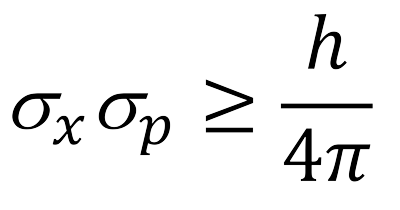
In this expression, σ (the Greek letter sigma) stands for “standard deviation,” which is a measure of how much a series of numbers differ from each other. In this context, the standard deviation is a measure of uncertainty. Specifically, σx measures our uncertainty of a particle’s position, and σp measures our uncertainty of its momentum. All the terms on the right are constant values, so on the literal level, this mathematical expression states that the product of the uncertainty of a particle’s position and momentum is greater than or equal to a specific number.
Why does this matter? Because if we know the exact position and momentum of a collection of particles at one point in time, we can use the laws of physics to calculate their respective positions at any other time in the past or future. Everything in the universe is made up of particles. So hypothetically, if we could determine the exact position and momentum of every subatomic particle in your brain, we could build a computer model that would tell us everything you’ve ever thought and everything you ever will think.
And if we knew the precise position and velocity of every particle in the universe, then we could calculate every detail of its history and future. And yet, we can’t do this because we can’t determine both the position and the momentum of any particle to more than a finite degree of certainty. Thus, on a more poetic level, Heisenberg’s uncertainty principle is a mathematical expression of human free will, since it precludes the possibility of calculating all your future thoughts and actions.
Oakley’s discussion of “equation poetry” seems a little more esoteric than most of the other content in the book. However, considering Oakley’s background, it arguably provides an example of a broadly applicable principle for achieving your full potential. Specifically, if you can find similarities between something you already understand and something you are struggling to learn, it will make the latter topic easier to parse and less intimidating.
In Oakley’s case, she studied literature and languages before she took an interest in learning math and science. She admits that there was a time when she found equations intimidating, but it’s probably safe to assume that, given her education, she was comfortable with poetry. As such, her discovery of the similarities between equations and poetry may have been a major breakthrough in her studies, as she found a way to conceive a difficult concept she struggled with through the lens of something she already understood and appreciated.