1-Page Summary
In the Biblical story of David and Goliath, a small shepherd boy conquers a giant by slinging a rock at his exposed forehead. We tend to think of David’s victory as a miracle, proof that sometimes, if he’s lucky, the weak can beat the strong.
But what if underdog victories have less to do with luck and more to do with the very circumstances we view as disadvantages? In David and Goliath, Malcolm Gladwell argues that what we assume are disadvantages might actually be advantages, and vice versa.
Lacking skills can be an advantage.
- You can’t use skills you don’t have. If you lack the skills others think are necessary for the game, and you still want to play the game, you can’t play like everyone else.
- Lacking certain skills forces you to get creative. You have to come up with new approaches to winning. Meanwhile, your skilled opponents have no reason to get creative (and discover more effective strategies) because the conventional way works for them. Your opponents don’t expect your novel approach. This gives you the edge.
- For example, David wasn’t skilled with a sword and shield, so he couldn’t battle Goliath the traditional way (the way Goliath was expecting). David had to get creative, using his skill as a slinger to knock Goliath to the ground. Because Goliath wasn’t expecting this tactic, he left himself vulnerable to it.
Having less than your opponent can be an advantage.
- Having too much limits you.
- We tend to believe that if something is good, more of it is better.
- But studies suggest that while qualities such as strength, size, and wealth positively impact our lives in moderation, you reach a point at which all those seemingly-great resources become disadvantages.
- For example, Goliath was covered in armor and loaded with weapons. In a battle, weapons and armor are good things to have. But Goliath’s overabundance of weapons weighed him down. What was an advantage in a limited amount became a disadvantage in a large amount.
- Likewise, having too much wealth could make parenting more difficult, when it becomes harder to pass down your hard-earned values to your comfortable kids.
- Having nothing frees you.
- Occasionally, you have to break the rules to win the game. When you have money, a nice house, a foreign car, and clout in your community, you risk it all when you buck convention. Your desire to hold onto everything you have forces you to play by certain rules, and this constrains you.
- On the other hand, if you have nothing to lose, you’ll try anything. Like David challenging Goliath with a rock and a sling, you’ll take the unconventional approach that’s so crazy (and perhaps morally questionable) it just might work.
Being a big fish in a little pond can be an advantage.
- When choosing a college, most would agree you should go to the most prestigious one that will accept you. This would make you a little fish in a big pond, but who cares?
- You should care. The theory of relative deprivation says that we judge our abilities based on the abilities of those around us.
- If you attend Harvard and struggle in a chemistry class, you may feel that you’re just not cut out for a career in science.
- In reality, your skills in chemistry may be better than 99% of people in the world studying chemistry. But you don’t compare yourself to everyone in the world; you only compare yourself to fellow Harvard students.
- When comparing yourself to your peers at a prestigious school, you lose confidence in your abilities. You may switch to a humanities major, depriving the world of a great scientist.
- Your confidence in your skills may be a better predictor of career success than the prestige of the school you attend. Being a big fish in a little pond can give you this confidence.
Having a disability can be an advantage.
- We generally consider having a disability a disadvantage. However, disabilities force some people to make up for them by developing extraordinary abilities in other areas.
- For people who can compensate, their disability becomes a gift—without it, they never would have needed to work so hard to develop other skills.
- For example, students with dyslexia struggle to read. Because they can’t depend on reading to learn, they often compensate by developing superior listening and observation skills instead.
Living through a traumatic event can be an advantage.
- Social scientists break people who have survived a traumatic event into two groups: near misses and remote misses.
- Remote misses are people who are slightly removed from the trauma. For these people, the death of a parent or an exploding wartime bomb strengthens them. Trauma actually leaves them better off than they were before.
- Because the worst has already happened, they have less to fear. They take more risks because even if they fail, things can’t get worse.
- Enduring something that is seemingly unendurable gives you confidence.
Exerting too much power can be a disadvantage.
- Power isn’t limitless. If you act as if it is and wield power that isn’t “legitimate,” you’ll get defiance from your subjects (or employees) rather than submission.
- Power is legitimate when:
- Subjects feel like their voices are heard.
- The law (or the person in power) is predictable.
- The law (or the person in power) is fair.
- If you are not predictable, fair, and attentive to the feelings of your subjects, you hold very little power over them.
If underdog tactics are so successful, why doesn’t everyone use them?
- Underdog tactics are hard
- They often require you to work harder than everyone else.
- They may call for brain power over brawn. You’ve got to be crafty.
- You need to be able to break from convention and think outside the box.
- Underdog tactics make others angry
- People don’t like it when you win without playing by their rules. You have to be able to tune out what others think of you.
Introduction: The Story of David and Goliath
For thousands of years, the Biblical story of David and Goliath has given hope to underdogs inspired by David’s miraculous victory against the giant Goliath, with only a rock, sling, and stick at his disposal. The odds were against David...or were they?
In David and Goliath, Malcolm Gladwell argues that we misunderstand underdog victories. We think of David’s small size, shortage of weapons, and lack of battle experience as disadvantages, when these were actually crucial to his success. Gladwell shows us that our various disadvantages--from loss and grief to discrimination and disability--may be advantages in disguise.
Two key ideas run through this tale and throughout the book:
1. Difficulty can be desirable
- When you face seemingly insurmountable difficulties and beat the odds, you cultivate the qualities we most value in society.
- We tend to think of all challenges and deficiencies as disadvantages, but what we assume are disadvantages are often advantages. There are some traits you only develop through adversity, such as unshakable self-confidence and emotional endurance.
2. We misunderstand underdog stories
- We think that power = physical strength, size, weaponry, or wealth.
- In reality, what we assume are advantages are often disadvantages. Heavy armor may appear to protect you when it actually weighs you down. Likewise, having too much wealth and exerting too much power can hold you back.
The Story of David and Goliath
To understand the book’s premise, we need to review the basics of its foundational tale from the Bible:
In the Valley of Elah, the Philistines want to capture the land ruled by the Israelites. The Philistines send their strongest man, the six-foot-nine Goliath, to do battle for them. The only Israelite to volunteer to confront Goliath is a shepherd boy, David. Saul, king of Israel and Judah, offers David a sword and shield, but David refuses them and runs, unprotected, toward Goliath. He slings a rock at Goliath’s exposed forehead before Goliath can react, and as Goliath lies on the ground, stunned, David grabs his sword and kills him.
How We Misunderstand the Story of David and Goliath
We think David’s victory is miraculous, but it’s more probable than we realize.
David’s perceived disadvantages were actually advantages
- He had no armor or sword, but these would have made him clumsy because he wasn’t used to them.
- He was small, but this allowed him to be fast and agile in his attack.
- He was a lowly shepherd boy rather than an experienced fighter, but protecting his sheep gave him practice in fatally slinging rocks at lions and bears, excellent preparation for his battle with Goliath.
Goliath’s perceived advantages were actually disadvantages
- Goliath was a giant, but medical experts believe this was due to a condition called acromegaly that causes an overproduction of human growth hormone. This condition also causes vision problems, which proved fatal to Goliath, who couldn’t see what David was up to until it was too late.
- Goliath had a lot of battle experience, but these prior experiences led him to assume that David would engage with him in traditional hand-to-hand combat. By declining to follow the conventional strategies, David caught him off guard.
- Goliath was likely wearing and carrying over a hundred pounds of armor and weaponry, but this left him immobile and unable to respond to David’s unconventional tactics.
Chapter 1: The Advantages of Lacking Skill
If you feel like the underdog, it may be because you lack skills that most people consider necessary to win in your field. You likely think of your shortcomings as obvious disadvantages. But, contrary to common sense, what if you could use your inadequacies to your advantage?
Chapters 1-3 have to do with the various advantages of “disadvantages.” In this chapter, we’ll talk about the advantage of lacking skill.
The Advantages of Having No Skill
If you’re really terrible at a game, you can’t follow conventional wisdom and win—you just don’t have the skills. Being unskilled (but still in the game) forces you to come up with new approaches to winning. Your skilled opponents (who aren’t as desperate as you are) have no reason to come up with novel strategies because the conventional ones work well for them. Consequently, your opponents are not prepared for your new approach. Taking them by surprise gives you an edge.
Two stories, one historical and one recent, illustrate situations in which a group’s lack of skill obliged them to implement strategies that were far more effective than the traditional ones.
Example #1: Lawrence of Arabia
At the end of the First World War, Lawrence of Arabia led the Arabs 6,000 miles through the desert, into battle against the highly trained Turkish army occupying Arabia. Lawrence commanded a small, untrained band of Arab nomads, many of whom had never held a gun. The troops only numbered a few hundred, but they beat the Turks’ army easily, only losing two men.
Why Did Lawrence of Arabia’s Underdog Tactics Work?
- They were unexpected: The Turks were prepared to defend themselves against an attack from British ships at the Gulf of Aqaba. They left themselves vulnerable to an attack from the desert, never imagining that any troop would be crazy enough to cross it, especially in the summer.
- They took advantage of the opponent’s weaknesses: Like Goliath with his burdensome weapons and armor, the Turks’ extensive material resources weighed them down and rendered them immobile, trapped between the sea and the desert. By approaching from the desert side, Lawrence’s army hemmed the Turks in, leaving them little room for escape.
- They didn’t allow their opponents to capitalize on their strengths: The Turks had modern weapons and material resources, but the Arabs’ surprise attack didn’t give the Turks time to utilize their resources to their full potential.
- They used their “disadvantages” to their advantage: The Arab soldiers carried only a rifle and a hundred rounds of ammunition. They brought little water or food. But, like David, they used their lack of weaponry and supplies to their advantage. Traveling light allowed them to cover upwards of 100 miles a day.
- They were audacious: Traveling 600 miles through the desert in the summer is bold. Few would have had the audacity, which is part of what made their appearance at Aqaba so surprising.
Example #2: Unconventional Basketball Plays
Vivek Ranadivé, an Indian immigrant who had never played basketball, decided to coach his daughter’s National Junior Basketball team in Redwood City.
Not having a group of skilled, experienced players, and without enough time to teach them the skills to make them competitive using conventional strategies, Ranadive took advantage of two deadlines. These are moments in a basketball game when the best teams are as vulnerable as the worst:
- Deadline #1: When Team A scores, a player from Team B takes the ball out-of-bounds and must pass the ball to a teammate within 5 seconds.
- The conventional strategy used by players of Team A, now the defense, is to retreat to the other side of the court.
- The unconventional strategy used by Ranadivé’s Team A was to stand in front of Team B players and block them from receiving the pass. Flustered, the out-of-bounds Team B player often couldn’t complete the pass, giving the ball back to Ranadivé’s Team A.
- Deadline #2: If Team B does happen to get the ball into one of its player’s hands, it has 10 seconds to get the ball onto their opponent’s side of the court, at the opposite end.
- Again, the conventional strategy for Team A is to retreat to their side of the court and await their opposition.
- Just as in their response to Deadline #1, Ranadivé’s unconventional strategy had his 12-year-olds aggressively surrounding the Team B player with the ball, keeping her from getting across midcourt in 10 seconds.
This play style, called a full-court press, kept the talented opponents of the Redwood City team from keeping the ball long enough to use their skills. Ranadivé’s Redwood City team of relatively unskilled players won almost all their games.
Why Did Ranadivé’s Underdog Tactics Work?
- They were unexpected: People have played basketball the same way for decades--it never occurred to the teams playing Redwood City that they could play it any other way. Consequently, the opposing teams were unprepared and bewildered when confronted with the full-court press.
- They took advantage of their opponent’s weaknesses: When trying to get the ball into play within the allotted 5 or 10 seconds, even the most skilled players are vulnerable. Ranadivé developed his entire game strategy to take advantage of these moments when even the best teams are under pressure.
- They didn’t allow their opponents to capitalize on their strengths: The best basketball players are highly skilled at dribbling, rebounding, or scoring 3-pointers. The Redwood City players didn’t let their skilled opponents get close enough to the basket to use these skills.
- They used their “disadvantages” to their advantage: Most of Ranadivé’s players were new to the game and didn’t have time to learn the skills. Their lack of skill led them to work much harder than their opponents. Often, you only work that hard when you’re desperate because you don’t have the skills that may have spared you the effort.
- They were audacious: Playing a full-court press is risky--because it’s a physically aggressive tactic, the chances of fouling out are higher. It’s also exhausting.
If Underdog Tactics Are So Successful, Why Isn’t Everyone Using Them?
Many have fought battles since the Arabs beat the Turks in Aqaba, and in 1971, the Fordham University Rams used the full-court press to beat the nearly unbeatable University of Massachusetts Redmen. Lawrence’s and Ranadivé’s unconventional tactics aren’t unknown. But in general, underdogs rarely learn from the past and use these unconventional strategies. Why not?
Reason 1: Underdog tactics are hard
Walking 100 miles a day through the desert in the summer is brutal. A full-court press involves being constantly in motion, so the Redwood City team had to be fitter than their opponents. Few but the desperate are willing to work this hard.
Reason 2: People get angry when you don’t play by their rules.
Thus, these tactics are best employed by those who don’t care if they upset some people.
If you care what others think of you, you’re less likely to use underdog tactics. (And it’s human nature to care what others think of you, making this difficult.)
- For example, Lawrence’s British compatriots scoffed at his Bedouin dress and “untrained rabble,” but he didn’t care. He was an archaeologist by trade and wasn’t invested in the good opinion of the military establishment.
- The coaches of opposing teams were furious that Ranadivé’s underdogs were crushing their skilled players (and that a “skinny, foreign guy” who had never played basketball was coaching the winning team); one was so upset he threw a chair, and the ref kicked him out of the building; another man threatened to beat Ranadivé up.
Exercise: Turn Lack of Skills into a Strength
Reflect on your perceived weaknesses to find their hidden advantages.
Think of a personal or career challenge that felt insurmountable because you felt like you were lacking skills. What was the challenge?
Did you feel at a disadvantage? Write down your disadvantages in the situation above.
Now look at each disadvantage. How can you reframe it as an advantage? Is there any aspect of the disadvantage that’s positive?
Chapter 2: The Advantages of Having Less Than Your Opponent
Most of us tend to believe that when something is good (like strength, money, or small class sizes), more of it is better. But Goliath’s abundance of size, strength, and weaponry didn’t protect him from David’s rock--it made him more vulnerable. There is a point at which the accumulation of resources ceases to be an advantage and another point at which those resources become a distinct disadvantage. The visual representation of this theory is the inverted-U curve.
The Inverted U-Curve
When you graph the relationship between, say, parenting success and money, or class size and student achievement (two examples we’ll explore more below), the shape is an upside-down U.

For instance, if we wanted to graph the relationship between money and happiness, we could chart wealth on the X-axis and happiness on the Y-axis. Picture the beginning of the inverted-U at the bottom left-hand corner, where the X- and Y-axes meet, at $0 and 0 on the happiness scale. (It’s difficult to be happy when you don’t have money and are just trying to survive.)
As wealth increases, the arch moves diagonally up to the right. (An increase in money means an increase in happiness.)
But, at some point (studies say at a family income of around $75,000), an increase in money stops making you happier—you have enough to meet your basic needs and buy yourself and your family a few luxuries. The diagonal ascent of the graph starts to level off, forming the top of the upside-down U—income increases, but happiness levels stay the same.
We tend to think the relationship between wealth and happiness ends here: at some point, how much money you have ceases to matter. But this is our error--we forget that we live in a “U-shaped world.”
Is there a point at which more money triggers a decrease in happiness, completing the upside-down-U shape? Many social scientists claim that, yes, you can have too much of a good thing, as we’ll explore further in the example of money’s effect on parenting, below.
The tendency of graphs toward an inverted-U shape shows us that many things we think of as unequivocally advantageous, like money or material resources, aren’t. Nothing is good, evil, or even neutral. An item’s value often depends on how much of it you have. It’s advantageous until you have so much of it that its value becomes neutral. At the point of overabundance, its value goes from neutral to negative. What was an advantage in a limited amount becomes a disadvantage in a large amount.
Let’s see how this plays out in two examples.
Example #1: More money does not necessarily lead to easier parenting
(Shortform note: Gladwell implicitly defines “parenting” as spending time with your children and instilling in them the values of hard work and independence.)
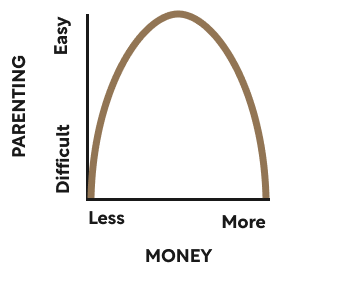
Picture the inverted U again. If the X-axis is wealth and the Y-axis is the “easiness” of parenting (0 being not easy at all), poverty is located at the bottom left of the curve. If you live in poverty, it’s harder to be a good parent. Spending long hours at a demanding job is exhausting and leaves you little time or energy to spend with your children.
An increase in money makes parenting easier...to a certain point. Then the benefits start to diminish in proportion to wealth.
Perhaps surprisingly, there’s a point at which the wealthier you are, the harder parenting is, and the curve makes its downward slope.
Why would having a lot of money make parenting harder?
You probably want to raise kids who understand the value of hard work and the fulfillment it brings. If your child asks for a pony, and you don’t have the money for one, it’s relatively easy to say, “No, we can’t afford that.” It’s the truth, and there’s no decision to make: buying a pony is not an option.
On the other hand, if your child asks for a pony and you do have the money, you can’t use the excuse that you can’t afford it. Still, you don’t want to buy your daughter a pony—you want her to learn to work hard for what she wants, rather than depend on her parents to satisfy her every whim. But it’s much harder to say “I won’t buy you a pony” than “I can’t buy you a pony.” If you refuse to buy a pony (rather than being unable to), you have to explain to your child why you won’t buy it. To explain why, you have to have clear values (not always easy) and know how to communicate those values (also not easy). Additionally, you have to stay firm in the face of an upset child, no mean feat when you have the resources to make your child immediately (if momentarily) happy.
Anecdote: The Hollywood power player
One unnamed Hollywood power player is very aware of how his wealth is a disadvantage for his children. He grew up in a lower-middle-class neighborhood in Minneapolis. If he wanted new shoes or a bike, he had to pay half, and to get the things he wanted he became an entrepreneur at age 10, paying neighborhood kids to shovel snow and rake leaves for residents. He worked throughout college, business school, and law school, and climbed his way up the ranks in Hollywood.
He attributes his success to the values he gained from growing up without financial means and working hard for everything he attained. Now a multimillionaire, he knows his children won’t have to work for what they want the way he did. He believes that his children will be less ambitious and won’t know the value of money or even their self-worth.
Example #2: Smaller class sizes do not necessarily lead to higher achievement
Countries (and parents) around the world have devoted vast amounts of money to keeping class sizes small, believing that the smaller the class, the higher the achievement of its students. But the inverted-U curve tells us that smaller classes are only better for students up to a certain point. Do studies bear this out?
Large classes: Kids in large classes, such as those in Israel that regularly have 38 or 39 students, perform worse than those in a class of 20. This makes sense. Smaller class sizes mean more individual attention for each student.
Medium-sized classes: Within a range of moderate class sizes (roughly 13-23 kids), student performance is equal.
Small classes: But with very small class sizes (under 12 kids), anecdotal evidence suggests student learning is impaired. (Shortform Note: Gladwell studied low class sizes by polling teachers and collecting anecdotes rather than depending on evidence from rigorous studies.)
Why would small class sizes lead to lower achievement?
- In small classes, there is nowhere to hide. Students feel vulnerable, especially the shyest ones.
- Bullies and students with big personalities are more likely to dominate social dynamics in a small class.
- Interactions between students are more intense--they start acting like siblings trapped in a car on a long road trip, and when they bicker, they can’t get any significant distance from each other.
- A small group lacks the energy and momentum that comes with the audience formed in larger classes.
- Small classes can be isolating and lack diversity.
- Small classes may isolate you from others who are confronting the same challenges you are. (A Dutch study showed that the kids who have the best chance of succeeding in school are those who see others grappling with the same issues they are, be they poverty or a learning disability. These children feel less alone and more normal.)
- Conversely, the smaller the class, the less diverse it is—children aren’t exposed to a range of thoughts and experiences.
- It’s more challenging to get discussions going in a small group.
Exercise: Find Your Advantage in Moderation
Reflect on the ways your desire for more is holding you back, and how moderation can help you move forward.
Think about something that you love (maybe a food or an activity) or something that you think of as unquestionably positive (perhaps a quality like patience or forgiveness). Can you imagine a point at which there’s too much of it? What would be the result?
Think of something you always want more of. (Money? A promotion? Attention? Pizza?) How would moderation of this thing be an advantage over having too much?
Chapter 3: The Advantages of Being a Big Fish in a Little Pond
Would you rather be a “Little Fish in a Big Pond” or a “Big Fish in a Little Pond” of your own choosing?
When applying to college, we want to attend the most prestigious university possible (and, therefore, be Little Fish in a Big Pond). Most would agree, when given a choice between two universities, you should choose the “best” one--the one with the most resources, the most accomplished faculty, the smartest students, and the prestige. But what if attending a “better” school could be a disadvantage?
The Theory of Relative Deprivation
The theory of relative deprivation says we compare ourselves to the people around us. Our feelings of happiness or deprivation, success or failure, are not absolute, but rather relative to how happy and successful our neighbors are.
For example, countries in which citizens consider themselves the happiest (Switzerland, Denmark, Iceland, the Netherlands, and Canada) have a higher suicide rate than countries in which citizens consider themselves generally unhappy or neutral. If you’re depressed in a place where everyone around you seems happy, you feel worse. However, if you’re depressed in a place where everyone around you also seems a little depressed, you feel normal and things aren’t so bad.
In education, we call this the “Big Fish-Little Pond Effect.” When assessing their own academic abilities, students don’t compare themselves to every other student in the world. They compare themselves to the students in their class. The more elite the school, the more negatively students perceive their own academic abilities.
For example, students who would be at the top of the class at School B (and would feel pretty good about themselves and their skills) might be in the middle or bottom of the class at the more prestigious School A (and feel bad because they compare themselves to students more skilled than they are).
Why does how we view our abilities matter?
Our perceptions have real-world consequences. Let’s take a look at the drop-out rates at Hartwick College and Harvard to see the “Big Fish-Little Pond Effect” influences graduation rates in STEM fields.
In America, more than 50% of all students majoring in STEM fields (science, technology, engineering, and math) drop out before receiving a degree. The majority of those who drop out are in the middle or bottom third of the class (ranked by SAT scores). This is true regardless of the university.
- Of those with SAT scores in the top third of their class, 45-55% will graduate with a STEM degree
- Of those in the middle third, 22-35% will graduate
- Of those in the bottom third, 11-20% will graduate
The fact that dropout-rate distribution is roughly consistent across colleges is surprising. Let’s say you score 569 (out of 800) on the SAT and you’re offered the choice between attending Hartwick College in upstate New York (Little Pond) and attending Harvard (Big Pond).
- An SAT score of 569 would place you in the top third at Hartwick. Because you’d be in the top third, you’d have a 55% chance of graduating (if you’re basing your chances on statistics from previous years).
- An SAT score of 569 would place you in the bottom third at Harvard. Because you’d be in the bottom third, you’d have a 15.4% chance of graduating.
So, which do you choose? Hartwick or Harvard?
The statistics say you’ll have a far better chance of receiving your degree if you choose to be a Big Fish in a Little Pond and go to Hartwick. Additionally, having a STEM degree is arguably one of the best things you can do for job and financial security. Therefore, choosing Hartwick over Harvard is the statistically smarter choice for increasing job prospects.
How can that be?
It’s all about the “Big Fish-Little Pond Effect” and how we perceive our abilities. When we compare ourselves to our peers at Hartwick, we feel relatively good about our skills. Our confidence increases our chances of success. When we compare ourselves to our peers at Harvard, we feel relatively bad about our skills. We lose confidence in our abilities and think we’re not cut out for a career in the sciences.
Gladwell shapes this chapter around the story of Caroline Sacks, a student who chose Brown over the University of Maryland. She dropped out of her STEM program when she felt her skills were inferior to her peers’. Gladwell argues that choosing the University of Maryland would have increased Sack’s chances of achieving her childhood dream of becoming a scientist.
The Impressionists
The Impressionists offer an example of a group that chose to be Big Fish in a Little Pond, a choice that ultimately secured their place in the history of art.
150 years ago, the Impressionists had to choose between exhibiting their work at the Salon in Paris, the most prestigious art exhibition in Europe, and putting on their own show. At the time, if you were not exhibited at the Salon, you and your work didn’t matter.
The Salon favored graceful, traditional works depicting historical events or stories from classical myths. The Impressionists—including Monet, Renoir, Degas, and Cézanne—used visible, audacious brush strokes to paint scenes from everyday life.
To the establishment, their work appeared unfinished and sloppy. The Salon rarely accepted work by the Impressionists, and when they did, the art was hung high up or in the back of the building, where it wasn’t seen.
In this situation, the Impressionists had two very different choices.
Choice #1: They could continue to attempt to gain viewers and buyers the traditional way, through the Salon.
- In doing so, they would be Little Fish in a Big Pond (the Salon was 300 yards long and two stories high, hung with three to four thousand paintings).
- Pros:
- They would have a chance at being recognized and validated by Paris’s esteemed art critics.
- Their work would likely increase in value if it won awards at the Salon.
- Choosing the Salon didn’t require the courage of breaking out on their own
- Cons:
- The crowds at the Salon were big. It was hard to actually see the art.
- Placed high among thousands of other paintings, their art wouldn’t get much attention (if it was seen at all).
Choice #2: They could exhibit at their own show. Here, they would be Big Fish in a Little Pond (the intimate show would display 165 works rather than thousands)
- Pros:
- They could paint what they liked and valued, rather than what the establishment expected to see.
- They could show as many canvases as they liked (the Salon set the limit at 3; in the inaugural Impressionist show, Degas exhibited 10).
- Their works wouldn’t get lost in a sea of others; People would actually see them.
- Cons:
- The Paris art establishment would mock or ignore them.
- Their art may not be worth as much as if it had succeeded at the Salon.
- They might be overlooked because they weren’t exhibiting at the Salon.
After many years of failing to get noticed at the Salon, the Impressionists struck out on their own. Although their exhibitions were controversial at the time, they drew huge crowds and their art was seen. If they hadn’t held their own exhibitions, we may not know the Impressionists today.
(Shortform note: While the Impressionists’ situation provides a good example of the benefits of being a Big Fish in a Little Pond, it is only tangentially related to the theory of relative deprivation. The Impressionists tried many times [largely unsuccessfully] to be Little Fish in the Big Pond of the salon. When they changed course and decided to be Big Fish in a Little Pond, they didn’t do it because they felt inadequate next to their peers, as the theory of relative deprivation would suggest. They left because the conventional way wasn’t working for them. After years of rejection, they were running out of options.)
Exercise: View Your Skills Objectively
Use this exercise to become more aware of how your environment—and the people in it—may be influencing your confidence and keeping you from your goal.
Have you ever felt like a Big Fish in a Little Pond? When?
Have you had the experience of transitioning from a Little Pond to a Big Pond? (Maybe from middle school to high school, or high school to college.) What did it feel like to make that transition?
Think of a time you felt inadequate. What was the situation? Were you comparing yourself with someone else? Who?
How would comparing yourself to a broader group, instead of just the people around you, change the way you felt about your skills? If you still feel insecure about these skills, what are some ways to reframe the situation to see your skills more objectively? (Remember, if Carolyn Sacks had judged her skills against those of every STEM major in America, rather than just those of her classmates at Brown, she might have seen how truly accomplished she was as a potential scientist.)
Chapter 4: Desirable Difficulty #1 - Disability
Part One (Chapters 1-3) discusses how what we perceive to be advantages are often disadvantages, or at least more of a mixed bag than we realize. In Part Two (Chapters 4-6), we see how so-called disadvantages can actually be strong advantages.
Desirable Difficulties
In Part Two we learn about three “desirable difficulties”: disability, tragedy, and having nothing. What makes these, or any difficulties, desirable?
- Not all difficulties are desirable—the students in the bottom third of an elite college do not benefit from feeling demoralized and discouraged from pursuing their dreams.
- On the other hand, not all difficulties (what we perceive as disadvantages) should be avoided. For instance, making a task more difficult can actually increase your chances of success on it.
An experiment involving the Cognitive Reflection Test (CRT) demonstrates the advantages of a desirable difficulty. The CRT is the shortest intelligence test in the world at three questions long. At Princeton, researchers first gave the test to students in clear, standard font and print size. Students scored an average of 1.9 correct answers out of three. The second time researchers gave the CRT to Princeton students, they printed the test in hard-to-read font that was 10% gray. The average score increased from 1.9 correct answers to 2.45.
Yes, CRT scores increased when researchers made the test more difficult. How can this be?
- When a task is more obviously difficult and frustrating, you slow down.
- You think more deeply about the task and devote more of your mental resources on it. In essence, you think harder.
Desirable Difficulty #1: Disability or Deficiency
When we are deficient in a skill area that most people depend on for success, we will only succeed if we find a way to compensate for our deficiency. We may compensate so well that our skills are more impressive than if we didn’t have the disability in the first place.
Capitalization Learning versus Compensation Learning
Most of our learning can be roughly divided into two types:
- Capitalization learning is the type we do when we get better and better at the things we’re naturally good at because we enjoy doing what comes naturally and easily. We capitalize on our strengths.
- If you sing well and have perfect pitch, you will likely join a choir.
- Compensation learning is the type we do when we need to compensate for a crucial skill we lack. This is learning out of necessity.
- Schools put a premium on the written word. If you have severe dyslexia and struggle to read, to succeed you need to develop abilities that compensate for your inability to read.
It’s not a given that someone with a deficiency in one area will automatically compensate for it by developing extraordinary talents in another area. But those that can do this are better off than they would be if they didn’t have the deficiency, because compensation learning (gained through struggle) is more powerful than capitalization learning (which is relatively easy).
Dyslexia: For Some, a Desirable Difficulty
A surprisingly high percentage (one study says ⅓) of successful entrepreneurs and business leaders are dyslexic. Are they successful in their careers despite their dyslexia or, perhaps, because of it?
People with dyslexia often compensate by developing other skills, including memory, observation, and summarizing skills.
For instance, David Boies is one of the most successful trial lawyers in the world. But he didn’t learn to read until he was in 3rd grade, and even today, he reads slowly and poorly. Boies credits his dyslexia (undiagnosed when he was young) for his amazing abilities in other areas:
Memorization
- In childhood: Because Boies couldn’t follow along when his mother read to him, he memorized what he heard.
- In adulthood: In law school, while his classmates were busy taking notes and, consequently, missing parts of the lecture, Boies was able to memorize the content of the lecture.
Listening and observation
- In childhood: Because he couldn’t read (and multisensory learning was not as popular as it is today), listening and observing others was the only way Boies could learn. He got good at these skills.
- In adulthood: As a trial lawyer, Boies catches hesitations during testimony, red-flag word choices, and nuance in tone and pace of voice that other lawyers miss. He takes advantage of these observations in his sometimes-brutal cross-examinations of witnesses.
Ability to simplify issues to their key points
- In childhood: Without the ability to refer back to a text, Boies became skilled at simplifying complex issues to their basic points, making them easier to remember.
- In adulthood: Many trial lawyers are academics and have trouble conveying their arguments to a jury because they get bogged down in the details. Boies presents the case to the jury in an accessible way and, therefore, has the advantage in court.
Other dyslexic people compensate in different ways. Movie producer Brian Grazer became skilled at the art of persuasion. Grazer’s dyslexia caused him to struggle in all his high school and college classes (which are usually text-based). After he received a grade, he’d go to the teacher and convince him or her to raise his grade by one letter. He says this worked 90% of the time. Grazer learned to negotiate out of necessity. This was good training for his eventual career as a movie producer.
Disagreeableness and Dyslexia
A surprising trait gained by successful entrepreneurs with dyslexia is disagreeableness. How does disagreeableness arise? If you grow up a misfit (due to your struggle with reading), you are practiced in not caring what others think of you. This carries through as an adult.
One psychologist argues that there are three qualities innovators tend to have in common.
- Openness: They are open to new ideas and can think outside the box.
- Conscientiousness: They are disciplined and have enough grit to see an unconventional idea through to the product stage.
- Disagreeableness: They are willing to ruffle some feathers and do things others don’t approve of.
- (Think of the Brit Lawrence of Arabia dressing in Arab clothing, speaking Arabic, and using unconventional war tactics, or Ranadivé outraging other coaches by instructing his 12-year-old basketball players to play full-court press.)
The first two entrepreneurial qualities make sense, but disagreeableness? Why is it an asset? If you’re worried about what people think of you, you’re not going to act on your unconventional—possibly revolutionary—ideas.
The Benefits of Disagreeableness—Example #1:
Ingvar Kamprad, the founder of IKEA (and is dyslexic), first upset the status quo by selling unassembled furniture cheaply and angering his competitors. He took his second major social risk when manufacturers boycotted IKEA; at the height of the Cold War, he turned to communist Poland to manufacture IKEA furniture. The gamble paid off. IKEA is still an enormously successful company, and it might not be around today if Kamprad had cared about the feelings of his compatriots.
The Benefits of Disagreeableness—Example #2:
Gary Cohn, the president of Goldman Sachs, was held back a year in elementary school. He has dyslexia, and it still takes him about 6 hours to read 22 pages. He got his job on Wall Street when he hopped into a cab with a guy who looked like he might have some power in one of the big brokerage firms. Cohn lied to him: He said he knew all about buying and selling options. (Cohn had barely made it through high school and, at the time, had a job selling aluminum siding. He had nothing to lose.) The following week, the man hired Cohn (after Cohn gave himself a crash course in options trading, no small task, even for someone without a learning disability.) This was a “disagreeable” act, an act in which Cohn didn’t care about the social consequences of pretending to be someone he wasn’t.
A note on dyslexia and success: Many people with dyslexia never learn to effectively compensate for their inabilities. A high proportion of prison inmates have dyslexia. Only when we can learn from our difficulties and overcome the failures they produce do they benefit us.
Exercise: Compensate for Skills You Lack
There are some difficult situations, like having a learning disability, that you can’t change. But that doesn’t mean they have to hold you back. Reflect on how you have compensated in the past, and how you can compensate in the future, for deficiencies.
Think about a skill that didn’t come easily when you were a kid. What was it? How did you compensate for your deficiency in it?
What did you learn from practicing or compensating for the skill you lacked?
Think of a goal that’s important to you. What’s a deficiency that you feel is limiting your ability to reach this goal? How can you compensate to get past this deficiency?
Chapter 5: Desirable Difficulty #2 - Trauma
The second “desirable difficulty” is trauma.
Courage is not innate; it is something you have to earn. You earn it by surviving something you didn’t think you could survive, or confronting a fear and realizing it’s not as scary as you expected.
Because it can result in courage, trauma actually leaves some people better off than they were before. How does this work?
- If the worst has already happened, you’re freed of fear to some extent. Nothing will ever be as frightening as the realization of your worst fear (an event you somehow survived).
- Overcoming fear leads to a confidence you couldn’t have earned without it. You endure the seemingly unendurable, and then you know you can live through it. It gives you a sense of your own invincibility and power.
Trauma Strengthens Some People and Weakens Others
We tend to believe that trauma affects everyone the same way, and that this effect is universally negative. There are actually 3 general effects of trauma:
- Direct hits: These are people who don’t survive the traumatic event.
- For example, the casualties of the Blitz, Germany’s bombing campaign of Britain during the Second World War, were direct hits.
- Near misses: These are people who are close to the traumatic event, perhaps even witnessing it, but survive. Trauma weakens them.
- During the Blitz, these were the people who were wounded or saw the carnage. These survivors remained preoccupied with the horror of the Blitz long after it was over.
- Remote misses: These people are slightly more removed from the traumatic event. They experience it, but not quite as acutely as those in the “near miss” group. Trauma strengthens them--they benefit from the elation and relief of being spared.
- These were the Londoners who heard the sirens and the bombs exploding, and witnessed the ruins in their neighborhood. Most of the Londoners who lived through the Blitz were in this group.
- The Germans thought that by bombing London, they would destroy the courage of the Brits. In fact, the Germans created courage in a country that was previously scared. Surviving the bombing, Londoners gained self-confidence and realized that the bombing wasn’t as bad as they had anticipated.
The Trauma of Losing a Parent
When you’re a child, it’s your worst fear that one of your parents, your providers and protectors, will die. You can’t imagine being able to survive such a loss. We assume that children of deceased parents are worse off than peers who did not lose a parent in childhood. Are they?
A 1960s study showed that 45% of high-achieving people (judged by whether or not their lives filled more than one column in an encyclopedia) had lost a parent before the age of 20. Various studies have repeated these findings among subgroups. For instance, more than half of famous poets lost a parent before the age of 15. 67% of English Prime Ministers, from 1800 to the start of WWII, lost a parent before the age of 16. And 27% of American Presidents, from Washington to Obama, lost a parent while young. (Shortform note: “young” isn’t defined here.)
Losing a parent is not a good thing. It’s devastating. Many children of deceased parents experience it as a “near miss.” Trauma harms rather than strengthens “near misses.” For example, prisoners are two to three times more likely to have lost a parent in childhood than people outside the criminal justice system.
However, some children experience a parent’s death as a “remote miss.” By surviving the unimaginable, they gain confidence in their ability to withstand trauma. Additionally, their other fears seem smaller and they take bigger risks (because, again, the worst has already happened).
A “Remote Miss” Example: Jay Freireich
Emil “Jay” Freireich is a doctor who pioneered chemotherapy as a treatment for childhood leukemia. However, he may never have persevered in the face of criticism and threats of being fired if he hadn’t had such a traumatic childhood.
Freireich’s parents, Hungarian immigrants, lost everything in the stock market crash of 1929. Shortly after, Freireich’s father died, likely by suicide. Freireich’s mother worked in a sweatshop eighteen hours every day to support her family until she remarried, at which point she fired the Irish maid Freireich considered his real mother.
When he was nine years old, a respectable doctor removed Freireich’s tonsils, and Freireich, having never had a man in his life that he looked up to, decided to become a doctor when he grew up. Another Hungarian immigrant gave Freireich’s mother $25 so he could go to college.
As a child, he had conquered fear over and over again. Traumatic experiences trained him to be courageous in his career and overcome consensus opinion and risk.
While working at the National Cancer Institute (NCI), Freireich developed two treatment strategies that horrified his colleagues and ended up being the keys to saving thousands of children’s lives.
Treatment Strategy #1: Blood Transfusions
The ultimate goal of Freireich’s team was to cure leukemia, but kids with leukemia tend to bleed everywhere, both internally and externally. Young patients were bleeding to death before doctors could treat their leukemia. Freireich held the radical belief that cancer destroyed his patients’ ability to make platelets. This, he said, was why their blood wouldn’t clot.
- Roadblock #1: Because Freireich’s platelet theory was unorthodox, the Institute blood bank wouldn’t give him blood, and he had to recruit blood donors himself.
- Roadblock #2: The conventional tools for transfusing blood were made of steel, rubber, and glass. But platelets stick to these surfaces. Freireich decided to try the new silicon needles and plastic bags.
- Roadblock #3: Transfusing using the new technology was risky. If done incorrectly, it could result in heart failure. Consequently, Freireich’s boss threatened to fire him if he kept transfusing platelets. Freireich ignored him.
The bleeding in Freireich’s patients stopped. The team could now keep them alive long enough to treat their leukemia.
Treatment Strategy #2: Drug Cocktails
At the time, doctors used one of three cell-killing drugs, in limited doses, to treat leukemia. Freireich wanted to use all three at once, plus another derived from the periwinkle plant. All four drugs attacked the cancer cells differently, but doctors still considered combining them extremely dangerous. Freireich’s attitude was, “Why not? They’re going to die anyway.”
- Roadblock #1: Because combining drugs was unheard of, and the periwinkle drug was a brand-new discovery, Freireich and his colleague Frei had to experiment to hit on the right dosage amounts and timing. Some kids became paralyzed in the experimentation process, and two children died.
- Roadblock #2: The NCI advisory board refused to approve the treatment, and Freireich and Frei had to wear down their boss to get approval.
- Roadblock #3: Children started to recover, but then the cancer would come back. Freireich decided to administer chemotherapy every month for a year, even when the children were in complete remission. This was dangerous (and highly controversial)--the drugs wiped out patients’ immune systems, leaving them vulnerable to infections and disease.
Everyone thought Freireich was insane, but he didn’t care. His traumatic childhood had been much worse than the criticism of his peers. Today, the standard leukemia treatment is a modified version of Freireich’s strategy and the cure rate is over 90%.
Why was Jay Freireich so successful? As a child, he had conquered fear over and over again. Traumatic experiences taught him courage.
Exercise: Acknowledge the Upside of Your Fear
As a society, we think of fear as something to be avoided. Use this exercise to reflect on how fear (and, crucially, confronting your fear) has impacted you, both negatively and positively.
Think of a time when you were afraid of something and you confronted that fear. (The fear could be big or small.) How did the experience alter your fear? Did you realize it wasn’t as scary as you expected?
How has overcoming that fear made you more courageous going forward?
What is one difficulty or trauma that has impacted your life? Is there any way in which it’s made you stronger?
Chapter 6: Desirable Difficulty #3 - Having Nothing
In a fair world, everyone could follow the conventional rules of the game and win. In the world we have, perpetual underdogs occasionally need to break the rules to succeed. To do so, they need to be “disagreeable” in the sense that they can’t care what others think.
If you have an abundance of wealth, status, and material goods, you risk all of it when you play by your own rules rather than society’s. You’re constrained. You have everything to lose.
But if you have very little and you’ve been neglected (or worse) by society, you don’t have anything to lose by bucking tradition and going your own way. This gives you freedom that those with more to lose don’t have.
Example: The American Civil Rights Movement
When the conventional way doesn’t work, try something unconventional. For instance, the leaders of the American Civil Rights Movement had to play by their own rules because society’s didn’t work for them.
Martin Luther King, Jr., and many Civil Rights activists, came from a community that had been enslaved and oppressed for hundreds of years. Being an underdog community for centuries was a clear disadvantage to its members. But it also taught them how to operate as underdogs and win. African Americans were not respected by the societies they sought to transform. They couldn’t lose a respect they never had. This made them freer in their strategies than their opponents.
Leaders of the Civil Rights Movement like Wyatt Walker, the executive director of King’s Southern Christian Leadership Conference, took inspiration from the “trickster” tales passed down through generations. The Brer Rabbit stories, a subgenre of the trickster tale, depict an underdog (Brer Rabbit) using his wits to outsmart characters who are bigger and stronger than he is. Walker’s strategy for fighting racism in Birmingham is a powerful real-world example of the use of trickster techniques to outsmart Goliath.
Walker devised a plan for Birmingham called Project C (“C” for confrontation). The last stage was a series of marches devised, in part, to fill up the jails with protesters. Jailing marchers was one way to smother the “civil rights problem,” but what would Goliath (in this case, public safety commissioner Bull Connor) do when all the jails were full? He would have to deal with the protesters directly.
The success of Walker’s plan depended on getting Bull Connor to fight back. The hope was that if they could get Connor to blatantly mistreat protesters, the news coverage would generate sympathy for the movement across the nation and in the government.
Connor didn’t want King’s marchers to cross into “white” Birmingham, and he would do anything in his power to keep them from doing it. Walker and King knew this about Connor. They also knew that Connor was itching for a fight. Walker’s plan was classic Brer Rabbit—figuring out what the enemy wanted more than anything and then using that knowledge to bait him.
As tricky as it was, a version of the plan had already failed at least once. Walker and King had just come from Albany, Georgia, where their campaign was a disaster. The Albany police chief, Laurie Pritchett, was not only a strong Goliath but a smart one--he saw what Walker and King were up to and refused to take the bait. He dealt with them in a friendly and respectful way. Pritchett even bailed King out of jail. Instead of directing sympathy toward the civil rights protesters, the lack of confrontation in Albany made Pritchett and his community look good.
Walker couldn’t fail again so soon after the Albany debacle. He was depending on Connor being a different kind of foe than Pritchett.
Three Tricks that Worked
Trick #1: The March with Imaginary Protesters
Many Blacks in Birmingham worried (justifiably) that they would lose their jobs if they marched with King. Walker couldn’t get people to show up.
This first trick was actually a felicitous mishap: Walker and his 22 marchers were scheduled to march at 2:30, but were delayed until 4. By the time they started marching, thousands had shown up to watch the demonstration. The next day, confused journalists reported that eleven hundred demonstrators had marched. Inspired by this unexpected success, Walker scheduled future marches for the late afternoon, when many people were leaving work and available to form an audience. The papers continued to report that thousands were demonstrating in the streets, when only a couple dozen of the crowd were actual protesters.
Meanwhile, Bull Connor was taking the bait. He decided he wasn’t going to let the marchers reach city hall. As long as Connor gave them restrictions to push against, Walker would have the publicity and momentum to keep the movement alive in Birmingham.
Trick #2: Getting Connor to Put Children in Jail
A month into the plan’s execution, members of Walker’s team used leaflets and the radio to encourage kids to show up to a “party” at a Baptist Church. The kids knew that “party” was code for “demonstration.”
Bull Connor threatened expulsion for any child who skipped school, but the kids still came. Walker’s team sent dozens of children out of the church holding signs and singing. Outside the church, the children knelt and prayed, and then passively walked to the police waiting to take them to jail. More than 600 kids ended the day in jail. It was not a good look for the Birmingham police.
Trick #3: Getting Connor to Turn on the Hoses and Bring Out the Dogs
The next day, 1,500 children showed up at the church to protest.
Connor called in both the police force and firefighters to combat the protesters. True to a previous threat, he also brought police dogs.
The jails were already full. Walker knew that if Connor sensed the protest getting out of control, he wouldn’t be able to resist using all the resources he had summoned. Walker wanted Connor to use them. He knew how it would look to northerners if a newspaper published a picture of the Birmingham police setting dogs on children.
As the children pressed closer to the police barricade, Connor ordered the firefighters to turn their hoses on them. He also called in eight K-9 units to keep the protesters from crossing into “white” Birmingham. One photographer snapped a picture of a dog lunging at a fifteen-year-old boy. It was a picture that turned the tide of the movement. Congress passed the Civil Rights Act of 1964 a year later.
(The boy photographed was actually a spectator, not a marcher. He also wasn’t a martyr, practicing non-violent resistance by passively letting the dog attack him; in the picture, he’s kneeing the dog in the chest. The officer was not actually siccing the dog on the boy; he was trying to restrain the dog. Trick #3 was extra tricky because the photograph wasn’t even depicting the brutality that Walker had hoped for. But Walker used what was handed to him.)
How did they come up with these “tricks”?
- King, Walker, and their team had nothing to lose. They had few material goods and no dependable rights.
- They were also desperate. They had nothing else to use. Conventional tactics hadn’t worked, so tricks were their only option. They also turned out to be effective.
But wait - Walker was pushing for police brutality against children. Isn’t that wrong?
Perhaps morality is just a name for the rules that Goliaths play by. Walker didn’t have any other options. The conventional, “moral” ways were not effective against the white giant and his racism. If the world isn’t fair, are you required to play fair?
Walker said later that he had no choice when he resorted to using children in his marches. He pointed out that Bull Connor was not moral, and therefore couldn’t be fought using “moral” methods.
Underdogs are not naturally tricky. They become tricky out of necessity.
Exercise: Be Tricky and Think Unconventionally
Use the example of leaders of the American Civil Rights Movement to inspire you to tackle tricky problems in unconventional ways.
What problem are you facing right now that conventional approaches just don’t seem to solve? Perhaps you’ve gotten a lot of advice about how to solve the problem, and none of it is working.
Now list 5 unconventional approaches to the problem, no matter how silly or unrealistic.
Take a look at your list. Which ideas are too radical or off-the-wall to put into practice? Are they really? What do you really have to lose?
Chapter 7: The Limits of Power - The Principle of Legitimacy
Part Three shifts the focus away from the Davids of the world and toward the Goliaths. We’ll discuss two aspects of Goliath’s power that actually make him less powerful: the limits of authority and the negative effects of the overuse of power.
What Goliaths, people with overt power, tend to misunderstand about power is that it has limitations. The traditional hallmarks of power—massive weapons, years of experience, society’s blessing—can only take you so far. The degree to which you are powerful depends, in part, on how much power your “subjects” are willing to give you.
The Principle of Legitimacy
An authority figure’s power over the rest of us is especially limited if we don’t perceive him and his power as being “legitimate.” An authority’s legitimacy is based on three things:
- We, the subjects, need to have a voice. And we need to believe that those in power care about what we have to say.
- We need to feel that the law we’re being asked to abide by is predictable.
- We need to feel that the law and the people enforcing it are fair.
If you’re the one with the power, why does it matter what people think of you?
People become defiant, rather than submissive, when they don’t view the authority as legitimate. Authorities may make the rules, but they have trouble enforcing them without legitimacy. In fact, if you aren’t “legitimate” and you exert your power, you may get the opposite of your intended effect.
A Negative Example: Northern Ireland and the Troubles
In the late 1960s, antagonism between Northern Ireland’s Catholic minority and Protestant majority came to a head. The UK government called in the British (mostly Protestant) Army to keep the peace.
Ian Freeland was the general in charge in Northern Ireland. He believed in ruling by force. He intended to meet any resistance with immediate and brutal punishment and didn’t care what anyone, particularly Catholics, thought about it.
Aiming to scare the rioters on both sides, Freeland threatened to shoot anyone caught throwing gasoline bombs. This backfired. The more Freeland threatened, the more violence occurred.
- In 1969, there were 13 deaths.
- In 1971, there were 184 deaths.
- In 1972, there were 497 deaths.
In response to the violence, Freeland suspended civil rights and brought in more troops. The army held suspects in prison without a trial, and soon, most Catholics had at least one family member in prison.
One incident demonstrates Freeland’s soldiers’ liberal use of force (and how it backfired).
- After receiving a tip that one house in Lower Falls, a Catholic neighborhood, contained explosives, the army came to search it. The local priest warned that the residents would cause trouble if the soldiers didn’t complete the raid quickly.
- As the soldiers started to leave the neighborhood in their armored cars, a few young men threw rocks at them. The soldiers stopped the cars and brought out the tear gas. The conflict escalated quickly from there.
- The priest begged the soldiers to stop the tear gas, promising to restore order if they did, but the soldiers refused to listen. As the priest turned to walk away, he was gassed as well. The army brought in helicopters, declared a curfew, and ransacked every house in the neighborhood, trashing them.
- After the Lower Falls had been under curfew for 36 hours, residents were running out of food (they weren’t wealthy and many houses didn’t have refrigerators).
- A woman named Harriet Carson rallied the women of neighboring Ballymurphy to gather bread and milk and bring it to the Lower Falls in prams, in defiance of the army and curfew.
- At first, soldiers knocked over women who tried to trespass the barricade. As more and more marchers approached with their prams, residents of the Lower Falls started coming out into the streets. The British Army lost control and gave up.
Gladwell maintains that the British Army’s illegitimate use of power turned a conflict that should have lasted a few months into 30 bloody, chaotic years.
What made Freeland’s approach illegitimate? Why didn’t it work?
To the Catholic minority, Freeland’s actions didn’t seem predictable or fair.
- The soldiers sent to be neutral peacekeepers were Protestant. This didn’t seem fair to the Catholics, who assumed that, when push came to shove (often literally), the soldiers would side with the Protestant Loyalists. They weren’t wrong.
- On one occasion, when Protestant Loyalists marched through the Catholic neighborhood of Ballymurphy, British soldiers stood as a buffer between the marchers and the residents. But the soldiers faced away from the street, giving the impression that they were protecting the marchers from the residents.
- Suspects didn’t get a trial.
- The Army shot and killed one young man when he went outside with a friend to smoke a cigarette. This was not an isolated incident.
- The curfew in some Catholic neighborhoods meant residents were imprisoned in their homes without enough food to feed their large families.
- Rather than searching one suspicious house, soldiers ransacked the whole neighborhood. (The army had searched every Catholic home an average of two times by the mid-1970s.)
The Catholic minority refused to abide laws that weren’t fair or predictable, causing more and more trouble for Freeland and the British Army.
A Positive Example: Crime Rates in Brownsville
Brownsville, in Brooklyn, is historically one of the most crime-ridden neighborhoods in New York City.
In 2003, Joanne Jaffe became the head of the city’s Housing Bureau and sought to use her power legitimately. Accordingly, she departed from the conventional approach to lowering the crime rate in Brownsville.
Jaffe and her team created a program offering job, education, and medical assistance to Brownsville juveniles with a record, but warned them that if they continued to commit crimes, the team would make sure they stayed in jail, no matter how minor the crime. Jaffe also committed to getting to know the juveniles’ families.
She wasn’t getting anywhere with this approach until a group of her officers bought a particularly antagonistic juvenile and his family a Thanksgiving turkey. Jaffe was touched, and asked the police commissioner for money to buy turkeys for all the families with juveniles in the program.
When the families felt cared for and heard, they willingly opened their doors to the police. After this success, Jaffe and her task force started playing basketball with their charges, taking them to dinner, and driving them to doctor appointments. They got involved in their charges’ lives in ways that had nothing to do with the law.
Jaffe got astounding results: Brownsville robberies decreased every year from 2006 to 2011, and robbery arrests of program members decreased from roughly 370 arrests (one year prior to starting the program) to roughly 20 arrests three years later.
What made Jaffe’s approach legitimate? Why did it work?
- The Brownsville families felt heard. When Jaffe visited families, she told them she understood why they sometimes hate the police. She said that although it seemed like the police were harassing them, it was because they truly care about them. By getting to know the families, Jaffe opened up honest, direct, and friendly communication between juvenile delinquents and the police.
- Jaffe made the law seem more predictable and fair. Likely all of the juvenile delinquents in Jaffe’s program had a family member who had been in jail. Because so many people they knew were imprisoned, the law didn’t seem fair to these kids and their families. It felt like the police were out to get them. Jaffe made it clear that her goal was to keep program members out of jail. By offering help to families wherever and whenever it was needed, subsequent arrests (if they happened at all) seemed fairer.
Exercise: Use Your Power Legitimately
When Goliaths use their power illegitimately, both Goliath and David suffer. Think about the power dynamics in situations in which you’ve been David and situations in which you’ve been Goliath.
Have you ever had a teacher, supervisor, or boss whom you didn’t respect (perceive as legitimate)? How did you react when he or she gave you direction or feedback? What could have the teacher, supervisor, or boss done to make you more willing to cooperate or give your best effort?
Who are you in a position of power over? (Your “subjects” might be your employees, children, students, or pets.) For an area of your responsibility, do your “subjects” feel: 1) They are heard? 2) You are predictable? 3) You are fair?
Chapter 8: The Limits of Power - The Inverted U
As we learned in Chapter 2, we live in a “U-shaped world,” so we know by now that more power does not necessarily equal more compliance from those over whom we exert it. As Goliaths, using our power helps us. However, overusing (or abusing) our power gets us in trouble. To use our power effectively, we need to use it moderately. We also need to compensate for power’s limitations with forgiveness.
Looking at the relationship between crime and punishment, Chapter 8 demonstrates how forgiveness might be a more appropriate response to a situation than exerting your power.
In particular, we’ll look at how the Inverted U applies to crime and punishment. As a society, we operate on the assumption that the tougher we are on crime, the less crime there will be. This is true up to a certain point, at which an increased severity of punishment ceases to matter. As we move further toward the right side of the inverted U, it’s possible that cracking down on crime actually starts to make the crime situation worse.
The Three Strikes Law
Let’s take a look at an example. California implemented the Three Strikes Law to decrease crime in California. Under the 1994 law, if you’re convicted of a second serious offense, you serve double the time. If you commit a third offense, serious or minor, you serve a mandatory sentence of at least 25 years.
Californian Mike Reynolds lobbied for the law when a crystal-meth addict brazenly shot his 18-year-old daughter in the head outside a diner. Reynolds promised his daughter that he would work to prevent the same thing from happening to anyone else. He also wanted justice.
Did the law have its intended effect?
Apparently. From 1994, when the referendum was signed into law, to 1998:
- The homicide rate dropped by 41.4%
- Convictions of rape dropped by 10.9%
- Robbery dropped by 38.7%
- Assault dropped by 22.1%
So it was an unequivocal success? Not exactly. California’s crime rates began to decrease before the enforcement of the Three Strikes Law. At the same time, they were decreasing across the country, in areas that didn’t have a version of the Three Strikes Law. Studies on the law’s effectiveness are mixed.
Why might the Three Strikes Law be ineffective?
1) It depends on the rationality of criminals. The Three Strikes Law is based on the idea that criminals behave rationally—If the consequence is more jail time, people will think twice before committing a crime. But most criminals don’t sit around weighing the risks and benefits of a crime they’re planning. Many repeat offenders are drug addicts. The crystal-meth addict who killed Reynolds’ daughter would later say of his thought process that he wasn’t “thinking much a nothing.”
When researchers interviewed armed robbers, many said that thinking about getting caught was a distraction, so they pushed it out of their minds. One said that he gets high so that by the time he’s committing a crime, he doesn’t care about what happens to him.
The success of the Three Strikes Law depends, in part, on criminals thinking ahead. But criminals generally don’t think ahead. Criminals also don’t have a stake in society; their position as outlaws makes them disinclined to care what society thinks of them.
2) The Three Strikes Law assumes that the more criminals in jail, the fewer out there in the community, committing crimes. But the math breaks down here. In California, the average age a criminal gets his third strike is 43. If he’s in prison for the minimum of 25 years, he’ll get out at age 68.
How many crimes does a person commit between the ages of 43 and 68? Studies say, not many.
What the Three Strikes Law does is shield us from criminals right when they’re ceasing to be dangerous.
How might the Three Strikes Law increase crime?
1. It negatively impacts the families of criminals. Many men in prison have children. It’s hard for a father to support his children (both emotionally and financially) from prison. Having a parent in prison increases a child’s chances of becoming a juvenile delinquent by 300-400% and of developing a psychiatric disorder by 250%.
2. It negatively impacts communities. When the criminal returns to his community, his job prospects are dismal, he has lost touch with many of his friends, and time behind bars has changed him. Now, the burden of supporting him as he transitions back to a life of freedom is placed on the community.
That burden is sometimes too much for a community to shoulder. Researchers examining crime in Tallahassee, Florida have attempted to find the point at which the inverted U starts to turn down (the point at which more prison time leads to more crime). They concluded that if more than 2% of a neighborhood’s residents go to prison, the crime rate in that neighborhood the following year increases.
An Alternative to Punishment
As a counterpoint to the story of Mike Reynolds and his Three Strikes Law, Gladwell tells the story of another parent of a murdered child, Wilma Derksen. Derksen’s 13-year-old daughter was kidnapped, tortured, and raped on her way home from school; 7 weeks later the police found her body, frozen, in a shed.
Rather than lobby to increase the punishment for such crimes (as Reynolds, the original lobbier of the Three Strikes Law, did), Derksen and her husband, who are Mennonites, sought forgiveness. They knew that whatever power they possessed was limited, and were skeptical that exerting it would do any good.
Gladwell believes that in choosing forgiveness over justice, the Derksens saved their marriage, friendships, and mental wellbeing. Gladwell implies that the way Reynolds deals with his grief may not be as healthy, and that excessive punishment can have unintended consequences on the inverted U curve
Exercise: Combine Appropriate Consequences with Forgiveness
Harsher punishments don’t always lead to better results. When you’re in a Goliath position, find ways to make the punishment fit the crime, and pair the punishment with a healthy dose of forgiveness.
Think of a time when you handed a punishment that was too harsh. What was the situation? How did you handle it?
In that situation, how would moderating the punishment, and increasing forgiveness of that person, have worked better?
Chapter 9: Summing Up the Limits of Power
Chapter 9 tells the story of the Vichy town of Le Chambon-sur-Lignon that openly defied the German Occupation government in France. The narrative ties together themes from throughout the book, including the principle of legitimacy, the advantages of disagreeableness, and the idea that courage can grow out of tragedy. It’s also the ultimate underdog story: A small town dares to challenge the Goliath of Naziism—and wins.
André Trocmé and the Resistance in Vichy
After France fell to Germany in 1940, the French government at Vichy revoked anti-semitism laws, revoked Jews’ rights, took away their jobs, and sent them to internment camps. The government also implemented a range of smaller changes impacting non-Jews: for instance, all school children had to participate in a full fascist salute of the French flag and teachers had to sign a loyalty oath to the state.
The residents of Le Chambon-sur-Lignon refused to comply with any of these new orders.
For centuries, Le Chambon had been a haven for various refugee and outcast groups, primary among them the Huguenots. The local pastor was André Trocmé, a pacifict, and he preached resistance of any government request that was contrary to the orders of the Gospel.
Hearing that Le Chambon was a tolerant and accepting community, Jewish refugees started coming in huge numbers.
When a Vichy government official visited the town, expecting the usual banquet, march, and formal reception, the residents treated him coldly. A group of students read a letter, crafted with the help of Trocmé, that informed the official, “We have Jews. You’re not getting them.”
Trocmé’s Advantages, Borne from Disadvantages
What gave Trocmé and his community this astounding courage? What were Trocmé’s advantages?
1. Tragedy: Trocmé’s Protestant ancestors had faced persecution for centuries. The Huguenot sect had been banned in France. In attempts to make practitioners return to Catholicism, French kings had imprisoned and massacred them. Because they had to worship in secret, the Huguenots learned to be evasive and tricky (much as American civil rights leaders learned the art of the trickster from Brer Rabbit stories passed down from their enslaved ancestors).
After a century of being outcasts (or worse), the community had learned that they could withstand terrifying events. They were no longer afraid. In this sense, they were “remote misses”: The French made the Huguenots stronger by trying, over a century, to obliterate them.
(Perhaps not incidentally, Trocmé’s mother died when he was 10, another traumatic, and perhaps advantageous, event.)
2. Disagreeableness: Trocmé and his fellow Huguenots didn’t care what others thought of them. Their countrymen had never thought well of them, so there was no good opinion to lose, and they certainly didn’t care what the Nazis, or the Occupation government, thought of them. They evaluated their actions by the words of the Gospel, not the opinions of others.
Although Trocmé had a family to worry about and was generally careful to keep from getting caught, he didn’t really care if he was arrested. He was willing to die for his beliefs. The townspeople also didn’t care about the consequences doled out by the authorities.
How do you defeat an adversary who isn’t bothered by your punishments? The Huguenots’ indifference to retribution made them, as a community, invincible. The government could arrest and kill Trocmé, but another of his community would rise to take his place.
3. The government was “illegitimate”: To the Huguenots, it was clear that the law wasn’t fair (it directly opposed the Gospel). Also, their community had lacked a voice in France for centuries, and you need to be heard to feel your government is legitimate.
Did the Nazis ever crack down on the residents of Le Chambon?
Not really. Especially when the tide of the war began to turn in favor of the Allies, the Germans had bigger problems. They also may have realized that using the full extent of their power would backfire, creating even more resistance. Thousands of Jews survived because they were taken in by the residents of Le Chambon and the surrounding areas.
Afterword: Konrad Kellen
Gladwell’s Afterword addresses one of the biggest questions posed by the book: If Davids beat Goliaths all the time, why hasn’t that changed the way we view “David and Goliath” situations?
- It’s counter-intuitive. The assumption that the bigger, stronger, wealthier, more weaponized side has to win is instinctive and goes against conventional wisdom. It’s hard to wrap your head around the idea that the victory of a small, weaponless shepherd boy over an experienced, armored giant is not only possible but probable.
- It’s easiest to measure advantage by what we can see: the number of soldiers, the amount of money, the available weapons and material resources. It’s harder to look below the surface to evaluate the less tangible or clear-cut advantages of disagreeability, deficiency, and trauma. Furthermore, disagreeability, deficiency, and trauma are painful. We’re wired to link pain with disadvantage, so we don’t as readily see pain’s advantages.
The Afterword looks at how these play out in the opposing views of two political scientists analyzing the Vietnam War. Leon Gouré was certain the U.S. military (Goliath) would be victorious over the Viet Cong (David); Konrad Kellen was certain the U.S. military would never suppress the Viet Cong. Kellen was right, but by the time the American government realized it, more than a million soldiers and civilians were dead and America was in turmoil.
In the 1950s, communists, backed by the Chinese, controlled North Vietnam, and a pro-Western government ran South Vietnam. The U.S. decided to send troops to help the South defend itself against communism and its North Vietnamese agents, the Viet Cong.
The plan, called Operation Rolling Thunder, was to bomb Viet Cong-controlled areas until the North gave in. The U.S. government was confident—as they saw it, they had all the advantages, the “three M’s: men, money, and matériel,” as one general put it.
The Morale Project
There was really only one problem: The U.S. didn’t know anything about its enemy, the Viet Cong.
Leon Gouré worked for the RAND Corporation, which developed the Morale Project. Its goal was to understand the motivations of people who joined the Viet Cong. For the project, dozens of researchers interviewed people who had defected from the Viet Cong or were captured current members. Because so few people showed an interest in hearing their stories, the subjects were often very willing to talk.
Gouré’s Interpretation of the Morale Project Evidence
Gouré, who read all the interview transcripts, told military and government officials that American bombing was making a huge difference in the conflict. He said that many people were defecting from the Viet Cong and that civilians in the countryside welcomed U.S. involvement in the region.
Gouré had evidence to support this interpretation: The number of defectors who thought the Viet Cong would win the war decreased from 65% to 20% after a year of increased U.S. bombing.
Gouré filtered the evidence through a military logic that said that a miniscule country with no resources had to succumb to the most powerful country in the world dropping 643,000 tons of bombs on its people and countryside.
Gouré’s takeaway: Even Northerners don’t think the Viet Cong will win the war. The Viet Cong will give up and the U.S. will win.
Kellen’s interpretation of the Morale Project evidence
Late in 1966, the RAND Corporation asked Konrad Kellen, who had previously served in U.S. Army Intelligence, to read and analyze the interview transcripts from the Morale Project and report back.
Kellen saw the same data, but interpreted that data through a different lens and reached a totally different conclusion. He took note of subtleties like those in interviews by Mai Elliott, who found that interviewees were actually defiant.
These subjects had sacrificed their lives for their ideals of reunifying Vietnam and getting rid of the Americans. One woman Elliott interviewed had been forced out of her home by Americans who suspected her village of being controlled by the Viet Cong. The Americans then required her to help build her new village. She hadn’t been a member of the Viet Cong when Americans arrived, but the Americans treated her badly, forcing her into the Viet Cong’s waiting arms.
Many of the Viet Cong insurgents were poor and disillusioned by the West’s “help.” Their lands had been bombed and they had few material possessions. They had the freedom of having nothing to lose.
Kellen intuitively understood the distinction between “near misses” and “remote misses.”
- Near miss: You’re a civilian. An American bomb leaves you badly injured and demoralized. You don’t have the energy or health to fight. You give up.
- Remote miss: You’re a civilian. An American bomb destroys your home and kills your family members, but you emerge unscathed (at least physically). This experience fosters so much hate of Americans and their allies in the South that you vow to never stop fighting.
Although Kellen saw the same statistics as Gouré—that only 20% of defectors thought the Viet Cong would win the war—he saw something Gouré didn’t: Defectors didn’t think the U.S. would win, either. In other words, “80% of defectors did not think the Viet Cong would win the war” does not mean “80% of defectors think the US would win the war.” Gouré had jumped to his own favorite conclusion.
The Viet Cong were indifferent to winning or losing. They were merely concerned with fighting. How do you conquer an enemy who doesn’t care if he wins or loses?
Kellen’s takeaway: Northerners don’t think there will be a winner in this conflict. The Viet Cong will never give up. Consequently, after spending hundreds of billions of dollars and sacrificing the lives of thousands of soldiers, the U.S. will be the loser in this conflict.
Kellen and his interpretation of the Morale Project transcripts were largely ignored by the White House and military officials.
What he was saying diverged too greatly from the common sense of American might. It might always be hard to believe that a small shepherd boy could conquer a giant.