1-Page Summary
If you’ve ever felt the déjà vu of a repeating conflict in a close relationship, or known someone who seems to manufacture their own drama, you’ve probably experienced the “games” that people play.
In this 1964 psychology classic, Dr. Eric Berne sheds light on our unconscious social habits. Many such interactions are healthy and harmless, while others—our “games”—are often destructive to us and our relationships. Fortunately, we can grow beyond our games into a healthier, more fulfilling way of relating.
Games People Play is Berne’s analysis of social interaction. Berne was an MD and psychiatrist who broke off from the Freudian psychoanalytic tradition after 15 years of training to pursue his own theory of social psychology.
He wrote Games People Play for clinicians, so to make the ideas more accessible, we’ve minimized the technical jargon and focused on the essence. We'll move from an overview of Transactional Analysis (T.A.)—Berne’s system—through to games, and conclude with his suggestions for growing past your games.
A Crash Course in Transactional Analysis
Berne studied social interaction, usually looking at close relationships. He felt that people's social habits hinted at their underlying psychological issues. These habits imply our stances, deeply rooted beliefs that determine how we relate to others. Uncovering these unconscious stances, and the games they fuel, is how Berne (who died in 1970) helped his patients to grow.
(Shortform note: Despite gaining mainstream popularity, Berne struggled to gain acceptance from the psychoanalytic community. Some consider T.A. a pseudoscience, since his taxonomy of games references categories he theorized more than empirical evidence.)
Let’s look first at the key concepts Berne created to explain social interaction. We’ll discuss his account of its origins in infancy, his model of personality, and how to use T.A. to analyze interactions.
We All Need to Be Seen and Heard
Transactional Analysis begins with the idea that humans need consistent recognition from one another. Berne called this “stroking,” and it stems from the fact that infants will die without literal stroking. By adulthood, though, we’ve learned to make do with more symbolic contact, or recognition.
Our need for recognition is analogous to hunger—if you don’t “feed” it, your physical, mental, and emotional health will decline. Berne cites one study showing that prisoners in solitary confinement develop psychoses and a second that used sensory deprivation to induce temporary psychosis in a lab setting. In other words, lack of social contact leads to psychological starvation.
In order to stave off that starvation, Berne argues, we unconsciously build our days around social interaction. By doing this we help each other gain the recognition we need to stay healthy.
(Shortform note: While we need social recognition to remain healthy, Berne seems to say that all social interaction happens because we need strokes. But this perspective reduces subjective experience to mere biological drives. Applying Berne’s logic to regular hunger, he might say that we eat because we’d die otherwise. But it’s unlikely this is the widespread rationale for eating—and equally incomplete to suggest that we interact solely because we need to survive.)
Exchanges, Sequences, and Ego States
Berne then argues that we can break social interaction down into discrete chunks, like the bars of a piece of sheet music. One chunk is one exchange, a back-and-forth between two individuals.
When you greet your friend—“Hey there! / G’morning!”—that’s one exchange. If you keep chatting, each back-and-forth is another exchange. This is our primary way of giving social recognition.
(Shortform note: Berne doesn’t provide any concrete evidence for the existence of exchanges (he terms them “transactions''). With this in mind, it’s more useful to think of T.A. as a set of mental models than verified truth. Concepts like “strokes'' and “transactions” help to make sense of social interaction, even if they aren’t “real” per se. They make up a mental framework, a set of tools, similar to the way concepts like perspective, line, and composition help you to interpret drawings and paintings.)
You and your friend's exchanges change with your states of mind. Berne proposed that three states of mind, or "ego states," compose the human personality: adult, child, and parent.
- The adult is your rational self. It comes online to handle complex decision-making and other significant calculations and also handles mature adult behavior.
- The child is the source of spontaneous emotions, developing out of early childhood experiences. It stores and plays back significant emotional associations: If you were bullied as a kid, your response to that intense emotional experience is deeply embedded in your personality.
- The parent is all about value judgments and tradition. Everything you inherit from your family about the right and wrong ways to act, think, and feel becomes your parent state—and you’ll pass it on too.
(Shortform note: Berne’s “ego states'' have some parallels with Freud’s model of the psyche. Roughly, the child maps to the Id (impulses and unconscious energies), the adult maps to the Ego (rational calculation and decision-making), and the parent maps to the Superego (handling moral judgment and values). But they also differ—for example, Berne doesn’t attribute all motivation to the libido, Freud’s idea of a psycho-sexual energy that supposedly drives all behavior.)
You’ve probably made some silly mistake before and had a parent or partner reprimand you. According to T.A., they’re talking down to you from their parent state, scolding the child state in you. This would likely cause a child-state reaction from you: When we get treated like children, it “energizes” the corresponding patterns in the brain, according to Berne.
Exchanges follow one-to-the-next like links in a chain. So long as they remain reciprocal, the participants’ mind states are in balance (adult to adult, child to child, and so on). However, Berne says, if one participant breaks that balance by, for example, behaving childishly when spoken to from the adult state, that’s a disrupted exchange.
(Shortform note: Berne’s notion of reciprocal versus disrupted exchanges is a useful way to explain the psychological level of abrupt communication breakdown. To build on this, also consider the perceptual level: Much miscommunication occurs because the receiver of a message interprets it differently from how the sender intended. Misinterpretation often accompanies emotional tension, like anger or defensiveness—states characteristic of a disrupted child or parent state. Berne doesn't provide a clear way to resolve a communication breakdown, but in The Four Agreements, Don Miguel Ruiz offers two principles that can help: Be impeccable with your word, saying nothing malicious or untrue, and make no assumptions, so that you voice your own confusions to maintain clear, reciprocal exchange.)
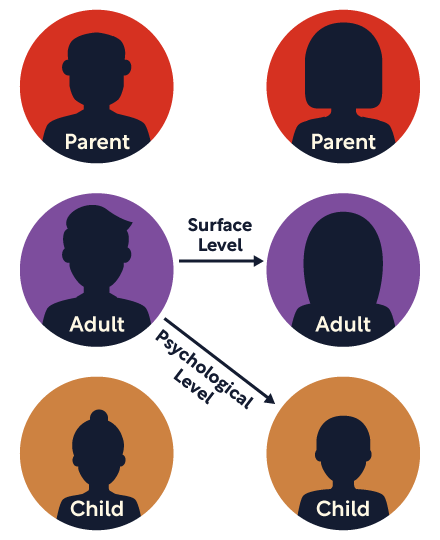
Finally, there are deceptive exchanges, where you say one thing, but (unconsciously) mean another. These operate on two levels: on the surface level you might say, “I can’t believe you’d treat me like this!” and on the psychological level you mean, “I need to offload my stress onto you.” Berne contends that these exchanges form the basis for games, which are a fundamentally deceitful form of interaction.
Three Elements of a Speech Act
Linguist Deborah Tannen offers a three-fold model of communication that’s somewhat similar to Berne’s. Say your partner just dropped a full dinner plate on the floor, and you say “Holy crap, why the heck did you do that?” This involves:
The explicit content: What caused you to drop the plate?
The emotional subtext: Anger and blame cast onto your partner
An implicit judgment: You’re a dumb klutz and I, having not dropped anything, get to judge your competence.
We’re very sensitive to the second and third elements, and they’re usually what we’ll respond to. This is similar to Berne’s model, where the players are really communicating through the game’s subtext.
In T.A., chains of exchanges make up the various forms of interaction. For example, you could break down a dinner date into each back-and-forth, and look at how the participants’ mind states interacted. Noting which states they exchange from helps you make sense of the interaction: whether they’re in balance, whether they’re playing games, or whether there are disruptive exchanges going on.
Games Are Our Social Theatricals
Berne defines a game as a stereotypical “act” that someone puts on, typically to gain a desired reward. For example, some people turn every little chore into a full-blown melodrama, looking for any excuse not to do it. Each such game is a pattern of behavior that occurs throughout the population, Berne says.
Berne calls them “games” because they’re standardized: They have rules, and there’s a reward at the end. We’re unconsciously driven to get that reward, just like with any other habit. Games are also typically destructive, so understanding yours can help you to grow beyond any dysfunctional relational habits.
(Shortform note: Keep in mind that Berne’s games are not intentional social games, like jockeying for power and status, making people laugh, or learned strategies for dating. They’re closer to social pathologies: dysfunctional ways of relating to others, à la “don’t play games with me,” said to (or by) the high school drama queen. Gossip, for example, provides pleasure and helps us to feel more powerful, but isn’t something we do all that intentionally. In fact, it may have had some evolutionary value, helping us to survive by fostering in-group cohesion—and this may mesh with Berne’s assertion that games help maintain our biological equilibrium: If games do so, then they’ve been doing so for many thousands of years.)
From another angle, your games are the ways you learned to deal with life’s challenges, typically as inherited from your family. When we’re children, significant life experiences shape how we relate to the world—a steadfast mother helps you learn trust; a best friendship gives you a sense of self-esteem; a school bully teaches you to stand up for yourself.
From these experiences, Berne says, we form deeply rooted beliefs about our place in the world. These stances concern things like right and wrong, should and shouldn’t, and what we deserve (or don’t): “People are basically good/bad,” “Life is great/a drag,” “Dreams are/aren’t real.” These beliefs then give rise to our games.
Our Games Come From Our Stances
Most of us don’t form particularly positive stances, and games are usually unhealthy (hence the need for therapists and personal growth techniques). Instead we learn things like, “People don’t like me, so I ought to scowl right back,” or “I am unlovable; no one has ever loved me.” Here’s how it works:
- Player A believes “Life is a constant struggle,” and so she interprets all her experiences through that filter. Inevitably she’ll see the worst in her partner, too, and that’s where the game comes in.
- Player A acts according to her belief, so she’s constantly finding things to be stressed out about. Eventually this causes her partner to get fed up with her, and they call her out—“God, why are you always so negative?”
- People don’t like to be criticized, so they fight. Eventually it breaks off, and A retreats to sulk. Here’s the reward: The fight confirmed her belief that “life is a constant struggle,” and that validation provides pleasure despite being embedded in an otherwise self-destructive pattern.
The key is that the game is mostly unconscious. Player A doesn’t realize she’s just defending a belief, and she didn’t intentionally provoke her partner. But it happened nonetheless and, according to Berne, she unconsciously desires the fight because of the reward: It reinforces her belief and allows her to feel “right” about her world.
(Shortform note: Berne describes here a kind of self-fulfilling prophecy: Insofar as you believe X to be true, you’ll create situations that prove it true. The placebo effect is the classic example: Believing that inactive, fake medications will work can actually cause them to have some effect. When it comes to mental health, this can cause downward spirals: Negative self-talk compounds on itself and makes things even worse.)
The Basic Pattern of a Game
Though Berne doesn’t explicitly lay it out, we can infer that the basic pattern of a game goes as follows:
- Player A holds some unconscious belief, and it gives them a hidden motive. Neither they nor the other players are aware of this motive, which is generally to create a situation that reinforces their belief.
- Working from that belief, Player A indirectly causes Player B to behave as they want them to.
- Player B typically plays into the game, and there’s some back-and-forth until B ends up proving A’s belief to them.
- Player A now feels validated: They got the outcome they wanted and reinforced their belief.
On the other side, Player B plays their own game—people play games that complement one another. A’s game works to prove B’s, too, so both players enable each other to keep playing.
- Say Player A is complaining about an annoying coworker, and Player B flares up—“God, can’t you stop being so negative?” Here, Player A’s game of “I Can’t Believe That…” complements Player B’s game of “Toxic Positivity,” allowing them both to keep playing.
Gather Details to Understand a Game
To truly understand a game, Berne states, you need to know the individual’s specific life history. The general pattern alone is not enough. Let’s go through a detailed example to illustrate a potential case. This game is called “Mr. Vesuvius,” and it goes like this:
- Mr. Vesuvius is a regular working man in regular suburban America. He provides for his family, but struggles with emotionality. He believes that “Anger is a justified way to punish rule-breakers.”
- Mr. Vesuvius never learned to manage his stress and is prone to anger; his father was the same way. When his kid or wife steps awry, Mr. Vesuvius often erupts. A door accidentally slammed too hard becomes his excuse to berate the offending family member.
- Eventually his anger wanes, and he walks off. Soon he returns with a back-handed apology, saying “sorry, but” and defending his outburst.
- With the offender cowed, Mr. Vesuvius has won his game: He got the reward of dumping all his frustration on an easy victim, and he reinforced his belief in justified anger.
Knowing more about a specific Mr. Vesuvius, in particular, enables you to better understand that instance of the game. Plenty of others play it, but background differences mean that each player has slightly different underlying motivations.
A Catalog of Games by Life Areas
Berne gives multiple ways to classify games; the clearest delineates them by areas of life:
Couples Games are the unhealthy habits that often develop between two people in a close, committed relationship. They can go on for years, and they may have a seriously negative effect on the players’ lives. (Shortform note: Some are what today we’d call abuse, like “love bombing.”)
Sex Games approach sexual interaction, but then instead derive satisfaction from the game’s reward, according to Berne. People who play these receive gratification from noncommittal flirting, making people fight over them, and so on.
(Shortform note: Here Berne’s sexism has influenced his interpretations. “Frigid Woman,” features a sex-refusing wife who “provokes” her husband into repeated advances, just so she can say, “Aha! All men are pigs!” There’s no real reason to go with Berne’s interpretation of her motives here: Any psychologist’s interpretations are subjective. They’re working to understand the subjective experience of another individual, and are thus subject to biases: We all tend to interpret things through our favored beliefs and mental frameworks.)
Career Games are long-term games that can consume the player’s life. Their lifestyle, health, and financial situation can all fall apart around the game. “Addict,” for example, can last for years, and often derails the player’s life.
(Shortform note: Extending Berne's notion of lifelong games, we might say that some have generation-spanning careers. Alcoholism, for example, can pass from parents to children. There's a physiological aspect—which Berne doesn't mention—to such inheritance, too: Traumatic childhood experiences can lead to chronic health problems. In this view, you don't control what games you inherit—but we each have the opportunity to combat any "generational curses" we receive, and thereby prevent our descendants from inheriting the destructive patterns.)
Criminal Games are illegal activities, occurring in the criminal underground and in prisons. For example, inmates who appear to want reduced sentences play “Want Out.” But really, they believe, “The world is uncertain, and uncertainty is frightening,” and so they’ll ultimately sabotage their own chances because prison is certain, thus safe.
(Shortform note: Transactional Analysis was one of the earlier treatments attempted in prisons: The psychiatrist Martin Groder drew on Berne’s game analysis, blending it with shock-and-awe style group therapy. This was Asklepieion, a rehabilitation program that ran at a federal maximum security prison for a full decade. Trained group members would shout, shame, and antagonize the “patients,” trying to force them to change their views and behaviors. The program succeeded in some ways, including by readjusting political dissidents to accept mainstream society. It was duplicated in 10 other prisons before being shut down due to multiple violent incidents within the therapy groups.)
Therapy Games are played by mental health professionals and their patients. Berne says that these can prevent real therapy from taking place, because they give the illusion of progress. “Psychiatry,” for example, features patients and therapists who get wrapped up in the experience of therapy. They believe that they’re making progress, but they really just enjoy being wrapped up in the illusion of progress.
(Shortform note: Ineffective therapy is a real issue, and can even leave patients worse off than when they started. Part of the issue is similar to what Berne describes: Well-educated, trained clinicians overestimate their own effectiveness, and they tend to resist changes that could improve patient outcomes. This is a case of ego getting in the way of effective therapy, and highlights the fact that holding a therapy license doesn’t mean you’ve resolved your own psychological dissonance—one study, for example, found that around two-thirds of clinicians experienced mental health issues.)
Positive Games have a net positive that offsets their deceptive qualities. For example, many privileged Westerners enjoy “Mission Trip” or “Peace Corps,” where they build schools, take pictures with the locals, and get to feel like good people.
We’ve based these tongue-in-cheek game names on Berne’s style. Colloquial names, he says, capture the feel of a game more effectively than psychoanalytic jargon like “verbalizing projected oral sadism.”
(Shortform note: Berne is right, insofar as jargon can often obscure the real message, make things sound more important than they actually are, and cause people to disconnect from what’s being said. Plain language has many advantages over jargon-heavy writing. However, Berne doesn’t consistently apply his own advice, often using Freudian psychoanalytic jargon like “oral frustration” and “transference reaction” that obscures his meaning.)
Identify and Overcome Your Games
Berne saw mostly destructive games because, he says, people with constructive games don’t go to therapy. Below, we’ve condensed and clarified his steps to identify games:
Step #1: Identify whether some social habit of yours seems to fit the pattern of a game. Is there a concealed motive in play? Are the exchanges deceptive? Is there some dramatic ending, or a self-validating outcome?
Step #2: When you think you’ve found a game, test it by trying to break it. According to Berne, attempting to break a game pattern results in significant resistance from the player. So if you notice substantial emotional resistance in you or the other person, you’ve likely found a game.
Step #3: If you want to better establish the pattern, look for more instances of it in the world. The more examples you find, the more you confirm that the game really exists. Then, describe the game’s characteristics, and learn to recognize it anywhere.
Once you’ve identified a game, there’s one key to overcoming it: You need an effective pattern-breaking solution. Berne explains that a good solution has a few characteristics:
- It’s tailored to the specific situation. Games are general patterns, but every specific situation is distinct. You need to create a disruption that fits the game and the person playing it. A direct call-out might work for someone less invested in their game, while Mr. Vesuvius might need a calm, patient pointing-out of his pattern.
- You use your adult state to intentionally disrupt the game. You refuse to communicate from the ego state the player talks to, and players are often taken off-guard by this rational treatment—at best, you snap them back into their adult state, too.
- It’s precise and considerate. Bluntly confronting people’s games is often less effective than threading the needle. Emotions can be volatile in game playing, so you need to be precise and mindful of triggers—your own and others’.
(Shortform note: Tony Robbins discusses his “pattern interrupt” technique in Awaken the Giant Within, arguing that you need to cut through the old habit with an unexpected interruption. His technique is somewhat blunt, though—like screaming and plunging your head into ice water to snap out of negative self-talk. It’s possible that sometimes you need a hammer (Robbins), and sometimes you need a needle (Berne). Alternatively, you can employ mindfulness to dampen your reactivity, making it easier to make new choices and form new habits.)
For example, you might disrupt someone’s game of “No I’m Less Wrong” by cheerfully acknowledging their superior reasoning abilities. No longer able to feed off a feeling of intellectual superiority, their game may just deflate.
After Games Comes Self-Sovereignty
Ultimately, games are a shallow, often unhealthy form of interaction. We default to them, Berne says, because the more fulfilling social form—intimacy—is either unavailable or too terrifying for most people.
But it’s possible to grow past your games, into a fuller life that involves intimacy. Berne calls this advanced stage of personal development “autonomy,” and we’ll refer to it as self-sovereignty. To transcend games and reach self-sovereignty, we need to develop three capacities:
#1: Present Awareness: This is the capacity to live in the here and now, to engage with raw reality. Presence affords you a deeper relationship with direct experience and enables you to show up more fully in life.
#2: Freedom of Choice: This means expressing your genuine emotions, uninhibited by parental and cultural conditioning. When you make choices that are true to you, unafraid of others’ expectations, you more fully become yourself.
#3: Sincere Connection: Present awareness and uninhibited choice enable you to show up, sincerely and vulnerably, in your relationships. From here intimacy can arise, which Berne believes is the most rewarding form of social living.
Berne's "Autonomy" and Maslow's "Self-Actualization"
When Games People Play was released in 1964, the humanistic psychology movement was just picking up steam. Humanistic psychology shifted away from the traditional focus on psychological problems and asked instead, “What about the human potential for living full, meaningful lives?” Berne’s work exemplifies this transition—he was concerned with pathologies, and he also focused on the potential to grow beyond them.
Another more widely known psychologist was directly involved—Abraham Maslow, famous for his hierarchy of needs, is considered a founder of the humanistic movement. At the top of his pyramid sits self-actualization, the need to grow into the best version of yourself. And there’s some interesting overlap between his ideas and Berne’s. For example, they both hold that spontaneity or uninhibited self-expression is crucial to peak development.
Elsewhere, they differ: Berne describes a type of automobile driver who is “at one” with the car, skillfully and fluidly navigating, and with great enjoyment. This sounds much like Maslow’s conception of peak experiences, a core indicator of self-actualization that involves feeling deeply immersed in the immediate experience. Yet for Berne, this is one step beneath true presence, which is closer to deep appreciation of the immediate experience à la mindfulness.
He also holds that “the most perfect form of living” is intimacy, which is fundamentally relational—not something you can achieve by yourself, like some peak experiences (being “in the zone” as an athlete, reaching big personal goals, and so on). In this way, Berne’s conception of fulfillment pivots away from our culture’s usual emphasis on the individual. We often frame a fulfilling relationship as subordinate to a satisfying individual life, but what if it were the other way around?
Achieving Personal Sovereignty
Despite our parental and cultural conditioning, we can recover the capacities of self-sovereignty. Berne argues that we had them as children, then lost them as we were molded by societal pressures. But we chose how to adapt—which of our parent’s traits to toss out, for example—and therefore we can reverse those decisions.
For example, maybe a parent insisted you follow a strict path through school to become a doctor. That pressure inhibited your ability to choose for yourself, but you can return and undo the negative effects it had.
Berne doesn’t say specifically how to do this, but he does sketch out the broad steps. Below, we’ve distilled his recommendations into four steps.
- First, overcome the influence of inherited conditioning. The expectations of parents and society often inhibit us from expressing who we really are. So to truly reach self-sovereignty or autonomy (which literally means “self-governing”), you have to throw off the influence of culture and tradition.
- Second, shake off the expectations of others. After addressing your cultural conditioning, shed the expectations of your immediate friends and acquaintances. Often, friends who don’t grow with you start to hinder your development.
- Third, stop indulging in your games. Games provide us easy, but ultimately unfulfilling, rewards. They’re more analogous to a chocolate bar than a soul-warming bowl of soup; you won’t grow healthy on games alone. Once you notice that you’re indulging in some self-validating behavior, it’s time to let go of that shallow gratification.
- Fourth, take the helm of your life’s ship. Focus on developing habits that reflect who you really are, and practice making only the choices that align with that. When you think, feel, and act as you genuinely want to, Berne argues, you can develop authentic relationships that transcend the influence of games and yield a fuller experience of life.
(Shortform note: Here, it’s clear why Games People Play has been labeled as an early self-help book. Despite the clinical content, Berne’s prescription for personal growth is familiar. His first two suggestions map well to individuation, which has been an important topic in psychology since Carl Jung first discussed the human need to realize your unique selfhood. And he wasn’t the first to suggest we should overcome unhealthy habits: Dale Carnegie, who died before Berne wrote Games People Play, encouraged people to be present and break bad habits. And his fourth suggestion, while a good reminder, is also nothing new—thinkers as far back as Aristotle have emphasized the importance of self-actualization in achieving a fulfilling life.)
Shortform Introduction
If you’ve ever felt caught in a frustratingly habitual argument with your significant other, or known someone who seems to always attract drama, you’ve probably experienced one of the “games” that people play.
In this classic of popular psychology, Dr. Eric Berne sheds light on our unconscious social habits. Many of these interactions are healthy and harmless, while others—our “games”—are often unhealthy, even destructive, to us and our relationships. In Games People Play, Berne offers a lens through which to understand these patterns, and he lays out the steps toward a healthier way of living.
About the Author
Eric Berne was a Canadian-born psychiatrist and author, prominent in the late 1950s and 1960s for creating Transactional Analysis, a new branch of psychiatry. Berne broke from the established approach of the time by focusing on social behavior, a pivot away from individually focused psychoanalysis.
Berne wrote Games People Play in 1964 to bring his approach to the public. It was a surprise hit, and it spent over two years on The New York Times bestseller list.
Soon after its release, Berne and his colleagues founded the International Transactional Analysis Association. Today the ITAA has members in 50 countries, who employ Transactional Analysis in counseling, therapy, education, and business development.
Berne was known for his wry humor, which is evident throughout the book, especially in the names he gives to the many games described.
Connect with the ITAA and Berne’s estate:
The Book’s Publication
Games People Play was first published in 1964 by Ballantine Books, now an imprint of Penguin Random House. Berne followed it with What Do You Say After You Say Hello? and Sex in Human Loving before his death in 1970. Games People Play has been republished multiple times, with the 2011 reprint featuring a new foreword from the then-president of the ITAA. We’ve based our guide on this edition, which makes no changes to the original text.
The Book’s Context
Historical Context
Psychology in Berne’s time was a field very much in development. Behaviorism—which takes observable behavior as the object of study—dominated in America, and Freudian psychoanalysis still held sway as well. It was the latter branch that Berne sought to join, training for more than 15 years and obtaining his MD from McGill University.
When he was rejected for membership as a psychoanalyst in the San Francisco Psychoanalytic Institute, Berne went his own way. He developed Transactional Analysis—his theory of how people relate—through the 1950s. Two books present his ideas: Games People Play, a slightly less technical overview; and Transactional Analysis in Psychotherapy, a fully technical articulation of his theory. T.A. was part of the humanistic psychology movement of the 1950s and 60s, a “third wave” to the first (Freudian psychoanalysis) and second (behaviorism à la B.F. Skinner).
Berne’s theory of how games work is still relevant, but many of his specific descriptions are somewhat outdated. What was in vogue in the 1960s was very different from today’s cultural mainstream—our slang, our mannerisms, the way we dress, the ways we relate to one other have all changed. Far more of us “hang out” or “chill” than have cocktail parties, for example.
Many of Berne’s games make sense; others are recognizable yet have a 60s’ feel to them. “Alcoholic” is clear, but “Schlemiel'' is opaque, unless you’re familiar with old Yiddish stereotypes. “Frigid Wife” and “Perversion” similarly demonstrate the author’s outdated attitudes toward women and sexual nonconformity. We no longer pathologize unhappy wives or LGBT people, but such attitudes were the norm in Berne’s time.
Intellectual Context
Berne’s approach is influenced by Freud, yet leans substantially into humanistic psychology. Characterized by the Human Potential Movement, humanistic psychology focuses on self-awareness and our ability to develop in positive directions. This attitude is evident in Berne’s notion of autonomy, which is how he conceives of fulfilling your potential.
Berne borrows Freud’s way of diagnosing mental illnesses, though, and so inherits a pathology-focused attitude toward people and our minds. But he doesn’t completely follow Freud’s footsteps. Where Freud focused on dreams and interpretation of the unconscious, Berne studied people’s behaviors in social settings. Where Freud did one-on-one therapy, Berne engaged in group therapy as early as World War II, when he was an Army psychiatrist.
Despite gaining mainstream popularity, Berne struggled to gain acceptance from the psychoanalytic community. Some consider T.A. a pseudoscience, since his taxonomy of games references the categories he theorized more than empirical evidence.
Modern T.A allows practitioners to integrate tools from their favored methods. A transactional analyst might use techniques from relational therapy or cognitive-behavioral therapy, in addition to Berne’s ideas. This happens within the basic context of T.A.’s “contract”: The therapist and patient enter into agreement as rational adults, and they take responsibility for what may happen.
Over the years, T.A. adherents have developed script analysis, which focuses on changing unhelpful beliefs, out of Berne’s work on the “life script.” Trained practitioners use script analysis in couples therapy, family counseling, and some educational and business settings. Research also shows that script analysis is effective at reducing conflict and increasing satisfaction in intimate relationships, and can help people cope with chronic illnesses. Another study has shown that transactional analysis is a more effective long-term approach than psychoanalysis.
The Book’s Impact
A major bestseller at the time of release, Games People Play has been called one of the “first self-help books.” It’s sold over five million copies since its first publication and continues to sell in countries around the world. T.A. enjoyed this cultural buzz for a number of years but struggled to gain acceptance from the academic community.
T.A. has since split off into numerous subschools that emphasize different techniques and aspects of Berne’s original theory. Some of these, like the reparenting school, have undermined T.A.'s credibility, while others show promise (redecision therapy, integrative T.A.)
The Book’s Strengths and Weaknesses
Critical Reception
At release, Games People Play was hugely successful. In 1965, it drew a favorable review from the author Kurt Vonnegut, who called it “a brilliant, amusing, and clear catalog of the psychological theatricals that human beings play over and over again.” Today the book remains well-received, though not without its fair share of criticism.
Many agree that the book delivers what it advertises—an insightful way to look at human relationships. It’s praised for delivering “aha” moments and for helping people to see their own games. Some credit Berne for translating opaque psychological terms into plainer language, and so opening the door for regular people to better understand their minds.
A main criticism is that Berne was prejudiced, particularly in his attitudes toward women and LGBT people. Sexism in psychiatry has been around for a long time, and many believe Berne’s work reflects that. Readers should keep in mind that Berne’s biases may color his interpretations of the behavior of women and the LGBT community. A number of his game descriptions use overtly biased language like “frigid woman” and “perversion” (in reference to homosexuality), and outdated gender roles feature prominently.
Despite these weaknesses, many of his intuitions about social behavior cast a revealing light on how we relate, and the notion of “games” is now common speech. A core part of T.A.—the idea that beliefs influence our behaviors—is a core feature of modern self-help. So it’s valuable to visit this early instance of popular self-help, both to get a sense of where the ideas came from and how they’ve since changed.
Commentary on the Book’s Approach
Games People Play is dense, yet the flow of ideas is broadly coherent. In places, the author makes logical leaps that are difficult to follow—he goes from A to C and skims over B—but the connections are there to be found. Berne also indulges in tangents that tend to interrupt the logic or replace clear explanations outright.
Berne’s writing meanders between a dense, academic tone and casual, direct prose. Games People Play was written for clinicians, so technical language features throughout. Some terms are clearly defined. Others, you never get a clear look at.
However, Berne offers a detailed, original theory and some practical methods in a compact package. Research supports a number of his main points, while other points lean on his interpretations and intuitions. Berne mentions some experiments that were in progress, and this makes the arguments feel more credible—as does his acknowledgment that Transactional Analysis was far from finalized at the time of writing.
Commentary on the Book’s Organization
The book lays out Berne’s theory, shows how it applies to simple social interactions, describes and catalogs games, and concludes with a section on growing beyond games. The introduction is somewhat dense, introducing many key ideas that the book returns to later.
Each of these parts is less internally coherent, though. It often isn’t clear why the author sequenced the chunks of theory as he did—ideas jump around within chapters, which can be difficult to follow. He also describes the games with varied levels of detail, so some feel far clearer than others.
Our Approach in This Guide
The author wrote Games People Play for clinicians, but modern readers will still gain a useful framework through which to view social interaction, as well as some solid practical advice.
Note that this book is less a work of pop psychology and more a theoretical exposition that builds up to a clinical handbook. For this reason, we’ve taken the essence of the ideas and reframed them from a clinical presentation to one applicable for personal development. Our omissions include chapter 15, where Berne illustrates the principles of chapters 16 and 17 (covered); and chapter 18, which diverges from the book’s main argument with a tangent on the fate of humanity.
We’ve connected the logical gaps Berne left and reordered the ideas to develop more clearly from A to B to C. We also update the author’s outdated examples. Psychiatric theory and practice have changed plenty since Berne’s time, so our commentary explores how his work relates to what came earlier and what’s developed since 1964. We also focus on the strengths and weaknesses of his ideas—in places the author shows prescience, and elsewhere he seems a product of his time.
Here’s a mapping of guide sections to book chapters:
- Part 1 → Book Chapters Intro, 1
- Part 2 → Book Chapter 2
- Part 3 → Book Chapters 3-4, parts of Intro
- Part 4 → Book Chapters 5-12
- Part 5 → Book Chapters 13-14, 16-17
Part 1: Introduction to Transactional Analysis
Games People Play is about the many ways that we habitually relate to one another. It describes Transactional Analysis (T.A.), Dr. Eric Berne’s approach to understanding social interaction, and it shows how T.A. makes sense of everything from our ritual greetings to our unconscious social games.
In pioneering T.A., Berne broke from the established psychoanalytic methods of the time to pursue a theory of social psychology. He held an MD from McGill University, interned at Yale University School of Medicine, and spent over 15 years in psychiatric training.
Berne’s theory is a lens through which to look at our social habits. Among other things, it reveals the nature of the unhealthy patterns we enact in our relationships and lives. With the “games” framing, we can learn to identify and move beyond these destructive habits. We can take meaningful steps toward lives of greater intimacy and maturity.
Games People Play was Berne’s breakaway 1964 bestseller, popular despite having been written mainly for other clinicians. It spent over two years on the New York Times bestseller list, and he followed it up with What Do You Say After You Say Hello and Sex in Human Loving before his death in 1970.
Transactional Analysis is fairly technical, so we’ve distilled it to the essentials. This guide provides mental models that will equip you to better understand and navigate how you relate to others. We also contextualize Berne’s ideas with contemporary updates to the science and introduce new examples where his have fallen out of date.
We’ve structured the guide as follows:
- Part 1 breaks down Berne’s account of the forces that drive us to interact with one another.
- Part 2 looks at the exchanges that compose those interactions.
- Part 3 covers three simple forms of interaction—procedures, rituals, and pastimes.
- Part 4 goes in-depth on games.
- Part 5 fleshes out Berne’s ideas on life beyond games and compares them to contemporary perspectives.
A Brief Overview of Transactional Analysis
Think back to a romantic partner you’ve had, back to the patterns you fell into with each other. The relationship probably featured both healthy and unhealthy habits—you probably laughed, loved, and learned; you may have hurt, deceived, or let one another down.
These relationships, and the habits that compose them, are where games take place. But before we get to that, let’s sketch an overview of T.A. Berne’s approach was to study social interaction, and he often treated one or both partners in close relationships (though his theory goes beyond intimate relationships, too.)
Your social habits, Berne noticed, offer hints about less-obvious parts of you. Delving into them, analyzing what’s going on beneath the surface, was how Berne sought to identify and heal harmful underlying beliefs and the behaviors they fueled.
(Shortform note: Berne’s theory depends on the idea that unconscious thoughts and feelings influence our behavior. This is a direct borrowing from Sigmund Freud, whose influence is evident in the core ideas of T.A.—for example, Berne’s theory of personality has three parts (child, adult, parent) that seem to parallel Freud’s own three-part model (Id, Ego, Superego.) We’ll point out these connections throughout the guide.)
At its most basic, Transactional Analysis rests on the idea that humans need recognition from one another—what Berne calls “stroking.” For example, when you greet your friend—“Hey there! / G’morning!”—you’re exchanging strokes. This is a primary benefit of relationships.
The above interaction is one “transaction,” or exchange—a reciprocal social recognition. If you keep chatting with your friend, each additional back-and-forth is another exchange.
Depending on your state of mind, your interactions change in nature. Going back to that romantic partner, you’ve probably had an experience where you made some silly mistake, and your partner reprimanded you (we all get stressed out and overreact at times).
In Berne’s framework, talking down to someone means acting as a parent scolding a child, and a distinct aspect of your personality is in play. Berne gives three states—parent, child, and adult—and uses them to distinguish healthy interactions from unhealthy ones. We’ll go into all of this in detail later in this section.
The Early Years of Transactional Analysis
Berne began developing the ideas that would become Transactional Analysis as early as 1949, in a series of six articles on intuition. “Stroke” and “Transaction” are two of the many terms Berne coined for this effort, and “Transactional Analysis” arose in the late 1950s.
In 1956, the San Francisco Psychoanalytic Institute formally rejected Berne’s effort to gain membership. This may have been because Berne’s ideas had begun to conflict with psychoanalytic theory, which sprung from the work of Sigmund Freud. That “stroking,” or recognition, is such a pivotal concept for Berne highlights how different his approach became: He began with the centrality of social life and relationships, while Freud prioritized the individual.
However it happened, that rejection led to Berne’s pioneering of Transactional Analysis, which otherwise might not have come to be. His 1950s seminar group developed the term, and that group evolved into the ITAA by 1964. While the psychoanalytical community still rejects T.A., the ITAA puts Berne’s idea into practice in business, counseling, and educational settings.
Transactional Analysis Underpins the Discussion of Games
Games are just one kind of interaction within Berne’s framework. They’re the focus of Games People Play because they factor heavily into our close relationships and because many games can be destructive.
Berne was a psychiatrist, so his chief concern was to heal his patients. Much of T.A. is about identifying and overcoming the sorts of unhealthy relationship habits that, for example, a young married couple might struggle with. It’s also useful for personal development, because it can help you see and change your own negative social habits.
Real, authentic social living lies beyond games in what Berne calls intimacy. Intimacy is difficult for many people, he says, accessible only when we grow past our games. But games are a shallow substitute for intimacy, so it’s well worth the effort to outgrow them.
(Shortform note: As you read, keep in mind that older theories in psychology tended to over-pathologize human behavior, which isn’t always productive. Berne displays this tendency: Some of his interpretations of games feel distorted to fit his perspective, and others we would now recognize as issues with complex causes. For example, addiction has both a psychological component, like childhood trauma or low self-esteem, and a physiological component—the body becomes dependent on the substance you take. Berne seems to say that addiction is just a psychological problem, and doesn’t address its physiological aspects.)
Our Hunger for “Strokes” Is at the Root of Social Interaction
Now that we’ve sketched an overview, let’s look at Berne’s account of the origins of social interaction.
He argues that social interaction arises from an underlying "hunger" for physical and social contact. This hunger begins in infancy as a need for “strokes”—literal for the infant, metaphorical for the adult—and remains linked to our mental and physical well-being throughout life.
First, we'll trace this need from infancy to adulthood. We’ll then discuss how it leads to what Berne calls “time structuring,” our mutual effort to fill our days with necessary social contact.
(Shortform note: Berne is known for using strict reductionism: He worked by breaking social behavior down to its (theoretically) smallest parts. Compare this to the holistic approach, originating in Gestalt psychology, which argues that you can only understand a whole by looking at how all of the parts go together. Combine the two and we reach a fuller perspective: Break an object down to its elements, then figure out how they relate. For example, you can’t understand a car motor by looking at its parts in isolation—you also have to figure out how they go together. Now do the same for the psyche: Identify its smallest elements, then explore how they compose the larger structure and its functions)
Infants Depend on Sustained Physical Contact
As infants, we need consistent physical attention from our mothers. Without sustained “stroking”—literal stroking, or head pats, peek-a-boo, and so on—infants don’t develop properly.
If an infant is neglected for long enough, her brainstem will experience nerve cell degradation. Without intervention this leads to death. So regular physical contact is a biological imperative for infants.
(Shortform note: Plenty of research confirms that infants need physical contact. It’s even been found that premature or otherwise unhealthy infants respond positively to light massage, suggesting that the nerve degradation Berne describes may be reversible. Going even further, varied stimulation like singing, playing games, laughing, and cuddling, has numerous benefits: They help the infant to develop early social and emotional competence and enhance their curiosity and appetite for learning. Even further, speaking and reading to babies can accelerate their language skills, leading to higher linguistic competence later in life.)
Adults Subsist on Social Recognition
Beyond infancy, our hunger for physical and social contact remains strong.
Unfortunately, Berne says, cultural conditioning discourages us from directly seeking a physical solution to this problem. As we age, we learn to make do with less intimate forms of recognition. By adulthood, the infant’s longing for her mother becomes a subtler need for simple social recognition—“Hi, how are you?” / “Good, thanks! You?”
Though we’ll no longer die from lack of touch, social recognition (Berne’s “stroking”) remains vital to our well-being as adults. Studies have shown that inmates who experience the prolonged social isolation of solitary confinement often develop physical and mental health issues. And even in laboratory settings, sensory deprivation can lead to temporary psychosis.
So, Berne infers, any kind of social interaction is better than none at all. This is why games still play a large role in our lives, despite often being unhealthy.
The Types of Strokes
Beyond Berne’s work in Games People Play, transactional analysts have delineated several different kinds of strokes. This can help us learn what kind of strokes, or recognition, we’re getting, and which we may need more of:
Do you get mainly positive or negative social contact?
Do you receive enough unconditional support, or mainly conditional recognition (“I love you no matter what” vs. “I love you because you validate me.”
Do you get mainly verbal or nonverbal strokes?
Interestingly, Gary Chapman’s book The 5 Love Languages seems almost to extend right from Berne’s theory: Everyone needs strokes, Berne says; everyone needs a unique kind of recognition, adds Chapman. Read our guide of The 5 Love Languages here to learn which styles of recognition you and your partner need: physical touch, words of affirmation, acts of service, quality time, or gift giving.
We Work Together to Satisfy Our Shared Need for Recognition
Now that we’re grounded in this understanding of why we interact socially, let’s look at what comes next: Because we all need recognition, we build social interaction into our everyday lives.
Berne argues that humans are naturally uncomfortable with inactivity, observing that when there’s little to do or nothing left to say, people get anxious. Imagine going on a first date where the conversation repeatedly fizzles out—few could stand the discomfort.
This malaise reflects our need for continual social contact: When the “strokes” stop flowing, we tend to get tense and uncomfortable. Berne argues that this discomfort is analogous to physical hunger, such that neglecting it is like starving.
Getting the needed recognition helps assuage our discomfort. So, Berne argues, we all unconsciously seek out interaction in order to stave off social starvation. And we all share this need, so our mutual seeking leads to everybody structuring their days around enough social interaction to stay “full.”
According to Berne, this is the point of social living: It helps us help each other with our need to be seen and heard, so that we all avoid emotional starvation.
(Shortform note: While Berne denotes both “recognition hunger” and “structure hunger” in Games People Play, we can infer that the latter is an extension of the former. Berne doesn’t explicitly show that we hunger for structure itself, but it’s plausible that structured interaction follows naturally from our hunger for social contact. Normal hunger for food is necessary for structured mealtimes, but we wouldn’t say that we hunger for mealtime itself. This is a case of “necessary but not sufficient”—hunger for social contact is necessary for structured interaction but doesn’t create it in and of itself.)
Consider your own immediate friend group. You likely have many shared interests and plenty of group-specific mannerisms. Berne calls these “pastimes” (for example, chatting about rock climbing gear) and rituals (like secret handshakes and inside jokes). These interactions, Berne would say, structure your days and fill you up with healthy social contact.
Without this social recognition, we’ll lapse into that social malaise—a hunger that can lead to physical and mental health issues.
(Shortform note: The Covid-19 pandemic effectively illustrates this dynamic. As the pandemic lingered longer than expected, many people began to experience depression and related mental health challenges—likely due to lengthy social isolation. Lacking much human contact, Berne would say, they experienced prolonged social hunger, which negatively impacted their health.)
Social Media as a Superficial Substitute for Real Relationships
In Berne’s time, social media didn’t exist, and we weren’t yet staying up late to scroll feeds and talk with strangers online. If he were still around, Berne might notice that our rapid, always-there access to online socialization allows us to avoid our inactivity discomfort as much as we want.
But what if by stuffing ourselves with unfulfilling online interaction, we’re actually making ourselves less resilient to the discomfort we’re trying to avoid? Studies have found correlations between social media addiction, depression, and lack of resilience, while other research shows that close relationships contribute to emotional resilience. This suggests that online “strokes” are the emotional equivalent of potato chips, while real-life relationships are more like a well-balanced meal.
Again, Covid-19 illustrates this well—one study found that increased social media use during lockdown correlates with decreased mental health. But at the same time, the phenomenon of family Zoom calls led many to reconnect and bond. So it’s not necessarily screen time that’s unhealthy, but the kind of screen time. Scrolling Twitter is fundamentally distinct from family Zoom: In the former you sit and consume a deluge of unfocused information, and in the latter you have focused, face-to-face conversation—despite the screens between you.
The "Three Ego States" Model of Personality
Let’s look now at Berne’s theory of personality. He proposes that three “ego states,” or distinct states of mind, compose the whole human personality. Consider how you might speak down to a friend who does something dumb. Here, Berne would say, you’re speaking from your “parent” state. The other two states are the adult and the child.
Defining Ego States
Let’s define these in more detail. Berne observes that people display different behaviors depending on the state of mind they’re in. That state of mind corresponds to a particular set of behaviors. For example, productivity habits correspond to the “adult” state of mind (that’s where rational behavior comes from, in Berne’s model). This pairing of mental state and behavioral repertoire is what Berne calls an “ego state.”
In our explanation below, we’ll use P for “parent,” A for “adult,” and C for “child.”
(Shortform note: Berne proposed that each ego state corresponds to a network of neurons in the brain. This distinguishes him from Freud: Where Freud gave no proof for the Id, Ego, and Superego, Berne references the work of Wilder Penfield, a respected neurosurgeon. Penfield found that stimulating small areas of the brain caused patients to vividly relive past experiences, and he inferred that the brain records memory like a tape recorder. Berne took this model of memory and suggested that those “recordings” exist in three clusters—his “ego states.” So when inhabiting an ego state, you express its recordings of emotion and behavior. Penfield’s research doesn’t directly prove Berne’s theory, but it adds more credibility than Freud mustered.)
Each ego state is an internally coherent system: When you’re in mind state A, you’ll only perform behaviors from set A, Berne would say. When you’re in mind state P, you’ll act from set P of your behavioral habits, and so on.
For example, if you’re operating from the child state, you’ll likely joke around and engage in antics (the child’s forte is spontaneous emotion). In contrast, you’ll act more judgmentally when operating from the parent state (morals and values characterize the parent state.)
Each ego state remains relatively segregated from the other two. So if you’re in mind state C, it’s unlikely that you’ll act from behavioral set A. In Berne’s model, the adult, parent, and child don’t overlap.
Take the previous example again—when you’re in a playful mood, you probably won’t erupt in sudden anger. When angry, chances are you won’t want to sing or dance.
Each ego state contributes unique strengths to a healthy personality. Berne argues that each of the three states serves its own functions, and together they compose a complete personality. For example, the adult handles rational decisions, while the child provides spontaneity and excitement.
Let’s look more closely at where each state comes from and what they contribute to the personality.
Shortform Commentary: From Freud to Berne to Fodor
Berne’s ego states seem to parallel Freud’s tripartite model of the psyche. Freud held that the psyche (or personality) is composed of the Id (unconscious, animalistic urges), the Ego (the conscious mind), and the Superego (morality according to parental influences). Berne’s model is similar yet distinct, dividing the mind into three parts with discrete functions. In each section below, we’ll trace the parallels with Freud’s model, and note the differences.
Early psychologists’ idea to break down the mind into component parts also seems to precede the modular theory of the mind, first proposed by Jerry Fodor in 1983. The modular theory holds that the mind is made up of various “mental modules,” and they operate separately from each other (they call this encapsulation,) a phenomenon that Berne intuited with his notion of ego state segregation.
But the modular theory goes further: There are numerous proposed modules, with functions ranging from language processing (Wernicke’s area and Broca’s area) to visual processing. In addition, Fodor didn’t believe that modules were responsible for higher-level cognitive processes, like rational thought—which Berne attributes to the adult ego state. It’s also unclear whether beliefs affect mental modules à la Fodor. Take the Muller-Lyer illusion, below:
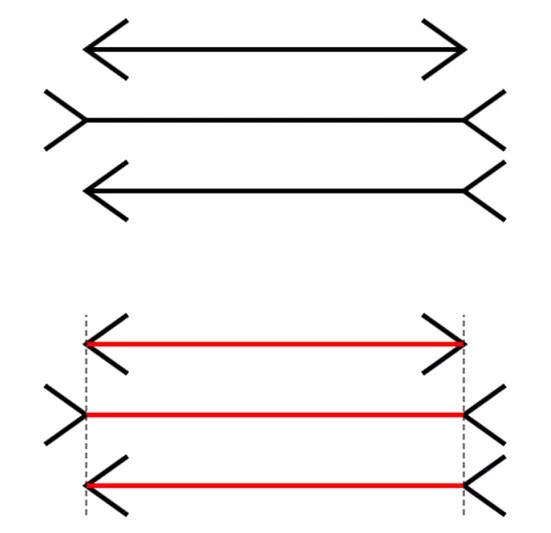
Even if you know that the lines are the same length, they still appear to be different. Based on this, theorists argue that beliefs do not affect mental modules. This differs from T.A., wherein a key stance is that beliefs underpin behaviors, thus are part of ego states. It’s possible that ego states are higher-level neural structures, while modules are lower level structures. The conscious “self” or personality could then emerge from lower-level neural functions.
The Adult
Origin: Each of us, Berne asserts, has a fully formed adult ego state within us—even when we’re still children. He observes that anyone, including children and the mentally ill, can act objectively under the right circumstances (though he doesn’t say what those are.)
Functions: The adult is your rational self. It activates when you need to act objectively. It generally corresponds to healthy, intellect-based adult functioning.
For example, the adult comes online when you need to do your taxes. Researching your deductions, calculating quarterly amounts to set aside, and budgeting monthly expenses are rational, objective operations. In Berne’s model, your adult does this work.
According to Berne, the key to a healthy personality is to bring the adult into steady control. As the source of reason, it can moderate the impulsive child and the often overbearing parent.
(Shortform note: Berne’s “adult” seems to parallel Freud’s Ego. Just as the Ego mediates between the Id and the Superego, the adult keeps the parent and child in line. Both also handle rational functions, like a cost-benefit analysis for an important business decision. Yet they differ in that Freud believed that “The Ego is not sharply separated from the Id; its lower portion merges into it...”—in other words, the Ego and the Id mix together. They interact like this: The Ego’s job is to fulfill the Id’s instinctual desires, like needs for food and sex, in a socially appropriate way. In contrast, Berne argues that the ego states are sharply segregated from one another—the child might grab control from the adult, but they remain distinct entities.)
The Parent
Origin: As we grow up, we’re shaped by our cultures. Your parents, peers, and society pass down to you myriad ways of thinking, feeling, and acting—table manners, social etiquette, and so on. You inherit views on what’s good and bad, what you should and shouldn’t do; you learn a worldview and how to act in accord with it.
This is where your parent ego state comes from: the influences of culture, tradition, and your own family elders. You internalize them, and they become a part of you.
Functions: When you act from your inner parent, you behave as your parents would’ve. This part of your personality, Berne holds, knows how to raise a family. It also handles the routine aspects of life—like how you eat, how you spend free time, and how you work. You inherit all of these, and they’re habitual (read: automatic) by the time you’ve grown up.
Imagine that you’ve just adopted a puppy, and she pees on your shoes. Whether you scold her, comfort her, or try to discipline her, your habitual response comes from your parent state—from how your own parents would’ve acted.
Similarly, how you start your day, handle chores, and manage meals comes largely from your parents. So we’d say, “you’re acting from your parent” in those areas of life.
(Shortform note: Since Berne’s time, researchers have identified the phenomenon of automaticity—unconscious enacting of various habits. Berne seems to have anticipated this with his idea that the parent automates life routines. It’s true that children model heavily on their parents and other influences. All those inherited habits then become automatic through long repetition. Think—did you consciously develop your mannerisms, your way of carrying yourself—or did they just happen? It may be that we’re less aware of our default emotional habits than we’d like to think. After all, automaticity makes behaviors unconscious—so aspects of our personalities that we take for granted, like a passive attitude toward conflict, may actually be habits formed in early childhood.)
The Child
Origin: Each of us, Berne states, retains traits that we developed in childhood. These traits develop out of significant early experiences, like a best friendship or being bullied in school. Through such experiences, we form deep emotional impressions about how the world works. For example, we learn how to relate to authority or where we stand on the social ladder, and those early adaptations shape who we become.
Berne doesn’t mention any specific traits—they seem to vary depending on your unique experiences. For example, if you spent early childhood adventuring in the woods with your best friend, you’d probably develop a strong sense of independence and the ability to find your own path.
Functions: Berne states that the child is the source of your intuition and creativity. It can be impulsive, expressing spontaneous positive or negative emotion. He doesn’t go into more detail than this, except to say that it’s the most valuable part of the personality.
For example, when your favorite song gets you singing or dancing, or when you’re laughing at a joke only you get, that’s your child expressing itself. In contrast, your child may also lash out in fear when threatened. The child’s key trait is spontaneity, regardless of the emotion expressed.
The Child and the Id
Here again, Berne loosely follows Freud’s footsteps. Like Freud’s Id, the child is a source of unconscious drives, giving rise to all sorts of emotionally impulsive behaviors. And a child out of control can cause unconstructive behavior, just like the urge-driven Id.
However, they differ in that Berne takes a much more positive view of this largely unconscious, emotional aspect of the psyche. He sees the child as deeply valuable, giving us our creativity and love of life, whereas the Id is more like a blind, instinctual animal. In the elephant and rider metaphor, the Id is the elephant: A feeling-driven animal that seeks pleasure and avoids pain. But Berne’s child doesn’t fit that model—it’s more about emotional expression, like spontaneous joy or anger, than animal needs.
(Related, our guide to Switch discusses strategies to leverage your emotional side—like envisioning tangible destinations and celebrating milestones—to reach success.)
Early Experiences Shape Our Later Lives
Recent research does support Berne’s claim that early experiences shape our adult personalities. Birth order, early emotional wounds, and poor adaptation to negative role models all carry over into our adult lives. Unless we address these, we can continue to operate from a damaged childhood mindset in our adult lives; much of Berne’s work was to find these dysfunctional adaptations and change them.
Part 2: Social Interactions Are Composed of Transactions and Sequences
Now that we've covered the basics, we can discuss “transactions,” Berne’s “basic unit” of social interaction. This section integrates the ideas covered so far: We gain social recognition through transactions, and we can analyze transactions by looking at the ego states that are involved.
We'll define transactions and cover the main types, then show how Berne looked at social interactions as sequences of transactions.
An Exchange Is One Segment of an Interaction
For Berne, a "transaction" is the basic unit of social interaction. Think of it as one back-and-forth between individuals: ”So, how about that weather? / Yup, sure is raining.” From here on, we'll use exchange to refer to a “transaction” because it’s more descriptive.
Berne observes that when two people are together in a social setting, one will inevitably engage the other, and the second will respond. For example, someone sitting next to you in the optometrist's waiting room says, "Hello, what are you here for?" and you respond, "Hi, just my yearly check-up. How about you?" This is one exchange.
(Shortform note: Berne receives criticism similar to that of Freud: that many of his ideas aren’t really scientific. But maybe Berne wasn’t trying to “prove” exchanges or transactions are real, so much as he was just describing a phenomenon. Think of “bars” as used in writing music: They aren’t necessarily real, but they are a useful tool. They enable us to segment musical expression, making it easier to analyze. Exchanges enable us to segment social interaction, making it easier to analyze.)
Ego States Determine an Exchange’s Type
From here, Berne lays out the types of exchanges. Each person involved in an exchange acts from their parent, child, or adult state. In Berne’s model, the exchange changes type depending on whether the initiator and the responder respect each other’s states.
- For example, chatting with a colleague is a balanced, adult-to-adult exchange.
- Or, say your boss gets frustrated with you (her parent to your child) for missing an important deadline, and you respond in fearful submission (your child to her parent)—still balanced.
- Now imagine that you’re sick of her, so you talk down to her. This breaks the balance—she spoke as a parent to a child, but then your condescension did the same to her—and disrupts communication.
There are a few different kinds of exchanges taking place here. We've grouped them into two categories, basic and complex.
Basic Exchanges
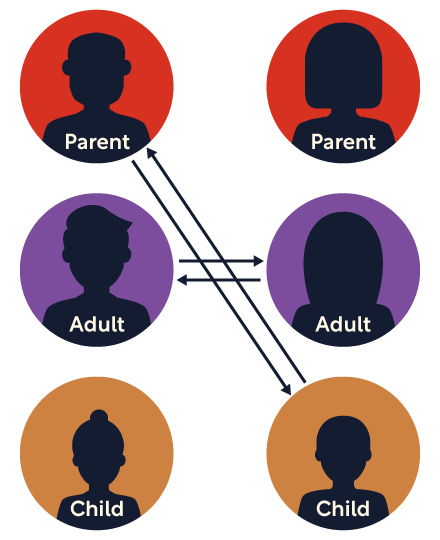
A basic reciprocal exchange is a normal, healthy back-and-forth. The exchange is friendly, follows good manners, and both people fulfill each other’s need for recognition. Berne also calls these “complementary” exchanges.
Reciprocal exchanges follow parallel lines of communication between states—a parent speaks to a child, and the child speaks back to the parent. Adult to adult, child to child, and so on. A typical T.A. diagram looks like this:
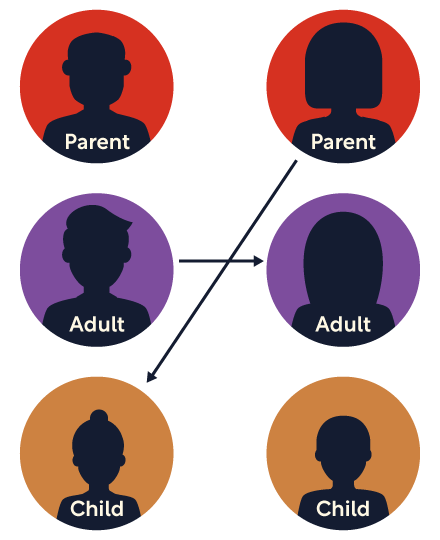
A basic disrupted exchange occurs when one person loses their cool and responds antagonistically. Anger, fear, annoyance, and so on, can all cause this. If you’re conversing adult-to-adult with a colleague, then accidentally offend them, Berne would say they’ve shifted mind states—probably to child or parent.
For example, say you ask your significant other to do the laundry this time, but they start complaining about how they always have to and really hate it (imagine some pouting, too). You spoke adult to adult, but they responded as a child to your parent, disrupting the parallel lines of communication. Here’s how Berne diagrammed disrupted exchanges:
(Shortform note: Some businesspeople have used Berne’s transactional model to aid workplace communication. And it works independently of psychoanalytic interpretations—just ego states and exchanges are enough to get a handle on where a communication breakdown comes from. Our guide to Crucial Conversations teaches how to navigate sensitive topics with strategies like creating a safe environment, regulating your emotions, and understanding each other by sharing your stories. This is how, as Berne would say, you can keep communication adult-to-adult: rational, respectful, and balanced.)
Complex Exchanges
Berne outlines multiple complex exchanges, but they aren’t all relevant to games. We’ve distilled out the one that’s key, which he labels “ulterior.” We’ll use deceptive as a more precise term.
Deceptive Exchanges occur when the initiator has a concealed motive, Berne says. On the surface the exchange looks normal, but on the psychological level it’s dishonest. The initiator tries to manipulate the respondent, consciously or unconsciously, into behaving a certain way.
For example, a copywriter writes marketing copy from their adult state but targets your emotional self—your parent or child. On the surface level, it looks like an adult making a pitch to an adult. On the psychological level, the copywriter aims to bypass the rational adult.
(Shortform note: Outside the realm of one-on-one communication, Berne’s notion of deceptive exchanges seems to map well onto modern propaganda. Much of what we see online is based on algorithmic calculation of our preferences—of what will pique our emotions. Algorithms present us with personalized advertisements and content that seems like an offering to our adult: It fits our tastes, our values, and so on. But in truth, there’s a concealed motive. It’s all meant to grab our attention and get us to scroll, or to buy something. Recognizing this, and training yourself to notice when an apparently harmless offering may be a deceptive exchange, can help you to reclaim your attention and live a more focused life.)
Sequences of Exchanges Flow One to the Next
Now that we know the types of exchanges, let’s look at how exchanges work in sequence.
According to Berne, a social interaction is a string of exchanges. Think of this like the links in a chain: A cues B, B cues C, C cues D, and so on. There are two rules that govern whether the chain continues or breaks off, Berne says.
Rule #1: When two people communicate back and forth in a respectful, healthy way, an interaction can theoretically continue without end. This is a string of reciprocal exchanges, where each person recognizes the other (remember that this refers to “stroking”), and their mind states remain parallel.
For example, two friends enjoying a normal conversation could continue indefinitely, so long as they respect each other’s states. In this case, it’s adult to adult. The same is true of any other pairing—child to parent, parent to adult, and so on—so long as neither gets upset and disrupts the parallel states.
(Shortform note: While Berne says that "in principle" an exchange could go on forever, it’s worth noting that this is never actually the case. Continuing his hunger metaphor, each of us needs a different amount of social contact to feel “full.” In Quiet, Susan Cain details how extroverts and introverts need very different levels of social stimulation: Extroverts derive energy from socialization, while introverts can only socialize so much before needing to recharge. Berne doesn’t discuss this, but the idea of a difference in “appetite” for socialization seems to fit well with his analogy of hunger. The lower your appetite, the less you’ll seek interactions that last for a long time.)
Rule #2: If one person (call them B) loses their cool, that disrupts the interaction and communication breaks down. For example, it’s an adult-to-adult conversation until A accidentally offends B. B gets fired up, moving into their parent state, and talks down to A.
Berne doesn’t describe any one solution to disrupted communication. Rather, there are two possibilities once communication breaks down:
- One or both participants can realize the breakdown and shift back to adult rationality, ideally finding the humor in their inappropriate behavior, or…
- One participant can go along with the other’s shift. For example, A might get emotionally swept up after B gets offended, and respond from the child state that B talked down to. According to Berne, this results in fighting, until the two can restabilize their emotions or simply part ways.
(Shortform note: If you’ve ever experienced an abrupt, negative shift in a conversation, then you’ve seen a disrupted exchange firsthand. Here, Berne’s concept is a useful heuristic for recognizing a communication breakdown, and it can be combined with strategies like those from Nonviolent Communication to resolve conflicts. For example, expressing your feelings and linking them to your basic needs can help people recognize your shared humanity, showing them how to better respond to you.)
Exercise: Notice Exchanges in Your Interactions
Practice seeing social interaction through Berne’s model of exchanges.
Think back to a recent argument you’ve had with someone close to you. Using the idea of exchanges, try to identify where the disrupted exchange happened, and how it derailed communication.
With that disrupted exchange in mind, recall Berne’s ego states. Reflect below on which you may have acted from, and which the other did.
Now consider how you may have been caught in an unbalanced exchange. If you’re part of a disrupted exchange in the future, how might you balance your ego state and resolve the conflict? (For example, maybe a friend angers your parent ego state, and you need to find a way to return to the rational adult.)
Part 3: Operations, Rituals, and Small Talk—Simple Forms of Interaction
So far, we’ve explained Berne’s model of social exchange, showing how he describes interactions in terms of exchanges, strokes, and ego states. In this chapter, we’ll apply these ideas to analyze Berne’s three forms of social interaction—procedures, rituals, and pastimes. Procedures, which we’ll call operations, are the simplest interaction type, while rituals and pastimes (which we’ll call small talk) are more complex.
To fully understand these interactions, we’ll start with Berne’s notion of “programming.” In short, a given interaction follows a “script.” Whether you’re comparing jobs, arguing with your kids, or attending a formal religious ceremony, that interaction unfolds according to a predetermined pattern, which Berne calls a script.
Then we'll explore operations, rituals, and small talk, each of which has a different source of programming. Each of these forms of social interaction (small talk, parties, coworking, and so on) is like a genre in music. Just as there is rock, hip-hop, and country, there are procedures, rituals, pastimes, and games: distinct varieties with distinct characteristics. The specific scripts you inherit determine the procedures, rituals, and pastimes you engage in.
We’ll define each form in terms of exchanges and ego states we’ve built up so far. Using T.A. to describe these simpler situations will help in understanding how it applies to games.
“Programming” Drives Social Interactions
As we’ve explained, T.A. views a social interaction as a series of exchanges. In many forms of interaction the exchanges are the same type, usually reciprocal—people tend to get along. So Berne distinguishes distinct “genres” of interactions based on differences in their “programming.”
He isn’t clear on where programming comes from, but we can infer that it’s a bit like genetics. Programming is to social interaction as gene encoding is to expression of human traits: It’s an underlying pattern that determines what comes to be and what doesn’t.
For example, the Western handshake is a long-standing greeting, passed down through thousands of years. We now receive it—Berne calls this “social” programming. We inherit the patterns of interaction embedded in our culture’s traditions.
Like your genes determine the traits that you express, an interaction’s programming determines its content. So the way a dinner conversation works in China differs from the same interaction in America, due to differences in each culture’s inherited scripts.
According to Berne, three sources can determine the content of an interaction:
- Programs created by humans to manipulate the material world—for example, agriculture, mining stone and building cities, turning raw materials into computers, and so on. (All of these require social coordination.)
- The programs handed down by culture: Things like mealtime etiquette, marriage conventions, and shared religious rituals
The programs of specific family lines, like how you celebrate birthdays, spend weekends, and express your emotions (or not)
Below, we’ll discuss each type in connection with the forms of interaction they shape.
Could Mythology Be the Origin of Programming?
Berne doesn’t go into detail about where programming comes from and, continuing the analogy of genetics, it’s similarly difficult to explain where genes originated. Beyond Games People Play, though, Berne did gesture at a possibility.
Following the examples of Freud and Carl Jung, Berne argued that the archetypal stories of human mythologies reflect the fundamental patterns of human life. He seemed to be saying that our mythologies may be the origin of programming, which is then passed down from family to family over thousands of years.
And fascinatingly, there is a case that the world’s mythologies have a common ancestor and may have spread like genes: Harvard University linguist Michael Witzel claims to have traced modern mythologies to origins over 100,000 years ago. The relatedness of worldwide myths could also explain the presence of human universals—baseline similarities between cultures, like child care, language, and music.
The chain of causality, from myths to programming, might look like: The “proto-myth” → similar myths worldwide → human universals → culture-specific manifestations of the universals. Berne’s “programming” is the last link: Most cultures have small talk and parties, but they all do them a bit differently, according to their culture-specific programs.
Operations: Rational Adult Interactions
Operations are the simplest of the three forms of interaction, Berne explains. They’re rational, goal-focused procedures, like flying a commercial airliner or running a therapy group. In T.A. terms, an operation is a string of reciprocal exchanges between adults, working together to achieve some tangible goal.
For example, a head chef and her sous chef on a busy night act from their adult ego states, carrying out precise and rational exchanges—“Plate for table 3 is prepped / Got it, hand me the garnish / Here you go!” Many operations are professional activities like running a kitchen—for example, team management, conducting research, strategically investing, and so on.
We program operations—we humans have figured out how to achieve anything from building a house to smashing together subatomic particles, and we’ve systematized the steps for doing each. We then pass on those “material” programs through professional training, higher education, and so on.
Berne’s characterization of rational behavior seems to sidestep the fact that we aren't particularly rational a lot of the time. Even in highly professional settings, emotion and biases play a role—for example, scientific research is subject to numerous biases that can affect the outcome of otherwise rational, systematic operations. Berne’s model doesn’t account for irrational behavior, and so can’t properly explain the fact that many operations are far from perfectly rational.
For example, one study found that between 44,000 and 98,000 Americans die each year due to preventable medical errors. If we were all perfectly rational, we’d smooth out these flaws in our procedures—and some organizations, like the Virginia Mason hospital system, do so, analyzing errors to improve their systems and move closer to the effective, rational ideal that Berne speaks of.
Rituals: Inherited Patterns of Interaction
Rituals are next in simplicity to operations. They’re highly standardized ways of interacting but differ from operations in that they’re typically more symbolic than functional. Think undergraduate commencement proceedings, but not running a research lab.
In the language of T.A., Berne defines a ritual as a string of reciprocal exchanges that follow a predictable pattern. He distinguishes between formal and informal rituals:
- Formal rituals are generally standard, rigid proceedings. Think of Eastern Orthodox Mass, or the opening of criminal court proceedings—“All rise for the honorable judge X…” These events show little variation from one instance to the next.
- Informal rituals are also standardized, but the specifics vary depending on who’s involved. For example, the usual American greeting is a handshake, while in Japan the standard is a slight bow. Think also of the various “secret handshakes” that close-knit groups come up with—these are informal membership rituals.
(Shortform note: These days, most of us experience fairly few formal rituals. Antone Martinho-Truswell, dean of Graduate House at St. Paul’s College, argues that modern life has become excessively casual, to the point that we’re losing the benefits of formal rituals. When informality dominates, he says, in-groups form more easily and social divisions grow. Formal rituals, on the other hand, level the playing field: Anyone can learn the conventions, dress the right way, show good manners, and so on. Such formal rituals bind us together in shared tradition, and create one big in-group that won’t blatantly shun aspiring members. Berne, on the other hand, makes no value judgment on formal versus informal rituals.)
Ritual programs pass down through tradition, from parent to child and on again. These “social” programs reside in your parental ego state, Berne says. For example, Christian parents who’ve always prayed before meals will pass that ritual on to their kids, who will do the same later on.
Ritual Greetings and Social Recognition
Berne compares recognition-seeking to bookkeeping, saying that we treat exchanges like business transactions. In this framing, a daily greeting with a work colleague is loaded with expectations:
- If the ritual goes as usual—“Hey Sarah! / Hi, morning!”—then each person feels they’ve received the recognition they’re owed. All is well; the accounts balance.
- If Sarah is having a bad morning and merely grunts in response, her colleague may feel slighted. He didn’t get the expected recognition, and he would feel he’s owed something more, Berne says.
- If Sarah is unusually emphatic and engages in more conversation than expected, this might throw off her colleague in the other direction. Sarah offered more recognition than usual, but her colleague wasn’t prepared to give so much interaction, and he now feels like his account balance with her is out of whack.
As Berne argues, we seek the social contact we feel we’re owed, and we give what’s expected of us. Unusual circumstances, like the above, break the patterns we’ve come to expect, throwing people off like an unexpected financial charge would. Consider how if you linger at a date’s house well past your welcome, they’ll likely get annoyed—they agreed to a date, not unlimited interaction.
(Shortform note: Berne seems to assume that everyone handles their strokes in the same way—with the business-like attitude above. But people are diverse, and research suggests that certain prosocial traits, like agreeableness, influence how different people give money. In characterizing everyone as a 60s businessman type, Berne vastly oversimplifies how selfish or selfless people are with their time and energy. For example, some people, often women, give their time and energy so freely that they deplete themselves. The bookkeeping comparison is useful, but it’s likely that we handle our recognition accounts in a variety of ways, just like we do with our finances—some give freely, some give fairly, and others give begrudgingly.)
Small talk: Various and Variable
Pastimes are casual social interactions of all shapes and sizes. There’s a wide variety of pastimes, and they further vary by culture. People mainly engage in pastimes at events like parties, weddings, or company social gatherings.
Berne defines a pastime as a series of reciprocal exchanges focused around a topic—cars, annoying neighbors, celebrity gossip, relationships, and so on. So you can also think of these as polite, topical conversations: small talk.
(Shortform note: The notion of pastimes, or small talk, is a useful way of pointing out a specific kind of social behavior. At the same time, it’s also fairly deterministic: Berne suggests that most of our behaviors fall into one of a handful of categories, and within each of those we just act from scripts. Compare this to human language: While it’s true that we use some set phrases, using language is a highly creative endeavor. We mix and match words, frequently creating expressions we’ve never before spoken. If our primary tool of communication is so complex and free-form, does it make sense that our social behaviors, which are mediated by language, would be simple and predetermined? After all, culture evolves over time—and the small talk we engage in today is very different from that of Berne’s time.)
There are plenty of contemporary examples of small talk—“Have You Seen This Meme” and “Midterms are Killing Me” are common among modern college students, and the ravers among them might play “What a Trip, Man” or “One-Up My Hangover.” On-the-grind millennials might play “What’s Your Side Hustle,” while young parents favor “Kids, Am I Right?”
A Product of His Time
A number of Berne’s pastimes (and later his games) have aged poorly. In his writing, men engage in “General Motors” and “Man Talk,” while women play “Wardrobe,” “Kitchen,” and “Lady Talk.” It’s not hard to imagine these stereotypes, but to suggest that everyone’s activities fit into such cleanly segregated categories is both reductionist and prejudiced.
Psychology has a long history of sexist bias. A particularly illustrative example is the idea of hysteria—think “she’s just crazy and emotional”—a hold-over from ancient Greece and Egypt that remained in the DSM through the 1950s. And given that Freud, a man not known for his sexual egalitarianism, influenced Berne, we have good reason to read his descriptions with a critical eye.
Informal rituals mark the start and end of many types of small talk. For example, you’ll greet your friends before jumping into some activity, and the goodbye niceties also follow ritual patterns.
Berne states that small talk gets “adaptively” programmed, though he doesn’t clarify what this means. We can infer that the programs for small talk also come from cultural influences, but can change more flexibly. Small talk changes based on who’s involved, going in various directions like a flowchart.
For example, say you’re joking about your kids with a couple friends, and a child-free acquaintance comes to join in. Now the conversation will either change to accommodate her, or she’ll find some creative way to relate (maybe her cat is her baby).
Berne states that we adapt our interactions like this to provide all those involved with an opportunity to be seen and heard. It isn’t quite egalitarian, though: You have to earn that recognition. For example, think of how the “funny guy” usually gets more attention than the quieter friends of a group.
Berne’s lack of clarity on “adaptive programming” may speak to the shortcomings of his reductionist approach. Not all phenomena have discrete, sharp boundaries, and this nebulosity can confound the “dissection” approach of most science.
While physical sciences, like geology, deal with concrete realities, the human psyche famously defies clear, complete description. In leaving “adaptive programming” unexplained, Berne may be indicating one edge of his theory’s explanatory power. Building a concrete, precise model of dynamic, changing social interaction might be impossible—similarly to how we can’t precisely describe the structure of a cloud—because there are too many variables to account for: Thousands of personality variations, numerous pastimes, innumerable contexts in which they could take place, and so on. So, in short, Berne leaves it at, “it’s complicated.”
What Small Talk Does for Us
At its most basic, small talk is an enjoyable way to use time and provide social contact for everyone involved. However, it also serves two more specific purposes, which we’ll cover below.
Small Talk Helps Us Find New Relationships
Berne explains that small talk helps you find potential partners for closer relationships. Your small talk reflects your games—many types of small talk are simpler, more socially acceptable versions of games. So the people whom you mesh with in more casual interaction are likely to be good partners for closer relationships.
This filtering is an unconscious process. While you’re at a social gathering, Berne says, your child intuitively sorts through the people you meet. You’ve probably experienced this—you go to a party, you meet someone new and interesting, and find you’d be happy to see them again. This is your child at work.
Berne also states that sometimes the adult handles this process. For example, if you’re a strategic person consciously looking for a romantic relationship or a useful business connection, you may more consciously look for a match, instead of leaving it to intuition.
(Shortform note: It’s a common idea that “we date our parents'', or in Berne’s terms, “we date those who play our games.” In contrast, evolutionary psychology holds that we pick partners based on who will best pass on strong genes. In this view, physical attractiveness, fitness, and intelligence play a larger role. Neither view seems to contradict the other, though, and considering both gives a more holistic view of the process. For example, you might filter potential partners through both sets of criteria: First, do they satisfy your standards for evolutionary fitness? This narrows it down a bit, but still leaves a large pool to select from. Considering who meshes with your games narrows it down even further, acting as a secondary filter that ensures you meet your psychological needs, and not just evolutionary drives.)
Small Talk Reinforces Our Beliefs
Think of how in-group conversations typically create a filter bubble: Everything discussed obeys the tribal group’s sanctions and taboos, and everybody (typically) validates each other. Small talk often works a good deal like this, according to Berne.
You engage in small talk from a “position.” This is a deeply held belief that usually concerns some broad, existential stance or major issue—“Big government is bad/good,” “People are basically moral/immoral,” “Children are great/awful.” That belief determines the small talk you engage in.
Then, the way you feel about that issue—the emotional aspect of your belief—determines how you show up when undertaking small talk. For example, say you believe that “coffee is superior to tea.” Depending on your emotional style, you’ll enact a particular character in casual conversations about that topic—maybe you’re an espresso maniac, or a coffee purist, or even an aggressive bean evangelist amongst your tea-drinking friends.
(Later we’ll refer to positions as stances, as in your point of view.)
Four Fundamental Positions
In a 1962 article in Transactional Analysis Bulletin, Berne introduced the concept of “okayness” to describe being basically at peace with your existence. To be OK is to respect yourself and others, and to act fairly.
The psychiatrist Thomas Harris further developed Berne’s theory of positions in his 1967 book I’m OK—You’re OK. Harris outlined four fundamental “life positions” that develop in childhood:
I’m OK, You’re OK
I’m OK, You’re not OK
I’m not OK, You’re not OK
I’m not OK, You’re OK
With this model, proponents of Transactional Analysis hoped to establish a set of fundamental beliefs from which all people’s scripts developed. Depending on your earliest experiences, you would end up with one of the four life positions—and in theory, all of your behavior would be rooted in that deepest belief.
Your friends can then receive your act in one of two ways, according to Berne. Both serve to reinforce your existing belief:
- They could receive you well and agree with the stance you express. Continuing the above example, say that your coffee drinking friends validate your love for cold brew. This confirms to you that your belief is the correct one, which reinforces it.
- Or, they could disagree with you and may get antagonistic. Maybe Brad thinks Matcha green tea beats coffee any day and scoffs at you. An argument may ensue, which will also entrench your beliefs.
(Shortform note: In another example of Berne’s apparent reductionism, he gives just two ways an interaction can go: up or down. Yet it’s possible to communicate more intelligently, to change people’s minds, and to successfully manage difficult conversations. For Edwin Rutsch, creator of the Empathy Circle conversational modality, active listening is the key to a more empathetic culture. In an empathy circle, you patiently listen, acknowledge, and reflect the speaker’s words back to them, and they do the same for you when it’s your turn. The idea is not to debate, but to engage in a structured dialogue that opens our ears to new perspectives. Interactions that reinforce your beliefs, whether through affirmation or confrontation, are not the only possibility.)
In the language of T.A., this is the “existential advantage” of pastimes, or small talk: It confirms beliefs that concern your worldview. Each confirmation helps you to feel like you have the “right” views on the world. Berne’s implication is that we unconsciously seek out experiences that confirm our existing beliefs.
Berne says that our stances develop while we’re young and tend to become fixed. And because beliefs are self-reinforcing feedback loops, as described above, you can easily fall into the trap of defending beliefs that have long since become unconstructive.
(This is the trouble with games. While pastimes are typically mild, like the coffee example above, game dynamics are more intense. More on this soon.)
(Shortform note: In more modern language, Berne seems to have noticed some form of confirmation bias: When we engage in small talk, we’re primed to agree with things that reinforce our beliefs (and we discount things that contradict them.) For example, you might catch yourself instinctively disagreeing with a political stance from the other side of the spectrum, even if you haven’t investigated the issue. We’re also prone to self-fulfilling prophecies: If you believe something to be true, you’re likely to act accordingly, and that brings that belief closer to reality. For example, this is the psychological underpinning of “fake it till you make it”: if you regularly practice acting confident, you’ll eventually develop that capacity.)
Small Talk Facilitates Tribal Dynamics
Different types of small talk tend not to mix with each other, Berne explains. Dividing lines often form along demographic boundaries—for example, Ivy League types might chat about who launched what startup, while state college graduates might talk about how tough the job market is.
If you don’t “get with the program” of a group you’ve walked into, they might reject you. For example, if a lifestyle gamer tries to socialize with a group of gym-lifers discussing their routines, they’ll probably reject her. But if you adapt to the pastime, the group may welcome you. Say that the gamer really wants to start lifting, and the gym friends would love to show her the ropes.
Some groups, Berne says, also have accommodating leaders who will state the program and make it easier to join in. For example, you walk up to a group and a woman says “Hey, we were just talking about bad housemate experiences. Got any interesting stories?”
(Shortform note: Berne’s notion of exclusionary small talk may have been a product of his time. These days many people have a wide variety of interests and hobbies, and demographic lines aren’t always a useful way to distinguish between people’s lifestyles and social habits. For example, maybe those lifters mentioned above are also gamers—the old stigma of gaming-as-geeky is fading, and gaming seems to transcend demographic lines, being widespread among men and women, across various ethnicities and age groups. So they may have welcomed the new person, especially if she also showed some interest in lifting.)
Two Ways to Classify Small Talk
Berne details several ways to classify pastimes, with varying levels of clarity. Below, we’ve described the two clearest schemes, and updated the examples.
Based on Demographics: As mentioned above, small talk often differs from one demographic to the next. People of different ages, genders, and income brackets tend to engage in different chat. For example, college-age guys and gals might chat about recent concert or music festival experiences, whereas lots of older folks love discussing the national news or their golf swings.
Based on Ego States: Some small talk takes three distinct forms depending on the ego states involved: adult-adult, child-child, and parent-parent. The chat “Kitchen,” can occur as two adults discussing the pros and cons of different stoves; as two children playing house; or as two parents trading recipes and admiring the marble countertops.
(Shortform note: A 2012 paper from UC Berkeley’s psychology department holds that social class very much determines the set of behaviors someone expresses. We all have a class mindset embedded in us, which is reinforced by the environments we live in. This seems to support Berne’s theory: If everyone around you drinks $7 Starbucks mixes and drives luxury cars, you’ll play a different set of pastimes than those who grab $1 McDonald’s coffee in their beat-up 2000 Civics. On other hand, another study from the same report demonstrated that class isn’t rigid: After sending interdependence-emphasizing welcome messages (a common value for poorer demographics) to first generation college students, they found that those students performed just as well as students from college-educated families.)
Exercise: How Do You Use Small Talk?
Get to know the social patterns you inhabit, according to Transactional Analysis.
Think back to a recent social event you attended, and consider the small talk you may have engaged in. Since Berne's examples are a bit dated, try to think of the modern versions and name them below.
Now consider how you showed up to those chats—what character or “role” did you enact in each? What stances or beliefs of yours might underlie the act you put on? (For example, you might act like a clown to make your friends laugh, believing that “I need to be funny for people to like me.”)
With a stance identified, can you notice how you unconsciously look for reinforcement of that belief? How do you feel when people validate your act, or when they rebuff you?
Part 4.1: Diving Deep Into Games
Operations, rituals, and small talk are all simpler forms of social interaction. By analyzing them, we’ve seen how an interaction is a sequence of exchanges, and how our beliefs shape the behaviors we enact. Now that we’ve covered these simpler interactions, we can move on to games. Games are more complex but, because we’ve explained small talk, we only need to add a bit more detail: specifically, about the deceptive nature of games.
Part 4.1 explains what games are and why they matter to each of us. We’ll then explore a reworked catalog of games to update Berne’s “thesaurus” with contemporary examples.
In Part 4.2, we’ll discuss the basic pattern that games follow and the purposes they serve in our lives. Finally, Part 4.3 will explain how to use Berne’s recommended strategies for identifying and overcoming your own unhealthy games.
Defining Games
Games as Natural Phenomena
A game is a set, stereotypical pattern of interaction, Berne says. Think of it as an “act” that someone puts on—for example, a husband who regularly explodes, apologizes, then acts like it never happened. This pattern can occur across thousands of households, and so can any other game—the same “acts” occur in many specific instances throughout a population.
In this way, games are almost natural phenomena. They’re like migration patterns, or bird mating dances. Berne is simply saying, “Look! Here are all these consistent, identifiable patterns in the fabric of human social exchange,” in the same way an ecologist points out patterns in a forest ecosystem.
(Shortform note: Insofar as the approach of science is to find and confirm patterns in the fabric of reality, Berne’s approach here is quite scientific. A 2006 paper in the Transactional Analysis Journal argues that Berne was a phenomenologist: He observed patterns across thousands of patients and described what he saw. This contrasts with Freud’s work, which relied heavily on individual case studies. But you need a large, representative sample to accurately generalize any psychological phenomenon across a population, in order to buffer the effect of outliers that might skew results in a smaller sample size. Freud, however, extrapolated much of his theory from a small set of his patients—which is why much of it isn’t considered empirical.)
Games in Plain Language
So a game is a natural phenomenon, a pattern. Now let’s look at the characteristics of this kind of pattern.
A game is a habitual way of behaving. Games are social—we play them in our close relationships. Each game follows a consistent sequence of “moves,” aimed toward an (unconsciously) desired outcome. That aim is typically to reinforce an existing stance of yours.
In this example, try to spot the four aspects mentioned above. This game, called “Mr. Vesuvius,” continues the previous example. It goes like this:
- Mr. Vesuvius is a regular working man in regular suburban America. He’s a hard worker and provides for his family, but struggles with emotionality.
- Failing to manage his daily stressors, pressure gradually builds in Mr. Vesuvius. Then his kid or wife steps slightly awry, and suddenly Mr. Vesuvius erupts. A shattered cup becomes an excuse to pour weeks of pent-up frustration out onto the unfortunate family member. They don’t understand how hard he works, they give him no respect, and never show him any care.
- Eventually his anger wanes, and he walks off. He comes back to apologize, but pivots sharply to explain how justified the eruption was. Soon after, he’s laughing and smiling once more.
You might know this game; it’s fairly common. We’ll look more closely at each move of a game, and their functions, throughout this part of the guide. First, two more important aspects of games:
- We play games unconsciously. These are not intentional social games, like learned strategies for flirting or debating. Mr. Vesuvius isn’t consciously choosing to behave as such—he’s stuck in a game. (And because we aren’t aware of the games we play, Berne later recommends that we develop self-awareness so we can escape them.)
- Games are typically unhealthy. A game is driven by some unhealthy, underlying belief, usually resulting from childhood trauma (here Freud’s influence on Berne is apparent). Take for example Mr. Vesuvius’s belief that “People won’t respect me if I’m kind, so I should strike first.” In Berne’s view, that belief causes him to create situations that reinforce the belief.
Games and Mindfulness
In the 1960s, mindfulness hadn’t yet surged in popularity as it has today. If it had, might Berne have made use of the effects it can have on psychological growth?
As Berne notes, one of the primary characteristics of games is that we play them unconsciously. One of the primary functions of mindfulness meditation is to train your awareness, which heightens how conscious you are to normally unconscious aspects of your experience.
Mindfulness correlates positively with successful behavioral change, and it seems to be effective for treating everything from substance abuse to binge eating. Closer to Berne’s main interest, Mindfulness-Based Relationship Enhancement (MBRE) has been found to improve empathy, shared well-being, and communication in intimate relationships—it’s hard to imagine he wouldn’t have taken an interest in such an effective tool.
Games in Terms of Transactional Analysis
With games explained in plain language, let’s look at a few more of Berne’s technical distinctions.
In a game, each player acts according to an underlying motive. These come from their beliefs, and players aren’t conscious of them. Berne isn’t clear about this, but we can infer that a player’s motive is typically to reinforce their stance. So if Player A believes “I am essentially unlovable,” she’ll play a game that tries to prove this. It follows that...
Games are dishonest. Unaware of the habits they’re stuck in, the player of a game tries to manipulate, provoke, or otherwise cause the other to prove her right. Again, this manipulation isn’t conscious. Berne says this is a key characteristic of games.
Say for example that Player A struggles to accept love. She shies away from affection, and starts to lash out when her romantic partner gets too close. Eventually the other feels spurned, insults her in a fit of anger—and so, her belief is confirmed.
(Shortform note: Berne’s view of games seems fairly deterministic: He seems to believe that, in most cases, people are ignorant of the psychological forces driving their behaviors, and incapable of acting otherwise. While 1960s culture may have been less self-aware, we’ve become increasingly focused on personal development, with more and more people engaging in awareness practices like mindfulness. The problems Berne indicates remain: We’re still susceptible to behaving without thinking, and cognitive biases often have us uncritically seeking confirmation of our beliefs. But in theory, dishonest relational styles may grow less prevalent as our culture continues to invest in personal growth: Widely held goals like achieving happiness, fulfillment, and well-being aren’t compatible with dishonest, deceptive behavior.)
Games aren’t blatantly dishonest, though. On the surface, games look like superficially believable interactions, and the underlying motive isn’t obvious. Often, neither player consciously knows the game they’re playing. These are deceptive exchanges at play: You say one thing, but mean another.
Berne would say that the woman above appears to be upset with her partner, but it’s actually about a deeper psychological issue—her self-destructive belief.
People play games that complement one another’s—Player A’s game fits like a puzzle piece into Player B’s game. Berne gives the example of “Wooden Leg” (we’ll call this “Poor Little Me”), where Player A leverages any minor hurt to shirk their responsibilities. This enables Player B to play “You Lazy Bum,” harrying Player A into their work. Player A now feels even more pitiable, which in turn leads Player B to pity them even less.
Games are dramatic—there’s usually some confrontation or emotional flare-up, like a fight over where to go for dinner. This happens in “Cornered,” where a simple plan for dinner or dancing gets derailed when one player triggers some sore spot in the other, and an argument ensues.
An argument is often the game's “payoff,” the end result the players seek. Berne states that the players appear to be upset but are secretly pleased, because the fighting confirms their stances.
(Shortform note: Berne’s idea of a “payoff” at the end of a game seems to anticipate the idea of rewards from the habit loop. In short, you perform a habit because there’s a reward at the end, usually some form of pleasure that, on a neural level, offers dopamine. In Berne’s model, the game’s “payoff” is the reward—one that usually validates your beliefs—while Charles Duhigg’s notion of rewards is more general. James Clear introduced the idea of “cravings,” to explain how we’re drawn into repeating habits. Berne may have intuited this notion as well, as he later characterizes games as indulgences—very close to cravings.)
Why Games Matter
Games play a more significant role in our lives than we realize. Since we’re typically unconscious of them, they can impact us in ways we don’t understand. For example, you might feel confounded by an inability to build a lasting relationship. This could be due to a game you’re playing!
Berne gives several reasons to explain the “so what?” of games, which we’ve distilled below along this theme: Games quietly influence how our lives unfold, often beneath our awareness. Unless we notice them and learn to change them, we’ll get stuck in patterns we never chose for ourselves.
#1: Your games are your inherited relational style. They come from at least as far back as your grandparents, Berne says, and possibly up to 100 years. They’re how you deal with discomfort and how you relate to the people closest to you (even if it’s by arguing over dinner spots). You express your characteristic emotions through your games—for example, Mr. Vesuvius’ outburst-game is a major part of who he is.
So if you’re unaware of your games, you probably don’t have a great handle on how you habitually relate to others. Or of the emotional palette and patterns that compose your life. Becoming aware of them is the first step toward more consciously shaping that social-relational style.
(Shortform note: One study found that nurture, more than nature, appears to predict adult attachment styles. This seems to support Berne’s case: That how we’re raised, more than genetics (he doesn’t mention this) determines how we relate to others. On the other hand, consider that your family’s inherited games are like your “emotional genetics”: traits and habits that persist through many generations. If we’re raised through persistent, inherited habits, is “nurture” much different from the inherited “nature” of our genes? This likely depends on whether your parents strictly followed what they were given, or broke off and developed their own perspectives. But could that inclination to individuate also be an inherited, nature-set tendency?)
#2: You may unknowingly pass your games on. Much of raising children, Berne says, happens as we unconsciously teach children our games. Children imitate their parents, so if they see you berating the dog when you spill soup, they’ll absorb that—“when something upsetting happens, dump your frustration onto vulnerable others.”
Becoming aware of your games is therefore a significant opportunity to break your family’s negative cycles. Maybe you’ve inherited a dysfunctional relationship with anger, or crippling shyness, or mildly narcissistic tendencies—we all get something that’s not great. But if we can notice these (and learn to change them), we put ourselves in a position to raise healthier children.
(Shortform note: This is much like the idea of generational curses: Repeated stories and behaviors pass from parents to children, such that the kids live lives similar to their parents’. Breaking these can help us to be more than just a “chip off the old block,” freeing us to develop in our own directions. The difficulty is that our education skips over “How to Grow 101,” leaving most to learn how to overcome unhealthy habits, and form new ones, on their own. The habit loop—James Clear explains a habit as a cycle of cue → craving → response → reward—is one piece of the puzzle. When wielded with sufficient self-awareness, it can enable you to untangle inherited habits and, as Clear explains, to reshape your identity to support new behaviors.)
#3: Your games determine who enters your life. Your close social circle and your intimate relationships are both made up of people who mesh with your games, Berne says. But maybe yours aren’t too healthy, so you keep ending up in failed relationships, or you find that old friendships feel frozen in time. Maybe your games are holding you back, and you aren’t even aware of them.
We inherit our games but they don’t fully reflect our unique personalities, Berne says. So we can infer that if you form relationships according to games you didn’t consciously choose, those relationships won’t really match you either. So again, learning your games and reshaping those habits puts you in a better position to live consciously, as opposed to being governed by unconscious, inherited forces.
(Shortform note: A 2016 study found that “opposites attract” actually isn’t true. In contrast, Berne’s view seems accurate—the study’s authors say that we choose partners who are very similar to us. When we meet a potential partner, we look for shared values and common ground. We also look for shared behavioral tendencies, like Berne suggests. The more connections we can find, the more we’ll trust that person, and feel that we can cooperate with them toward shared goals. Picking your partner based on these similarities is so common, they say, that it’s practically a “psychological default.”)
Classifying Games According to the Areas of Life
Berne gives multiple ways to classify games, with the clearest simply dividing them into several areas of life. Below, we’ve reworked Berne’s scheme and updated his examples.
Pseudo-Small Talk develops out of small talk, when the friends of a group have drawn closer. These games often start as small talk, then develop some counterproductive or unhealthy quality. From Berne’s writing, it isn’t clear how this change occurs.
In the pastime “Water Cooler,” for example, two normal adults vent frustrations about their bosses. In the game version, they might start muttering insults in earshot of her, hoping to get a rise out of her. That would confirm their belief that she’s overbearing, though it might get them fired (remember that many games are self-destructive).
(Shortform note: It’s interesting to note that, as Berne describes it, previously unharmful small talk can become unhealthy games when people grow closer. Why is this? It may be that before we know someone well, we “put on a good face,” so as not to conceal our less wonderful qualities. However, once we start to trust someone, we open up more—which can lead to more authentic relating on the one hand, and exposure of our nastinesses as well. Berne might say that once you’ve engaged in small talk with someone long enough, you can tell what games they’ll play. So if you have games in common, you may only play them once you’re sure you won’t lose face by acting in a potentially unsavory way.)
Couples Games are the unhealthy habits that often develop between two people in a close, committed relationship. They can go on for years, and they may have a seriously negative effect on the players’ lives. Some are what today we’d call abuse.
Say for example a man holds the unconscious belief that “women deserve no respect.” He treats his partner poorly, gradually damaging her mental health. After a while depression sets in, and she starts gaining weight. Her partner then gets mad—“I can’t believe you’ve let yourself go like this.” His belief led him to create a situation that “proved” his belief, and he’s unconscious of it all along, Berne would say.
(Berne does say that “game” used as such isn’t meant to trivialize these situations. Instead, it refers to the regulated nature of such an interaction—there’s a discernible pattern it follows.)
(Shortform note: Whether abusers are aware of their behavior or not is up for debate. Stephanie A. Sarkis Ph.D., the author of Gaslighting: Recognize Manipulative and Emotionally Abusive People—and Break Free, suggests that some abusers are fully conscious of what they do and even study strategies to get better at it. On the other hand, plenty of emotional abuse seems to get meted out by people unconscious of what they’re doing. This can lead to difficult situations where, for example, an emotionally unavailable partner is hardly aware of what they’re doing. Automaticity, the phenomenon wherein habits become unconscious and second nature, may help to explain this. If Berne is right that our games develop in childhood, then they’d surely be automatic by adulthood.)
Sex Games flirt around sexual interaction, but instead offload the “satisfaction” of healthy sexuality to the game’s reward, according to Berne. In other words, people who play these derive pleasure from exchanges that stop short of actual sexual interaction.
Berne gives the example of “Kiss Off,” where Player A might believe, “Other people ought to want me, but can’t have me.” At a club or party, she teases and flirts mildly with other people. Someone pursues her, playing into her game, but she refuses advances beyond that initial flirtation.
(Shortform note: This is a fairly mild example of where Berne’s sexism seems to have influenced how he described some games. This category also demonstrates one of the weaknesses of Berne’s approach: Most of the games make reference to Freud’s psychosexual stages, which no longer enjoy much support. For example, it’s not much use to describe a woman’s flirtatious tendencies as deriving from unconscious “phallic” frustrations. Berne is inconsistent in his language choices—on the one hand, he argues that plain language, like in his game names, helps understanding. On the other hand, he still uses opaque Freudian jargon to diagnose many games. This may reflect Berne’s competing desires to make T.A. accessible through Games People Play, while also fighting for credibility in the academic community.)
Career Games are long-term games, and may consume the player’s life. With serious career games, the player’s lifestyle, character, health, and financial situation can all fall apart around the game.
“Addict,” for example, can last for years, and it often derails the player’s life. Say Player A holds some belief like “I am worthless.” Various difficult circumstances (remember that each instance of a game has a unique history) lead Player A to substance abuse. This kicks off a destructive cycle that damages her health and position in society.
People may try to help her—likely playing ”Good Samaritan”—but according to Berne’s model, Player A will find some way to perpetuate her game. She may feel more worthless because people want to help. It confirms her belief, reinforcing her game.
This game-loop may take years off the player’s life, and it can remain unresolved without effective intervention.
(Shortform note: Though he doesn’t place it in this category, Berne characterizes homosexuality as a pathological lifestyle: He calls gay men “professional homosexuals,” as if to suggest that it’s a career game. And like career games, he argues that the game “Homosexuality” wastes time and handicaps the individual’s ability to live a good life. Psychiatry historically treated homosexuality as an illness to be cured. This is actually a step back from Freud, who wrote that same-sex desire is neither an illness nor something to be ashamed of. “Ego-syntonic Homosexuality” has since been removed from the Diagnostic and Statistical Manual of Mental Disorders, though Berne’s blatant homophobia lives on in Games People Play.)
Career games exemplify another point Berne makes: that people play their games at various intensities. He compares these to the severity of a crime: first-, second-, and third-degree.
- First-degree games are generally mild or benign. Many of us play “Morning Joe,” a very mild form of “Addict,” which at the most involves some grumpy mumbling.
- Second-degree games are preferably kept under wraps. “Day Drinker”, for example, may involve a flask, a concerned partner, and worsening health.
- Third-degree games lead to serious legal or fatal consequences. “Florida Man,”—a meme that mocks off-the-rails crimes perpetrated by men in Florida—can, for example, involve methamphetamine-fueled car chases that end in murder and the perpetrator’s arrest.
Criminal Games are illegal activities as viewed through Berne’s framework. These games occur in the criminal underground and in prisons.
Berne’s example is “Want Out,” played by inmates who appear to want reduced sentences. Say Player A is an inmate who believes, “The world is uncertain, and uncertainty is frightening.” He behaves as if he wants to get out early, but when the opportunity arises he falls apart. His underlying fear, Berne says, causes him to sabotage his own chances because prison is certain, thus safe.
(Shortform note: Mental health treatment wasn’t widely available to inmates until at least the mid 20th century, despite the fact that mental illness is far more prevalent in prisons. Berne’s T.A. was one of the first therapies used, part of the Asklepieion program in Marion, Illinois. In this controversial program, therapists and trained inmates aggressively used the “games” framing to force inmates to think and behave differently, demanding that they admit their games and let go of them. Asklepieion found limited success and spread to at least ten additional prisons before several violent incidents in therapy groups led to the program’s end.)
Therapy Games are played by mental health professionals and their patients. Berne says that these can prevent real therapy from taking place, because they give the illusion of progress.
For example, “Greenhouse” involves trained group therapy members who focus excessively on feelings. Player A may believe, “My feelings are precious, delicate things, not to be mishandled.” He presents each one like a rare blossom, and the group acts appropriately awed. Berne says they thus create a hothouse in which emotions are revered, but little real progress is made. The “Greenhouse” player, he states, simply builds a self-absorbed focus on their own emotions, reinforced by the group’s participation.
(Shortform note: Ineffective therapy is a real issue, and can even leave patients worse off than when they started. Part of the issue is similar to what Berne describes: Well-educated, trained clinicians overestimate their own effectiveness, and they tend to resist changes that could improve patient outcomes. This is a case of ego getting in the way of effective therapy, and highlights the fact that holding a therapy license doesn’t mean you’ve resolved your own psychological dissonance (one study, for example, found that around two-thirds of clinicians experienced mental health issues).)
Positive Games are generally productive, not destructive. Because games are deceptive by definition, Berne says that it’s difficult to identify wholly positive games. Instead, these games have a beneficial effect that offsets their negatives.
“Mission Trip,” for example, involves financially privileged, college-age Americans going to less developed countries. They build schools, take pictures with the locals, and feel that they’re doing some good in the world.
Using Berne’s model, folks who play “Mission Trip” (and related games like “Peace Corps” and “Teaching English Abroad”) unconsciously do so to confirm some belief like, “I am a good person.” In that way the trip is for their own benefit, but because these trips do have net positive outcomes, they’re “good” games.
We’ve based these tongue-in-cheek game names on Berne’s style. He states that colloquial names communicate the character of the game more effectively than technical names. For example, compare “I Can’t Believe Them” with something like “verbalizing projected oral sadism.”
Part 4.2: How Games Work
Now that we’ve defined games and looked at Berne’s categories, let’s clarify how they work. To clear up Berne’s clinical jargon, we’ve distilled out the basic pattern that games follow. Below we’ll explore their main characteristics.
You Play a Game From a “Position”
As we covered in our section on pastimes, a “position” is an unconscious, deeply held belief. If you hold the belief that “life is basically pointless,” you’ll behave in ways that reflect that belief, according to Berne. (Again, we’ll call these stances.)
You play any game in accord with such an underlying belief. It gives rise to a hidden motive, and that causes you to seek situations that reinforce the belief.
For example, the above belief might yield a game where Player A is always apathetic or depressed. A family member or friend tries to cheer him up, but Player A cynically refuses—“Don’t bother trying; are you even happy yourself?” His stagnant energy makes those around him less cheerful, “proving” to himself that “life is pointless, no one is happy anyway.”
(Shortform note: Dysfunctional relationship habits don’t necessarily come from just beliefs. For example, Mr. Vesuvius’ angry outbursts may come from brain trauma earlier in life. Berne also doesn’t account for the fact that genetic influences often underlie addictive patterns. All the same, the best way forward is often to focus on what we can control. When something is out of our control, like a genetic susceptibility to mental illness, our options are internal: Embrace your life’s difficulties, develop resilience, and be resourceful—which may mean reshaping your psychology despite physiological problems like, for example, repeated concussions from long years of football.)
The Basic Pattern of a Game
Though Berne doesn’t make it clear, we can infer that the basic pattern of a game goes as follows:
- Player A holds some unconscious belief, and it gives them a hidden motive. Neither they nor the other players are aware of this motive. In general, the motive is to create an outcome that reinforces their belief.
- Working from this belief, Player A tries to cause Player B to behave how they want. What A wants is for B to play into their game and prove their belief.
- Player B typically responds by falling for the game. There may be some back-and-forth (remember deceptive exchanges), and B ends up proving A’s belief.
- Player A now feels some kind of self-righteous validation. Their belief has been reinforced; A got the outcome they wanted.
On the other side, Player B plays their own game (remember that people play games that complement one another). A’s game also works to prove B’s, such that game players often help each other to keep playing.
Say Player A is complaining about an annoying coworker to gain validation, and Player B flares up—“God, can’t you stop being so negative for one day?” Here, Player A’s game of “I Can’t Believe Them” complements Player B’s game of “Toxic Positivity”; they mutually enable each other.
“It’s Just Too Hard”
Let’s illustrate the basic pattern with a simple game. “It’s Just Too Hard” occurs when Player A doesn’t want to do anything effortful, so he manipulates Player B into relieving him of responsibility.
Player A’s motivating force: an unconscious belief like, “I’m entitled to avoid responsibility.” The game goes like this:
- Player B (typically A’s partner) asks Player A to perform some responsibility, like doing the laundry. Reluctantly he does so but does a shoddy job.
- Player B returns and notices that A did a poor job—her whites have been ruined because A didn’t separate out the darks.
- Angry, B confronts A about this. A argues that he doesn’t really know how to do laundry, so she shouldn’t have asked him. She should just do it herself.
- With no good alternative, B relieves A of the responsibility. She’ll do it herself, because he can’t be relied on.
- Player A has succeeded in avoiding responsibility, reinforcing his stance. Unconsciously, he now feels even more entitled.
(Shortform note: This is a real pattern that many women report experiencing (not just with laundry), called “weaponized incompetence.” In short, some men seem to underperform when asked to handle chores, like babysitting the kids, so that the woman has to take back the responsibility in order to ensure that the work is done properly. Berne’s model effectively describes the pattern (as above,) which speaks well of this part of his theory. However, note that it’s not clear whether weaponized incompetence is conscious or unconscious. It’s a gray area and likely varies from situation to situation. Berne held that games are unconscious, but it’s worth noting that he didn’t provide any empirical studies to support that assertion.)
Games and Ego States
Berne doesn’t directly state how ego states factor into games, so we’ve worked out a few connections to clear things up.
- You play a game from a stance, so that belief is at play in the game.
- Berne says that stances form in childhood, which is when both the child and the parent form. So it’s likely that we play games from those two states.
- Therefore games aren’t typically played from the adult ego state. Berne acknowledges that there are conscious, intentional games—like racketeering—but this book isn’t about those.
Earlier on Berne suggests that you “grow up” by getting your adult state into primary control, and throughout the “thesaurus of games” he describes games as coming from the child or parent. The above logic is possibly how he meant it, then.
Looking at these states is a way of breaking a game down, and making sense by looking at its parts:
- If you notice that an interaction is composed of deceptive exchanges, you’ve found a game. Then you can look at how the participant’s states interact on the surface level and the psychological level: What appears to be going on, and what’s going on “under the hood”?
- And if you can say, “oh, she’s operating from her child,” then you’ve begun to locate the psychological issue that underpins the game. We’ll see later how this helps in dismantling your own games.
Our Games Reflect Our Unconscious Life Paths
We’ve discussed how games arise from our stances—deeply rooted beliefs about the world and our place in it. These give rise to our games, and our games, Berne says, determine how we’ll make use of the opportunities life gives us.
He doesn’t explain that assertion, so we’ve worked out the logic below:
- Your games are often ways of handling unresolved emotional issues. For example, A learns to play the fool because it amuses others and assuages his anxiety.
- You default to living through your games in any close relationship, Berne holds. They’re your habitual ways of handling your partner’s emotions, too. For example, say B learned to interrupt women and explain how “wrong” they are, regardless of the topic.
- Any game pattern of yours, like B’s above, will play a role in any relationship you have. In fact Berne says earlier that games form nearly all of your close social time.
- Relationships are key to success in everything from romance to business, so your games will determine how those critical parts of your life unfold.
So, Berne says, your particular life path unfolds according, in part, to your games. Left unchanged, your life unfolds according to your games. Berne says they “fill in” time while we wait for life to end. In this view, life is a march toward some final payoff—the finale of your life’s script. He argues that depending on the character of your games—whether they’re productive or counterproductive—you’ll live optimistically or pessimistically.
(Shortform note: Earlier, we discussed scripts on a smaller scale: We all inherit programming that determines the basic scripts our games follow. The larger, compound script—the sum of all your smaller scripts—is your life path. He doesn’t go into detail in Games People Play, but later transactional analysts developed scripts much further. The basic idea is that we form core beliefs about the world in early childhood, and those beliefs determine how we navigate our lives. Think of that person who never accepts help—“Nah, I can handle it myself”—and how extensively such a basic relational habit characterizes that person’s life: It pervades all their relationships, and that unwillingness to be vulnerable may prevent intimacy from developing.)
Games Serve Several Important Purposes
Because real intimacy is either unavailable or too terrifying to us, Berne says, we spend most of the time in our serious relationships playing games.
He argues that despite the negative aspects of games, they provide important benefits. They’re also a normal phase of psychological development—we all learn to play games, and growing past them is like a sapling becoming an oak.
Below, we’ve broken down the main advantages that games provide.
Games Keep Us in Balance
As we discussed earlier, we all need social recognition to remain healthy. Playing games gets us that, because games are social. Remember that any amount of social contact is better than none at all—it’s a biological concern. And so games maintain our baseline health even though they don’t support higher well-being.
Similarly, each time a game confirms one of your stances, it stabilizes your belief system. This confirmation helps you feel secure in who you are and how you relate to the world, Berne says.
(Shortform note: The implied argument here is that someone in solitary confinement would do worse than someone in an abusive relationship. There are caveats that Berne doesn’t mention: Solitary confinement may predictably drive you crazy, but abuse can escalate rapidly. Verbal abuse may suddenly become physical; a slap can become a gunshot. So when it comes to abusive situations, games may keep you alive in theory, but real life is more complex than that. Further, a healthy degree of solitude can help you clear your mind, enrich your inner life, and work through tough problems without distraction.)
For psychologically unstable individuals, Berne states, the belief-stabilizing function of games is often essential to maintaining their sanity. If such an individual’s game is broken up, they may experience a serious existential crisis.
Say Player A believes that “All others must show me respect.” One day, his kid steps out of bounds and A blows up on them. But the kid unexpectedly holds her ground, which challenges Player A’s whole self-image. Lacking the capacity to process this, A may “short-circuit” psychologically.
Because of this risk, Berne says, always consider how stable you or another is before you try to break any games.
Narcissism May Exemplify Unstable Game-Playing
Many of those who display narcissism demonstrate Berne's warning about unstable individuals. Narcissists are prone to fits of rage, which often trigger when those close to them threaten the narcissist’s inflexible, fragile sense of self.
Some research has found that “vulnerable” narcissists lack much resilience, which seems to support Berne’s assertion. Yet the same study found that “grandiose” narcissism correlates positively with resilience, leading to greater mental toughness in people with an inflated sense of superiority.
A third variety, histrionic narcissism, seems to fit the bill. Histrionic narcissists are prone to rage and intense emotional drama, mainly when they feel they aren’t receiving the attention and validation they want. Berne might say: By denying them that stroking, you’ve threatened their fragile self-image and destabilized their existence.
Games Keep You in the Comfort Zone
Your games are habits: They’re second-nature patterns that you default to using. Developing beyond existing habits is typically uncomfortable, requiring both psychological and behavioral growth. Games provide just enough satisfaction to keep us happy, so many never try to grow past them.
For example, if you play “It’s Just Too Hard,” you may consistently avoid taking necessary steps in your personal development. Each time your game confirms that “It’s just too hard,” you get more comfortable with settling, and the discomfort of growth becomes even less appealing. This is an inner benefit of games: They keep you from having to live effortfully.
Games also help you avoid the external, real-world experiences that, according to Berne, you’re unconsciously afraid of. For example, “It’s Just Too Hard” might help you avoid developing some new skill—like practicing public speaking on-stage.
(Shortform note: Positive Psychology discusses how leaving the comfort zone is essential to growth, lending support to Berne’s implication that games generally keep us stagnant. On the other hand, our comfort zones are where we rejuvenate and relax. The key is to balance it: Push your limits, then rest, and gradually expand your capacities. In The Art of Learning, Josh Waitzkin argues for an incremental approach to growth, as above. Just as you can overdo physical exercise and injure yourself, you might also cause yourself undue anxiety if you’re overly focused on changing. Healthy growth, Waitzkin argues, comes from a foundation of psychological well-being, which you can find by practicing acceptance of your emotions.)
Playing Games Structures Our Close Relationships
Your games substitute for real intimacy, Berne states. Most of us either can’t handle intimacy or have no opportunities to experience it. So instead, we play games. They’re rewarding enough to maintain our baseline health, even if they aren’t as fulfilling as intimacy.
The games you play in your closer relationships also give extra “advantages” in your casual relationships. Berne says that “Let’s You and Him Fight,” where a woman causes two men to fight over her, gives her two advantages. First, she gets to feel desirable. Second, she gets to chat about it with her friends—and that small talk is a secondary benefit of the game.
(Shortform note: While Berne doesn’t explain this in Games People Play, outside sources describe his forms of social time—withdrawal, rituals, small talk, activities, games, and intimacy—as choices for interaction along a spectrum of intensity. When you’re less familiar with someone, you’ll order that social time with pastimes. When you’re more comfortable with someone, you may start to relate to them through activities. Games come into play as our main way of structuring our close relationships. Further along lies intimacy, which corresponds strongly with personal need fulfillment. This seems to indirectly corroborate Berne’s intuition that games constitute a lesser form of relationship.)
Part 4.3: How to Identify and Overcome Unhealthy Games
Now that we’ve explored the what, why, and how of games, let’s look at how T.A. can help you to identify and overcome them. Berne wrote mainly for clinicians, so this section of the book is highly analytical. We’ve extracted the principles and reframed them to be useful for your own personal growth efforts.
We’ll first look at where games come from, then at how to identify them. Once you can spot games, we’ll illustrate Berne’s approach to growing beyond them.
Games Originate in Childhood
There’s limited evidence for the origin of games, Berne says. However, he argues that games are passed down from parents to their children. This is usually unconscious. Most parents consciously teach operations, rituals, and small talk (for example, table manners), but children naturally absorb games, whether they know it or not.
According to Berne, a family’s games are the emotional environment they create. In other words, there are “currents” or patterns of emotion that repeat in a given household. These are the emotions of their games—think of Mr. Vesuvius, or similar narcissistic parental archetypes.
A child then picks up on how her family expresses emotions. She learns to play the same games by unconsciously imitating her parents, Berne says. Then, children start to deliberately initiate games in order to learn how they work. Little Vesuvius blows up at her brother, experiences the payoff, and thus learns the game.
By the time we’ve grown up, most of us have forgotten the games we learned to play. But because they come from childhood, Berne argues, we should consider the games we played as children to better understand the games we play as adults.
(Shortform note: Children do learn from what we do, and not just what we say. But it’s possible to raise emotionally intelligent kids—it boils down to being an emotionally mature parent, so that your kids model on that effective behavior. If a kid grows up in a game-free family, then perhaps they can skip games altogether. Yet most of us didn’t have that experience, and in that case, Family Systems Therapy can help. FST helps family members to express feelings, uncover old traumas, and heal from unhealthy coping mechanisms. This is an established, evidence-based approach to changing old patterns of thought and feeling that, if ignored, will continue to influence your behavior.)
How to Identify a Game
Berne writes that at his time, mostly destructive games were well-understood. People with more constructive games didn’t go to therapy, and there were still plenty of games that hadn’t been identified. He describes how to spot them—below, we’ve condensed and clarified his steps:
Step #1: Identify whether some social habit (yours or another’s) seems to fit the pattern of a game. Is there a concealed motive in play? Are the exchanges deceptive? Is there some dramatic ending, or a self-validating outcome?
Step #2: When you think you’ve found a game, test it by trying to break it. According to Berne, attempting to break a game pattern results in significant resistance. So if you notice substantial emotional resistance in you or the other person, you’ve likely found a game.
Step #3: If you want to better establish the pattern, look for more real-world examples of the same game. The more examples you find, the more evidence you have that the game really exists. Then, you can use Berne’s analytical framework to describe the game’s characteristics.
(Shortform note: Berne’s method here is fairly empirical: Find a pattern, test if it fits known characteristics of games, then gather evidence. But note that we’re all subject to patternicity, a cognitive bias where we tend to interpret information according to models we’ve already got in our heads. This tendency is widespread—for example, in Black Box Thinking, author Matthew Syed recounts an interaction between the philosopher Karl Popper and the psychologist Alfred Adler (theorizer of inferiority and superiority complexes): Popper states that Adler confidently applied his theories to a child he had never met. While the model may have fit, Syed argues that to honestly develop a theory, you have to look for where it falls short. That failure clarifies the limits of the theory, offering the opportunity to improve it. Otherwise, it remains stagnant.)
Overcome Unhealthy Games by Disrupting the Pattern
Once you’ve identified a game, there’s one real key to overcoming it. A game is a pattern, so you need an effective pattern-breaking maneuver.
In Berne’s language, this is the “antithesis” (we’ll call it the solution), and it’s essentially an intentional use of disruptive exchanges. Games are reciprocal—the players go back and forth along the expected path of the game. So if you disrupt that sequence, you can break off the game’s flow. Below we’ve identified the characteristics of an effective solution:
#1: An effective solution is tailored to the specific situation. Games are general patterns, but every specific situation is distinct. You need to create a disruption that fits the game and the person playing it. A direct call-out might work for someone less invested in their game, while Mr. Vesuvius might need a calm, patient pointing-out of his pattern.
#2: An effective solution disrupts communication from the adult state. Many solutions work by refusing to communicate from the ego state the player games from, instead speaking from the adult state. The players are often taken off-guard by this fair treatment.
Imagine you’re in a heated argument with your significant other when they suddenly pivot: “Hey, hold on. We’re getting nowhere like this, and I’d rather develop a compromise with you than fight. I’ll listen first—please go ahead.” Chances are, their rational mode would positively influence you, because…
#3: …An effective solution snaps the player back into their adult state, Berne suggests. Back in that rational state of mind, it’s easier to see that you’ve behaved unconstructively. Berne notes that many of his patients experienced sudden relief, even laughter, after he broke their patterns.
(Shortform note: Berne gives a fairly shallow explanation of some solutions, saying for multiple tough games, like “Alcoholic,” that people need “preparation” (he doesn’t explain this) before receiving his antithesis. Some criticize Berne for failing to flesh out his solution methodology. His solutions address one aspect of a problem—psychological blockages—but don’t handle others, like the various neurological damages that can affect behavior. For example, significant brain trauma can lead to poor anger-management skills later in life, and that’s a physiological issue that can’t be treated by T.A. alone.)
#4: An effective solution has finesse. Bluntly confronting people’s games isn’t often the most effective approach. Instead, try to thread the needle. People’s emotions can be volatile when they’re playing games, so you need to be precise and mindful of triggers—your own and others.
This is especially true if you’re trying to help someone else end a game. Remember that some games keep their players psychologically stable. Berne states that you need to adequately “prepare” these people, but he doesn’t say how to do so. He seems to mean that less stable people need gentle therapy that builds up toward the pattern-breaker.
Break the Pattern or Slow It Down?
Tony Robbins discusses a similar pattern-breaking method in Awaken the Giant Within, arguing that to successfully change your behavior, you first need to disrupt the old pattern. But his solutions are often blunt—like mocking a man’s shoes to try to cure his suicidal thoughts. Some say that Robbin’s claims lack empirical support (and pose ethical issues,) but the parallel with Berne’s “antithesis” suggests that pattern-breaking techniques aren’t without merit—you just need to do it with care.
Let’s contrast this with the mindfulness-based approach to habit breaking, with the following model: A habit is a feedback loop, where completion of the behavior results in a reward that reinforces the loop. Imagine this loop as a whirlpool in a backyard pool. The more you push the water in one direction, the more momentum it gains. When we’re trying to change existing habits, it’s like trying to change the flow of all that momentum.
Berne’s and Robbins’s strategies are to disrupt the flow: Berne by confronting it with some degree of finesse, and redirecting it; Robbins’s by charging it head-on and breaking it up (one of his techniques involves “scrambling” old thoughts and feelings.) In contrast, the mindful approach is to sit with the flow of the water, not pushing it along, until it naturally slows from lack of reinforcement.
Each of these has its own strengths and weaknesses—Robbins’s technique might be faster than mindfulness, for example. In the end, what matters is to try them out, and keep what works while leaving what doesn’t. As Berne recommends, use strategies that work for you, considering your own history—which could mean that his methods aren’t right for you, or any given person.
Here are a couple of examples of pattern-breaking solutions:
“Schlemiel” is one of Berne’s chief examples. He describes the game and solution as follows:
- Player A is a clumsy guest who seems to inadvertently spill things and damage the host’s property. A actually derives satisfaction from this. They believe “I am blameless,” and they want to get away with childlike behavior. Player B is the host.
- When A causes a mess, they look to be forgiven. B must contain their anger and forgive them. On the surface, they must excuse “genuine” accidents to save face. On the psychological level, A’s child enjoys getting away with it. B’s forgiveness reinforces A’s belief and game.
- Solution: To break the pattern, Player B must refuse to excuse A’s destructive behavior. B should directly call out the false accidents: “Go ahead and ruin my couch, spill on my carpet—just don’t pretend it’s an accident.”
- A few things can happen next. If A adheres stubbornly to their game, Player B may make an enemy. Or, A may suddenly snap into awareness of their game. They shift from child to adult and genuinely apologize.
(Shortform note: Note that the psychological community doesn’t recognize “Schlemiel” as a real psychopathology, and RationalWiki calls Berne’s classification of such games “arbitrary” and “lacking in empirical evidence.” While these are valid perspectives, we can still acknowledge Berne’s ideas as helpful without being watertight truth. In this sense T.A. is more a conceptual framework, and less a proven reality—and the same goes for Berne’s solutions.)
“See What You Made Me Do” is another of Berne’s games. Player A is solitary and prone to snapping, and the other players are his family members. Berne describes it like this:
- Player A often seeks solitude to do hobby or craft work. A family member comes to ask him something. His focus slips; he makes a mistake—a stray paint stroke ruins his work.
- He now feels justified in shouting at that family member, “Look what you caused!” He blames the other, reinforcing his game and belief that “I am faultless; others are flawed.”
- Solution: To break this pattern, you simply leave Player A alone. By declining to interact with him while he’s prone to shouting, Berne implies, you don’t give him the opportunity to play the game.
(Shortform note: In this particular example, leaving Player A alone may lead to synaptic pruning: If he never uses that habit, the neurons may atrophy, and his behavior may actually change. But in most cases, Berne’s solutions don’t address the neural aspect of growth, like how substance abuse in young people can damage the brain’s myelin processes, making it harder to develop new habits (to be fair, neuroscience was young in the 1960s.) This is a major criticism of Berne: He didn’t develop a technique that created lasting change in the patient’s script or games. It’s possible the “script” metaphor had him thinking that you just need to rewrite childhood beliefs—but you can’t just “flip the script,” all in one go. Forming new habits, and changing your psychology, takes a long-term commitment to positive growth.)
How to Analyze Games
We’ve seen now what games are, why they matter, and how they work. We’ve described how to overcome games with pattern-breaking maneuvers. Now, we’ll put it all together with an in-depth illustration of one game—“Good Vibes Only.”
After a description of the game, we’ll break it down with Berne’s analytical framework. This allows us to look more specifically at each aspect of the game, and we’ll also comment where Berne’s ideas have fallen out of date.
First, note that Berne describes two forms of game analysis:
1. Practical Game Analysis addresses one specific instance of a game. You first identify the game as a general pattern and then gather specific background knowledge about the individuals involved. This enables you to assess the specific situation and tailor-make an appropriate solution.
You might know someone who plays “Wasn’t Me” (they won’t own up to the messes they make). If you don’t know their personal history, though, you can’t really understand their specific version of it.
(Shortform note: Keep in mind that Berne’s method is distinct from game theory, which considers how fully rational agents would act in pre-defined arenas. A classic example is the prisoner’s dilemma, wherein an interrogator incentivizes each of two criminals to confess (they’ll go free,) condemning the other to a long sentence. If both confess, both get sentenced; if neither do, they stymie the prosecutor. T.A., on the other hand, deals with non-rational agents—games in Berne’s sense are driven by emotion, not reason. And some argue that mathematical game theory is useless, because it deals with pure theory—logic-based analyses that depend on the theorist’s predefined premises. Berne, on the other hand, took on the messy challenge of describing complex, real-world phenomena. As he put it, the games T.A. deals with are “more real.”)
2. Theoretical Game Analysis distills many instances of a game into a generalized pattern. According to Berne, you can use that model to identify a game all across the world, regardless of culture. However, Berne states that he didn’t study games across cultures, calling that a job for sociology.
(Shortform note: Berne’s Theoretical Game Analysis seeks to generalize game patterns and apply them all across the world—which can seem implausible, given the huge diversity of behaviors and lifestyles across cultures. But consider the notion of human universals, cultural traits that appear across the world. Donald Brown, an American anthropologist, originally proposed 67 universals, ranging from music-making to healing, burial rituals, and the notion of history. Many of these are more elemental (conflict, mediation, courtship rituals) than Berne’s games, but they may support the existence of common behavioral patterns across cultures. All the same, the modern ITAA seems not to have an updated list of games, global or not.)
Shortform Example: “Good Vibes Only”
Describing the Game
“Good Vibes Only” is a variant of “Toxic Positivity.”
Player A is a regular guy who believes something like “Negativity is awful; just be positive!” He’s typically pretty happy, though the inevitable emotional lows throw him off.
Someone close to A, like a child or partner, struggles with depression. This is Player B. Player A and Player B live together, so A is often exposed to B’s low, heavy emotions.
He doesn’t much like this. A often gets frustrated with B, who tends to “kill his vibe.” But A is at heart a good person and wants to help B to be more positive. His motives conflict: A tries to help but gets frustrated with B’s persistent gloominess. A is impatient; he wants B better now.
This tends to worsen B’s situation. B doesn’t need quick-fix solutions; she needs empathy and patience. B gets upset when A tries to force her to “just be positive,” and they fight each time. Then they storm off in opposite directions, and A broods—“God, I hate how negative she is. Why can’t she just be happy?” At the same time, B feels even more alone.
Their fighting confirms A’s belief—negativity brings bad experiences—and reinforces his game. He’ll soon be back at it.
Analyzing the Game
With the game laid out, let’s break it down. Berne lists several items to analyze, which we’ve condensed into two phases—description and solution—for clarity. We’ll briefly explain each, then show where it applies to the game.
Describing the Game
The Description: First, describe the game in detail. Lay out the series of events and include any details you know of the player’s histories (trauma, parental influences, etc.). If it’s your game, try to view yourself objectively, taking time to reflect on your own psychological history.
Feel free to glance back at our description above to pick out how the game unfolds. Note also the specifics we’ve included about each player’s psychology.
The Purpose: Next, consider the player’s purpose: Why do they (or you) play this game? While the general aim of a game is to validate your beliefs, that validation has a specific character—vindication, reassurance, righteous triumph, and so on.
Berne doesn’t detail where these come from, but we can infer that they depend on how the player enacts their belief. In “Good Vibes Only” as above, Player A denies his own negative emotions. He’s actually very anxious, so he acts on the belief “Negativity is awful; just be positive!” in an impatient, fearful way. He seeks reassurance—that he’s right, that he’s OK.
The Characters: Now describe the characters required for the game. Remember that you play from a belief, and you enact that belief in a certain way. Each game requires certain “acts” in order to work. For example, “Alcoholic” is played with the Drunk, the Dealer, the Rescuer, and often an Antagonizer.
“Good Vibes Only” calls for a Gray Knight and a Depressive—respectively, Player A and Player B. A Gray Knight is someone who embodies the saying, “The road to hell is paved with good intentions.” A Depressive is an emotionally depleted individual, who’s usually difficult to help.
(Shortform note: Berne’s “roles” (above characters) have since been expanded by Bernd Schmid, a prominent figure in the European Association for Transactional Analysis (EATA). He holds that an individual is composed of their full range of roles. In other words, you are the sum of the many hats you wear—stressed-but-caring partner, ambitious freelancer, reliable friend, coffee evangelist, and so on. This is much like the theory of subpersonalities advanced by Jon Rowan, which states that distinct aspects of your personality come online to deal with different situations, like a social confrontation or when meeting someone new. Lastly, we might connect this to the idea that consciousness is an emergent phenomenon: It arises out of the complex interconnection of many parts—like your experience of being a “self” arises from many subpersonalities seamlessly interacting.)
The Steps: Several moves compose a game, and we can generalize these from enough samples. Berne says that each move provides recognition: Each is an exchange. He describes the moves in general terms, as below. These help you to identify the general pattern.
- B’s low moods irritate A—Provocation
- A offers some “cure” to B—Quick-Fix Offering
- B refuses, or fails to rapidly get better—Noncompliance, or Failure to Heal
- A gets frustrated, and tries to force the issue—Frustration
- B gets upset, and they fight—Confrontation
- Both split off, each to brood in their own way—Disengagement.
Examples: Many games originate in childhood, and finding the childhood form often helps to make sense of the adult game. “Hypochondriac,” Berne shows, follows from a childhood habit of playing up little hurts to gain benefits.
Resolving the Game
Interpretation: To better understand your game, reflect on what early experiences you’ve had that may have led you to form an unhealthy belief. Here Berne makes reference to Freud’s psychosexual stages, describing games as coming from things like “phobic sources” or “penis envy,” but this style of interpretation isn’t widely used anymore.
Instead, try to recall the significant experiences from your childhood, and think through what could reasonably follow. For example, the adult player of “Good Vibes Only” may have had a parent who got upset whenever they weren’t happy. So as a child, they learned that forcing yourself to be positive is how you avoid uncomfortable emotions. Now, they impose that same belief on others.
Benefits: Often we keep playing games because they feel rewarding, albeit shallowly so. Find these rewards and you’ll be better equipped to stretch beyond the comfort zone the game provides. Maybe you feel validated when you argue with your partner, or get pleasure from telling people how wrong they are—whatever it is, note them down (and prepare to give them up).
“Good Vibes Only” rewards the player with a feeling of superiority—“I get it, why can’t she? All you gotta do is be positive!”
(Shortform note: Behavioral psychology also involves identifying a bad habit’s reward. But they don’t use antithesis: Instead, the common strategies are to punish your bad behaviors (if you scroll too much, you have to work for 15 minutes more a day) or remove their rewards (it means no phone for a day). Behavioral psychology also holds that you need to form a positively rewarding behavior to take the place of the old habit. Berne doesn’t address this point, and Games People Play stops short of discussing how to form new, healthier relationship habits. In Attached, authors Amir Levine and Rachel Heller argue that the key to a healthy relationship is understanding your attachment style—secure, avoidant, or anxious—and learning to communicate openly and honestly, like a secure attacher.)
Solutions: While Berne states that you can only fully understand a game in the clinical situation, we can still solve our own games. Games on paper aren’t quite the real thing—a theoretical description of a game necessarily compresses it—so don’t forget to consider your unique life circumstances when crafting a solution.
If you learned to play “Good Vibes Only” as a way to keep a parent happy, you might consider whether you’ve repressed your own negative emotions. A good solution could then be to show yourself that you don’t actually feel positive all the time, contradicting the belief and opening you up to a fuller experience of your own emotions.
Exercise: Reflect on the Games You May Play
Identify a game you’ve played (or experienced secondhand) and figure out how to overcome it.
Think back to a significant relationship in your life, like with a parent or past romantic partner. With the basic pattern in mind, can you recognize any games that you and the other played?
What stance do you think that you played from? Try to describe the deeply rooted belief, and reflect on what specifics in your life might’ve led you to play that game.
With a game in mind, consider how you might overcome that pattern. Remember Berne’s method: Find a pattern-breaking maneuver, and be cognizant of what would work for you specifically.
Part 5: Learn to Grow Past Your Games
With our discussion of games complete, it’s time to look at what lies beyond games.
In the final part of this guide, we’ll discuss the five brief chapters, which conclude Berne’s work. Each is relatively short, so we’ve opted to synthesize the main thrust of them into one part.
Games People Play focuses on the games, but Berne also gestures beyond them. Games are unhealthy and, Berne says, a shallow substitute for deeper human connection. To transcend them, we must learn to show up with deep presence, express ourselves authentically, and embrace sincere relationships. Below, we’ll look at each of these in turn.
After Games Comes Self-Sovereignty
Berne calls this advanced stage of personal development “autonomy,” and we’ll refer to it as self-sovereignty. It’s composed of three capacities, which together enable you to grow past game-playing. Beyond that compulsive drive, we can develop healthier connections with our emotions, understand and control our behavior, and live more fully.
Autonomy in Psychology and Philosophy
Berne isn’t the first person to emphasize the importance of autonomy—it’s been an important concept for many thinkers throughout history.
In psychology, autonomy is one of self-determination theory’s core ingredients of intrinsic motivation. Edward Deci expanded earlier research, finding that autonomy, along with competence and relatedness, motivate us to do things for their own sake (intrinsic motivation). And when we lack autonomy, as when external pressures from work or relationships push on us, we tend to feel worse.
In philosophy, autonomy is a controversial topic. Thinkers such as Kant and John Stuart Mill used it to denote a sort of moral self-determination, while in political philosophy it’s an essential ingredient in how we conceive of our basic rights (if we aren’t autonomous, how can we enjoy liberty?).
Berne holds that autonomy is the highest form of psychological development, where you’re able to make free choices and live uninhibited by external pressures. This seems to reflect Kant, whose notion of autonomy was rational and fully self-willed.
As we grow up, parents and culture exert a heavy influence on us. According to Berne, this inhibits our natural ability to have honest, authentic relationships. Your parents teach you labels and categories for everything and teach you “proper” behavior, while education pushes you through a standard mold.
For example, Berne argues that children perceive raw reality—young eyes see a caterpillar without filters. But when your parents teach you, “That’s called a caterpillar, and that’s a butterfly,” they cloud your direct experience of the fullness of reality. In other words, concepts and judgments distort our perception.
Berne says that most adults have lost this capacity for direct awareness and need to recover it. He outlines it and two other elements that compose “autonomy” or self-sovereignty, and argues that recovering these capacities leads to a more fulfilling experience of life.
Present Awareness: This is the capacity to live in the here and now. To be aware is to see things directly, as they truly are and not how you were taught to see them. Cultivating presence gets you into a deeper relationship with your own direct experience, and Berne argues that you’re only as alive as you are present.
For example, say you’re working at your desk on a project report. If you’re worrying about the deadline, you’ve projected your mind off into the future. You’re somewhere other than your immediate experience. Berne would say that your partial presence means you’re only partially alive, since you aren’t genuinely there. Clear, present awareness is therefore an essential ingredient of a fuller life.
Berne’s assertion that you’re only as alive as you are present is provocative when combined with his notion of life scripts: The idea that we’re all acting out predetermined patterns, set way back in childhood. He seems to be saying that most people are hardly alive, if at all.
Yet this idea isn’t without merit. The researcher Samo Burja discusses “live” versus “dead” players—in short, some people or entities (like a government) are incapable of taking novel actions, while others are capable of doing so. In Berne’s terms, scripts rule some lives, but others have figured out how to live script-free. From a neural angle, we could say that existing, myelinated habits (like games) rule dead players, while live players are capable of carving new pathways. Insofar as mindful, present awareness is a powerful tool for habit change, Berne seems to be spot-on in this prescription.
Freedom of Choice: This is the capacity to express your genuine emotions and inclinations, uninhibited by parental and cultural conditioning. Berne calls this “spontaneity.” It means making the choices that are true to you, no longer doing what others think you should. When you break free of inherited ways of thinking, feeling, and acting, genuine self-expression becomes possible.
Consider the common phenomenon of corporate workers who realize, 20 years into their careers, that they never really wanted to do this. They wanted to write, or paint, or sail, or start their own business. Yet so many of us walk the “normal” paths because of how strongly culture conditions us. Breaking free of this, Berne argues, is a crucial step toward real self-sovereignty.
Many of us in fact struggle with genuine self-expression, as Berne suggests. Yet according to positive psychology, it’s a critical aspect of personal development: Learning to express yourself authentically helps you to develop a well individuated personality, and learn about your own mind and values.
And at the same time, self-inhibition has been linked to addiction: An addiction develops when you suppress a need, like for a more intimate time with your partner, and replace that void with an easy, gratifying action, like binge eating or drug use. Berne’s stance is similar: Suppressing genuine self-expression perpetuates your games and, since games are positive feedback loops, this is almost a behavioral addiction.
Sincere Connection: This is the capacity to show up authentically in our relationships. Deeper, fuller connection becomes possible when you’re present and uninhibited. Berne calls this “intimacy,” and he believes that it’s the most rewarding form of interaction.
He argues that when you’re sincere, open, and present with someone, you’ll naturally feel affection toward them. Think of the raw, intimate experience of looking deeply into your partner’s eyes. Showing up like this, we make ourselves vulnerable. But when there are no games left to hide behind, a deeper, fuller connection starts to bloom.
Berne characterizes intimacy as “the most perfect form of human living.” This sounds like Abraham Maslow’s notion of peak experiences, wherein you are fully, transcendentally immersed in the present moment. Yet it’s different in one key way: peak experiences are often yours alone, while intimacy requires another person. Our individualistic culture typically focuses on personal achievement (we revere personal development, and hardly think of collective development).
ART International corroborates Berne’s view, having trained thousands to find more fulfilling relationships through authentic relating: A communication modality characterized by sincere self-expression and intimate connection—which Berne also held to be important. So, the idea that perfect living lies in relationship isn’t so far-fetched—we are social animals, after all.
Achieving Personal Sovereignty
Despite the weight of our parental and cultural conditioning, it’s fully possible to develop these capacities. Berne argues that because we have these capacities as children, we can always recover them. As children, we each decide how we’ll adapt to the influences of our parents and culture. Because this was (at some point) a conscious decision, Berne says, we can find it and reverse it.
For example, you may have had a parent who tried to determine your career path at a young age. Maybe they insisted you follow in their footsteps, or maybe that you become a doctor, lawyer, or engineer. That pressure inhibited your ability to choose for yourself, but you can return and undo the negative effects it had.
While Berne doesn’t say specifically how to undertake the necessary psychological and behavioral growth, he does give a sketch of the process. It’s possible, despite being a continual fight to overcome your prior conditioning. Below, we’ve distilled his recommendations into four steps.
Step #1: Overcome parental influences. First you have to identify and throw off the influence of culture and tradition. Often, the expectations of parents and society inhibit us from expressing who we really are. Consider modern-day Mormons, where children are born into a deeply traditional environment. A child who wants real autonomy needs to overcome the heavy influence of this immediate cultural background.
(Shortform note: In fact, Pew Research reports that 36% of Mormon-born people leave the faith, showing that it’s possible to overcome cultural conditioning. But Berne doesn’t address the counterargument: Oftentimes, strong community and meaningful connection to cultural roots are beneficial to personal well-being. Community connections can provide support when you’re struggling, give you purpose in the larger collective, and often share your values and beliefs. Berne is right that it’s important to seek a strong personal identity—if you don’t, you may experience low self-esteem, lack direction, and struggle to set boundaries—but that individuation shouldn’t cut you off entirely from community support.)
Step #2: Shake off the expectations of others. Berne doesn’t go into detail here, but we can infer that people who aren’t trying to transcend their games weigh you down. So after addressing your cultural conditioning, shed the expectations of your immediate friends and acquaintances. Often, friends who don’t grow with you serve only to hinder your development.
For example, say you have a friend who’s always trash-talking her boss. She wants validation and encouragement, but giving it to her keeps you at that level. To grow beyond your own games, you need to stop playing both yours and hers.
Social Circles Exert a “Network Effect,” Influencing Your Choices
In contemporary self-help culture, it’s now a common notion that we need to leave behind people who don’t grow with us. Oftentimes, close friends can enable your bad habits, like drinking or being negative, because they do them too. Or as Berne would say, they enable you to keep playing your games.
Author and entrepreneur Jim Rohn famously said, “You are the average of the five people you spend the most time with.” In other words, the people around us exert a large influence on who we become. And in fact, it’s not just the closest five: Research has found that second-degree (friend of a friend) and third-degree (friend of a friend of a friend) social connections influence the spread of obesity, though the strength of that influence diminishes the more distant the connection is.
This “network effect” may also affect behavior related to work, health, and educational choices. Further, this study argues that network effects may account for increasing social inequality. When members of a given social network adopt an advantageous behavior, like regular exercise, it spreads via the network effect. This creates a positive feedback loop: As more network members adopt it, the easier it is for others to join in.
While good for that network, this also widens the gap between them and other networks that lack the advantageous behavior. This sheds light on privilege: Those who start in a healthy, successful social network have a better chance of finding health and success than those born into social networks characterized by poor health and low socioeconomic mobility.
From Berne’s point of view, we could say that your network influences your games—and as we explained earlier, your games determine how you use the opportunities that come your way. If you inherit unhealthy, ineffective social habits from an unhealthy network, you’re at a disadvantage from the get-go. Berne’s advice, then, may help: Identify relationships that are holding you back, and lessen those connections (thereby lessening their influence on you via the network effect.)
Step #3: Stop indulging in your games. Games provide us easy but ultimately unfulfilling rewards. They’re more analogous to a chocolate bar than a soul-warming bowl of soup; you won’t grow healthy on games alone. Once you notice that you’re indulging in some self-validating behavior, it’s time to let go of that shallow gratification.
For example, it’s far easier to argue than it is to communicate productively. Argument lets us feel right for little effort, whereas effective communication is more difficult but more rewarding. To stop this, notice that you’re probably arguing to validate your emotions (and not for any rational purpose), and give up that indulgence.
(Shortform note: Opinions are split on indulgence. As a long-term habit, it can be destructive, as with drug or alcohol abuse, gambling, and so on. Yet other researchers have found that some indulgence is a good thing: If we’re always worried about control, plans, and the future, we can’t enjoy worry-free pleasures in the present moment. Consider also the phenomenon of dopamine fasting, where abstaining from pleasure-giving activities supposedly “resets” your brain, defeating your indulgent habits. But you can take this too far, as some did—they removed any and all pleasure from life, including social contact, delicious food, and eye contact. As Anna Lembke argues in Dopamine Nation, pleasure requires balance: We deserve to enjoy our lives, but excessive stimulation, like from a Tik Tok feed or porn, desensitizes you and reduces your ability to take pleasure in day-to-day living.)
Step #4: Develop your self-control. After the first three steps, shift toward developing control over your repertoire of behaviors. In other words, develop habits that reflect who you really are, and practice making only the choices that align with that. When you think, feel, and act how you genuinely want to, Berne argues, you can develop authentic relationships that transcend the influence of games.
(Shortform note: Here again, it seems like mindfulness would’ve been of great value to Berne’s theories. Practicing mindfulness helps us move from reactivity to response-ability, so it would theoretically help us to notice and disengage from those habits. We cover basic techniques in our guide to Mindfulness in Plain English, many of which complement Berne’s pattern-breaking method: For example, meditation develops your capacity to allow emotions and urges to pass without letting them control you. You could then use that skill to regulate your emotions when you start getting caught up in a game, and thereby maintain adult-state stability that helps to solve the issue.)
Exercise: Consider Your Level of Self-Sovereignty
Reflect on your progress toward game-free living.
Berne argues that fuller human experience depends on breaking out of our inherited conditioning and acting for ourselves. In what ways have you been conditioned by your parents and culture?
All of us lie somewhere along the complex spectrum of personal development. To what degree do you feel you’ve learned the capacities Berne recommends? (Remember, he suggests we develop awareness, uninhibited self-expression, and sincere connection.)
How has developing these capacities improved your life, if they have at all? If you wanted to go further, what could you do to increase your self-sovereignty, based on Berne's recommendations?