1-Page Summary
Many of society’s successful leaders and businesspeople are lauded as “great geniuses,” but psychologist Angela Duckworth argues that talent and intelligence matter less to success than grit, which she defines as a combination of perseverance and passion. In her book Grit, she explores what grit is, where it comes from, how it drives success, and how you can develop it.
Duckworth has a BA in Neurobiology from Harvard University, an MSc in Neuroscience from Oxford University, and a Ph.D. in psychology from the University of Pennsylvania. She was awarded the MacArthur Fellowship, often called the “genius grant,” in 2013. Today she serves as a professor at the University of Pennsylvania and runs the Character Lab, a nonprofit devoted to helping children thrive using scientific research and insights.
Duckworth is primarily interested in how to raise gritty kids, and her insights have inspired parents and educators around the globe since the book’s publication in 2016. However, she firmly believes that adults, too, can develop grit, and she lays out specific, measurable ways to do so.
Her work has sparked heated debates about which matters more to success, innate talent or deliberate effort, and whether or not grit is instinctive or can be developed and taught. Throughout our guide, we’ll address these controversies, and we’ll refer to other psychologists who shed additional insight on Duckworth’s ideas.
What Is Grit?
Duckworth formulated the idea of grit after noticing that talent and luck were incomplete explanations for success in a variety of fields, including the military, sales, business, and sports. In each of these, people who showed early potential sometimes dropped out, and some very successful people didn’t start off showing the most promise.
Duckworth noticed that the one characteristic that the successful people had in common that distinguished them from the non-successful was grit, which she defines as a personality trait combining perseverance and passion.
- Perseverance means having resilience: It’s the ability to overcome setbacks, work hard, and finish things rather than give up.
- Passion means having direction: It’s the ability to adhere to a goal over the long term and maintain your interest level, as opposed to changing your goal mercurially.
Is Grit Different From Conscientiousness?
Critics of Duckworth’s book contend that grit is not a new concept, but instead is merely a deep exploration of conscientiousness, a long-known and well-acknowledged personality trait.
Conscientiousness describes the tendency to be responsible, organized, persistent, goal-oriented, and self-controlled. Duckworth has argued that grit differs from conscientiousness in that it also incorporates passion—the adherence to high-level, long-term goals—rather than just short-term commitment to goals. Thus she describes grit as not just resilience—the ability to bounce back from setbacks—but also loyalty to goals over many years.
However, some researchers have had difficulty finding distinctions between grit and conscientiousness even with this explanation, and have concluded that they’re essentially the same thing and have the same influence on a person’s success. These psychologists contend that both grit and conscientiousness describe a tendency to work hard toward goals, and any distinction that accounts for long-term goals is moot because people who work hard naturally accomplish long-term goals.
Natural Talent Versus Purposeful Effort
Duckworth contends that even though people generally acknowledge the importance of hard work and perseverance, we tend to believe talent is more often the cause of a person’s success.
She notes there are several reasons for this. One is that when you see a successful person, you see the end result of long-term practice and perseverance. However, since you haven’t seen that hard work in progress, but instead only see the end result, it’s easy to misattribute the success to innate ability. For example, if you watch a highly skilled athlete in action, you might think to yourself what a “natural” that person is, but in reality, what you’re seeing is the accumulated result of years of hard work.
(Shortform note: Nassim Nicholas Taleb agrees with Duckworth that we often mistakenly credit success to skill, but he comes up with a different alternative explanation—he believes that it’s luck that’s more often the cause of great success, rather than either hard work or talent. He argues that we can assume that many people of similar talents are working similarly hard, and therefore the only explanation for their different successes is that one might have, for example, gotten fortuitous access to early opportunities while the other didn’t.)
Duckworth says another reason we too often credit success to skill is out of a self-protective instinct. We mythologize natural talent because it excuses our failures: If innate talent is the primary contributor to success, we won’t feel as bad about ourselves when we see high achievers. We won’t feel we’re to blame for our failures if those failures are inevitable—if we can say, “No matter how hard I worked, I wouldn’t be able to do what that person does.”
(Shortform note: While Duckworth makes a good case against accepting a fatalistic view of your talents, some thinkers point out that there’s also value in honestly evaluating your innate strengths and weaknesses so that you have a realistic opinion of your own potential. If you’re considering going into a field where only the superstars survive—for example, professional sports or academia at an Ivy League school—you might save yourself some heartbreak (not to mention years of effort) if you honestly assess from the start that you might not be cut out for it.)
How Effort Affects Success
Duckworth lays out her theory of grit in a quasi-mathematical equation that encapsulates why effort matters so much:
- skill = effort x talent
- achievement = effort x skill
In this formula, skill is created by applying effort to talent. Then, achievement is created by applying effort to that skill. In this way, effort factors in twice—it increases talent, and then it increases the application of that talent.
This means that between two people who work equally hard, the one with more talent will improve faster. But between two people of equal skill, the person who works harder will achieve more.
Another way to look at this formula would be:
- achievement = effort x (effort x talent), or: achievement = talent x effort2
Framing the equation this way allows us to graph it mathematically, giving us a simplistic model of how much a person might achieve based on inputs of talent and effort:
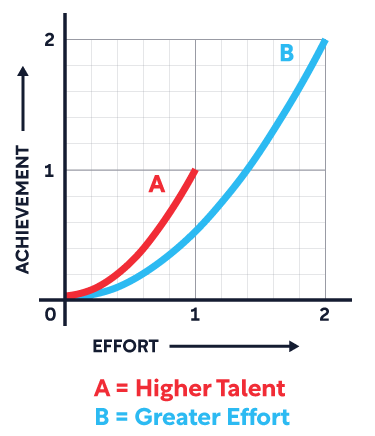
In this model, line A represents the achievement of someone with twice the talent of line B. When they both put in an effort level 1, Person A achieves twice as much as Person B. However, if Person A stops there and puts in no more effort, but Person B continues putting in effort, B can achieve twice as much as A, even though A has twice the talent.
Reading Between the Lines: Talent Still Matters
This graph points to a nuance of Duckworth’s theories: Given equal effort, talent matters a lot.
What Duckworth’s graph shows, even if she doesn’t explicitly mention it, is that if Person A has outsized talent and also puts in a lot of effort, they can achieve more than Person B if Person B puts in equal effort—or even if Person B puts in just a bit more effort.
A frequent criticism of Duckworth’s work says that she argues that effort alone is what matters, and that talent plays no part in success. However, she does acknowledge the importance of talent. Rather, her theories can be more accurately understood as disputing the popular notion of the naturally talented person who effortlessly stumbles into success.
Grit Is Built on Passion
After examining the benefits of effort—the perseverance element of grit as she defines it—Duckworth then turns her attention to passion, the second element.
Duckworth argues that passion is what differentiates grit from mere conscientiousness. She defines passion not as enthusiasm (as passion is often thought of), but instead as endurance. She argues that passion is less about the intensity of your commitment to your goals and more about the consistency of your commitment to your goals. Hard work alone isn’t enough to produce success, she says, if you change your goals from year to year.
Notably, Duckworth doesn’t deny that emotion is involved in passion. Once you have an ultimate goal in place, it’s something you almost obsess over. You’re loyal to the goal, not changing it on a whim. You think about it as you close out your day and again as you start your next day. You can be, and should be, passionate (in the classic, emotional sense) about your passion. However, it’s ultimately not the emotion that drives grit—it’s the long-term commitment.
(Shortform note: Some critics have noted that while consistency of effort is important to success, when taken to an extreme, it can hinder success rather than help it. If you operate under the unwavering mindset of “I can accomplish anything I set out to,” you might end up pursuing a goal that would be better abandoned. For example, you might spend years developing a product that has fatal flaws that will prevent it from becoming a runaway success. You would be better off honestly assessing your situation and picking a new goal, rather than continuing to try to make your flawed product work.)
Identify Your High-Level Goals
To frame your passion, Duckworth suggests organizing your goals on multiple levels, with high-level goals supported by mid-level goals, which are supported by low-level goals. The high-level goals are your end-goals—the overriding purpose toward which you work, such as “make a difference in the world,” or “end animal cruelty.” Lower-level goals are short-term goals, like “get to work on time,” that lead to and support your high-level goals.
To figure out your higher-level goals, keep asking yourself, “why do I do this thing? Why do I care?” Each answer forms a progressively higher-level goal.
Eventually, you’ll end up with a question that has no answer—there is no “why” other than, “because I want to” or “because I must.” This unanswerable question is your highest-level goal—the focus of your passion. It is the goal that must drive all your decisions and smaller goals.
High-Level Goals Are Your “Just Cause”
Duckworth focuses on a person's individual goals, but an organization can also examine its goals to identify its higher purpose. In The Infinite Game, Simon Sinek encourages companies to do just this, arguing that defining your company’s “Just Cause,” which serves as a guiding principle for all your lower-level decisions, is the first step to finding lasting success.
Sinek contends that your Just Cause must be a specific vision of an ideal state in which you want to live, and that it must have five elements:
It stands for something, not against something, and it’s optimistic (for example, aim to be healthy, not to not be overweight).
It’s idealistic: It’s inspiring, bold, and ongoing (for example, don’t aim to be healthy for a certain event, because after that you’ll give up the goal—instead, aim to live your healthiest life, which is something you can work toward forever).
It’s inclusive, inspiring others to join.
It’s resilient, able to withstand technological, cultural, and economic change.
It’s service-oriented, aimed at helping others.
The Four Stages of Grit
Duckworth identifies and explores four psychological assets that lead to grit, and she thinks of them as four stages:
- Interest
- Practice
- Purpose
- Hope
Duckworth argues that these stages build upon each other. Interest is the first stage—without an interest in a skill or subject, a person won’t start down the path to mastery. Practice is the next stage—practice takes over once interest has evolved from playful exploration into something more deliberate. Purpose comes next, after a person has achieved a certain level of mastery and can begin to look outward to figure out how their skill can benefit others. Hope, Duckworth argues, is not a final, separate stage, but rather, is a stage that accompanies the other three all the way through, because it fuels the other stages with a feeling of optimism and empowerment.
Additional Elements of Grit
Other psychologists studying grit have suggested additional psychological assets that make up a gritty mindset. Some have noted that a gritty attitude takes courage—the ability to triumph over fear. Others add ambition to the list, noting that ambition in this context doesn’t mean a desire for superiority but rather, a desire for excellence. Quite a few psychologists mention resilience—the ability to bounce back from failures.
Duckworth doesn’t address these items as separate elements of grit, but we can see how they relate to some of the elements she does define. For example, courage, ambition, and a desire for excellence might be products of a sense of purpose. A desire for excellence might also drive the motivation to practice, and be driven itself by interest. Resilience is implied in Duckworth’s concept of hope.
Overall, Duckworth’s theory outlines a basic understanding of how grit develops, and it serves as a jumping-off point—a framework—for identifying other qualities that also drive a person to master a skill.
Stage 1: Interest
Duckworth contends that grit starts with interest because interest is the seed of passion—a well-developed interest leads to a long-term commitment to a goal. Consistently, Duckworth observes that gritty people love what they do and they’re overjoyed to do it. They pursue projects not because they’re forced to or because they feel obliged to, but because they want to.
(Shortform note: For this reason, some psychologists contend that schools that try to teach grit focus too much on the persistence piece of it, and should instead focus on fostering interest, as interest is the foundation for perseverance over time. They argue that success is less dependent on a mere stick-to-it attitude and is more influenced by a person's intrinsic motivation—fueled by interest—and it’s the intrinsic motivation that creates a stick-to-it attitude.)
Duckworth notes that most people don’t find meaningful interests early in life, and they don’t simply find something and fall in love with the idea and have a solid direction from then on. Instead, people find their interests by trying out different fields and activities, choosing one to focus on, and then becoming more and more involved with it.
(Shortform note: In her book The Defining Decade, psychologist Meg Jay says active experimentation is part of having a productive identity crisis—a process of figuring out who you are and what you should do with your life. She notes that most people think of identity crises as periods of intense reflection, and while she acknowledges that reflection is an essential part of an identity crisis, she argues that the truly useful part is not mere thinking, but active doing. It’s only through doing, she says, that you can truly figure out what you like and what type of life you’re attracted to.)
Stage 2: Practice
Duckworth notes that while hard work is crucial to success, it doesn’t guarantee it. The type of hard work is essential. Sometimes, a person might devote countless hours to a pursuit but never rise above a middling mastery of it. She argues that this kind of arrested development can happen if a person doesn’t engage in deliberate practice: a structured, purposeful, and disciplined way to direct your efforts so that they produce real results.
She contends that the key to deliberate practice is not just repeatedly doing the same actions, but to strive to get better each time you do it. This, she says, is the hallmark of successful people: a desire to improve on their existing expertise.
(Shortform note: Duckworth credits psychologist Anders Ericsson with the development of the theory of deliberate practice. The theory has attracted much debate, as Ericsson emphatically believes that deliberate practice accounts for the vast majority of a person's success, while natural talent only plays a small role. Critics note there are many exceptions to this rule, where a person gains mastery of a skill far sooner than others who put in more effort. Ericsson responds that in those cases, the people putting in more effort may not have put in the correct type of effort—specifically, deliberate practice. The debate on how much talent counts for or against effort continues.)
How to Practice Deliberately
To properly engage in deliberate practice, Duckworth recommends the following process:
- Set a stretch goal: Focus on a specific, narrow aspect of your larger goal that you want to improve. (Shortform note: Researchers point out in the Harvard Business Review that stretch goals are motivating—when it comes to teamwork, people find challenging goals more appealing and perceive them as more attainable than lesser goals.)
- Give that goal undivided attention: Concentrate and focus on reaching that goal. Practice in solitude, without the assistance of other people. (Shortform note: Cal Newport advises scheduling regular, uninterrupted time to accomplish intensely focused work, which he calls Deep Work. Then you must use that time productively by measuring your progress and holding yourself accountable.)
- Seek feedback: Ask for advice or have someone evaluate how you’re doing. Be more interested in what you did wrong than what you did right.
- Reflect on that feedback: Ask yourself what the feedback is telling you—what are you doing correctly? What are you doing wrong?
- Continue to give your stretch goal undivided attention until you’ve hit it.
- Set a new stretch goal.
(Shortform note: Many psychologists emphasize the importance of feedback to this process. In Thanks for the Feedback, Douglas Stone and Sheila Heen argue that people can only achieve success by accepting and incorporating other peoples’ criticisms and direction. They note that feedback can be hard to hear, and we all have emotional triggers that compel us to ignore feedback we don’t like, but by becoming aware of these triggers (which are typically centered around the perceived truthfulness of feedback, the relationship we have to the feedback giver, or how the feedback reflects on our identity), we can prevent our emotions from blocking helpful advice.)
Stage 3: Purpose
The next stage of grit Duckworth examines is purpose, which she defines as a desire to increase the well-being of others. Along with interest, purpose is essential to passion because purpose enables interests to survive over long periods. Passion may start with interest, but it survives with purpose.
Purpose corresponds to the “high-level goals” Duckworth discusses in her earlier exploration of passion. These are the goals at the very top, for which you can’t provide an answer to the question “Why?” What makes these high-level goals special—what makes them a purpose—is that they have a focus other than self-interest. When Duckworth probes a gritty person about their high-level goals, they inevitably mention other people, either in specifics (like their children or customers) or through an abstract concept (like society, country, or science).
(Shortform note: Having a purpose is important not only for professional success but also for personal happiness. In his book The 12 Rules for Life, Jordan Peterson suggests that if you are upset because you want something you can’t have, ask yourself why you want that thing and why you feel that way, and continue asking until you’ve arrived at the core desire that’s driving your discontent. When you have consciously identified your highest “why,” your purpose, you can align your thoughts and behaviors with it, and will be able to find happiness.)
Stage 4: Hope
The fourth stage of grit that Duckworth identifies is hope. Duckworth defines hope as the belief that you have the power to improve things.
Duckworth notes that this is a different kind of hope than the hope that says “tomorrow will be better.” Hoping for a better tomorrow is hoping for luck. That type of hope doesn’t sustain grit because it depends on external factors.
In contrast, the hope that sustains grit is an optimism that you yourself can make tomorrow better. This hope—an enduring belief that you can eventually achieve your goals—sustains passion over long periods of time.
(Shortform note: Many psychologists have noted how important hope is in sustaining progress toward goals because it can propel you past the negative feedback that a setback gives you. When a setback signals you to stop by telling you what’s not working, hope can be what encourages you to keep going by promising what might work. Psychologists emphasize that hope is not a denial of reality—it’s not about ignoring or dismissing challenges, but rather, accepting the hard work needed to move past those challenges, and believing that the hard work will pay off.)
How to Parent for Grit
Duckworth argues that the best parenting method for fostering grit in children combines disciplined guidance with emotional support. She calls this wise parenting. It’s neither overly strict nor indulgent. It makes children feel that even when their parents are demanding, they have their best interest in mind. Children raised by wise parents have fewer social and emotional problems as adults and have healthier lifestyles (less drugs or alcohol).
(Shortform note: A leader of an organization can “parent” wisely too. When leaders convey to their team members that they believe in their capabilities, have high expectations, and want to help them improve, those team members end up more motivated and committed to the organization.)
Extracurriculars Encourage Grit
Duckworth points to numerous studies showing that children who participate in extracurriculars do better on almost every metric: grades, self-esteem, behavior, and so on. Further, these benefits last across many years—committing to an extracurricular has a positive correlation with graduation rate, employment, and salary.
Duckworth theorizes that extracurriculars are strongly correlated with positive achievement rates later in life because they offer kids a way to practice grit. And, as with any skill, the more practice the kids get at it, the more grit takes hold. This explains her observation that the long-term benefits of extracurriculars only exist among kids who commit to them for more than a year, and are more strongly correlated with kids who also achieve some kind of measurable advancement in the activity (for example, those making the varsity team or are appointed editor of the school newspaper). Kids who stick with extracurriculars for multiple years are simply getting more dedicated grit-practice.
Extracurriculars in History
Duckworth’s admiration for extracurriculars is part of a long cultural tradition—both parents and teachers have long been aware of the character-building potential of participating in sports and clubs. Psychologists started seriously examining these effects in the 1930s, positing three reasons to explain the correlation between extracurricular participation and higher grades:
Through organized games, students learn how to follow instructions—how to listen to them and apply them toward a desired outcome.
Students learn how to set goals and solve problems.
Students learn the importance of both motivation and persistence.
This last point in particular corresponds to Duckworth’s point that kids participating in extracurriculars are both interested and challenged—terms that mirror motivation and persistence.
Measuring Grit: The Grit Test
How do you measure grit? Duckworth quantifies grit through a self-assessment that she developed. You can take it yourself and see how much grit you have.
(Shortform note: The book covers only 10 items, but the quiz we’re including below is an adaptation of the original 12-item Grit Scale from Duckworth’s landmark 2007 study. You can find this test, and a shorter, eight-question version, on her website.)
For each statement, answer:
- Not at all like me
- Not much like me
- Somewhat like me
- Mostly like me
- Very much like me
The 12 statements:
- I have achieved a goal that took years of work.
- I have overcome setbacks to conquer an important challenge.
- I finish whatever I begin.
- Setbacks don’t discourage me.
- I am a hard worker.
- I am diligent.
- I often set a goal but later choose to pursue a different one.
- New ideas and projects sometimes distract me from previous ones.
- I become interested in new pursuits every few months.
- My interests change from year to year.
- I have been obsessed with a certain idea or project for a short time but later lost interest.
- I have difficulty maintaining my focus on projects that take more than a few months to complete.
For the first six questions, score your choices as:
- Not at all like me = 1
- Not much like me = 2
- Somewhat like me = 3
- Mostly like me = 4
- Very much like me = 5
For the second six questions, score your choices as:
- Not at all like me = 5
- Not much like me = 4
- Somewhat like me = 3
- Mostly like me = 2
- Very much like me = 1
Now add up your score—there’s a possible total of 60. Then divide that by 10. The higher your score, then the more grit you have.
Here are the approximate percentiles of grit across the population:
- The 10th percentile, or well below average, has a grit score of 3.0.
- The 50th percentile, or average, has a grit score of 4.6.
- The 80th percentile, or above average, has a grit score of 5.2
- The 99th percentile, or the very top, has a grit score of 5.9
Duckworth developed this test to measure both perseverance and passion. The first six questions deal with perseverance—your ability to persist through obstacles. The second questions deal with passion—how consistently you maintain your interests over time.
Duckworth notes that many people score higher in perseverance than in passion. It seems to be easier for most people to work hard than to maintain a consistent focus. It’s easy to get attracted to a new idea. It’s hard to maintain that passion over a consistent period of time without giving up.
Critiques of Duckworth’s Grit Test
A number of psychologists have critiqued Duckworth’s test. One criticism notes that the way she frames the questions affects the answers—in order to score high, a respondent must answer the perseverance questions in the affirmative but the passion questions in the negative. For example, for “I am diligent,” they would have to respond, “Very much like me,” but for “My interests change from year to year,” they would have to respond, “Not at all like me.” Studies that adjusted the questions so that all questions required an affirmative answer for the high score returned very different results, suggesting that Duckworth’s data was based on faulty methodology that didn’t actually capture her subjects’ mindsets accurately.
Another criticism argues that even though Duckworth sets out to measure both perseverance and passion, she really only measures perseverance. Duckworth herself has expressed regret at not including questions that better examined a person’s long-term goals and acknowledged that the test correlates more strongly with traits of conscientiousness than passion.
A third line of criticism objects to the inclusion of passion-focused questions at all. This argument claims that subsequent research has revealed a strong correlation between perseverance and success but no such correlation between passion and success. In fact, some studies suggest that a single-minded focus on an unchanging goal corresponds with lower rates of success, possibly because people in this mindset have trouble recognizing when it’s time to change direction.
Critics in this camp note that as long as a person isn’t constantly changing her mind, there doesn’t seem to be an advantage in sticking with a goal indefinitely. And it’s worth remembering that Duckworth herself changed careers twice—she started out in management consulting, then moved to teaching high school math, and then went into psychology.
Shortform Introduction
Duckworth argues that talent and intelligence matter less to success than grit, which she defines as a combination of perseverance and passion that drives a person to consistently pursue goals over many years.
Duckworth is primarily interested in how to raise gritty kids, and her insights have inspired parents and educators around the globe since the book’s publication in 2016. However, she believes that adults, too, can develop grit, and she lays out specific, measurable ways to do so.
Her work has sparked heated debates about which matters more to success, innate talent or deliberate effort, and whether or not grit is instinctive or can be developed and taught. Throughout our guide, we’ll address these controversies, and we’ll refer to other psychologists who shed additional insight on Duckworth’s ideas.
About the Author
Psychologist Angela Lee Duckworth is the child of Chinese immigrants. Her father was a chemist and research fellow at Dupont who valued intelligence highly and was obsessed with how smart he and his family were, which helped fuel Duckworth’s research interest in what drives accomplishment.
Later in life, Duckworth won a 2013 MacArthur Fellowship, often called the “genius grant,” ironically for her theory, later popularized in Grit, that accomplishment may depend more on passion and perseverance than inborn talent.
Duckworth has a BA in neurobiology from Harvard University, an MSc in neuroscience from Oxford University, and a Ph.D. in psychology from the University of Pennsylvania.
Today she serves as a professor at the University of Pennsylvania as well as a faculty co-director of the Penn-Wharton Behavior Change for Good Initiative and Wharton People Analytics. She also runs the Character Lab, a nonprofit devoted to helping children thrive using scientific research and insights.
Connect with Angela Duckworth:
The Book’s Publication
Grit was published by Simon & Schuster in 2016. It was a continuation of theories Duckworth had first developed in 2007, when she published a study exploring the importance of grit. The book built off the popularity she achieved after her 2013 TED Talk, which was viewed over 8 million times before the publication of the book (and has been viewed four times that amount since, between both the TED site and YouTube posting).
The book spent several months on the New York Times bestseller list as a hardcover and remained on its paperback bestseller list for years after.
The Book’s Context
Grit sits in a long line of books aimed at demystifying the psychology of success by emphasizing hard work over natural talent or intellect. In the long-running debate over nature versus nurture, these books bank firmly on nurture, arguing that learned behaviors matter more than your innate cognitive or physical abilities. Importantly, this means that you can control your life rather than being limited by the constraints of your inborn talents, as you can consciously decide how to think and how to act.
Other books that advance these theories include:
- Mindset by Carol Dweck
- Outliers by Malcolm Gladwell
- Atomic Habits by James Clear
- The 5 AM Club by Robin Sharma
- The Talent Code by Daniel Coyle
- Talent Is Overrated by Geoff Colvin
It also sits squarely in a genre of books aimed at teaching your children how to develop characteristics that will lead them to future success, including:
- How Children Succeed by Paul Tough
- The Marshmallow Test by Walter Mischel
- Battle Hymn of the Tiger Mother by Amy Chua
In focusing on how a personality trait can affect achievement, Grit participates in the discussion of how personality—broadly defined as your unique thoughts, feelings, behaviors, and temperament—affects your life. Many psychologists have explored and written about personality extensively, and four main theories of personality have emerged:
- Psychoanalytic, which incorporates theories of the id, ego, and superego
- Trait, which is more commonly known as the “Big Five” personality scale measuring openness, conscientiousness, extroversion, agreeableness, and neuroticism
- Humanistic, which holds that our personalities are formed according to a hierarchy of needs, starting with basic needs like food and shelter and ending with self-actualization needs that allow us to reach our full potential
- Social cognitive, which contends that our personalities are learned from others
Duckworth’s exploration of grit aligns most closely with one of the five personality characteristics in the Trait theory of personality—specifically, the conscientiousness characteristic.
The Book’s Impact
Duckworth’s book had an enormous impact on the conversation around how grit or perseverance affects success, supercharging the cultural debate on which matters more: nature or nurture.
Many readers were particularly interested in what her research suggested about child development and the importance of raising children with a gritty mindset to best prepare them for future challenges. It sparked debates about how parents and educators can instill grit in children, and it inspired schools to add grit-focused elements to their curriculums, both by testing for grit and trying to teach it.
The Book’s Strengths and Weaknesses
Critical Reception
Grit earned positive reviews in major publications, including the New York Times, The Wall Street Journal, and Scientific American.
Other publications reviewed the book with less enthusiasm—The New Yorker, for example, wondered what readers might actually learn from the book, since the link between hard work and success is fairly well-established.
Overall, several main lines of criticism have emerged in response to Duckworth’s book:
- Grit is no different from the well-known personality trait of conscientiousness.
- Duckworth’s insights are simply common sense—naturally, if you work hard, you’ll be more successful.
- Grit doesn’t actually matter to success—intelligence and talent are what counts.
- A focus on grit engenders a “blame the victim” mentality, crediting a person’s failure to a lack of effort and ignoring the many social and economic obstacles that face some people.
Supporters of Duckworth’s theories, however, respond to these criticisms, saying:
- Grit measures more than just conscientiousness because it measures passion as well as perseverance.
- No one is claiming Duckworth invented the concept of grit—but her analysis of its importance is sound.
- Although studies are inconclusive as to exactly how much intelligence affects success, research does indicate that grit matters.
- Duckworth doesn’t ignore socioeconomic and other factors that challenge kids, but emphasizes that these factors don’t inevitably define a person, and they can be overcome. Further, she doesn’t claim to have all the answers on how to create grit, but instead her discussion points out its importance.
We’ll review each of these criticisms and responses throughout our guide.
Commentary on the Book’s Approach
Duckworth’s primary interest as a researcher is children. She first started questioning how grit might affect a child’s success when she was a seventh-grade math teacher and noticed that the kids who got the best grades were not necessarily the ones with the highest intelligence, but rather, they were the ones who worked hardest. She started thinking about how personality traits might affect success more than natural talent, and she left teaching to become a researcher in the field of psychology.
Although her focus is on how to raise gritty kids, her insights apply to adults as well, and many of her discussions involve people who developed grit later in life.
Notably, although Duckworth never argues that intelligence and talent have no effect on success, her book is often interpreted as making that claim. It’s possible that because she focuses almost exclusively on the benefits of hard work, readers get the sense that she doesn’t recognize or acknowledge any benefits of natural talent. However, a closer reading of her theories reveals the balance in her beliefs, where intelligence and talent matter, but not for nearly as much as is commonly thought.
Our Approach in This Guide
Duckworth organizes her book into three parts. The first discusses the general concept of grit, exploring what it is, why it matters, and how it differs from intelligence and talent in its effects on success. The second part discusses in depth the four elements of grit that Duckworth identifies: interest, practice, purpose, and hope. The third part explores how a person can develop grit, and how parents, teachers, coaches, and so on can foster grit in others.
Within this overall organization, we’ve reorganized and grouped similar concepts in each of the three parts for clarity and simplicity.
Throughout the guide, we’ll explore some of the primary debates on grit—how much it matters over intelligence or talent, and whether or not it can be taught—and bring in insights from other thinkers, psychologists, and researchers. We’ll reflect on how Duckworth’s theories might answer these debates, and we’ll explore nuances or weaknesses of her insights.
Part 1.1: Introduction to Grit
Duckworth argues that talent and intelligence matter less to success than grit, which she defines as a combination of perseverance and passion that drives a person to consistently pursue goals over many years. In Part 1, she explores how effort enhances talent and what lies behind passion. She discusses why people tend to be biased against grit in favor of natural talent, and why effort very often has an advantage. She also includes the grit test she developed that underpins her research.
In Part 2, she explores more deeply the elements that make up grit, which she identifies as interest, practice, purpose, and hope. Then, in Part 3, she discusses both how a person can develop grit and how grit can be taught to others. Her primary focus is on how to raise gritty kids, but her insights apply to adults as well, and many of her discussions involve people who developed grit later in life.
What Is Grit?
Duckworth formulated the idea of grit after noticing that talent and luck were incomplete explanations for success in a variety of fields, including the military, sales, business, and sports. In each of these, people who showed early potential sometimes dropped out and some successful people didn’t start off showing the most promise.
Duckworth noticed that the one characteristic that the successful people had in common that distinguished them from the non-successful was grit, which she defines as a personality trait combining perseverance and passion.
- Perseverance means having resilience: It’s the ability to overcome setbacks, work hard, and finish things rather than give up.
- Passion means having direction: It’s the ability to adhere to a goal over the long term and maintain your interest level, as opposed to changing your goal mercurially.
Is Grit Different From Conscientiousness?
Critics of Duckworth’s book contend that grit is not a new concept, but instead is merely a deep exploration of conscientiousness, a long-known and well-acknowledged personality trait. Conscientiousness is one of the Big Five personality traits used by psychologists to predict how a person will react to life and to adversity. (The other four traits are openness, extroversion, agreeableness, and neuroticism.)
Conscientiousness describes the tendency to be responsible, organized, persistent, goal-oriented, and self-controlled. Duckworth has argued that grit differs from conscientiousness in that it also incorporates passion—the adherence to high-level, long-term goals—rather than just short-term commitment to goals. Thus she describes grit as not just resilience—the ability to bounce back from setbacks—but also loyalty to goals over many years.
However, some researchers have had difficulty finding distinctions between grit and conscientiousness even with this explanation, and have concluded that they’re essentially the same thing and have the same influence on a person’s success. These psychologists contend that both grit and conscientiousness describe a tendency to work hard toward goals, and any distinction that accounts for long-term goals is moot, because people who work hard naturally accomplish long-term goals.
Duckworth contends that gritty people constantly see themselves as never good enough. They’re never complacent with where they are. Yet they’re not miserable—gritty people are content being discontented. They work on things of great interest to them, and the idea of giving up rarely crosses their mind. This is what brings them success.
Getting Comfortable With Discomfort Leads to Success
Other experts agree that discomfort is not an inherently bad thing, because it can inspire you to improve your situation. For example, Frank Yoo, who served as director of design at, among others, Google, Lyft, and Coinbase, has discussed his relationship with discomfort as a positive one. He observes that when you feel frustrated or anxious, it’s your mind and body telling you that you need to grow. He relates periods in his career when he had a choice to either keep using a skill set that he’d already mastered or to start learning a new, more difficult one, and he chose to take on the difficult one. He attributes his success to always choosing to take on a challenge.
Yoo recommends that you actively seek out challenges that make you uncomfortable so that you constantly push your limits. In doing so, he notes that you might initially feel some imposter syndrome—where you doubt your abilities and feel like a fraud—but that this reaction fades with experience.
Research on Grit
In forming her theories, Duckworth conducted many studies measuring the predictive power of grit on success. In one of her earliest, she examined newly admitted West Point cadets, looking for personality characteristics that might predict which candidates would complete the school’s rigorous programs and which would not.
She focused on the admissions program, an intense, seven-week boot camp after which one in 20 cadets typically dropped out of the academy. For her study, Duckworth had the cadets fill out a questionnaire before they started the program, from which she calculated a grit score. After the program, Duckworth looked back to the questionnaire to see whether it predicted which cadets had stuck with the program and which had dropped out.
She also examined the cadets’ admissions scores that the school used to admit them to the academy in the first place. Admissions criteria considered SAT scores, high school rank, physical ability, and leadership potential (participation in academic clubs and sports).
Duckworth notes that the admissions criteria heavily weighted natural attributes of intelligence and physical fitness. In contrast, her questionnaire measured persistence and passion—grit. She found that the school’s admission criteria couldn’t accurately predict who would drop out, but her grit questionnaire predicted completion better than any other predictor.
Additionally, she found that grit had little relationship to IQ score, suggesting the two factors are independent. Further, grit was able to predict success even after accounting for IQ, meaning it contributes to success above and beyond IQ.
Her research found similar results in many other studies:
- Grit predicts the retention of salespeople better than other personality traits like conscientiousness or extroversion.
- Adults who complete graduate degrees have higher grit.
- Children who perform better in spelling bees showed higher grit scores.
Counterpoint: IQ Can Sometimes Better Predict Test Scores
Critics of Duckworth point to studies that indicate the opposite conclusion: that IQ has a greater influence on success. A large study in England found that grit only accounted for 0.5% of the success of students taking the GCSE exams—comprehensive exams evaluating a student’s mastery of a particular subject at the end of secondary school. Intelligence mattered far more, accounting for 40% of the outcome.
Researchers concluded that grit doesn’t in fact matter to academic success, and that the current preoccupation with grit inspired by Duckworth’s book is misguided. They then advised that schools drop their grit-focused curriculums.
However, Duckworth does acknowledge that intelligence counts highly on tests like SATs. Her argument, though, is that for success beyond tests—success in an overall professional or academic career—grit is a better predictor of achievement than intelligence.
The studies referenced above support this argument. The West Point program favors not just people who can intellectually and physically meet its challenges, but also those who can endure through the hardships of the program. The fact that salespeople with longevity have grit shows that grit matters over the course of a career—while intelligence or talent may get you a job, it’s grit that will keep you in it. Same goes for people working toward graduate degrees.
The case of the children in spelling bees brings up a nuance of the theory, though. Duckworth’s studies show that successful spelling bee contestants study longer and more effectively than contestants who aren’t as successful. This clearly points to grit, but other studies, as noted above, have shown that test taking is influenced by intelligence more than grit. Spelling bees are a test. So why does grit matter here more than intelligence?
It may have to do with the type of test that these are—spelling bees are less about reasoning and more about straightforward memorization. They might, therefore, be more influenced by how many hours a person spends reviewing spellings than by intelligence alone.
Historical Attitude Toward Grit
Duckworth notes that historically, high-achieving people have been known to be dogged in their pursuit of achievement, and that in eras past, people often spoke more highly of hard work than exceptional intelligence. Charles Darwin commented that “men did not differ much in intellect, only in zeal and hard work.” Darwin himself was considered to be of above-average, but not extraordinary, intelligence, but he persisted stubbornly in tackling a problem well after others had already moved on.
Duckworth points to a 1926 study of accomplished figures from history in which Catharine Cox, a psychologist from Stanford, inferred their IQs from their accomplishments and categorized the most eminent geniuses and the least eminent geniuses. The “most eminent geniuses” (Francis Bacon, Isaac Newton) had an average IQ of 146, and the “least eminent geniuses” (Giuseppe Mazzini, Joachim Murat) had an average IQ of 143. So IQ didn’t distinguish these two groups, but “persistence of motive” did. Cox found that people with high enough intelligence, combined with strong persistence, achieved more than the smartest people with less persistence.
Grit Separates the Good From the Great
Duckworth notes that Cox concludes that overall, these highly accomplished historical figures are on average, smarter than most of us today, and she says that this is no surprise—the work that each of these people did required intelligence. Again, this points to the nuance of Duckworth’s arguments: Duckworth acknowledges the importance of intelligence but contends that it is insufficient to explain success alone. Her theories outline the missing ingredient in success if a person has all the other requisite characteristics: intelligence, physical ability, talent, and so on.
We can assume that throughout history, there have been many people who were born with high intelligence, talent, and physical ability, but only a few achieved accomplishments on the level of those whom Cox studied. Duckworth's theories attempt to explain this: While innate ability might give some people an advantage over other people, grit is what separates the good from the great among those who are born with the natural capabilities to succeed.
Natural Talent Versus Purposeful Effort
Duckworth contends that even though people generally acknowledge the importance of hard work and perseverance, we have underlying biases that cause us to feel talent is more important.
She notes that we’re often not consciously aware of these biases. When surveyed directly, Americans are more likely to point to hard work as the key to success, rather than talent. But when asked indirectly, we tend to show a “naturalness bias” toward talent rather than persistence.
For example, if researchers ask participants to describe the traits they’d most want in a hypothetical worker, they usually emphasize “hard working” over “naturally skilled.” However, when presented with two hypothetical candidates, they more often choose the one described as having a higher IQ than the one with a stronger resumé of experience.
The Origin of Our Bias Toward Talent
The naturalness bias that Duckworth explores here probably evolved as a way to save mental and physical energy. We assume a smarter candidate will be easier to train, even if another candidate is already more highly trained, and therefore we believe the naturally talented one will save us time and energy in the future. We thus discount the proven grit of a candidate in favor of another’s unproven potential.
The human mind has evolved many such biases—shortcuts of thinking that help us make decisions. There are solid, evolutionary reasons for these shortcuts (also called heuristics). If we had to spend time fully analyzing every choice we’re presented with, we wouldn’t survive: We’re primed to think certain things look dangerous, for example, so that we can quickly respond to threats before they get the better of us.
However, our biases can mislead us. This is because biases are emotion-based, and bypass our rational mind in order to make decisions. Psychologists have long noted how these biases can lead us to, for example, misjudge risk, and therefore bet on a hot stock without fully researching it because everyone else is buying it—only to lose money when it tanks. The same is true when they lead us to choose a naturally talented candidate over one with proven grit, even if the gritty candidate is a less-risky choice because of their track record.
Why We Focus on Talent
Duckworth explores some reasons that people tend to idolize talent and credit success to natural ability.
First, she notes that when you see a successful person, you see the end result of long-term practice and perseverance. However, since you haven’t seen that hard work in progress, but instead only see the end result, it’s easy to misattribute the success to innate ability. For example, if you watch a highly skilled athlete in action, you might think to yourself what a “natural” that person is, but in reality, what you’re seeing is the accumulated result of years of hard work.
We Also Mistake Luck for Talent
In his book Fooled by Randomness, Nassim Nicholas Taleb agrees with Duckworth that people tend to wrongly credit success to innate talent. He argues, though, that what we’re overlooking when we do so is the hidden effect of luck, not necessarily hard work or persistence.
His argument assumes that many people have equal talent, skill, intelligence, and persistence. He maintains that what separates such equally matched people is the random effect of fortune. For example, two start-ups, both of which are run by intelligent and talented people, might have very different success trajectories if one of them gets an early contract for their product, leading to other contracts and additional business. Both companies started with equal advantages, but a bit of early luck put one on a more successful path.
Taleb does concur with Duckworth’s emphasis on hard work in some respects, though. While he focuses his discussions primarily on “wild” successes, such as becoming a superstar CEO or making a huge fortune in the stock market, he does note that run-of-the-mill success, such as developing a career as a doctor, lawyer, or teacher, depends on hard work and perseverance. For that reason, he advises his readers to aim for ordinary success, and to avoid, for example, investment trading.
Second, Duckworth references the philosopher Friedrich Nietzsche, who argued that we characterize other people as geniuses out of a self-protective instinct. Nietzsche believed that we mythologize natural talent because it excuses our failures: If innate talent is the primary contributor to success, we won’t feel as bad about ourselves when we see high achievers. We won’t feel we’re to blame for our failures if those failures are inevitable—if we can say, “No matter how hard I worked, I wouldn’t be able to do what that person does.”
Duckworth strongly disagrees with this fatalistic view, arguing instead that not only is grit the important factor in success, but also that (as we’ll discuss later) grit is learnable and trainable.
In Defense of a Fatalistic View
It might be said that there is some value in honestly evaluating your innate strengths and weaknesses so that you have a realistic opinion of your own potential. If you’re considering going into a field where only the superstars survive—for example, professional sports or academia at an Ivy League school—you might save yourself some heartbreak (not to mention years of effort) if you honestly assess from the start that you might not be cut out for it.
Janet Lowe discusses the advantages of this attitude in Damn Right, her biography of Charles Munger (Poor Charlie’s Almanack), Warren Buffett’s right-hand-man at Berkshire Hathaway. She relates that in college, Munger considered becoming a physics professor, but after watching the skill of his existing professors, he decided that he didn’t innately have what it takes to be as good as they were, and that he didn’t want to enter a profession that he couldn’t dominate. Instead, he made a name for himself as an investment trader.
It’s worth noting, though, that this attitude of “If I can’t be the best, why bother” only applies to fields that support just a select few people at the very top. In other fields where success is more evenly distributed among a wider swath of people, a person can achieve a decent level of success even without becoming a superstar—for example, there are countless doctors, lawyers, teachers, and corporate positions in which a person might be successful without becoming the very best worker ever.
The Drawbacks of Focusing on Talent
Duckworth argues that overemphasizing the importance of talent can lead to a number of problems, both in our own individual lives and in a larger organization.
In our individual lives, it can bias us against hard-working but less talented people who could end up achieving even more by leading us to ignore other important personal traits that contribute to success, like grit.
(Shortform note: This recalls our discussion of heuristics, in which we make emotion-driven short-cut decisions that ignore more rational analysis. This shows another way that such biases can hurt us—by causing us to miss out on opportunities that can help us or our company down the road. In this case, the missed opportunity would be a qualified person who might either contribute to our business’s success or might help us personally in our career.)
It can also make us place a cap on our own potential. Duckworth discusses several cases where a child who was placed in lower-level classes comes to believe that they’re not capable of achieving anything significant, only to discover later in life that they’re perfectly capable after all, if they face challenges with zeal and great effort.
(Shortform note: Duckworth’s anecdotal findings align with research showing that children with a positive, “I can do this” attitude outperformed others with a more negative, cautious attitude in math tests. Researchers theorize this is because a positive attitude shields a person from anxiety, which can decrease performance, and also primes a brain into “ready” mode, so that it’s poised to tackle challenges.)
In addition, within an organization, a focus on innate talent can cause a toxic and unproductive work environment. Duckworth discusses the insights of Malcolm Gladwell, who argues that an over-focus on talent mindset in the workplace creates a narcissistic culture where people are pushed to prove they’re smarter than everyone else.
Enron, the energy company that imploded under the weight of its false claims in 2001, exemplified this type of workplace. The company emphasized superstar talent so much that it fired the bottom 15% of performers annually, regardless of their actual performance. This culture led to an emphasis on the appearance of competence over actual substance, and an obsession with short-term gains that looked immediately impressive, rather than long-term gains that took years to manifest. Ultimately, this led to a workforce that made poor decisions, resulting in the downfall of the company. (Shortform note: Read more about the rise and fall of Enron in our summary of The Smartest Guys in the Room.)
A Focus on Talent Can Create Perverse Incentives
An automatic-firing policy like the one that Enron pursued can lead to a dysfunctional workplace by incentivizing people to try to keep their jobs in ways that ultimately harm the company.
Enron’s policy was a management technique based on the so-called vitality curve, sometimes called “rank and yank.” Popularized by Jack Welch in the 1980s at General Electric, the principle was to sort workers into three groups: The top 20% were the best performers and would be given the best perks, the middle 70% were the adequate workers and would be offered minimal rewards, and the bottom 10% would be fired. The practice was adopted by a number of prominent firms including Motorola, IBM, Yahoo, and Amazon in an effort to winnow their workforce down to only the best, most naturally talented employees.
Many companies abandoned the practice after finding it caused employees to focus on internal competition over anything else. Microsoft, for example, abandoned the system after finding it led people to avoid working with talented people so they wouldn’t be ranked against them, and it led supervisors to keep less skilled people on their teams to protect their more skilled workers from being cut. The practice has been credited as a leading factor that brought about a “lost decade” for the company in the early 2000s where employees were more concerned with keeping their jobs than being innovative.
How Effort Affects Success
Duckworth lays out her theory of grit in a quasi-mathematical equation that encapsulates why effort matters so much:
- skill = effort x talent
- achievement = effort x skill
In this formula, skill is created by applying effort to talent. Then, achievement is created by applying effort to that skill. In this way, effort factors in twice—it increases talent, and then it increases the application of that talent.
This means that between two people who work equally hard, the one with more talent will improve faster. But between two people of equal skill, the person who works harder will achieve more.
Another way to look at this formula would be:
- achievement = effort x (effort x talent), or: achievement = talent x effort2
Framing the equation this way allows us to graph it mathematically, giving us a simplistic model of how much a person might achieve based on inputs of talent and effort:
In this model, line A represents the achievement of someone with twice the talent of line B. When they both put in an effort level 1, Person A achieves twice as much as Person B. However, if Person A stops there and puts in no more effort, but Person B continues putting in effort, B can achieve twice as much as A, even though A has twice the talent.
This model has several implications:
- Someone of lower talent can catch up in skill level by applying effort.
- Even if someone never catches up in skill level, they can still achieve more by applying effort.
Consider an analogy: a low-talent painter, who is aware of the limits of her talent, works to improve her skill by taking lots of classes and creating many paintings. A higher-talent painter may start off making better paintings, but if she assumes her innate talent will propel her to success, she may put in less effort. After one year, the higher-talent painter might be making better paintings, but after two or three years, the lower-talent painter may eclipse her, and end up making better paintings and having a more successful career.
The same concept may apply to academics, athletics, career, and even social relationships.
Reading Between the Lines: Talent Still Matters
This graph points to two nuances of Duckworth’s theories:
First, it counters critics who say Duckworth discounts the importance of natural talent.
Second, it implies that given equal effort, talent matters a lot.
Some critics of Duckworth point out that there are many highly talented people who’ve eclipsed the success of others who put in more effort, calling into question how important effort actually is. One famous example is long-reigning top chess master Magnus Carlsen, sometimes called the “Mozart of chess.” One study estimated the number of hours of deliberate practice he’s likely engaged in over his lifetime and concluded he’s practiced fewer hours than others who’d been less successful, refuting Duckworth’s insights.
However, Duckworth never argues that talent is irrelevant. Her formula above for predicting skill argues that effort counts twice where talent counts once—but talent does count.
What Duckworth’s equation shows, even if she doesn’t explicitly mention it, is that if Person A has outsized talent and also puts in a lot of effort, they can achieve more than Person B if Person B puts in equal effort—or even if Person B puts in just a bit more effort.
To illustrate this, let’s examine the case of Carlsen. The authors of the study examining him argue that because he started playing chess at age eight while others often start at age four or five, Duckworth’s theories are wrong—he’s put in fewer hours over his lifetime but had more success.
However, it shouldn’t be overlooked that Carlsen started playing chess seriously at age eight. He didn’t, for example, merely take up chess in college. Over the course of a career that stretches into adulthood, the time that his rivals may have devoted to their craft might not be significantly more than his—not enough to overcome their lesser talent, given that he, by wide agreement, is exceptionally talented.
In fact, Duckworth herself would probably not dispute the study’s final conclusion, which states that deliberate practice by itself will not bring about high levels of performance. Nowhere in Grit does she say differently—what she argues is that talent can’t make up for a lack of effort, and that given equal talent, effort is the key to success.
This illustrates a common theme in criticisms of her work. Her theories have been popularly misconstrued as arguing that effort alone is what matters, and that talent plays no part in success. However, her theories can be more accurately understood as disputing the popular notion of the naturally talented person who effortlessly stumbles into success.
Part 1.2: Grit Is Built on Passion
Duckworth then turns her attention to the second element of grit after perseverance—passion. Passion, she argues, is what differentiates grit from mere conscientiousness. She defines passion not as enthusiasm (as passion is often thought of), but instead as endurance. She argues that passion is less about the intensity of your commitment to your goals and more about the consistency of your commitment to your goals.
(Shortform note: Some critics have noted that while consistency of effort is important to success, when taken to an extreme, it can hinder success rather than help it. If you operate under the unwavering mindset of “I can accomplish anything I set out to,” you might end up pursuing a goal that would be better abandoned. For example, you might spend years developing a product that has fatal flaws that will prevent it from becoming a runaway success. You would be better off honestly assessing your situation and picking a new goal, rather than continuing to try to make your flawed product work.)
Duckworth notes that hard work by itself won’t produce success unless it’s coupled with consistency. If you repeatedly choose new goals that have nothing to do with one another, you won’t reach a significant level of achievement even if you’re working very hard. For example, you can devote 80 hours a week toward writing a novel, but if you abandon it after six months before it’s finished and instead start devoting 80 hours a week toward learning the trumpet, but then again abandon that goal six months later, you’ll never be accomplished even though you’ve worked very hard along the way.
This is what differentiates grit from mere effort, says Duckworth: Grit is about returning to your project each day, consistently, over a long period. She therefore argues that high-level performance is surprisingly unremarkable—it’s a combination of small activities that have been drilled into habit after repeated, consistent effort.
Your Body’s Physical Response to a Lack of Consistency
In The Talent Code, Daniel Coyle explores some of the physiological reasons behind the importance of repeated, consistent practice. He explains that the development of skills depends on the growth of myelin, the insulation around our neural circuits. When we repeatedly perform an action, myelin increases, strengthening the neural connection. But when we let our practice lapse, the myelin decreases, worsening the connection.
Therefore, a lack of consistent effort doesn’t just pause our progress, but it also effectively pushes us backward—making us lose skills we’ve already mastered. This is true for anything from learning piano to making sales calls.
Thus, Coyle argues that mental skills respond to practice in the same way physical skills do. If an athlete stops practicing, she’ll lose muscle mass in her legs and arms, making it more physically difficult for her to master her skill. Coyle says that her brain is also physically responding to a lack of practice, as myelin atrophies and makes it more difficult for her to succeed.
Identify Your High-Level Goals
Duckworth argues that one reason people change their goals before accomplishing them is that they haven’t explicitly defined their passion. Defining your passion, she says, will give you measurable guidelines and parameters that will keep you on the path to success. Without a unifying passion, you are more likely to wander aimlessly and get involved in pursuits that will split your focus.
To define your passion clearly and to frame it so that you can work toward it consistently, Duckworth suggests organizing your goals on multiple levels:
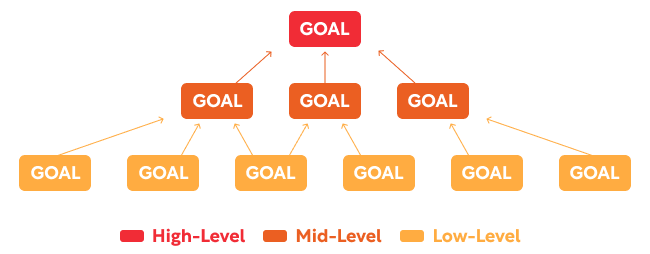
The lower-level goals are short-term goals, like “get to work on time.” These goals lead to and support medium-level goals that in turn support higher-level goals, which are more abstract and define an overall purpose, like “become a professor” or “end animal cruelty.”
To figure out your higher-level goals, Duckworth recommends that you keep asking yourself, “Why do I do this thing? Why do I care?” Each answer forms a progressively higher-level goal.
For example, you might ask, “Why do I want to get to the office on time?” You might answer that you want to earn a good reputation at work. If you probe further (Why? Because you want to be given more responsibilities. Why? Because you want to have decision-making power. Why? Because you want to make a difference in the world), you’ll eventually end up at a question that has no answer. For example, you might not be able to answer “why do you want to make a difference in the world,” except to say, “because I do.”
This unanswerable question is your highest-level goal—your end-goal. It is the goal that must drive all your decisions and smaller goals.
(Shortform note: This advice corresponds to basic business strategy advice: When crafting a business plan, your lower-level goals (tactics) must serve your mid-level goals (objectives), which serve even higher-level goals (strategies), which ultimately serve your highest-level goal (your mission or vision).)
High-Level Goals Are Your “Just Cause”
Duckworth focuses on a person's individual goals, but an organization can also examine its goals to identify its higher purpose. In his book The Infinite Game, Simon Sinek encourages companies to do just this, arguing that defining your company’s “Just Cause,” which serves as a guiding principle for all your lower-level decisions, is the first step to finding lasting success.
Sinek contends that your Just Cause must be a specific vision of an ideal state in which you want to live, and that it must have five elements:
It stands for something, not against something, and it’s optimistic (for example, aim to be healthy, not to not be overweight).
It’s idealistic: It’s inspiring, bold, and ongoing (for example, don’t aim to be healthy for a certain event, because after that you’ll give up the goal—instead, aim to live your healthiest life, which is something you can work toward forever).
It’s inclusive, inspiring others to join.
It’s resilient, able to withstand technological, cultural, and economic change.
It’s service-oriented, aimed at helping others.
These last three points might seem more applicable to an organization rather than an individual, as Sinek intended, but can be applied to personal goals as well if you envision your success being a positive part of the world, able to adjust to changing times, and ultimately working for the good of others.
Drop Lower Goals That Don’t Serve Higher Goals
Duckworth advises that you make sure each lower-level goal directly helps you achieve the goal above it. If you can’t see a direct connection between a lower goal and your ultimate goal, then your lower-level goals likely aren't moving you closer to your top goal, and you should probably stop pursuing them. Low-level goals are not to be held sacred—they can be removed or changed. If you find a new low-level goal that is more effective or feasible, you can swap it for another.
For example, if your goal is to write a novel, but you’re spending a lot of time building a brand on social media, you may realize that the time you spend promoting yourself is time not spent writing, and therefore is not moving you closer to your goal. Instead, you may switch out that low-level goal of self-promotion for a different low-level goal, like getting up at 5 a.m. every day to write 500 words.
Monitor How You’re Spending Your Time
While your goals should be results that you purposefully aim for and that shape your lower-level activities, life-coach experts warn that sometimes, the process can work in reverse, and your lower-level activities can shape your results. This happens when you’re not purposeful about those lower-level activities.
For example, if your conscious goal is to switch careers to something more fulfilling, but you spend your days working eight hours at your unfulfilling job and then coming home and watching television for three hours, it might be said that your true goal is to live with your job and watch television.
Although your lower-level activities aren’t goals per se, when we spend a lot of time on them, they function as goals. Therefore, experts advise that you consciously track how you’re spending your time so that you’re aware of when you are devoting significant effort to something that is not advancing your ultimate goal. When that happens, you should switch out those activities for something that will advance your ultimate goal. This expands on Duckworth’s advice by emphasizing that you should switch out not only your purposeful goals but also your non-goal time spends if they’re also preventing you from reaching your goals.
Duckworth argues that when you are flexible with your lower-level goals, you’ll have a more resilient high-level goal because it will be able to absorb failures without defeating your ultimate aim. Furthermore, this lowers how defeated you feel after failure. If you fail on a low-level goal, another can take its place. Lots of low-level activities can drive you toward your top-level goal. You have a lot of routes to get there.
She stresses that when a lower-level goal isn’t working, you should substitute it for something that approaches the next level goal a little differently. It’s not enough to follow the advice of “try, try again,” but instead, you should “try, try something else.” This might mean reexamining what you’ve been doing to figure out why it’s not working—for example, if you’ve been submitting a manuscript to publishers and getting nothing but rejections, study that manuscript to see if it has a problem that’s fixable. Then, fix it before submitting it elsewhere.
Flexibility Leads to Resilience
Many management experts have offered advice on how to set goals that will ensure long-term success, both for individuals and organizations. For example, Jim Collins and Jerry Porras discuss setting visionary goals in their book Built to Last, which helps leaders develop and maintain companies that will stay relevant and overcome years of challenges. (Duckworth might call such companies “gritty companies.”)
Collins and Porras point out that the vision statements of long-lasting companies have two elements:
A core principle that gives them an overall mission: This corresponds to Duckworth’s “high-level” goals.
A more practical principle that directs their actions on a more specific level but can be changeable: This corresponds to Duckworth’s “mid-” and “low-level” goals.
For example, a company might set out to “help students learn,” which would be their overriding, larger mission (their high-level goal). On a more practical level, they might have a mission of “offering tutoring services” (their mid-level goal). As their business evolves, they may change that more practical mission to “offering online video tutorials” or even “making documentaries,” and as long as the new direction fits with their core principle, they’re being true to their vision. The stability of the core principle combined with the flexibility of the practical principle allows the company to stay true to their overall mission and ensure that their smaller missions align with it, just as Duckworth advises.
Common Goal Problems
Duckworth discusses some common failings of goal choices that can interfere with success, in particular, either having no lower-level goals mapped out to support your higher-level goals, or having multiple higher goals with no unifying theme.
No lower-level goals

You might have a dream goal, like becoming a famous actor or a billionaire but are unable to envision the lower-level goals that will bring you there. Having a lofty goal like this without the lower-level goals supporting it amounts to no more than positive visualization.
Duckworth cautions that positive visualization may be fun and make you feel good, but if you don’t consider the practical steps needed to achieve your goal, you’re highly unlikely to reach it. Then when you fail, you’ll feel significant disappointment.
Positive Visualization Can Hinder Your Progress
Duckworth doesn’t explore the mechanics of how positive visualization can negatively affect success, but other researchers have, proving that when you visualize your goals without also visualizing the steps needed to get to that goal, you’re less likely to achieve the goal.
This seems to be a function of psychological energy. Researchers have found that when subjects used positive visualization techniques, their energy for their goal decreased, and they were more likely to abandon their project. In contrast, subjects who either visualized negative things or thought about the possibility that they might not achieve their goal had higher energy and accomplished more.
The researchers hypothesize that visualizing a positive outcome has a relaxing effect on the body (which is why psychologists sometimes use positive visualization techniques to help anxious patients relax). However, if your goal is to accomplish something that requires energy and action, such relaxation techniques can be counterproductive. It’s far better to prepare yourself mentally for the challenges you face so that your mind gathers the strength and stamina you’ll need to face those challenges.
Mid-level goals without a top-level goal
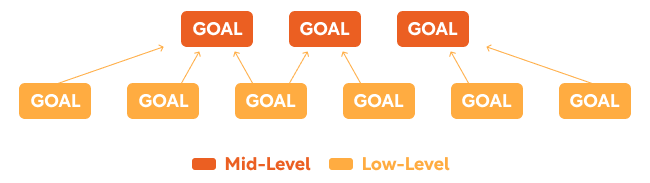
Duckworth warns that a more common problem is having multiple mid-level goals without a unifying, overall goal to bridge them together. When that happens, you might end up with goals that conflict with each other, or you may feel like you’re spinning your wheels—applying a lot of effort without going in any particular direction.
If you feel pulled in too many directions, how do you prune your goal list? Duckworth relates an exercise that Warren Buffett suggests to help you prioritize:
- Write a list of 25 career goals.
- Circle the five highest priority goals for you. Choose only five—be strict with this.
- Examine the 20 goals remaining that you didn’t circle. These are your most tempting distractions. You must actively avoid these to focus on your top five goals.
If you can’t decide on five, then consider quantifying your goals on two scales: interest and importance. Also, consider whether some of them contribute more to your ultimate concern than others.
Focusing Your Efforts Means Making Choices
Many management books have acknowledged the importance of focusing your efforts and discussed how to do so. Greg McKeown, for example, explores the idea in his book Essentialism, arguing that you won’t find success or happiness unless you narrow your focus so that you concentrate only on tasks that will move you toward your overriding, ultimate aim. If you don’t, you’ll stretch yourself thinly, make little progress, and feel overworked with little to show for it.
Like Duckworth, McKeown advises that you start by defining your overall purpose so that you can eliminate all non-essential tasks. He advises you clearly define a specific and measurable purpose based on questions like, What inspires me? Where do my talents lie? What would make the world a better place?
He then notes three principles you must internalize when narrowing your focus:
You alone (not your boss, family, or coworkers) need to choose how to use your time and energy.
You need to determine what’s most important. Very few things matter—most things are trivial; only a few are crucial.
You have to make trade-offs—you can’t have or do everything. Instead of asking how you can make it all work, ask which problem you want to solve.
In other words, ask which problem is most important to you, and best represents your ultimate goal. Then, ignore all goals that don’t advance it.
Part 1.3: Grit Is Malleable
Duckworth then turns her attention to the plasticity of grit. One of her central arguments is that grit is not static, but rather, a person can develop it.
She acknowledges that genetics influence traits like talent, intelligence, and grit, but she contends that they can also be shaped by the environment. She concludes, then, that they can change as environmental influences change. She further argues that grit can be consciously, purposefully changed, and also that it can be taught.
How Malleable Is Grit?
Ever since Duckworth’s book, psychologists have debated if grit actually is changeable.
Some argue that long-recognized personality traits, like extroversion, openness, and conscientiousness, are fixed—they’re determined by biological factors and resistant to environmental influences. Psychologists on this side of the debate argue that grit can also be considered a personality trait, and that therefore, it’s determined largely by biological factors and isn’t malleable. Many base these conclusions on research that found that adoptive parents seem to have a smaller influence on their child’s personality than do genetics, indicating the strength of nature over nurture.
However, there is some evidence that grit can, indeed, be taught. In one study, researchers split seventh graders into two groups and asked them each to write an essay at four points during the school year. One group was asked to write about values. The other was asked to write about how those values affected their lives. The group that had to reflect on how the values affected them—essentially, to observe how their thoughts could influence their actions—went on to earn higher grade-point averages than the other group. Notably, the effect persisted for years.
The debate matters, because those who believe that grit is changeable have encouraged schools around the world to design curricula to teach it and even tests to evaluate it. This indicates support of Duckworth’s contention that grit can be purposefully developed, and suggests that the mechanism to do so might be by framing people’s outlook on life and on effort.
Genetic Traits Can Change
Duckworth points out that even traits that are typically thought of as being entirely influenced by genetics, such as height or intelligence, have been shown to be somewhat influenced by environmental factors.
- The average male height increased from 5 feet 5 inches in 1850 to 5 feet 10 inches today.
- The average IQ has increased greatly: Measured against modern norms, people who lived 100 years ago had an average IQ of 70, while measured against their norms, the average IQ today is around 130.
Human genetics don’t change rapidly, so when a trait like intelligence or height changes rapidly in a population over time, the most likely causes are environmental—for example, better nutrition, better overall health, and better education. The fact that even these somewhat “sticky” traits have changed in response to environmental influences suggests that traits that are more skill-based, like talent and grit, are even more responsive to environmental factors.
How Accurately Do IQ Scores Measure Change in Intelligence?
There is some debate about how accurate the increases in IQ scores are, and whether they show actual increases in intelligence over time.
The theory that Duckworth references in her book, the Flynn Effect, has measured a steady rise in IQ levels in many countries. However, some psychologists argue that rising IQ scores can’t be an accurate reflection of an equal increase in intelligence. They point out that scores are estimated to have been near 70 a century ago, which would put the average person at an almost disabled level of intelligence—an unlikely scenario. It’s probable instead that there is more to intelligence than IQ scores alone.
Some argue that IQ scores merely reveal an increased ability to take tests, and that they’ve improved as education has increased in length and quality, leading people to become acclimated to test-taking. Others argue that rising IQ scores correlate to rising literacy rates, not absolute intelligence.
Regardless, experts generally agree that whether or not IQ is a strict reflection of intelligence, the dramatic increase in scores indicates at least some improvement in intelligence. The greatest increases have been at the lower end of the scale, so that groups that once tested with low scores are now testing higher, while groups that used to test high are still testing at that same level. This suggests that many of the gains are due to things like better nutrition and better education (environmental factors) that were not accessible to lower-scoring groups in the past but now increasingly are.
Talent Can Change
Duckworth notes the long-observed fact that many talent-based traits have changed over time, some significantly. For example, athletes continue to set and break records for increased speed or achievement.
She argues that this is due to the social multiplier effect, which holds that people improve their skills as they learn from other people, leading to a higher level of average skill in the overall population. She suggests that the advent of television has helped to increase this effect, as athletes can easily see what other athletes are doing and learn from them.
(Shortform note: The dramatic increase in swimming speeds among professional athletes illustrates this effect. Because swimming strokes are complex, there’s a lot to learn, and swimmers who learn more can improve more. Over the years, the collective knowledge of the mechanics of the sport has increased and built upon itself so that today, swimmers have a deeper understanding of what propels them faster through the water. Thus, since they’ve crafted and honed new techniques over the years, they’ve collectively improved. Technology has helped, too—specialized swimsuits and goggles, for example—but even accounting for technological changes, swim times have steadily improved.)
Grit Changes Over Time
Duckworth writes that behavioral traits can change not only in general populations throughout history, but also in individual lives, over the course of years. She notes that studies show higher levels of grit in older populations than in younger populations, as shown by this graph:
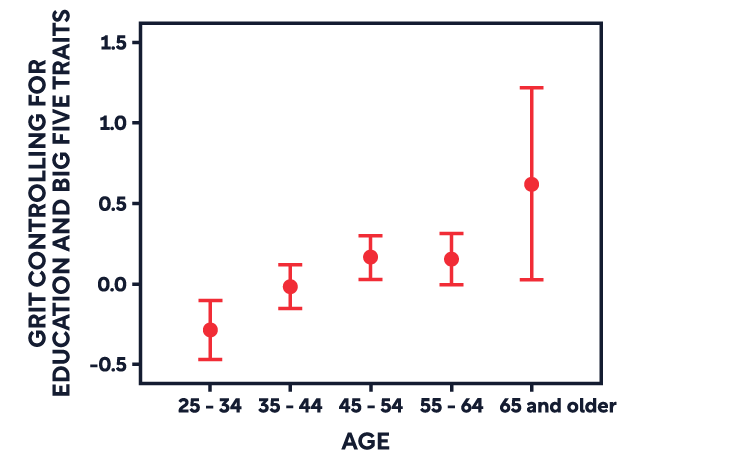
She notes there might be several possible explanations for this:
- Older people might have endured more hardship throughout their lives (e.g. by surviving through World War II and the Cold War) and have developed more grit in response.
- Maturation could be genetically programmed—evolutionarily, grit may not be as beneficial in early years when seeking mates, and it may be more helpful later when caring for a family.
- Maturation might happen naturally over time as people learn that grit is a successful strategy for accomplishing goals, and that the opposite—quitting plans, shifting goals, starting over—leads to failure and is unsatisfying.
- Life experiences—like getting a job, having children, or caring for parents—require us to mature and adopt more grit.
Because we don’t have longitudinal studies of grit, we can’t distinguish between these explanations, but the third is Duckworth’s favorite. Anecdotally, people change when new expectations are thrust upon them—imagine the teen who sleeps in daily, but then enlists in the military and is punished for waking up past 6 a.m. In this way, Duckworth firmly believes that grit can be grown.
Social Expectations Can Affect Personality
Duckworth’s argument that people develop grit as they age because they grow into roles that require it aligns with the social investment theory of personality. This theory holds that personalities can change when people are thrust into new social roles that lead to new expectations and responsibilities.
A famous example demonstrating this theory was the Stanford Prison Experiment in 1971 that placed 24 male college students in the role of either prison guard or prisoner and then observed their behavior. Although the participants came from similar backgrounds and had similar personality profiles (based on maturity and lack of antisocial tendencies), by the end of the six-day experiment, they were behaving very differently depending on which role they’d been assigned. Those in the role of prison guard acted cruelly and those in the role of prisoner acted subserviently.
While many observers have critiqued the study for its ethical breaches and questionable applicability to real-world situations, the study does strongly suggest that personality is determined by more than mere genetics, aligning with Duckworth’s argument that grit can be influenced by a person’s role and stage in life.
In a less extreme example of how grit responds to social roles, Meg Jay discusses the importance of having purpose, vision, and consistency in your twenties in her book The Defining Decade. Like Duckworth, Jay notes that in your twenties, flitting between careers is common, and she proposes that this is because it’s culturally accepted and even encouraged, as young adults are bombarded by messages from the media, friends, and even family that they should enjoy their twenties as a “second childhood.”
Jay advises you to ignore these messages, and instead to place yourself in the role of a more mature, forward-thinking person, because if you don’t build the foundation for a career in your twenties, you’ll be playing catch-up in your thirties against people who started working toward their long-term goals earlier.
Jay never mentions grit or Duckworth’s theories, but her book is an exploration of the real-world application of grit and how consistency (or, in Duckworth’s words, passion) can affect the trajectory of your life depending on how early you adopt it. Her advice aligns with Duckworth’s that grit is changeable and is something you can consciously choose to adopt.
Part 1.4: Measuring Grit: The Grit Test
How do you measure grit? Duckworth quantifies grit through a self-assessment that she developed. You can take it yourself and see how much grit you have.
(Shortform note: The book covers only 10 items, but the quiz we’re including below is an adaptation of the original 12-item Grit Scale from Duckworth’s landmark 2007 study. You can find this test, and a shorter, 8-question version, on her website.)
For each statement, answer:
- Not at all like me
- Not much like me
- Somewhat like me
- Mostly like me
- Very much like me
The 12 statements:
- I have achieved a goal that took years of work.
- I have overcome setbacks to conquer an important challenge.
- I finish whatever I begin.
- Setbacks don’t discourage me.
- I am a hard worker.
- I am diligent.
- I often set a goal but later choose to pursue a different one.
- New ideas and projects sometimes distract me from previous ones.
- I become interested in new pursuits every few months.
- My interests change from year to year.
- I have been obsessed with a certain idea or project for a short time but later lost interest.
- I have difficulty maintaining my focus on projects that take more than a few months to complete.
For the first six questions, score your choices as:
- Not at all like me = 1
- Not much like me = 2
- Somewhat like me = 3
- Mostly like me = 4
- Very much like me = 5
For the second six questions, score your choices as:
- Not at all like me = 5
- Not much like me = 4
- Somewhat like me = 3
- Mostly like me = 2
- Very much like me = 1
Now add up your score—there’s a possible total of 60. Then divide that by 10. The higher your score, then the more grit you have.
Here are the approximate percentiles of grit across the population:
- The 10th percentile, or well below average, has a grit score of 3.0.
- The 50th percentile, or average, has a grit score of 4.6.
- The 80th percentile, or above average, has a grit score of 5.2
- The 99th percentile, or the very top, has a grit score of 5.9
Duckworth developed this test to measure both perseverance and passion. The first six questions deal with perseverance—your ability to persist through obstacles. The second questions deal with passion—how consistently you maintain your interests over time.
Duckworth notes that many people score higher in perseverance than in passion. It seems to be easier for most people to work hard than to maintain a consistent focus. It’s easy to get attracted to a new idea. It’s hard to maintain that passion over a consistent period of time without giving up.
Critiques of Duckworth’s Grit Test
A number of psychologists have critiqued Duckworth’s test. One criticism notes that the way she frames the questions affects the answers—in order to score high, a respondent must answer the perseverance questions in the affirmative but the passion questions in the negative. For example, for “I am diligent,” they would have to respond, “Very much like me,” but for “My interests change from year to year,” they would have to respond, “Not at all like me.” Studies that adjusted the questions so that all questions required an affirmative answer for the high score returned very different results, suggesting that Duckworth’s data was based on faulty methodology that didn’t actually capture her subjects’ mindsets accurately.
Another criticism argues that even though Duckworth sets out to measure both perseverance and passion, she really only measures perseverance. Duckworth herself has expressed regret at not including questions that better examined a person’s long-term goals and acknowledged that the test correlates more strongly with traits of conscientiousness than passion.
A third line of criticism objects to the inclusion of passion-focused questions at all. This argument claims that subsequent research has revealed a strong correlation between perseverance and success but no such correlation between passion and success. In fact, some studies suggest that a single-minded focus on an unchanging goal corresponds with lower rates of success, possibly because people in this mindset have trouble recognizing when it’s time to change direction.
Critics in this camp note that as long as a person isn’t constantly changing her mind, there doesn’t seem to be an advantage in sticking with a goal indefinitely. And it’s worth remembering that Duckworth herself changed careers twice—she started out in management consulting, then moved to teaching high school math, and then went into psychology.
A fourth line of criticism builds on that third objection, arguing that Duckworth’s test actually measures two separate traits that aren’t correlated. Studies show that perseverance and passion are distinct characteristics that don’t affect each other. A person can have high perseverance but low passion, and vice versa. Thus, critics in this camp suggest grit doesn’t actually exist as she describes it, but it’s instead a combination of two separate qualities.
To these critics, Duckworth might reply that they’re missing the point. While it’s true that people might have varying levels of either perseverance or passion and that these qualities can vary independently of one another, grit measures where they collide, and in the end, it’s the people who have a strong work ethic and the passion to sustain that ethic over the long haul who will be more successful.
Part 2.1: The Four Stages of Grit
In Part 2, Duckworth identifies and explores four psychological assets that lead to grit. She thinks of these four elements as stages in the development of grit, and argues that these stages build upon each other:
- Interest is the first stage—without an interest in a skill or subject, a person won’t start down the path to mastery.
- Practice is the next stage—practice takes over once interest has evolved from playful exploration into something more deliberate.
- Purpose comes next, after a person has achieved a certain level of mastery and can begin to look outward to figure out how their skill can benefit others.
- Hope, Duckworth argues, is not a final, separate stage, but rather, is a stage that accompanies the other three all the way through, because it fuels the other stages with a feeling of optimism and empowerment.
Additional Elements of Grit
Other psychologists studying grit have suggested additional psychological assets that make up a gritty mindset that Duckworth doesn't explicitly mention. Some have noted that a gritty attitude takes courage—the ability to triumph over fear. Others add ambition to the list, noting that ambition in this context doesn’t mean a desire for superiority but rather, a desire for excellence. Quite a few psychologists mention resilience—the ability to bounce back from failures.
Duckworth doesn’t address these items as separate elements of grit, but we can see how they relate to some of the stages she does define. For example, courage, ambition, and a desire for excellence might be products of a sense of purpose. A desire for excellence might also drive the motivation to practice, and be driven itself by interest. Resilience is implied in Duckworth’s concept of hope, which, as we’ll discuss, is a belief in your ability to improve your situation.
Overall, then, Duckworth’s four stages outline a basic understanding of how grit develops, and they serve as a jumping-off point—a framework—for identifying other qualities that also drive a person to master a skill.
Stage 1: Interest
Duckworth contends that grit starts with interest because interest is the seed of passion—a well-developed interest leads to a long-term commitment to a goal. Consistently, Duckworth observes that gritty people love what they do and they’re overjoyed to do it. They pursue projects not because they’re forced to or because they feel obliged to, but because they want to.
Why Is Interest Important?
Duckworth argues that interest is crucial for success for two reasons:
- You’ll be far more satisfied with your job if you’re interested in it, which means you’ll stick with it longer.
- You’ll perform your job better if you’re interested in it, which will lead to better outcomes. Employees who like their jobs earn more and rise higher. Students who like their studies get better grades.
Essentially, people who are not intrinsically interested in an activity will not work as hard or achieve as much as people who are.
(Shortform note: For this reason, some psychologists contend that schools that try to teach grit focus too much on the persistence piece of it, and should instead focus on fostering interest, as interest is the foundation for perseverance over time. They argue that success is less dependent on a mere stick-to-it attitude and is more influenced by a person's intrinsic motivation—fueled by interest—and it’s the intrinsic motivation that creates a stick-to-it attitude.)
Interests Develop Over Time
Surveys suggest that only 13% of adults consider themselves engaged at work, indicating that most people aren’t working in the field of their greatest interest. Duckworth notes that this is not necessarily because they decide to work in a field different from what grabs their interests—she contends that most young people starting their careers need little encouragement to follow their interests. The real problem is that most young people don’t know exactly what their interests are yet.
Duckworth notes that there’s a common misunderstanding about how a person finds their interest. People expect they’ll find something that just clicks and will fall head-over-heels in love with an idea, skill, or subject and have a solid direction from then on. They also assume that successful people found their passion early and didn’t stray from that path.
However, Duckworth observes that finding your interest doesn’t usually happen like this. Instead, people find their interest by exploring several areas of interest, choosing one, and cultivating it to the exclusion of other interests.
She notes that:
- You shouldn’t expect to discover your interest early in life or right out of college. Many people find their life’s work only after trying lots of different things.
- Interests rely on trying things and receiving more information. You won’t arrive at your interest solely by introspection or by forcing yourself to like something.
- Interest deepens after engaging with an activity over time. Through repeated exposure to your interest, you discover fascinating subtleties and facets that you would never find if you didn’t stick with it.
Duckworth argues that eventually, your interests will fuel your desire for mastery, and you’ll be driven to continuously improve your skills in order to more effectively engage with your interest.
(Shortform note: In her book The Defining Decade, psychologist Meg Jay says this is part of having a productive and useful identity crisis—a process of figuring out who you are and what you should do with your life. She acknowledges that reflection is an essential part of having an identity crisis, but that people misunderstand the term and think it’s only about reflection, while the truly useful part is not mere thinking, but active doing.)
Counterpoint: Should You Ignore Interest Entirely?
While Duckworth recommends that you explore your interests to find one that drives you, Cal Newport, in his book So Good They Can’t Ignore You, argues that you should ignore your interests.
He contends that (1) only around 4% of all people have interests that are related to their work, (2) that many people who love their jobs didn’t get there by following their interests, and (3) that sometimes, a person might have an interest related to their profession but might still feel unfulfilled (for example, someone might follow their interest into medicine but still be miserable because her organization is unpleasant or because of all the paperwork involved).
Instead, Newport advises that to find success, people focus on developing a skill set that will set them apart from their peers. A person can then leverage these skills to gain autonomy and control over their career, and finally, to make themselves indispensable to others. Once they’ve achieved a high level of success, they can use their autonomy and influence to fulfill their personal mission, make a difference in the world, and thus find meaning in their work.
Of course, Duckworth argues that you’re far more likely to invest time and energy into developing skills within a field that interests you. However, the debate remains about which comes first—does interest encourage skills, or do skills lead to interest?
Interests Often Start as Play
Duckworth notes that interests typically start out as play. Experts start as amateurs, doing something they enjoy rather than something they take seriously.
Once play has sparked an interest, supporters, such as parents, teachers, and friends, can help it thrive. A support group helps a person learn more about an interest and provides positive feedback to nurture it.
She advises parents not to push young children too hard in a specific direction, arguing that in childhood, it’s too early to detect long-term interests. People only start to gravitate to general interests in middle school age. She also warns that studies indicate forcing a passion erodes intrinsic motivation. When parents allow their kids to freely choose what kinds of activities they like, those kids are more likely to develop strong passions in later years. Duckworth thus advises parents to allow for open play and discovery before enforcing discipline.
Play Makes Passionate Kids
Other writers note that in allowing children to discover a subject matter through play rather than through work, caregivers instill in the children a positive association with that subject, which sustains the child through the more rigorous practice that comes later.
In Peak, authors Anders Ericsson and Robert Pool note that top achievers in a variety of fields have one thing in common: As children, they’d all been introduced to their field in a fun, lighthearted way, often through toys. For example, one future chess master started by playing with game pieces like figurines, and a future golf pro was given a toy club as a toddler. The authors note that parents encouraged their kids’ burgeoning interest with copious praise, making the experience an overwhelmingly positive one.
It was only after their childrens’ interest was firmly established that parents brought in teachers or coaches to help develop their skills. Continuing positive praise from teachers and coaches, combined with deliberate practice encouraged by their parents, eventually translated into intrinsic motivation in the children themselves.
Exercise: Examine Your Interests
Duckworth notes that interests typically start out as play. Experts start as amateurs, doing something they enjoy rather than something they take seriously.
Think of something you really enjoy doing. This might be something that relates to your professional work or not—it may be just a hobby or a pastime.
Where did that interest start for you? How did you get introduced to it, and how was it developed?
Does this interest correspond to your current line of work or study? Why or why not?
Part 2.2: Stage 2: Practice
Duckworth notes that while hard work is crucial to success, it doesn’t guarantee success. The type of hard work matters. It needs to be deliberate practice: a structured, purposeful, and disciplined way to direct your efforts so that they produce real results.
Instead of just repeatedly doing the same actions, you must strive to get better each time you do it. This, she says, is the hallmark of successful people: a desire to improve on their existing expertise.
Duckworth cites psychologist Anders Ericsson’s development of the theories of deliberate practice. Ericsson popularized the idea that to become an expert, you need to invest roughly 10 years of hard work or 10,000 hours into a pursuit. But his key insight, according to Duckworth, is that the type of practice matters more than the amount.
The Debate on Deliberate Practice
Ericsson outlines his theories in his book Peak, in which he explores how peak performers in any field develop their abilities. He falls squarely into the “effort over talent” camp, arguing that anyone can become an expert in any field they choose through deliberate practice. He argues more strongly than Duckworth that talent makes little difference to success, and that mastery of a skill can be almost entirely explained by practice.
His theories have sparked years of debate. While Ericsson estimates that deliberate practice accounts for around 80% of the difference between high performers and mediocre ones, subsequent studies by other researchers concluded that practice time can only account for 20% to 25% of the difference, and that natural talent is the much larger influence on mastery of a skill. Ericsson counters that those studies don’t differentiate between deliberate practice and other, more casual, practice, which explains the contradictory conclusions.
Critics note that at lower levels of performance, practice might matter more because, among people of equally average intelligence and talent, practice can be the thing that sets them above their competitors. However, at the highest levels of performance, innate abilities like intelligence or natural talent make the true difference between great performers and the greatest performers, because at a certain level of performance, everyone is practicing the same amount—a lot.
The debate recalls our earlier discussion where Duckworth notes that effort counts for twice talent, meaning that given equal talent, the harder-working person will go further. However, implicit in this analysis is the suggestion that given equal effort, the more talented person will go further. The problem seems to be in identifying how much talent will make up for effort, and vice versa.
How to Practice Deliberately
To properly engage in deliberate practice, Duckworth recommends the following process:
- Set a stretch goal: Focus on a specific, narrow aspect of your larger goal that you want to improve. (Shortform note: Researchers point out in the Harvard Business Review that stretch goals are motivating—when it comes to teamwork, people find challenging goals more appealing and perceive them as more attainable than lesser goals.)
- Give that goal undivided attention: Concentrate and focus on reaching that goal. Practice in solitude, without the assistance of other people. (Shortform note: Cal Newport advises scheduling regular, uninterrupted time to accomplish intensely focused work, which he calls Deep Work. Then you must use that time productively by measuring your progress and holding yourself accountable.)
- Seek feedback: Ask for advice or have someone evaluate how you’re doing. Be more interested in what you did wrong than what you did right.
- Reflect on that feedback: Ask yourself what the feedback is telling you—what are you doing correctly? What are you doing wrong?
- Continue to give your stretch goal undivided attention until you’ve hit it.
- Set a new stretch goal.
Note how deliberate and goal-oriented this process is, compared to merely putting in time absent-mindedly and going through the motions.
How Important Is Feedback to the Process?
As Duckworth notes, endless practice does not lead to success if you’re not practicing deliberately. Other experts further caution that endless practice can actually prevent success if you simply repeat the same (wrong) techniques. Duckworth mentions seeking feedback as part of the process of practicing correctly but she doesn’t explore it deeply. However, other thinkers on the subject identify feedback as a central piece of the process, arguing that you can’t improve without it.
In Thanks for the Feedback, Douglas Stone and Sheila Heen contend, like Duckworth, that people can only achieve success through conscious and purposeful effort toward specific, measurable goals. They then zero in on feedback, arguing that unless you accept and incorporate other peoples’ criticisms and direction, you can’t achieve success.
They note that we all have certain triggers that compel us to ignore feedback we don’t want to hear, and they argue that in order to successfully incorporate feedback, we need to recognize these triggers so that we can stop them from driving our thoughts and actions. The divide triggers into three categories:
Truth triggers, where you feel the feedback is incorrect
Relationship triggers, where you don’t want to hear the feedback from that particular person
Identity triggers, where the feedback threatens your sense of who you are
By becoming consciously aware of these triggers, you can prevent them from controlling your emotions, and you’ll be better able to effectively judge a piece of feedback. Then you can properly reflect on the feedback (as Duckworth also advises) and incorporate it into your life and work in a way that makes your efforts more effective.
Three Levels of Engagement With an Interest
Duckworth identifies three levels on which a person can engage with their interest. Deliberate practice is just one of those levels, but, she argues, it’s the only level where a person will improve a skill. The three levels are:
- Play: A person has fun with their interest. A tennis player might bounce the ball around with a friend. A swimmer might play in the pool.
- Testing: They quiz themselves. A tennis player might challenge his coach to a game. A swimmer might race a friend.
- Deliberate practice: They engage with their interest using the deliberate practice steps outlined in the section above—setting a stretch goal, striving for it, listening to feedback, incorporating feedback, conquering their goal, and then setting another.
The first level, play, is too casual an interaction with a skill to see improvement. It’s akin to playing pickup football with your friends every day because you enjoy it—you might do this every day for years, but if you only play in a casual, fun way, you’re not going to get truly good at football.
The second level is useful for figuring out where your weaknesses lie so that you can address them. But you won’t improve a skill just by testing it unless you also move on to the third level.
The third level is where actual improvement happens. She notes that without this third level, deliberate practice, you can put countless hours toward a pursuit but never achieve mastery.
Duckworth cautions that deliberate practice isn’t “fun.” People describe deliberate practice as effortful and tiring. After engaging in deliberate practice, people usually need to rest—some even take naps. She advises that it’s difficult to do more than one hour of deliberate practice at a time, and that most people can’t do more than three to five hours in one day.
Counterpoints: Play and Testing Might Be Just as Valuable
Some experts disagree with Duckworth and argue that play and testing actually do lead to improvements in skills.
Many thought leaders have noted that breakthroughs often happen when a person is playing. In his biography of physicist Richard Feynman, Genius, James Gleick relates how Feynman had an “aha” moment while playing with cafeteria plates that led to the development of his Nobel Prize-winning theory in quantum electrodynamics. Feynman would often turn to play by purposefully putting himself into a childlike mindset of exploration and fun when he was struggling with a difficult challenge, as it was often in those moments that he would make progress.
Other experts likewise argue that testing is, in fact, a valuable skill-building tool because it requires students to recall information they’ve learned, the act of which reinforces that information and commits it to long-term memory (psychologists call this the “testing effect”). Research shows that when prompted to regurgitate information, students master that knowledge much more quickly than other students who engage in straight study without being quizzed. In other words, the testing itself has a beneficial effect on a person’s mastery of a subject, not just because it points out weaknesses, but because it encourages the formation of long-term memory.
These competing schools of thought might be reconciled if we view the three levels of engagement as pieces of the same holistic process. Play not only inspires interest and leads to deliberate practice, but it also can act as the “rest” Duckworth mentions that people often need after a period of deliberate practice. Likewise, testing can serve as a form of feedback, which Duckworth notes is a crucial element of deliberate practice—or even a form of play, as it can be fun to flex your skills.
Through this lens, we can view Feynman’s playful period not as an alternative to deliberate practice, but as a part of it. After all, Feynman didn’t exclusively play, but rather, punctuated his larger, more concentrated efforts with short periods of play. But otherwise, and for the most part, Feynman engaged in very focused work, spending endless hours visualizing algebraic problems and studying theories of physics.
Similarly, the students in the study who more readily mastered their subject after being quizzed on it did so within a framework of deliberate practice. They weren’t substituting practice for testing but instead were supplementing it.
We can thus detect a nuance in Duckworth’s theory, which is that deliberate practice is even more effective when allowed to stray from its “deliberate” framework. To truly harness the full benefits of deliberate practice, it’s likely that we must occasionally engage in alternate activities, allowing our minds to fully process the time we spend in regulated activity.
Make Practice a Habit
To get the most benefit from deliberate practice, Duckworth advises that you make deliberate practice a regular habit.
To make developing the habit easier, find an environment in which you most enjoy deliberate practice. This might be a place, but it also might be a time—for example, maybe you enjoy working out in your living room, first thing in the morning, before your kids wake up.
Then, she encourages you to commit to deliberate practice in that environment every day. This will help you engage in your deliberate practice automatically without thinking about it.
How to Form Positive Habits
Most experts agree that forming new habits can be difficult, but there are techniques that can help. In Atomic Habits, James Clear argues that you can achieve your goals when you adopt small, measurable, consistent changes—habits—instead of trying to achieve a major change with a massive expenditure of effort.
He explores how to establish good habits, and explains that one of the best ways to do so is to pre-plan an action and schedule it to be triggered by either a time or a place. For example, instead of saying “I will exercise more,” say “I will do 10 push-ups at 7 in the morning,” or “I will do 20 jumping jacks when I enter the basement.” When the time or place rolls around, your brain will be cued to implement the action. After a time, it will become a habit.
To apply this technique to deliberate practice, you might not only plan the time and place of your practice, but also plan a stretch goal: “I will advance to the next page once I’ve mastered the notes on this one three times with no mistakes.”
You might even plan your emotional reaction to setbacks, in order to encourage positive feelings about your practice: “When I mess up for the third time in a row, I will remind myself that mistakes are how I learn.”
Accept the Difficulty
Duckworth also advises that in order to get in a habit of regular practice, you should change how you feel about it. Rather than viewing its difficultness negatively, see it as simply a part of the process. Duckworth notes that children start off with this attitude—when toddlers learn to walk, they keep trying and fall over, but they don’t get discouraged. Later, when adults start giving feedback that failure is bad, the child might start feeling anxiety about deliberate practice. To rewire this tendency, Duckworth advises that you embrace difficulty—relish how hard a session was, and how proud you are that you’ve improved: “That was tough! I feel great!”
(Shortform note: Psychologists have long recommended that to conquer challenges, you view them as opportunities. This reduces stress—seeing a burden in a positive light makes it less intimidating—and it helps you formulate solutions because you see a hardship as something to be overcome and moved past, rather something to be lived with on a permanent basis, which encourages your brain to look for fixes.)
Deliberate Practice Versus Flow
Duckworth then explores how deliberate practice relates to and differs from the state of “flow,” which is a mental state in which you feel fully immersed in your activity and can perform it almost flawlessly. Athletes and performers describe flow as an automatic performance done without thinking and without excessive effort. People who experience it describe it as enjoyable and energizing.
Some thinkers, Duckworth says, argue that mastery is not demonstrated by deliberate practice but instead by the ability to enter a state of flow. This debate matters because it offers a contradiction: While deliberate practice is difficult and painful, flow feels easy and enjoyable. How can both be a marker of expertise but feel so different?
Duckworth concludes, however, that there’s actually no conflict. During deliberate practice, your challenges exceed your current skills, which is why it feels difficult and disagreeable. During flow, your skills meet your challenges, so you can perform your task with ease and mastery. They are two different states—deliberate practice is about preparation, while flow is about performance. Deliberate practice leads to flow.
An example of this would be a gymnast who toils through deliberate practice to perfect her jumps and spins. Then, during her performance, she enters a state of flow—she’s trained for that moment, her skills meet her current challenges, and she’s able to perform her task automatically and without thinking.
Flow Is Part of the Process
Duckworth’s discussion of flow is based on the theories of Mihaly Csikszentmihalyi, who outlines the concept in his book Flow. Csikszentmihalyi says that flow is a state you enter into when you’ve mastered your skills. It’s an optimal experience that gives you a sense of control and purpose. Because of these feelings, you remember flow experiences positively even if they’re difficult—for example, even though a marathon runner may endure muscle cramps and fatigue, she feels good about the experience.
Csikszentmihalyi notes that flow has a cyclical nature: You enter it as you master a set of skills, then repeat those skills until they become easy, then you become bored at which time you exit flow and no longer have the sense of control and purpose. To achieve flow again, you need to set your goals higher and master a new set of skills. Then the process repeats.
Csikszentmihalyi’s concept of flow clearly dovetails with Duckworth’s concepts of deliberate practice and setting new stretch goals as you attain old ones. While Csikszentmihalyi focuses his discussion on the performance aspect of mastery, Duckworth focuses on the preparation element. But Csikszentmihalyi’s theories of flow are intimately connected to Duckworth’s theories of practice, as the second enables the first. It might be said that once you’ve achieved flow, you’ll know that it’s time to set a new stretch goal.
Exercise: Make Practice a Habit
To get the most benefit from deliberate practice, Duckworth advises that you make deliberate practice a regular habit. To make developing the habit easier, find an environment in which you most enjoy deliberate practice.
Think of a skill that you are either currently mastering or have considered taking up. This might be something in your professional life (a software program, for example) or it might be something in your personal life (like learning the piano).
In what environment do you enjoy (or would you enjoy) practicing that skill? What environment—place or time—do you associate with that skill?
How can you use that environment as a trigger to help you make a habit of practicing that skill?
Part 2.3: Stage 3: Purpose
The next element of grit Duckworth examines is purpose, which she defines as a desire to increase the well-being of others. Along with interest, purpose is essential to passion because purpose enables interests to survive over long periods. Passion may start with interest, but it survives with purpose.
Purpose corresponds to the “high-level goals” Duckworth discusses in her exploration of passion in the first part of the book. These are the goals at the very top, for which you can’t provide an answer to the question “Why?” What makes these high-level goals special—what makes them a purpose—is that they have a focus other than self-interest. When Duckworth questions a gritty person about their high-level goals, they inevitably mention other people, either in specifics (like their children or customers) or through an abstract concept (like society, country, or science).
She notes that some people might object that grit and purpose conflict with each other—grit means working toward your own goals while purpose means working for the good of others. However, Duckworth counters that purpose is crucial to grit because it sustains both passion (when you feel you’re helping others, you care more about your goals) and perseverance (you fight harder for goals that you care more about).
Importantly, she notes that purpose alone is not enough to create grit—purpose must be paired with interest in order to motivate you to work harder. For example, imagine you instinctively like to organize things. If you have a strong desire to help others (purpose) and you take a job as an office manager (which appeals to your interest in organization), you’ll be more likely to work hard (helping the office to run smoothly) than you would if you took a job in something that doesn’t interest you even if it also served the purpose of helping others—say, for example, rescuing abused animals, if that wasn’t something that grabbed your attention.
Aligning Your Actions and Emotions With Your Purpose
Having a purpose is important not only for professional success but also for personal fulfilment and happiness. Some experts advise that if you are having trouble or conflict in your life, you can resolve it by examining it closely to see where your actions and desires are misaligned with your ultimate purpose.
For example, in his book The 12 Rules for Life, Jordan Peterson suggests that if you are upset because you want something you can’t have, ask yourself why you want that thing and why you feel that way, and continue asking until you’ve arrived at the core desire that’s driving your discontent.
For example, if you want your boss’s job, ask yourself why. You may come up with a number of answers, each of which has a unique why behind it:
You want more money. Why?
Because you want to provide for your family.
Because money makes you feel valued and recognized.
You want a higher title. Why?
Because a higher title has more status.
Because a higher title allows you to direct decisions more, which will allow you to do more good in the world.
You want to “beat” your boss.
You feel you’re a better employee than your boss.
You feel life is unfair and that you deserve it and your boss doesn’t.
(This is similar to the process Duckworth outlined to help you find your true purpose—to keep asking why until you’ve reached the end of your whys.)
Then, once you’ve outlined all your whys, you can evaluate which ones are most important to you. Think about which correspond to Duckworth’s ideas of selfish, pleasure-seeking goals and which ones align with meaningful, purpose-driven goals.
You might not have even been consciously aware of all of your whys in detail until you take the time to examine them, but once you do, you can either confront those that don’t align with your overall purpose in life, or you can figure out another way to achieve that purpose. For example, maybe you decide that your bitterness about life being unfair doesn’t align with your goal to do good in the world—if so, you can work on letting that feeling go. Or, maybe you decide that you can better serve your goal to do good if you take on a different role or position in your company.
Either way, when you have consciously identified your purpose, you can better align your behaviors with it and will be better positioned to find happiness and fulfillment.
Purpose Is Instinctive
Duckworth notes that seeking a purpose is one of two ways that people find happiness. The other is seeking pleasure. Pleasure is self-centered happiness, while purpose is outward-benefiting happiness.
She argues that both of these are important because each increases our chances of survival: We seek pleasure because if we didn’t pursue things like food and sex, our species wouldn’t survive, and we seek purpose because a cooperative species thrives more than individuals do on their own.
Different people place different values on each type of happiness—some prioritize pleasure over purpose, and some do the opposite. Duckworth’s studies conclude that gritty people value pleasure just as much as other people, but that they value purpose far more than non-gritty people do.
(Duckworth acknowledges that there is a possible sample bias in her study, in that she only included people who work in ways that basically benefit others—she didn’t interview, for example, terrorists or despots, many of whom might well be gritty but are driven by selfish motives, or who might say they strive to help others but kill millions of people in the process. Therefore she acknowledges that her theory that gritty people have more altruistic tendencies might overlook a swath of gritty people who don’t have such tendencies. However, she hypothesizes that these people are probably outliers, and that overall, the data showing most gritty people to have a heightened sense of purpose is accurate.)
Purpose Enables You to Evaluate Your Desires
The conflict between the selfish and the altruistic drives in the human psyche is one of the most basic tensions we live with. How we reconcile this conflict determines in large part whether we achieve happiness and lasting success.
In his book The Happiness Hypothesis, Jonathan Haidt proposes that the key to happiness is to distinguish between desires for fleeting happiness and desires for lasting happiness. Fleeting happiness comes from satisfying immediate, often physical needs. Lasting happiness comes from fulfilling your purpose.
Haidt argues that you can only be happy when you successfully direct your attention and energy to those desires that bring lasting benefits (through your purpose) while ignoring those that only bring temporary pleasure. To do this, he advises that you work to gain control over your emotional responses, which typically drive you toward fleeting desires, and instead aim to let your more rational, thinking side steer your actions.
He argues, further, that one of the most important sources of lasting happiness is an attitude of altruism. He notes that we’ve evolved to be altruistic because what benefits the group benefits us individually, and that studies consistently show that people who are more altruistic are happier.
He concludes, therefore, much as Duckworth does, that happiness is a product of finding a purpose in life that makes your work feel impactful, and that this is tied directly to an altruistic instinct by which we want to make the world a better place for others.
Job Versus Career Versus Calling
Duckworth says that people generally fall into three categories, depending on whether they view their work as a job, a career, or a calling. Those who see their work as a calling have a purpose over and above those who don’t.
- People who have jobs are interested only in the material benefits from work and don’t receive other rewards from it. The work is not an end in itself. (“I sell tires.”)
- People who have careers have deeper personal investment and enjoy advancement within the organizational structure. (“I am a salesperson.”)
- People who have callings find their work inseparable from their life—the work is personally fulfilling. (“I help people make the best decisions given their safety needs and their budgets.”)
Duckworth maintains that while some careers might more obviously lend themselves to a sense of purpose (for example, medicine or teaching), there are people in all walks of life and all fields who see deeper meaning behind their jobs. Even people performing mundane tasks, like window washing or bagging groceries, can find a purpose in their work—as an important part of city maintenance, for example, or as someone who makes customers’ lives a little easier and brightens their day.
People who feel purpose in their work show meaningful benefits:
- They feel more satisfied with their jobs and lives overall.
- They miss fewer days of work.
- They’re more willing to work unpaid after hours.
- They work more overtime per week.
- They improve performance metrics, like the number of calls made or dollars raised, in fundraising calls.
- Anecdotally, having purpose pushes you beyond normal obstacles. Because you’re working for a greater cause and are backed by all the people you want to help, you’re not afraid to pound on doors and doggedly pursue your goal. Whereas when you’re acting selfishly, you become self-conscious about barriers.
Purpose Helps Organizations as Well
When you feel purpose in your work, you not only benefit your own success, but also that of your coworkers. Companies that adopt a purpose and encourage their workers to also adopt it consistently outpace companies that don’t work under a clearly defined purpose.
In their book The Leadership Challenge, James Kouzes and Barry Posner argue that strong leadership starts by firmly establishing a purpose, and to do that, you need to first explicitly communicate your values—your own values as well as the values of the company. Your values are the lasting beliefs that drive your actions and guide you toward your goal.
They then argue that the next step in crafting strong leadership is to establish an inspirational goal—a positive vision of the future that engages people’s imaginations and emotions. They emphasize how important this is because in order to move forward, you must have a specific, purposeful vision of where you're going: You can’t judge what path to take if you don’t know your destination.
Both of these ideas expand on Duckworth’s insights on purpose. People who have callings rather than merely jobs or careers have strong values that inspire an ambitious, positive vision. This vision is the high-level goal she advises you to work toward. Organizations that establish this framework have happier, more motivated employees.
How to Develop Purpose
Duckworth notes that while some people know their purpose early and shape their career around it, most successful people typically follow a three-part progression to purpose, and that, like interests, a sense of purpose often takes time to develop:
- People start by being attracted to an interest for self-centered reasons.
- They become proficient at this interest through self-discipline and practice.
- They begin to understand how their skills can benefit the world around them, and they start to prioritize other people’s needs.
(Shortform note: These phases correspond to the three stages of grit we’ve explored so far—finding an interest, becoming proficient through deliberate practice, and finally, integrating skill with a purpose. We can thus see that purpose is an extension of passion, and that passion leads to purpose as it matures. In fact, many experts advise that the two are intimately intertwined, and that a person will only be truly passionate about something that gives their lives purpose—for example, when Simon Sinek advises, as we previously discussed, that you adopt a Just Cause in your pursuit of success, he argues that the reason it’s important to do so is that having such a purpose will inspire passion, not only in yourself but in others around you.)
Duckworth argues that because purpose often develops through this predictable process, you can consciously nurture it in your existing profession, thus turning your current job into a calling without changing jobs. The key is in seeing your tasks not just as obligations that have to be done, or as opportunities that will lead to personal success, but instead, as something that will connect you to a greater good—a larger purpose that serves humanity.
She uses the example of a man who took a job as an entry-level engineer working on New York City’s subway system. At first he took the job because he needed rent money and he had no better plan, but he ended up becoming more and more interested in the work and started to look for ways to deepen his knowledge and skills. He eventually came to see his work as a vital part of the city, helping to keep the trains running. Once he saw how he was making a contribution to society, he started to view his work as a calling.
Do What You Love, or Love What You Do?
Many people are familiar with the popular advice, often attributed to Confucius, of “Choose a job that you love and you’ll never have to work a day in your life.” But some experts argue that the emphasis on finding what you love is overrated, and instead, you should figure out how to love what you do by finding purpose in it.
In his book Great Work, David Sturt observes that people are able to craft meaningful jobs out of every sort of career path, from janitors to engineers to chefs. The trick is not in looking for what you may get out of a job, but instead, looking for how you might benefit others through your job. He argues that this is because humans are hard-wired not only to look out for themselves, but also to care about other people, and that this can inspire greater motivation than simple interest in a field can.
As an example, he discusses hospital cleaning staff who find career satisfaction by seeing themselves not just as cleaners, but also as people who contribute to the patient experience. These workers find little ways to go above and beyond their job requirements that make a difference in people’s lives—for example, they might rearrange photos on a desk of a comatose patient to give him a change of scenery, or offer tissues to family members receiving difficult news.
Sturt argues that anyone can learn to find this sort of motivation in their current position if they adjust their mindset to see their work as more than just a set of requirements, and if they try to expand the reach of their job description to benefit others as well as themselves. He notes that with this mindset, people have found satisfaction and success in a wide range of fields, many of which they might not have set out to pursue based on a pre-existing passion.
For the most part, Duckworth advises that you pursue your intrinsic interests, but her ideas intersect with Sturt’s in this section when she notes that if you can’t feasibly do that, you can still find happiness by focusing on something you can love in your current pursuit.
Finding Purpose in Your Current Work
Duckworth discusses three techniques that can help you figure out how to find purpose in your current position.
1. Reflect on how the work you’re doing can positively contribute to society.
Researchers asked students to connect what they were learning with how the world could be a better place. The one-time intervention took just one class period. Compared to a control group, students increased their GPA (from 1.9 to 2.1), doubled their time studying on practice questions, and completed more math questions.
2. Think about how you can change your current work to connect to your core values, even if just in small ways.
The idea is that even if you don’t think of your job as particularly “purposeful,” you can still adjust your work practices to align with your interests and values. Duckworth discusses studies that show employees working in positions like sales and finance, who didn’t think of their positions as very purposeful, but were significantly happier and more motivated weeks after being asked to come up with ideas for changing their daily routines to make their work more meaningful.
3. Find a purposeful role model.
Identify someone who inspires you to be a better person, and who acts on behalf of other people. This exemplar proves to you that it’s possible to be successful carrying a mission greater than yourself. In turn, this inspires your own belief that you can personally make a difference.
Purpose Leads to Motivation
Daniel Pink explores how purpose affects motivation in his book Drive, noting that overall, motivation comes from either extrinsic forces (like a desire for money or status) or intrinsic forces (like a desire for mastery or a purpose). He argues that people are naturally motivated by intrinsic desires (think of the way a child naturally tries to learn to walk), but that we are taught to value extrinsic desires through societal expectations, our schooling system, and our employment system.
He argues that people who are motivated primarily by intrinsic desires outperform those who are primarily motivated by extrinsic desires. They also have overall better mental and physical health. He notes that this doesn’t mean that intrinsically motivated people don’t also value things like money and status, but instead that they value things like responsibility and purpose more.
To improve your motivation, or to increase the motivation in your workplace, Pink advises you look outward and try to see how your work benefits others. Like Duckworth, he observes that people are wired to help others, and that they find purpose in doing so.
He therefore advises you to find the “why” behind your work (like Duckworth’s first recommendation above, to reflect on how your work contributes to society), and to see your work as a reflection of your values like honor, justice, or beauty (just as Duckworth asks you, in her second recommendation, to connect your work to your values).
Pink doesn’t directly discuss Duckworth’s third point above, about finding a mentor or role model. Instead, he offers slightly different advice—advice that applies particularly to raising children. He recommends that to help your kids develop purpose and motivation, you give them variations of adult responsibilities. This will foster a sense of ownership of their tasks and will encourage them to feel intrinsically motivated to work on them.
For example, you can have them work on a project of their choosing and have them set performance goals toward it. You can even give them performance reviews with specific feedback for improvement (as well as praise for things done well). This is essentially a reimagining of Duckworth’s role model idea—instead of advising you to find a role model for your kids, Pink advises encouraging children to become their own role model by modeling adult behavior.
Exercise: Identify Your Purpose
Purpose corresponds to the “high-level goals” Duckworth discusses in her exploration of passion in the first part of the book. These are the goals at the very top, for which you can’t provide an answer to the question “Why?”
Think of an everyday, lower-level goal that you have set for yourself. This might be one that improves a daily action (like getting up earlier every morning) or one that addresses a pattern of thought (like responding to criticism less defensively).
Ask yourself “why” you aim for that goal. What larger goal does your everyday goal support?
Now ask yourself “why” you aim for that larger goal. What even higher goal does it support?
Continue asking “why” for each progressive goal, until you arrive at a question you can’t give an answer for. This will be your “because I do” question—your purpose. What is that purpose?
Part 2.4: Stage 4: Hope
The fourth stage of grit that Duckworth identifies is hope. Duckworth defines hope as the belief that you have the power to improve things.
Duckworth notes that this is a different kind of hope than the hope that says “tomorrow will be better.” Hoping for a better tomorrow is hoping for luck. That type of hope doesn’t sustain grit because it depends on external factors.
In contrast, the hope that sustains grit is an optimism that you yourself can make tomorrow better. This hope—an enduring belief that you can eventually achieve your goals—sustains passion over long periods of time.
(Shortform note: Many psychologists have noted how important hope is in sustaining progress toward goals because it can propel you past the negative feedback that a setback gives you. When a setback signals you to stop by telling you what’s not working, hope can be what encourages you to keep going by promising what might work. Psychologists emphasize that hope is not a denial of reality—it’s not about ignoring or dismissing challenges, but rather, accepting the hard work needed to move past those challenges, and believing that the hard work will pay off.)
Helplessness Leads to Hopelessness
Duckworth begins her discussion of hope by exploring its opposite: hopelessness, which is a direct result of helplessness. Helplessness is a feeling of having no control over a negative situation. Importantly, Duckworth argues that suffering itself doesn’t lead to hopelessness, but rather, the belief that you can’t control your suffering does.
To demonstrate this connection, she focuses on learned helplessness, which is when you’re taught through experience or instruction that bad things can’t be stopped or controlled. Studies have shown that when people (or even animals) are taught that they can’t prevent something bad from happening, they give up, accept the negative events and suffer through them rather than try to figure out how to escape them. This attitude continues into new situations even if in that new situation, the negative events are escapable—people and animals who’ve learned helplessness typically choose to suffer through them instead of stopping them. Further, people feeling helplessness suffer depression, sleep problems, and poor concentration—all of which indicate hopelessness.
Learned Helplessness Leads to Lower Performance
In The Leadership Challenge, Kouzes and Posner explore how this kind of learned helplessness can affect workers in an organization. They argue that messages of either control or a lack of control can affect a person’s confidence, which in turn affects their performance—people have more confidence, as well as better performance, when they believe their opinions will affect how other people make decisions.
Studies back this up by comparing the behavior of people who’ve been told their colleagues will listen to their opinions against people who’ve been told they are welcome to voice their opinions but they won’t affect the decision-making process—the former group put in more effort and assumed more leadership roles, while the other group was demotivated.
Optimism Drives Motivation
Duckworth suggests that the opposite of learned helplessness is learned optimism. She explains that optimists tend to attribute their suffering to temporary and specific causes, while pessimists blame permanent and broad causes. These differing interpretations of the same challenges or setbacks can have significant effects on a person’s motivation.
(Shortform note: Martin Seligman developed this theory in his book Learned Optimism, in which he argues that optimism and pessimism are different explanatory styles—ways in which we explain bad events to ourselves. He attributes the differences between these explanatory styles to three ways people can interpret events. The first two mirror the concepts Duckworth explores—seeing problems as either temporary or permanent, and either specific or broad. He then adds one more: Optimists see problems as a result of outside forces while pessimists attribute problems to personal failures. Like Duckworth, he feels that these habits of thinking are malleable, and that if you work at changing them, you can adjust your mindset from a pessimistic one to an optimistic one.)
For example, if a pessimist and an optimist both fail a test, the pessimist is more likely to explain it with permanent, broad causes, like, “I always fail when it matters,” or “I’m bad at math.” These are causes that can’t easily be changed, so the pessimist will more likely believe they simply can’t pass this test, and will more likely give up or drop the class.
The optimist is more likely to explain it with specific, temporary causes, like, “I didn’t spend enough time studying these particular concepts.” These types of explanations lend themselves to actionables. Someone attributing failure to these specific causes can work on them so that next time they won’t fail.
Psychologists have found that self-talk like that illustrated above can have an enormous influence on how people view challenges and how they respond to setbacks. This has given rise to the field of cognitive behavioral therapy, which treats depression and other psychological disorders by helping patients to think about negative events in healthier, more optimistic ways. The effects of self-talk are so pronounced that this type of therapy has proven more potent and longer-lasting than antidepressant medication.
Three Elements of Learned Helplessness
In his book Awaken the Giant Within, Tony Robbins defines learned helplessness as a globalized, overall belief in your own incompetence. He says this belief has three elements:
Permanence: People who suffer from learned helplessness believe their problems will last forever, while people who are able to overcome adversity understand that their problems are temporary.
Pervasiveness: People who feel helpless believe their challenges infuse every aspect of their lives, while stronger people are able to compartmentalize—the first type of person might say “I have no willpower,” while the second might say “I tend to overeat in the afternoons.”
Personal: People who feel helpless attribute their problems to personal faults, while stronger people credit their problems to the specific approach they took. It’s the difference between “I don’t get science” and “I didn’t study properly for that test.”
Robbins advises that to break out of a mindset of helplessness, you find something in your life that you can control and then take proactive steps toward controlling it. This will give you a feeling of accomplishment that will start to color your perspective on other challenges. For example, organizing your desk can make you feel in control of your environment, which can help you approach other problems with more confidence.
The Growth Mindset
To further explore optimism, Duckworth discusses the research and findings of Carol Dweck, who was interested in why different people develop different styles of self-talk, leading to either optimism or pessimism. Dweck’s insight was the theory of the growth mindset, which has become a cornerstone of many psychological theories since.
Dweck describes two mindsets that a person might have—a growth mindset or a fixed mindset.
- People with a growth mindset believe that intelligence and talent can change over time and with effort. You can get smarter or better if you have the right opportunities and you work at it.
- People with a fixed mindset believe that things like intelligence and talent are static—you are born with a certain amount of intelligence or capacity for mastering a skill, and that determines what you can and cannot do.
If you have a growth mindset you’ll have more grit and perseverance because if you hit an obstacle, you don’t attribute it to permanent personal traits. You instead believe you have the capacity to improve, no matter what you do.
In contrast, with a fixed mindset, you believe that you failed at something because you simply don’t have it in you and you’ll never have it—so why keep trying?
Duckworth notes that people with a growth mindset have similar characteristics to optimists because their explanations of their failures focus on specific, changeable things rather than broad, permanent factors.
Growth Mindsets See Success Differently
In Mindset, Carol Dweck notes that growth mindsets and fixed mindsets reflect very different attitudes toward success.
With a fixed mindset, success is about proving to yourself and others that you’re smart and talented. With a fixed mindset, you believe that if you fail, it means you’re not smart or talented. Therefore, failure is intolerable, as it’s a reflection on you as a person.
In contrast, with a growth mindset, success is about stretching yourself, learning, and improving. You define failure as not seizing an opportunity to learn, not striving for what’s important to you, and not reaching for your potential.
Dweck notes that the two mindsets create different attitudes toward effort: Those with a fixed mindset feel that if you need to put effort into something, it proves that you’re not smart or talented enough. Effort has a negative quality. In contrast, people with a growth mindset view effort positively, as an integral part of their identity and a natural part of the process of working toward a goal.
These differing attitudes toward effort can have far more of an effect on a person's success than their innate intelligence or talent. This means that people with fixed mindsets stack the deck against themselves from the outset because their prioritizing of innate talent over learned effort can itself limit their innate talent.
Benefits of a Growth Mindset and Optimism
Duckworth contends that a growth mindset and an optimistic attitude lead not only to greater professional success but also to more personal happiness.
Optimists are less likely to suffer from depression and anxiety, tend to earn higher grades, stay healthier, are twice as likely to stay in their jobs, and are 25% more successful in sales than pessimists.
Growth mindset students are grittier, earn higher grades, and are more likely to persist through college. Duckworth relates a study that found that employees in growth-mindset cultures (that focused on developing employees rather than comparing them to the top performers) were 47% more likely to say colleagues are trustworthy, 49% more likely to say their company fosters innovation, and 65% more likely to say their company supports risk-taking.
Organizations Benefit as Much as Individuals
Duckworth focuses on the importance of a growth mindset for individual success, but she touches briefly on its importance in a corporate setting as well by pointing out that employees are more satisfied with their companies when they work within a growth-mindset culture. Many management experts have drawn the same conclusion, and have gone further to argue that, like individuals, companies with a growth mindset are more successful and more competitive.
In The Leadership Challenge, Kouzes and Posner argue that when leaders of an organization cultivate a growth mindset in their company, the people who work there take on more responsibility and strive to be leaders themselves, lessening the need for managers to oversee them closely.
The authors note that in successful organizations, workers often make more mistakes than in less successful organizations. This indicates that when workers feel comfortable being wrong, they stretch themselves toward higher goals. They acknowledge their mistakes along the way so that they can work on them—this is all part of having a growth mindset that sees failures as learning opportunities rather than judgments.
Where Does a Growth Mindset Come From?
Duckworth identifies three main influences that determine whether a person has a growth mindset or a fixed mindset: (1) feedback received during childhood, (2) habits of thinking, and (3) experiences of overcoming adversity.
1. Childhood Feedback
Duckworth contends that much of your self-talk echoes feedback you received from authority figures in your childhood. When you did something well, the praise you got, and whether it was for your efforts or for your talent, probably mirrors the language you use today when judging your successes and failures.
Parents, psychologists, and educators who know this strive to praise kids for their efforts rather than for their raw talent. Duckworth discusses some specific ways you can phrase feedback to children that encourage an attitude of perseverance, such as:
- Don’t say: “You’re so good at this!” Say: “Look how hard you worked on this!”
- Don’t say: “Oh well, you tried.” Say: “Looks like that didn’t work. How can you approach it differently next time?”
- Don't say: “It’s okay if you can’t do this.” Say: “It’s okay if you can’t do this yet.”
Duckworth points to the example of the charter school system Knowledge Is Power Program (KIPP) as an illustration of how educators can foster an attitude of grit with demonstrable results. KIPP teachers praise effort over natural talent and are trained to use grit-encouraging phrases like these listed above. Duckworth reports that the vast majority of KIPP students come from lower-income families, almost all of whom graduate from high school and more than 80% of whom go on to college, and she credits their focus for those successes.
KIPP’s Successes Are Debated
Although Duckworth lauds the KIPP program, some critics dispute the statistics showing its successes. They also contend that the successes that KIPP does have can be explained by factors other than grit training.
Critics argue that statistics showing the higher achievements of KIPP students are misleadingly presented. They note that the reported high-school graduation rates ignore the fact that there’s a significant attrition rate of students out of the program before high school—half of the fifth-graders who start at a KIPP school don’t finish eighth grade at one, and of those, only 70% choose to continue in KIPP high schools, suggesting that KIPP high schools end up with only top students to begin with.
Critics further argue that where KIPP schools do show improvements in grades, they’re working with a self-selected population of students who hail from families who prioritize education, as indicated by their interest in enrolling their kids or entering them in the lottery for enrollment. Not only that, but the students who leave KIPP schools before eighth grade tend to be the lower-scoring students, indicating that KIPP’s methods are not serving those who need it the most, and that the schools’ achievement scores are skewed because they often shed the lower performers.
Therefore, critics argue that KIPP schools don’t have the same mix of disadvantaged students (non-English speakers, homeless children, special needs kids, students with criminal histories, and so on), so that comparisons to public school performances are distorted. To properly assess KIPP methods, these critics argue, a KIPP school would have to take over an entire district, and all of its students, and apply its methods.
2. Habits of Thinking
Duckworth argues that optimism and pessimism, as well as growth or fixed mindsets, can be self-reinforcing in either virtuous or vicious cycles.
If you believe your skills can perpetually grow, and that misfortune is temporary and can be fixed, you keep trying to solve problems. When you break through and improve, you further reinforce your positive beliefs, which makes you try even harder next time.
(Shortform note: This corresponds to Duckworth’s earlier discussion of deliberate practice, where she notes that in order to grow your skills, you must continually have small breakthrough moments. Such moments will foster your confidence, leading to optimism and a growth mindset.)
In contrast, if you believe your skills have hit their permanent limits, and you believe life’s problems are caused by those limits, you are less likely to overcome roadblocks – after all, it’s logical to give up if there’s no way out. Your recurrent failures then perpetuate your negative feelings, which further reduce your likelihood of success and cause you to avoid challenges that would have led to growth.
(Shortform note: This explains why people who have learned helplessness during one experience will carry that attitude into their next experience. In the same way that a person suffering from learned helplessness feels they have no control over their failures, so too, do they feel they have no control over their successes, either—they believe that their efforts can only amount to so much because they’re limited by pre-ordained levels of intelligence and talent. Thus, they feel a lack of control over their lives in general and are therefore more likely to give up on a goal.)
3. Experiences of Overcoming Adversity
Duckworth cites studies indicating that subjects who are taught to overcome adversity at a young age—typically around adolescence—are better able to manage adversity later in life. These studies reveal that the opposite is also true—subjects who are taught early in life that they can’t control their suffering carry that lesson with them for the rest of their life.
She references different studies involving both dogs and rats in which the animals were exposed to shocks, and some had a mechanism to stop the shocks but others didn’t. The animals that weren’t able to stop the shocks learned to be helpless, and they responded to challenges helplessly for the rest of their lives. However, those that were able to stop the shocks developed a feeling of resilience, and they were later able to overcome future obstacles. She notes that the effect in both directions was most pronounced when the animals went through the traumatic experience in their adolescence.
Duckworth sees the same patterns in humans. Children and teens who face and overcome adversity are more resilient as adults. She emphasizes that this resiliency is only developed if kids face actual adversity and experience true success against it. It’s not enough to just tell kids that they can get through difficulty—in order for the brain to incorporate this belief into its wiring, kids have to experience the feeling of progress against obstacles.
She notes that the duration of learned helplessness is troubling for kids in poverty, who receive a lot of helplessness experiences and not enough mastery experiences. For kids at an impressionable age, the wiring between failure and mindset can be strengthened repeatedly.
Similarly, on the other end of the spectrum, kids who coast through life without having to overcome adversity can have low grit that makes them crumble under pressure.
Both situations can be reinforced by fixed mindset attitudes from parents or teachers—“you’re just no good at this, and you’ll never amount to anything,” or conversely, “you’re so talented, what a natural you are!” Either way, the fixed mindset doesn't equip the child with skills for facing future adversity.
Believing in Control Is the Key to Resilience
Experiences of overcoming adversity are the opposite of the experiences of learned helplessness that we discussed earlier. Research on the exact neurological mechanism of learned helplessness sheds light on how early experiences of either success or failure against challenges can affect a person’s future behavior.
Studies reveal that a fearful response to stress is actually the brain’s natural state—the region of the brain that releases the hormones that react to stress always acts first. Therefore, it’s not that animals are learning helplessness when they’re exposed to uncontrollable shocks, but instead, they’re learning to stay in their natural state of fear and apprehension. It’s when they’re offered an opportunity to control a situation that a second region of the brain steps in to calm down the more reactive region.
Researchers conclude that the process of unlearning helplessness is more about learning that we have the ability to control a situation. In his book Essentialism, Greg McKeown expands on this idea by arguing that learned helplessness happens when we get overwhelmed by our circumstances and forget that we even have an option to choose.
McKeown argues that we can see this in children who learn early that certain subjects are difficult and then stop trying to conquer them, or in adults who, at work, feel they don’t have any choice about what tasks they choose to take on, and respond by either becoming demotivated, believing their efforts are futile, or by trying to take on all tasks, and getting burned out.
Exercise: Examine Your Optimism
Duckworth explains that optimists tend to attribute their suffering to temporary and specific causes, while pessimists blame permanent and broad causes. These differing interpretations of the same challenges or setbacks can have significant effects on a person’s motivation.
Think back to a recent setback you endured, either professionally or personally.
With what thoughts did you respond to that setback? Did you get discouraged and feel like the setback was a permanent loss? Or did you think through the specific reasons for the setback so that you could understand what brought it about?
Whether you responded optimistically or pessimistically, was there a more effective way you could have approached the situation? Could you have sought to understand it better, or could you have responded more rationally?
How might you respond to a similar situation in the future?
Part 3.1: How to Foster Grit in Others
In Part 1, Duckworth discusses the importance of grit. In Part 2, she explores how you can develop grit by increasing your interest and sense of purpose and by pursuing deliberate practice. In Part 3, she looks at the environmental influences of grit, and how your support network, your opportunities, and the feedback you receive affect how gritty you become. In this section, she looks in particular at parenting methods and organizational practices that can encourage grit.
How to Parent for Grit
Duckworth notes that the word “parent” has Latin roots meaning “to bring forth,” so that when she discusses “parenting for grit,” she is speaking not only of actual parents raising children, but also of coaches, teachers, business leaders, military leaders, and anyone else who seeks to foster the four elements of grit in others—interest, practice, purpose, and hope. For the purposes of our discussion, though, we’ll use the terms as they apply to parents and children.
Four Parenting Styles
Duckworth argues that there are two spectrums, or axes, on which parenting styles can fall:
- Undemanding versus demanding: This axis is about discipline. This is a measure of the expectations a parent places on their children to achieve goals.
- Unsupportive versus supportive: This axis is about emotional support. A supportive parent accepts their child as they are for their own strengths and weaknesses and supports their individual goals. An unsupportive parent tries to guide their child toward choices they, the parent, would have made.
These two axes form a 2x2 grid of parenting styles, giving us four parenting categories: Authoritative, Permissive, Neglectful, and Authoritarian.
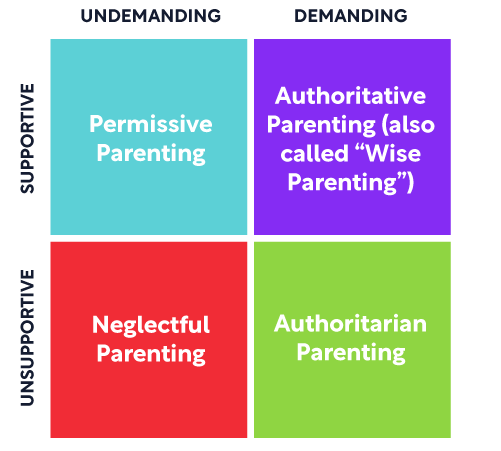
Evolving Terms
Duckworth renames “authoritative” as “wise” so as not to confuse it with “authoritarian,” but psychologists generally use the term “authoritative” when describing this parenting style. The other three terms Duckworth uses—authoritarian, permissive, and neglectful—are the ones that are in common use among psychologists today.
Duckworth didn’t originate the theory of the four categories. They were first developed in the 1960s by Diana Baumrind, a researcher at the University of California, who originally distilled them into just three categories, not four: authoritative, authoritarian, and permissive. Later, psychologists (along with Baumrind herself) came to see the permissive category as, in fact, two separate categories: permissive-indulgent and permissive-indifferent (today better known as “neglectful” or “uninvolved”).
Today, psychologists evaluate parenting styles based on how the parent ranks in four measurements:
Maturity demands
Control of the child’s behavior
Warmth and nurturing
Communication (whether or not the child’s opinion is sought and respected)
These measurements correspond to Duckworth’s axes of discipline and emotional support, also termed “demandingness” and “responsiveness” by some psychologists: Discipline incorporates maturity demands and control of behavior, and emotional support incorporates warmth, nurturing, and open communication.
Authoritative Parenting Leads to Better Outcomes
Duckworth notes that in the past, many parenting experts advocated for authoritarian parenting—full of rules and discipline but not much emotional support. In more recent years, she says that many parents have reacted to that attitude by going in the complete opposite direction—lots of emotional support but little directional guidance.
She argues, though, that the best parenting method lies in between these two extremes, combining disciplined guidance with emotional support. It’s the parenting style described by the upper right corner of the grid—authoritative, or wise, parenting.
Duckworth contends that authoritative parenting has consistently been shown to be the parenting method that best produces grit in children. In authoritative parenting, parents have high standards and expectations for their children but also offer loving support. Authoritative parenting produces kids who get higher grades, are more self-reliant, and experience less anxiety and depression. This is generally true across ethnicity, social class, and marital status.
The effect of authoritative parenting seems to carry on into adulthood. Studies show children of authoritative parents tend to end up with the healthiest behavior as adults:
- Children of neglectful parents drink alcohol and smoke twice as much as their wise-parented peers. They also display far more antisocial behavior, anxiety, and depression.
- Indulgent parenting produces children with just slightly better outcomes than neglectful parenting.
- Authoritarian parenting produces children with similar alcohol and smoking use to authoritative parenting, but slightly more antisocial behavior and noticeably more anxiety and depression.
When Authoritative Isn’t Best
Many studies have backed up Duckworth’s assertion that authoritative parenting leads to the best outcomes in children. However, some researchers have noted that these studies focused almost exclusively on families from Western, Anglo-Saxon, European or American cultures, but that when the studies looked at minority groups within those cultures, there were discrepancies in the study results. These discrepancies indicated that the authoritative style might not be the most beneficial style in non-Anglo-Saxon cultures.
Specifically, researchers observed that African American teens showed no correlation between authoritative (wise) parenting and achievement, and both Hispanic and Chinese American teens responded best to authoritarian parenting. Additionally, authoritarian parenting was correlated with higher achievement scores in communities with low income and low education.
Further, in some other countries, such as some Middle Eastern and Asian countries, authoritarian parenting doesn’t seem to be as detrimental to adolescents’ mental health as it does in Western cultures. And, studies in Spain, the Philippines, Germany, Mexico, and Brazil revealed that the permissive (or “indulgent”) method performed equal to, and sometimes better than, the authoritative method.
Several theories that have been put forward to explain these differences focus on the different environments in which children from these cultures grow up. In explaining the success of authoritarian parenting, psychologists look to the fact that many poor, ethnic communities can be dangerous, and authoritarian parenting, centering around obeying authority figures, can provide some protective benefits for children. Additionally, in authoritarian countries, the authoritarian parenting style may prepare children better for dealing with business contacts and authority figures as adults.
To explain the strength of permissive parenting, psychologists argue that strict parenting may be less acceptable in cultures that value egalitarian relations rather than hierarchical ones.
Tough Love
Duckworth notes that the term “tough love” has traditionally been associated with the authoritarian method of parenting, where parents show you they love you by enforcing rules and discipline, but not by offering emotional support.
However, Duckworth argues that tough love should be understood differently. She emphasizes both words of the term—tough and love—so that tough love is reflective of the authoritative parenting method where discipline and rules are combined with explicit emotional support. In this manifestation of tough love, a parent might compel their child to finish a sport program or an educational program, but the child understands that the parent has the child’s best interest at heart. Tough love is about the parent trying to help the child, but it’s never about the parent trying to control the child.
Ramifications of Tough Love in KIPP Schools
Critics of KIPP schools object to the way the program emphasizes the old-fashioned “tough love” associated with authoritarian parenting over more progressive teaching methods, arguing that the program mistakenly conflates a focus on effort with strict rules and regulations.
They argue that in striving to achieve academic performance goals, KIPP teachers adopt a “no excuses,” punitive mindset that, they contend, hasn’t been shown to be effective in raising students’ performance.
Critics further argue that if these kinds of strict, rules-focused methods were actually effective, they would have been adopted by schools in middle-class areas, but they haven’t been. Instead, wealthier students are educated with more supportive teaching methods that foster independent thinking and creativity. Critics contend that such differences might create two types of adult workers—one who’s been trained to think and one who’s been trained to follow orders—and that these groups of workers will be largely split along class and race lines.
Parenting Comes Through Messages
Duckworth notes that parenting styles are communicated through specific messages to children. If you regularly convey the following messages, you’re likely parenting wisely:
- My children can come to me with problems and know I’ll help them.
- I spend time just talking to my child or having fun with them.
- My kids have a right to their own point of view.
- I expect my children to follow the family rules.
- When my children make mistakes, I point out how they could do better, but not in an angry or judgmental way.
In contrast, these kinds of statements indicate you’re not parenting wisely:
- I don’t like listening to my kids’ problems and will ask them to stop talking about them.
- I rarely praise my kids for doing something right.
- I expect my kids to listen to my ideas and not raise objections.
- I make most of my kids’ decisions for them.
- When my kids do something wrong, I either punish harshly or let them get away with it.
Duckworth notes that teachers can convey the same messages to the same effect. She points to a study that showed when teachers give feedback on an essay along with a note saying, “I have high expectations and I know you can reach them,” the students revised their essay more than twice as much—and with far greater enthusiasm—than did students who received feedback with a note saying, “Here’s some feedback on your paper.”
Authoritative Parenting Can Become a Virtuous Circle
Although they don’t use the term, In The Leadership Challenge, Kouzes and Posner apply the concept of authoritative parenting in an organizational setting where leaders are in the parenting role, and explain how such enlightened leadership can inspire employees to perform better.
They focus on the importance of positive support in the form of feedback. When a leader conveys to her workers that she believes in their abilities, those workers feel respected and more highly motivated, and they’ll end up feeling confident, capable and empowered to take initiative. In one anecdote, a manager made sure to “parent wisely” in this way by keeping three coins in his left pocket as reminders to dole out positive feedback—throughout his day, he would move one coin to his right pocket whenever he recognized or encouraged his team’s efforts, aiming to have all three in his right pocket by the end of every day.
Kouzes and Posner argue that this kind of practice creates a virtuous circle whereby you explicitly make note of other people’s positive behaviors, which in turn encourages them to behave more positively, which in turn encourages you to comment on their behavior again.
Although Duckworth doesn’t specifically mention a virtuous circle, this is essentially what her advice would create: a situation in which you convey to your child, student, mentee, or direct report that you believe they are capable and that you support them emotionally, which in turn encourages them to achieve higher goals and makes them more emotionally secure.
Parents Need to Model Grit
Duckworth observes that consistently, parents who successfully impart grit to their children are those who model it—she notes that even parents who parent wisely won’t impart grit to their children if they themselves aren’t living it. She emphasizes that there are two components to this:
- Have your own passion and perseverance for your goals.
- Foster a positive relationship with your child so they will be encouraged to emulate you.
She notes that many studies have shown how readily children imitate the behavior of adults they observe, and that anecdotally, many successful, gritty children have careers that are in some ways similar to the careers of their parents, indicating that the interests of the parents are passed down to the child along with a work ethic.
As a caveat, she notes that while parents are typically the source of most of the grit-training in a child’s life, this is not always the case. Sometimes a child won’t have authoritative parents but will instead have another adult in their life who provides the right feedback, guidance, and emotional support to help them develop grit.
She points to examples of children from disadvantaged homes where the parents are either incarcerated or absent, but who still grow up to be successful, happy adults because other adults stepped forward to offer support at some point in their development: teachers, coaches, other relatives, and so on. The important thing is that there is some adult presence in a child’s life to model grit and support the child’s development.
The Influence of Environmental Factors on Interest
The importance of parental guidance points to one of the major criticisms of Duckworth’s theories, which is that her focus on grit places the blame for failure too much on the shoulders of the person who’s failed, ignoring the outsized influence that environmental factors have on a person’s development of interest and perseverance.
Duckworth doesn’t discount the influence of other people, though. She acknowledges the contributions of a community of supporters when, for example, she discusses Olympic swimmers who started off playing in pools and later joined local swim clubs and teams, until their identity shifted from “someone who swims” to “I am a swimmer.” This development depended not only on the personal grit of the swimmer, but also on the encouragement and support of the swimmer’s community.
In fact, Duckworth’s theories might be interpreted as an argument against “blaming the victim,” by exploring how people in positions of influence can help (or hinder) others in developing grit. Her theories are not only a recognition of the different ways that grit can be developed in a person, but also a guide to how parents, teachers, and coaches can teach grit, belying the argument that she places blame for failure on the shoulders of the person who failed.
Part 3.2: Extracurriculars and Grit
To foster grit in children, Duckworth highly recommends getting them involved in extracurricular activities. Extracurriculars have been shown to correlate well with student outcomes like better grades, higher self-esteem, and lower delinquency. In particular, studies show that the longer and the more intensely a child engages in an extracurricular, the better the outcomes.
Extracurriculars Predict Success
Duckworth points to numerous studies showing that children who participate in extracurriculars do better on almost every metric: grades, self-esteem, behavior, and so on. Further, these benefits last across many years—committing to an extracurricular has positive correlation with graduation rate, employment, and salary.
Notably, Duckworth observes that these long-term benefits of extracurriculars only exist among kids who commit to them for more than a year, and are more strongly correlated with kids who also achieve some kind of measurable advancement in the activity (for example, making the varsity team or being appointed editor of the school newspaper). She theorizes that this is because grit is a measure of pursuing a goal over the long term, and extracurricular activities are a way to practice grit. Therefore, those who stick with them for multiple years are getting more dedicated grit-practice.
In fact, she says, studies show that, after controlling for grades and SAT scores, follow-through—the ability to stick with a project—over several years predicted the future success of high school students more than any other identified personal characteristic (including socioeconomic status, career interests, educational goals, and over 100 other factors).
Do Grades Predict Success Better Than Follow-Through?
Duckworth discusses studies showing that follow-through is the strongest predictor of future success, but glosses over the fact that these results are apparent only after controlling for grades and SAT scores, leaving the question: Are grades and SAT scores actually stronger predictors of success?
Other researchers examining this issue have concluded that the strongest predictor of success is grade-point average (GPA), but not SAT or other standardized test scores. Consistently, across high schools from varying geographic and socioeconomic areas, GPA is strongly correlated with college graduation rates and course achievement, while standardized test scores had no consistent correlation—sometimes they were positively related, sometimes there was no relation, and even sometimes, there was a negative correlation, where higher ACT scores were associated with decreased graduation rates.
Researchers theorize that GPA is a result of not just test-taking ability, but also a wide variety of skills that are needed to succeed in college. In contrast, standardized tests measure a narrow set of skills, and are something that students can prepare for in specific, limited ways that may not translate into a better college experience.
Duckworth’s theories of grit do seem to be positively correlated with GPA, as grittier students are the ones who consistently study, show up to class, and put effort in over the course of their four years in high school. Therefore, while the studies she references control for GPA, they may be equally insightful even if they did not, as both follow-through and GPA seem to be strong indicators of success—although not SAT or other scores.
Why Are extracurriculars so helpful?
Duckworth discusses two main reasons why extracurriculars are so beneficial:
1. Extracurriculars are designed to cultivate the four elements of grit—interest, practice, purpose, and hope. Importantly, kids feel both challenged and interested when engaging in extracurriculars. In other activities, they often feel only one or the other: In class, they’re challenged but uninterested, and with friends, they’re interested but not challenged. Being both challenged and interested leads to grit.
Extracurriculars in History
Duckworth’s admiration for extracurriculars is part of a long cultural tradition—both parents and teachers have long been aware of the character-building potential of participating in sports and clubs. Psychologists started seriously examining these effects in the 1930s, positing three reasons to explain the correlation between extracurricular participation and higher grades:
Through organized games, students learn how to follow instructions—how to listen to them and apply them toward a desired outcome.
Students learn how to set goals and solve problems.
Students learn the importance of both motivation and persistence.
This last point in particular corresponds to Duckworth’s point that kids participating in extracurriculars are both interested and challenged—terms that mirror motivation and persistence.
2. Extracurriculars are led by an unrelated adult who offers supportive and demanding guidance. These adults act as complementary role models to parents—parents can find it hard to offer honest feedback to their children, often defaulting to praise for any effort. A coach or teacher is more emotionally removed from the child and is often able to be more straightforward, enforce rules more closely, and demand more accountability.
An Outside Authority Has Credibility
Although parents are usually the primary “coaches” of their children, many people have argued that outside of the home, having a non-parent coach can be extraordinarily beneficial. Duckworth notes that coaches and teachers who aren’t related to a child can often evaluate their behavior, strengths, and weaknesses with more fairness and honesty. Others note that because of this understood impartiality, children are likely to take the guidance of a coach or teacher to heart more readily. For example, if your parent says, “I know you can do this,” you might not be as inspired as you would be if your coach said the same words—you’re probably used to such encouragement from your parents and therefore might take it less seriously.
Causation or Correlation?
Duckworth acknowledges that there’s no definitive answer as to whether participation in extracurriculars is a cause of future success or if it's simply correlated with it—do extracurriculars train grit, or do gritty people tend to participate in extracurriculars?
Duckworth suggests it’s both. Commitment to an activity requires a baseline of grit, and then builds it at the same time. A student may initially get involved in an activity because they have a certain amount of interest (or because a parent makes them), but very often, their involvement turns out to be a transformative experience, through which they learn from others, develop their priorities, and develop character.
Psychologists call this the “corresponsive principle,” which states that the traits that steer us toward certain life situations are the same traits that those situations reinforce.
The corresponsive principle can create both virtuous and vicious cycles. For example, if you’re the type of person who likes to experiment, you may take up painting and enjoy trying out different methods and mediums. Each time you discover a new way to do a painting, you feel a satisfactory breakthrough, which encourages you to continue with the hobby, learning more as you experiment more. This would be a virtuous cycle.
In contrast, if you’re someone who worries a lot about money, you may be hesitant to invest in the stock market because you worry about the risk. As a result, you may miss many opportunities to increase your wealth, which would alleviate your financial anxiety, and therefore, you never achieve a level of financial security that would get rid of your worry. This would be a vicious cycle.
Exploring the Corresponsive Principle
While studies acknowledge that there’s no way to determine if extracurriculars lead to grit (and then success) or if gritty (and more successful) students are more inclined to sign up for extracurriculars, the question might be posed in reverse: If a student who has natural grit and ambition doesn’t have the opportunity to participate in extracurriculars, would that student end up developing the same success-oriented skills that they would have if they’d the opportunity to engage in the extracurricular?
For ethical reasons, a controlled experiment testing this question has never been run—there are ethical limits to how much researchers can meddle in a child’s life and, for example, tell a student who wants to sign up for debate club that they aren’t allowed to. However, given the fact that extracurriculars actively teach kids success-oriented skills and provide opportunities for practicing those skills, it’s likely that kids who participate in activities, and are therefore practicing success-oriented skills, will develop these skills more than kids who don’t participate, independent of the initial reasons the kids signed up.
This is another way to look at the corresponsive principle, and to answer the chicken-or-egg debate on which comes first: Does grit lead to participation, or does participation lead to grit? The answer can be both. Grit may lead a child to participate in extracurriculars, but that doesn’t negate the positive effect that the extracurriculars will have on the child’s grit.
Extracurriculars Teach Transferable Industriousness
Duckworth notes that much of the thinking on the benefits of extracurriculars is theoretical and hasn’t been tested experimentally. A proper experiment would assign a random assortment of students to activities randomly and track them to see if they develop grit that then transfers to other areas of their lives, like schoolwork. Of course, these types of experiments would be unethical—they’d be too intrusive in kids’ lives.
However, as a proxy for these kinds of experiments, she points to research examining whether doing difficult tasks prepares a person to conquer other difficult things. For example, lab rats are better able to figure out puzzles if they’ve been fed in a way that requires them to work for their food rather than just eating it off the floor. The same effect has been seen in children: School kids who are given difficult tasks work harder and longer on other, unrelated difficult tasks later.
Challenges Can Spark Creativity
Jack White, former lead singer of the White Stripes, believes so strongly in the positive effects that solving challenges can have on your motivation and skills that he structures his practice and performance habits around them, purposefully placing obstacles in his own way as he makes music.
He believes that when life gets easy, people lose their sharpness and their creativity, which mirrors the findings of the studies of lab rats and school kids that Duckworth references. He therefore makes his own processes difficult—he uses cheap guitars that don’t stay in tune and positions instruments far away from each other during performances, so that when he has to switch from, say, guitar to keyboards, he has to dash across the stage.
Research backs up his theories, demonstrating that increased challenges that require increased effort result in superior creativity. In one study, two groups were given puzzles to solve. Researchers distracted one group by calling out random numbers, while the other group was allowed to work in silence. The distracted group performed better, seeing unusual connections and making unexpected associations.
These findings, along with anecdotal findings like White’s, suggest that the power of effort may extend even beyond what Duckworth claims, and that effort not only allows success to happen but can itself transform the nature of those efforts.
Adopt a Difficult Extracurricular
Duckworth advises that to develop grit in your kids (or students, mentees, and so on), you require them to commit to an extracurricular activity, separate from school or work, that gives them a long-term goal to work toward. The parameters for this strategy are:
- Everyone in the family has to do a hard thing. A hard thing requires daily deliberate practice (such as learning guitar or training for a half-marathon).
- Everyone gets to pick their own hard thing. This develops interest.
- Everyone is allowed to quit, but not until a natural stopping point. Examples of stopping points include an orchestra recital or a race. They can’t quit just because they change their mind, have a bad day, or decide the activity is getting in the way of more fun pursuits (like hanging out with friends). After the natural stopping point, they are free to choose a different activity or continue with their current one. Duckworth recommends that for older kids (high school age), you require them to stick with a project for two years, then allow them to either switch to something else or continue.
Duckworth recommends that you yourself also choose an activity to work toward. This will model grit for your kids.
Short-Term Projects Can Benefit Grittiness, Too
Some experts suggest that goal-oriented projects can help develop qualities of grit even if they’re short-term projects, rather than long-term projects. Such programs can particularly help with the development of intrinsic motivation.
For example, in Drive, Daniel Pink advises that company managers implement a program for their workers called “FedEx days,” which are aimed at engaging workers in the same way that extracurriculars engage kids. A FedEx day is a 24-hour period during which workers are encouraged to tackle any problem they’re aware of in the company, from software problems to customer service issues. The only criteria are that the problem must be unrelated to the employee’s regular responsibilities, and that they must develop a solution and present it to their team the next day (the “next-day delivery” inspired the name of the program).
These unstructured, employee-led programs can produce insights and ideas that might never have seen the light of day otherwise. They also excite workers because they inspire them to take personal control of a problem and to use their creativity to overcome adversity—habits of thinking that Duckworth contends lead to grit.
Pink notes that some companies extend these programs beyond just one day, allowing their employees to, for example, devote 20% of their working hours over six months to the problem they’ve identified—essentially turning such programs into professional extracurriculars.
Pink also notes that parents can adapt these types of programs for children, encouraging kids to start and finish a project of their choosing over the course of one day, with the potential for further development. Such programs would allow kids to feel ownership of their project, which, as we discussed earlier, is part of helping them develop a sense of purpose as well—again, a key element of intrinsic motivation.
Extracurriculars and Inequality
Duckworth notes, with concern, that students in lower-income areas have less access to extracurricular activities than do students in better-off regions. There are several reasons for this. Schools that are strapped for cash cut extracurricular activities to save money. Many sports require sign-up fees, and even when they don’t, have uniforms and equipment that can be cost-prohibitive for families without disposable funds. The same goes for music activities, which require instruments and instruction. Additionally, extracurriculars require a time commitment that working parents may not be able to accommodate, nor do all families have access to transportation for games, practices, and lessons.
This inequality prevents kids in lower-income areas from developing the important skills of grit that are often fostered in students from wealthier areas. The difference is measurable: Duckworth observes that grit scores of lower-income high-school seniors were a full point lower than those of wealthier students in the samples she tested, indicating a troubling correlation between grit and socio-economic status.
Additional Repercussions of a Lack of Extracurriculars
Researchers worry that low rates of lower-income student participation in clubs and sports will damage these students’ futures in more ways than just a lack of grit-training. Lower-income kids are more likely to grow up in neighborhoods where drug and alcohol use, violence, and early sexual activity (often leading to teen pregnancy) are common. Supervised activities can provide alternatives to these types of pastimes and thus keep kids from making lifestyle choices that can trap them in poverty. In addition, extracurriculars often provide networking opportunities that can turn into job prospects, so not participating in extracurriculars can thus shut these kids out from career opportunities. And, not having a well-rounded resume can put them at a competitive disadvantage when applying for colleges.
While there are no easy answers to this problem, educators advise lower-income parents and students to seek out low-cost activities like volunteering. Others note that youth mentoring programs like Big Brothers Big Sisters can have significant social and academic impacts on young people growing up in difficult environments.
Part 3.3: Grit in Your Organization
Duckworth notes that when you’re in an organization with a strong culture (shared values and norms), it becomes part of your identity. So, for example, you’re not just a ballplayer, you’re a Yankee.
Therefore, Duckworth advises that to develop your grit, you should become part of a gritty group. You’ll conform to the group and adopt their gritty habits.
How Culture Develops
Duckworth argues that the effects of culture go in both directions between a group and its members. Often, a group is made up of naturally gritty people because it selects for them—for example, a successful company only hires highly motivated workers, and a winning sports team has gritty athletes because they’ve successfully passed tryouts. The grit of each individual contributes to the organizational culture.
Then, in reciprocal fashion, the grit of the group encourages even more grit in its members. When everyone around you is acting gritty, you’re more likely to. For example, if your friends arrive at the gym at five every morning to work out, it will normalize that behavior in your mind and you’ll be more likely to do so as well. This is the corresponsive principle at work: a group adopts the characteristics of its members and then enhances those same characteristics.
(Shortform note: In a continuation of the corresponsive principle, when a group’s culture is firmly established and easily recognized from outside the group, the group will then attract members who identify with that culture, again enhancing it. This can be seen with companies like Google—the company advertises its culture of hard work mixed with intense fun, and as a result, attracts workers who identify with those characteristics.)
How Cultural Identity Affects You
Duckworth contends that when your personal identity becomes intertwined with the identity of a group, you’ll typically start adopting the characteristics of that group. So, if your group has a gritty culture, you’ll start making decisions with a gritty mindset because it becomes part of how you see yourself. For example, you’ll get up early to exercise, not because you do a rational cost-benefit analysis weighing the advantages of working out against the advantages of sleeping in, but because you’ll think of yourself as the kind of person who gets up early to work out. Eventually, such decisions become habit.
(Shortform note: The power of a group to influence habits is well-established. It’s the psychology behind weight-loss programs like Weight Watchers or sobriety programs like Alcoholics Anonymous. Psychologists have found that the social aspect of such groups is one of the primary reasons they work—people respond to peer influences partly because they are hard-wired to foster social connections, and social connections are often strengthened when people have similar values and habits.)
How to Create a Gritty Culture
Duckworth offers several specific techniques to develop more grit within your organization:
Verbalize your values: Make sure your group members know how much you value grit. Pick some inspirational quotes that capture your values and post them. Some organizations (like sports teams, schools, and West Point) even require their members to memorize the quotes, which Duckworth contends helps them internalize those values.
(Shortform note: In The Leadership Challenge, Posner and Kouzes write that the first step in strong leadership is to establish, convey, and then model your values. They note that strong teams are built on shared values, which is why it’s so important to be sure that everyone agrees with, or at least understands, the core values of the organization.)
Measure and showcase your members’ grit: Have group members fill out Duckworth’s grit questionnaire. Let them know their scores. Repeat this process at a later date so people can see their progress. Engage in activities that highlight stamina and celebrate those who succeed. For example, a sports team might run an extra-long course or a music class might memorize an overly complicated piano score.
(Shortform note: Posner and Kouzes write that recognizing and celebrating team members’ accomplishments is crucial because such encouragement helps people function at their highest level. Positive feedback helps people endure when hours are long, work is difficult, and challenges seem daunting. Celebrations act as emotional replenishment that fuels their commitment.)
Coach grit: Work with struggling team members. Don’t just give them a goal and let them figure it out if they’re struggling—coach them to get to that goal with improvement plans that are reasonable but ambitious.
(Shortform note: In addition to coaching, Posner and Kouzes advise that you provide access to classes, seminars, and special projects. They also recommend you rotate some job responsibilities. All of these things will help develop your team members so that they are living up to their potential, and it encourages a growth mindset where your direct reports feel that you believe in their potential to grow.)
Hire well: Recruit people who are demonstrably grittier than the average in your team so that they can inspire the team to aim higher.
(Shortform note: Some experts advise that you go further and hire someone who’s not just better than your average team member, but who’s better than you. When you hire someone better than you, they inspire you to keep learning new things and they fire up your competitive drive, spurring you to improve yourself.)
Lead With Grit
Duckworth advises that above all, you model the gritty behavior you expect of your team members.
She notes that the two key factors that foster excellence in both teams and individuals are support and continued challenges. She notes that this is very similar to wise parenting, which offers emotional support combined with demands for excellence. Therefore, she reasons that an effective leader is somewhat like an authoritative parent—demanding, supportive, and modeling of the correct behavior.
(Shortform note: Duckworth’s view on leadership aligns with that of many other management experts, who advise that leadership is more about fostering productive relationships than commanding underlings. The Leadership Challenge, for example, advises that leaders don’t exist without a team, and a strong leader/team relationship is one where the team willingly and enthusiastically follows their leader. Therefore, when you work to develop your leadership, you should focus primarily on developing your relationships with your team members.)
Encourage Healthy Competition
Duckworth notes that competition doesn’t necessarily mean a win or lose battle against another person. The word originates from Latin and means strive together, a definition that doesn’t include the notion of one party triumphing over another.
Duckworth argues that the better meaning of the word “compete” is to strive for excellence—to push yourself against your obstacles so that tomorrow, you’re a little bit better than you were today. She recommends that a healthy culture of grit include an emphasis on this kind of competition—not to vanquish an enemy, but to push yourself to be better.
Collaborative Competition Leads to Long-Term Success
In The Infinite Game, Simon Sinek argues that competition can bring out the best in a person when they see their competitors not as rivals to be vanquished but as worthy rivals from whom they can learn as they struggle against them. Like Duckworth, Sinek proposes that you view competition as somewhat of a collaboration, using your rivalry to improve yourself, and seeing the real challenge as the skill you need to grow rather than the person you need to beat. He notes that when you see competition as a win-or-lose fight, you fall into short-term thinking that leads to short-term success. However, when you view competition as a call to improve yourself, you set yourself up for long-term success.