1-Page Summary
Standard economic theory relies on the idea that humans use infallible logic when making decisions, and even when we make wrong decisions, we quickly realize and remedy them. On the other hand, behavioral economics argues that humans frequently act irrationally, and we often don’t realize our errors at all. Instead, we continue making the same mistakes—we’re not only irrational but predictably so.
The good news is, it doesn’t need to be this way—here, we’ll discuss common pitfalls of human logic, and explore the forces that really drive your actions. Armed with this knowledge and awareness, you can consciously avoid the triggers of irrationality and improve your decision-making skills.
Irrationality Trigger #1: Relativity
It’s human nature to make comparisons to find guidance toward the “right” choice. We don’t have an inherent sense of the value of things, so we resort to surmising the value of an item by considering its relative advantage or disadvantage over another. Because of our need for guidance, relativity has a powerful influence on how we make decisions.
Many advertisers play into this need using the decoy effect. That is, they present you with options, including a clearly unfavorable option—the “decoy”—to trigger a comparison that will guide you toward a specific choice.
- For example, an advertisement for magazine subscription bundles might include three options: internet only for $59/year; print only for $125/year; and an internet and print bundle for $125/year. You’ll likely conclude that the print-only option—the decoy—is a rip-off. It’s much more expensive than the internet option, even though both options include only one medium. Instead, you’ll choose the bundle, which appears to offer two media for the price of one. However, if the print-only option weren’t included, you’d likely choose the cheapest option, internet-only.
We compound the decoy effect by making irrational comparisons—we tend to focus on similar, easily comparable products and reject products that are different and thus less easily comparable.
- Salespeople know this and play into it. When you’re deciding between two options (A and B) and their accompanying attributes, you’ll likely be presented with a decoy third option (-A). This option is similar to—but worse than—one of the options. Because the two “A” options are more easily comparable than A and B, you’ll quickly reject option B. Then, because the -A option is clearly worse than the A option, A will be your final decision—just as the salesperson intended.
Relativity doesn’t just drive irrational decision-making—it makes us miserable. We measure our possessions against others’ due to our comparative nature, which leads us into a trap of comparative consumption. There are two ways to avoid this trap.
- First, you can diminish your comparison opportunities. By controlling what products you see, you can exercise control over how tempted you are to make comparisons. For example, if you’re car shopping, only look at options within your means instead of browsing expensive, unwise choices.
- Second, change your focus. Think about your choices in a larger context—you may realize that your money will be better spent on something more rewarding in the future.
Irrationality Trigger #2: Anchoring
Often, you’ll find that your idea of a fair price for a product doesn’t match another person’s idea of a fair price. This is because of arbitrary coherence—your “right” price for an item is completely arbitrary, usually just the first price you saw that product listed for. Once you have a price in mind, it becomes a benchmark for all other prices for that product (coherence).
- For example, if you grew up in Hawaii, your idea of a fair price for a gallon of milk would be around $7—but for a Wisconsinite, a fair price would be around $2.95. The product is the same, but the idea of what’s a reasonable price depends on wherever you happened to grow up.
This process of establishing a product’s price as “normal” and making it the benchmark by which you judge all other prices for that product is called anchoring. You’re constantly influenced by prices—advertisements, the manufacturer’s suggested retail price (MSRP), a car salesman explaining a car’s value. A price “sticks” as an anchor as soon as you consider buying a product at that price. Though you may rationally be aware that prices must change depending on environment and circumstances, your anchors will irrationally inform your choices.
An anchor can easily develop into a long-term habit, through a process called self-herding—that is, if you have a positive first impression (your anchor, in a sense) of a decision you’ve made, such as trying a new product or restaurant, you’ll later make the same decision based on your memory of your first impression. Over time, you start to think that this behavior is a preference when it’s simply a habit built on that first impression.
These “preferences” often cost time and money—ask yourself what pleasure you’re getting from the habit.
- Is it worth the money you’re spending on it, or is it just a habitual decision?
- Would it be possible to cut back or spend your money elsewhere?
Irrationality Trigger #3: “Free”
“Free” is a powerful marketing tool because we’re inherently attracted to things that are free. Every transaction has an upside and a downside—you gain something, but you may have spent money on a dissatisfying purchase. “Free” eliminates the possibility of this downside, and does away with rational cost-benefit analysis.
- If you were offered a Belgian chocolate for 15 cents or a dollar-store chocolate for 1 cent, you’d likely do a quick cost-benefit analysis (as the standard economic model predicts) and choose the Belgian chocolate. It’s a very low price for a far superior product.
- If the price of each chocolate was lowered by 1 cent, there should be no difference to your choice because both prices are reduced by the same amount. But, instead of doing a cost-benefit analysis, you’ll choose the dollar-store chocolate, which is now free—pushing rational decision-making aside in favor of a transaction with no downside.
“Free” influences your choices even when it comes to products that must have a price (and therefore, a downside). By attaching “free” to a purchase, advertisers can trigger an irrational reaction that costs you more money. Online retailers practice this by offering free shipping on orders over a certain amount. This often costs you extra money in the end.
- For example, you’re shopping online and your total comes to $23.75. A notification pops up—you’re just $1.25 away from qualifying for FREE shipping. You add one more book to your order to snag the deal. That book cost you an extra $11, whereas paying for shipping would have cost just $4.
When you’re faced with something free, take a moment to question your decision-making. Ask yourself: If this wasn’t free, what choice would I make? Could I justify this purchase if the “free” part was eliminated?
Irrationality Trigger #4: Social and Market Norms
We all operate within two norms simultaneously. The first set of norms are social norms—requests are made and obliged because of the human need for connection and community. These social transactions have three key parts: they provide pleasure to both parties; there isn’t a need for immediate “compensation”; compensation isn’t monetary—it’s a reciprocal act of connection or community, such as inviting your neighbor for dinner to thank her for mowing your lawn.
The second set of norms are market norms—requests are made and obliged because they are expected and enforced. The key parts of market transactions are directly opposite those of social transactions: they’re not necessarily for pleasure; there’s a need for immediate compensation; compensation is monetary—non-monetary compensation is considered inappropriate.
Usually, you’ll keep these two worlds separate—you wouldn’t offer your friend payment for the dinner they cooked for you, or pay your employee with home-cooked meals instead of money. However, these two worlds occasionally mix—and the blurring of the two often creates irrational and unexpected outcomes. Sometimes, this will be to your advantage, but other times it can seriously damage pre-established relationships.
When you introduce market norms to social relationships, social norms disappear—often harming the social relationship permanently.
- For example, a daycare in Israel tried enforcing a late pick-up fee to encourage parents to be timely. Instead, the parents started showing up later—now that they were paying for the right to be late, they weren’t bound by the social expectations of being on time.
On the other hand, introducing social norms to market relationships usually has a positive outcome.
- For example, a group of lawyers refused when asked to significantly discount their fees when working with residents of a retirement home. However, when they were asked to volunteer their time and expertise to help the retirement home residents, they agreed. The social norms made them more interested in fulfilling social obligations than making money.
Furthermore, an experiment at MIT showed that people operating under unpaid social norms tend to work significantly harder than those operating under paid market norms. This suggests that the cultivation of social relationships is the best way to get people to do cheaper, more effective work for you.
- This idea extends to your workplace. While it feels more rational to have market relationships with employees, it’s more effective to create social relationships. Doing so taps into the sense of purpose, motivation, and loyalty that employees feel toward their work. You can accomplish this by fostering excitement about the work—for example, by reporting positive customer reviews or recognizing individual employees for excellent work.
Irrationality Trigger #5: Emotional Arousal
We think we know ourselves well enough to accurately predict decisions that we’ll make—but we don’t take into account that there are two selves driving our decisions.
- The first is who you are in a “cool state,” when you’re able to make decisions calmly and rationally.
- The second is who you are in an “aroused state.” In an emotionally aroused state—such as when you’re hungry, afraid, or sexually excited—you tend to make choices that are neither rational nor in your best interest.
Most people think that if they know their aroused self will act irrationally, they can train themselves to think clearly and rationally. However, experience with a particular aroused state doesn’t make you better at controlling how you act when you’re in that state again. The decisions you practice when you’re in a calm state won’t hold in your aroused state.
It might not be obvious, but procrastination stems from this discrepancy between cool state decisions and aroused state decisions. Procrastination is simply the abandonment of rational plans in order to indulge in whatever will appease your aroused-state emotions. You set your goals with the best intentions—while in your rational cool state. When your emotions are triggered, you naturally act in ways that aren’t aligned with what you want to do.
Because you can’t predict how you’ll act in an aroused state, you have to work against procrastination by creating natural guidelines toward rational decisions. There are three helpful anti-procrastination tools.
- Pre-commitments are promises or decisions your cool-state self makes that are aligned with the way you want to act. These commitments are made in such a way that when it comes time to act, you’re either held accountable to another person—such as a gym buddy—or the decision is made for you—as with an automatic savings plan.
- Breaking the cycle of random rewards is helpful if you spend too much time on things that should be put off until later, like checking your phone or email. These activities randomly deliver rewards such as a text from a friend, or an important email. When rewards aren’t predictable, they take on a surprising, addictive sheen; reducing the possibility of random rewards removes this temptation. Try putting your phone on Do Not Disturb while you work, or set your emails to chime only when an urgent email comes in.
- Creating positive associations can give you a type of “reward” for doing unpleasant tasks you usually put off, such as doing laundry or studying for exams. This helps fulfill your need for immediate gratification and prevents you from seeking it elsewhere. Try watching your favorite show every time you fold laundry to create an association between the two activities.
Irrationality Trigger #6: Ownership Bias
Ownership is an inherent part of our lives, but unfortunately, it drives us to make poor selling and buying decisions.
Irrational Selling Decisions
There are four particularities of human nature that drive poor selling decisions:
- You naturally start to love things as soon as you own them.
- You focus on potential losses more than potential gains.
- You assume that the buyer shares your view of the item.
- Your sense of ownership becomes stronger the more work you put into an item.
These particularities combine to create the endowment effect—that is, when you own something, you value it much more than other people do. This contributes to poor selling decisions in several ways.
- First, it’s harder to part with an object when you love it or are focused on its loss—driving you to price it exorbitantly, or not sell it at all.
- Second, when you price items you’ve put a lot of work into, you’re pricing based on your effort—not on the actual (lower) value of the item.
- Third, you’ll assume that your price is fair, because you know the item’s cost-worthy features. However, the buyer won’t see how the item is better than another, similar, lower-priced item.
It’s very difficult to think objectively about your possessions, but by recognizing how ownership colors your perspective, you can be more receptive to the advice of neutral parties—such as a friend or real estate agent. Their clearer ideas of the value of your possessions can help guide your decision-making.
Irrational Buying Decisions
Poor buying decisions stem from the fifth particularity of our nature—you can feel ownership of an object before you even own it. This is called virtual ownership, a powerful selling tool that usually comes in the form of advertisements and trial periods.
- Advertisements feed you a visual story where you can imagine yourself owning a product—which causes you to naturally fall in love with it.
- Trial periods, on the other hand, let you experience what it’s like to own a product. Because trials replicate the feeling of ownership, you’ll naturally start to feel that the product is yours and become averse to losing it.
In both cases, your lack of real-life ownership starts to feel like a loss—driving you to buy and therefore actually own, the product.
You can avoid the trap of virtual ownership in several ways. First, when you see an advertisement, think about how the product will really show up in your life. Second, avoid trial periods if you don’t need the product—once you “own” the product, it starts to feel like a need.
Irrationality Trigger #7: Options
It’s human nature to keep as many options open as possible. However, having too many options distracts you from your goals and causes you to miss out on disappearing opportunities. There are three ways to stop wasting time on insignificant options and commit to decisions:
1) Narrow your options. Recognize when options realistically have very little opportunity or potential and eliminate them from your thinking. Some of these options are insignificant and easy to dismiss—such as eliminating little-enjoyed activities from your children’s schedules. Other times, these options will be significant and difficult to choose between—such as choosing your major in college. In these cases, you’ll have to put a great deal of thought and commitment into deciding which option is the best choice for you.
2) Consider your losses. Even with only two options before you, you’ll spend time trying to decide which option is the “correct” choice. In these cases, focus on what you lose by not making a choice. For example, not committing to a major means you miss out on interesting electives, or staying in a fizzling relationship prevents you from creating happy memories with a new partner. While keeping many options open holds many opportunities, actually committing to one option is what grants you opportunity.
3) Recognize disappearing options. Examine options in the context of the long term—you’ll discover which options have a sense of urgency, because they won’t be available forever. These opportunities demand that you invest time and energy in them now. These options can be incredibly significant—such as choosing to spend more time with your children than on work—and other times, important in a small way—such as choosing to quit a club in order to spend more time enjoying your garden. This exercise eliminates options that don’t serve your best interests in the long term or can be revisited at a later time.
Irrationality Trigger #8: Expectations
Your perception of events is heavily colored by your expectations and knowledge going into an experience. This doesn’t just influence your belief of what happened—your expectations can physically modify your sensory perceptions.
- For example, in blind tests between Pepsi and Coke, most people prefer Pepsi. However, when people are told what brands they’re drinking, they overwhelmingly prefer Coke—their ideas of the brand physically modify the taste they experience.
Expectations—conscious and subconscious—exist in all facets of your life, and it’s important to try to keep them as unbiased as possible. While it’s difficult to “unlearn” the information that colors your experience of an event, you can find ways to make decisions and sort through problems as rationally as possible.
- You might present a neutral account of what happened to prevent people from arguing “their” side and highlight factual discrepancies. For example, instead of arguing, “You stole money from our savings for a ridiculous purchase, and you didn’t even ask me!” you could try, “Money was taken from our joint savings account for a large purchase that wasn’t agreed upon.”
- You could ask a neutral third party to help with arguments—such as a couples therapist.
The placebo effect is one well-known way that our expectations can drastically alter the outcome of an experience. The placebo effect is more nuanced than the simple belief that you are receiving effective medicine—experiments show that when medications and products come at a higher price, the placebo effect is stronger because we naturally associate quality and high prices. This means that companies and providers can not only influence how well we think products, procedures, or medications are working, but how well they actually do work—just by bumping up the price.
It’s a natural, unconscious reaction to think that low price is equivalent to low quality—putting in a moment of conscious thought goes a long way toward interrupting this irrational reaction. This moment of thought might look like reading the active ingredients in brand name and generic brand medications to objectively see that they’re the same medicine or reading user reviews when comparing two similar, but differently priced, products.
Irrationality Trigger #9: Trickle-Down Distrust
The rational way to consume resources is to commit to ensuring that resources aren’t exploited or depleted, so everyone can enjoy the benefits. However, there are often people and organizations that act in their short-term self-interest and destroy the resources for everyone in the long term. As a result, we naturally feel that we can’t trust organizations with public resources—they’ll exploit them, sooner or later. This general distrust of organizations has far-reaching implications.
First, we irrationally apply distrust to everyone instead of just the person or organization in question. For example, people are so used to seeing organizations use the word “free” as a sly marketing half-truth that they automatically think that any “free” offer must be a trick—so when a peer offers them something for free, they automatically distrust the intentions behind it.
Second, we’re more likely to engage in untrustworthy behaviors ourselves when we feel that others are not trustworthy. These dishonest behaviors may be beneficial in the short term, but they’re irrational because they only serve to continue the cycle of distrust. Those who do act with honesty are punished for doing so—men who don’t lie about their height are overlooked, or a candidate with an unembellished résumé doesn’t land an interview. In the future, they will also resort to untrustworthy behavior, because it’s the only way to be competitive.
If we worked toward building trust instead of spending energy on “winning” or avoiding being swindled, we’d be able to reap more rewards from our exchanges and transactions. The only way out of the ongoing cycle of distrust and untrustworthy behaviors is to become more trusting. There are two ways that you can accomplish this: consciously stop contributing to interpersonal distrust and engage with trustworthy organizations.
1) Consciously stop contributing to interpersonal distrust. Trust is an easily exploited resource—make sure that the way you communicate isn’t contradictory or doesn’t rely on confusing or hidden subtext. For example, make sure you always say what you mean. If you tell an employee that there’s “no rush” on a project, don’t become upset when they don’t start working on it right away.
2) Engage with trustworthy organizations. Working on interpersonal relationships helps establish small pockets of trust, but recall that most general distrust trickles down from distrust of organizations that exploit resources. To repair your general sense of distrust, engage with trustworthy companies that don’t demonstrate self-serving behaviors. Ask yourself: Does this company engage in initiatives that are in the interest of the common good, such as reducing carbon emissions? Is this company’s marketing misleading or dishonest?
Irrationality Trigger #10: Rationalized Dishonesty
We irrefutably think of ourselves as good and honest people, even though everyone is guilty of dishonest actions—like taking a roommate’s leftovers or swiping a few pens from work. Usually, your decisions about whether or not to act honestly depend on your conscience, which is essentially the internalization of social values. However, the influence of your conscience is only so strong—at times, the financial benefit of acting dishonestly can overpower your moral compass.
We put laws and oaths in place to prevent dishonesty, but the promise of financial benefit is strong. People easily find loopholes that allow dishonest dealings. For example, pharmaceutical companies can’t bribe doctors with money, but they can send them on nice vacations.
The key to being honest is recognizing the irrational mental gymnastics we go through in order to think of ourselves as honest while acting dishonestly. The type of dishonesty perpetrated by otherwise honest people is at least one degree separated from cash, because the absence of money makes it much easier for you to rationalize your actions. Rationalizations leave our consciences untriggered—we can believe that we’re honest people, despite the fact that we regularly engage in dishonest actions.
- For example, if you write off lunch with a friend as a business expense, you might think, “She works in a similar field so this was a valuable networking opportunity.”
The first step to becoming more honest is recognizing the ways you’ve rationalized dishonest behaviors. When you know your patterns of rationalization, it’s easier to spot them when they come up and consciously work against them. The second step is interrupting these thought processes by reframing your thinking—think about the cash value of your dishonesty. For example, if you’re about to write off that lunch as a business expense, ask yourself, “Would I take $100 directly from my company?”
Irrationality Trigger #11: Making Choices Aloud
When we make decisions aloud, we tend to be less satisfied with the outcome. This is because we tend to make very different choices in front of others than we would privately. And, when we make decisions aloud in a group, everyone in the group makes much more varied choices than if they were choosing privately. We do this because we have a need to project a certain “individual” image of ourselves to others. On the other hand, those who make decisions privately are more often satisfied with their choices—their decisions come from their preferences, not their need to prove something.
Be aware of this inherent need to make individual choices. While it may only result in a small unsatisfying decision—like ordering a drink you didn’t really want—it has the power to drive a large, life-altering decision—such as choosing a university you don’t love because a rival already chose your first pick.
It’s helpful to think ahead about your decisions, so you’re not tempted to change them in front of others.
- First, know what you want. If you wait to hear the decisions of others before making a choice, you’ll be easily influenced.
- Second, try to announce your decision first. Announcing your choice first puts a “claim” on the decision, and protects your individuality, even if someone else makes the same decision as you.
What Human Error Can Teach Us
Many of our practices are based largely on information about how people should act, but it’s clear that we should be more focused on learning how people do act. By doing so, we can find ways—irrational though they may be—to improve our communities and social relationships, make better choices for ourselves, and act with honesty.
(Shortform note: Read our summary of Thinking, Fast and Slow to learn more about how we make decisions, and why those decisions are often irrational)
Introduction to Behavioral Economics
The standard economic model that our world operates on is based on the idea that humans are rational creatures. This model assumes that when you’re presented with options or a decision to make, you’ll carefully weigh the benefits and drawbacks of each of your options, and choose the best possible outcome for yourself.
Furthermore, this model dictates that in the case you do act irrationally and make a poor decision, the flaw of your decision will be quickly revealed to you, you’ll realize your mistake, and you’ll avoid making the same mistake again in the future.
Behavioral economics, on the other hand, argues that humans are systematically irrational, often don’t recognize their mistakes, and don’t learn to make better decisions.
The emerging discipline of behavioral economics pushes against the standard economic model and seeks to understand why humans so frequently depart from perfect reasoning skills and how our everyday environments are used to influence and shape irrational behaviors and decisions.
Both experiments and real-life scenarios consistently reveal a significant quirk of human nature—we’re not only irrational but predictably so. Because we’re not conscious of when or why our decisions are irrational, we fail to correct our mistakes. Instead, we continue to repeat the same mistakes in such a predictable way that our irrational line of thinking can be used against us—by marketing agencies, employers, or even your real estate agent.
The good news is, it doesn’t need to be this way. In this book, Duke behavioral economist and best-selling author Dan Ariely untangles the common pitfalls of human logic and explores the forces that really drive your actions. Armed with this knowledge and awareness, you can consciously avoid the traps of irrationality and improve your decision-making skills to act in ways more beneficial to you.
Chapter 1: How Relativity Makes Decisions For You
It’s human nature to make constant comparisons in an effort to find guidance toward the “right” choice. This is why, as a general rule, people can’t pinpoint what they want until they see someone else with it. For example, if you were asked to shop for headphones, it’s likely you wouldn’t know exactly what to look for because you don’t know what makes for “good” headphones. However, if you spotted someone wearing a really sleek pair of headphones, you’d likely want to buy similar ones. Because someone else has those headphones, we assume that they’re a good choice.
Because of our need for guidance, relativity has a powerful influence on how we make decisions. Humans don’t have an inherent sense of the value of things or what the right decision is. Instead, we resort to surmising the value of an item by considering its relative advantage or disadvantage over another. However, these value-determining comparisons are often set up for us in a way that leads us to irrational choices.
An awareness of how we rely on relativity to make decisions is important because it influences all parts of your life—where and how you spend your money, how you choose who to date, and how satisfied you are with your life.
How Relativity Influences Your Purchases
Marketing agencies and salespeople understand that people naturally make comparisons, as a sort of decision weathervane. Subsequently, their advertisements and tactics are often framed to force you into making comparisons and drawing conclusions that are beneficial for them, not you.
The Decoy Effect
Many advertisers utilize the decoy effect. They present you with options, including a clearly unfavorable option—the “decoy”—to trigger a comparison that will guide you toward a specific choice.
Imagine that you see an advertisement for National Geographic subscription bundles. There are three options:
- Internet only: $59/year
- Print only: $125/year
- Internet and print: $125/year
The print-only option is the decoy—you’ll likely conclude that it’s a rip-off, because it makes no sense to pay $125 for just print when you could have the internet and print bundle for the same exact price. Furthermore, because the print-only price and the bundle price are the same, it seems that the bundle offers the internet subscription for free. Just as the advertisers planned, you’re thinking that the bundle is a very good deal.
It’s likely this is an irrational choice for you. Is it really necessary to have two media options? Perhaps you prefer to read print copies of magazines, or only intend to use the internet portion of your subscription. But, as it feels like the “right” choice compared to the other two, you’ll almost certainly choose the bundle.
Experiment: Magazine Subscriptions
For further proof of how drastically “decoys” can disrupt rational decision-making, consider the following experiment at MIT. In the first part of the experiment, the three subscription choices were presented to 100 students. As predicted, their choices were:
- 16 students: Internet only for $59
- 0 students: Print only for $125
- 84 students: print and internet for $125
In the second part of the experiment, the decoy was removed. Rationally, their choices should be exactly the same as in the first part, because the only option that was removed was the option that 0 students chose. Instead, the students responded as such:
- 68 students (up from 16): internet only for $59
- 32 students (down from 84): print and internet for $125.
The majority of students chose the internet-only option. This makes sense—the internet-only option is far cheaper, and university students are likely to only use the internet. This tells us that without the inclusion of an unfavorable decoy, we have a much greater capability to make rational decisions that suit our needs and preferences.
The Middle-Of-the-Road Decoy
At times, the decoy effect won’t be so obvious and there won’t be a clearly unfavorable option present. In these cases, you’ll look for information that can nudge you toward an option that feels safe or correct. Salespeople use this to their advantage, setting up options that act like gutter guards on the sides of a bowling alley, keeping you on a straight path toward the “middle” option they’ve already chosen for you.
This tactic can be hard to spot. Imagine that you’re shopping for a new television and you see three TVs set up together at the store:
- 36-inch Samsung for $500
- 48-inch LG for $825
- 60-inch Sharp for $1,560
As a customer, you’re unlikely to research how Samsung, LG, and Sharp measure up against one another and if the advertised prices are a decent deal or not. Instead, you’ll probably use the highest and lowest prices and biggest and smallest screens as comparative guidelines—and choose whatever’s in the middle. Your TV salesperson knows this, and prices his televisions and sets them up side by side to encourage this very thought process. In doing so, he guides you to the LG television (which likely turns him the largest profit).
This tactic could also look like a restaurant far overpricing something on the menu to maximize their profits. They do this because it’s been shown that restaurant-goers often won’t order the most expensive item on the menu, but they’ll very often order the second-most-expensive item on the menu. Therefore, when restaurants set their prices, they often list a dish that they’re not particularly interested in selling as their most expensive dish and will list a profit-turning dish they do want to sell a few dollars lower.
Beware of Easy Comparisons
One thing that compounds the trickiness of the decoy effect is the way we decide how much effort we’re willing to put into making comparisons. When making comparisons, we tend to focus on comparing things that are similar—therefore more easily comparable—and ignore things that are different and therefore less easily comparable.
Many industries, such as real estate and travel agencies, play into this line of thinking. When you’re deciding between two options (A and B) and their accompanying attributes, you may be presented with a third option (-A), which is similar to—but worse than—one of the options. Because the two “A” options are more easily comparable than A and B, you’ll quickly reject the B option. Then, because the -A option is clearly worse than the A option, A will be your final decision.
Imagine that you’re looking to purchase an apartment. The two most important factors in your search are outdoor space and distance to work. You find two interesting apartments—a split home in the suburbs (A) and a brownstone in center city (B). The suburban option is superior in terms of outdoor space, but the brownstone is much closer to your work.
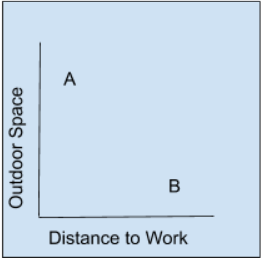
Your real estate agent then shows you a third apartment (-A): a suburban split home with a lot of outdoor space—but that outdoor space is directly next to busy train tracks.
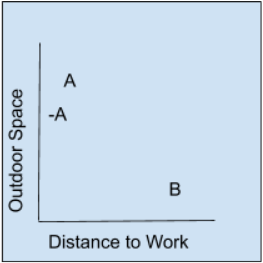
With the introduction of apartment -A, your real estate agent has essentially made the decision for you. You’ll naturally reject apartment B, because it’s too different from the others, and therefore harder to compare. Then, you’ll choose option A as it’s clearly the better of the two suburban homes.
The Decoy Effect in Travel Agencies
The decoy effect is a common selling tactic in travel agencies. Imagine that you’re planning a trip to Europe, and your travel agent shows you two packages—one for Barcelona and one for Amsterdam. You’re having trouble deciding between the two because they cost the same, and both include flights, a hotel, and breakfast. Both are interesting destinations with much to see and do.
Then, your travel agent presents a third option: another Amsterdam package. It’s the same price as the others and includes flight and hotel, but it doesn’t include breakfast. Now your choice shifts—it’s not just Amsterdam and Barcelona now. It’s Amsterdam (A), Amsterdam without breakfast (-A), and Barcelona (B).
You’ll likely reject Barcelona right away, as it’s different from the others and not easily comparable. Then, because included breakfast is preferable to no breakfast, you’ll choose the Amsterdam (A) package—just as your travel agent planned.
Using Knowledge of the Decoy Effect to Make Better Purchases
The decoy effect is a powerful selling tool, but you can consciously work against it. When making purchases, think about why you’re making the comparisons that you’re making. Are you just looking for a middle-of-the-road price, instead of doing research? Were you presented with options designed to lead you toward a specific choice?
When you’re aware of how the decoy effect is being used to influence your purchases, you can make a rational decision by doing research or by committing to making smart comparisons, even if the two items before you are very different and will take a good deal of mental effort to compare.
The Decoy Effect and Dating
The decoy effect works the same way when you’re comparing people as it does when you’re comparing houses, televisions, or vacation packages. For this reason, it can actually have a heavy influence on who you find attractive or choose to date.
In an experiment at MIT, students were presented with three photographs. Two of the photographs were of person A and person B, both similar in looks and overall attractiveness. The third photograph was of person -A—that is, a slightly distorted image of person A. The students were asked to choose which of the three people they would prefer to date.
75% of the students chose person A. Following the decoy effect, they rejected person B because they were different and therefore not easily comparable, and then realized that person -A was clearly unfavorable compared to person A.
An interesting takeaway here is that you can use the decoy effect to your advantage when it comes to dating. Try going to the bar with a friend who has similar physical characteristics to you, but is slightly less attractive and see how it plays out in your favor.
- First, the people you’re chatting up will focus on you and your friend, as the crowd is full of dissimilar faces that are too difficult to compare.
- Second, when it’s down to you and your decoy friend (-you, in a sense), you’ll be the more attractive choice.
(Of course, don’t tell your friend what you’re up to unless you’re interested in destroying a friendship.)
How Relativity Makes You Miserable
A last important point to understand about relativity is how powerful it can be in making you miserable, even if what you have is objectively good. Your comparative nature reaches far beyond making purchases or choosing who to date—it can cause you to ceaselessly compare your life to the lives of others. Recall from the beginning of the chapter that people often don’t know exactly what they want, until they see someone else with it. This is why you were happy with your reliable Honda until you saw your neighbor’s new Tesla. Or, why your brother-in-law’s recent jet ski purchase made you suddenly want to get into boating.
Of course, this tendency toward comparison and subsequent envy comes with myriad problems. These problems can be smaller, such as the trap of comparative consumption you fall into when you need to have the same products as those around you. Other times, comparison and envy can translate into larger problems.
- For example, information about CEO salaries is often leaked as a way to create outrage toward the CEO and corporation in question and to push for fair wages for those at the bottom of the ladder. Instead, this often has the unintended effect of CEOs across the country realizing that their salaries could be even higher, and pushing for a salary equal to or better than the one leaked.
Finding Happiness Despite Your Comparative Nature
Relativity is all around you, and your perception is inherently colored by it. However, there are several ways you can control your comparison compulsion.
1) Diminish comparison opportunities. By controlling what products you see, you can exercise control over how tempted you are to make comparisons. For example, if you’re shopping for cars, be sure to only look at cars that are well within your means instead of casually browsing expensive, unwise choices. Looking at expensive cars will inevitably prompt you to compare them against your current car—which of course, makes the expensive car look like a good choice.
2) Change your focus. It’s helpful to think about your choices in a larger context—you may realize that you are making a decision that isn’t for the best, in the long term. Take the example of shopping for cars. In a moment of narrow focus, giving up your reliable Honda for a new Tesla might seem like a good choice. The Tesla has more features, self-parks, and doesn’t require gas, and your Honda is a little on the older side anyway. However, reconsider this choice within a larger context. If you don’t buy the Tesla, you’ll save yourself a great deal of money, which could probably be better spent. You could eventually buy a new reliable Honda and have money left over to take your family on a vacation.
In the end, it’s important to understand how strong the influence of relativity can be on your decisions and your desires. With the awareness that your choices might not be sound, you can consciously work against your natural tendency to make comparisons. Instead, focus on doing thorough research before making purchases, putting extra mental effort into making comparisons between dissimilar items, and focusing on what you do have instead of what you could have.
Exercise: Think About How the Decoy Effect Has Influenced You
Stopping the decoy effect from influencing your decisions depends on being aware of what faulty or forced comparisons look like in your life.
Think of the last purchase you made where you had to choose from a set of options (for example, purchasing a new refrigerator or selecting from a menu at a restaurant). What decision did you make?
What factors led you to the option you ultimately decided on? (For example, the fridge model seemed to be the best value, or the lobster was a good price.)
Looking back, how do you think the decoy effect may have influenced your purchase? (For example, the fridge you chose was the mid-price model in the shop, or the lobster was the second most expensive item on the menu.)
How would you have made the decision differently, if you were conscious of how relativity was a factor?
Exercise: Break the Cycle of Comparative Consumption
Practice diminishing your comparison opportunities and broadening your perspective to avoid the irrational purchases that relativity can encourage.
Think of a large purchase you’re considering. What is the purchase, and what prompted you to first consider making it?
How do you think comparison may be influencing your decision to make a purchase? (For example, your friend got a jet ski and now you want one, or you recently saw an SUV that’s nicer than your current car.)
How can you diminish your comparison opportunities? (For example, not researching jet skis, or committing to not going to the car dealership.)
Change your focus—what could that money be better spent on? (For example, you can go on vacation and rent a jet ski, or you can put the SUV money toward a house.)
Chapter 2: How We Unreasonably Determine Reasonable Prices
Often, you’ll find that your idea of a fair price for a product doesn’t match another person’s idea of a fair price. This disparity can be explained by the concept of arbitrary coherence—the “right” price you assign to an item is completely arbitrary. Usually, it’s simply the first price you saw that product listed for. But, once you have that price in mind, it influences how you think of the present and future prices for that product (coherence).
- For example, if you happened to grow up in Hawaii, your idea of a fair price for a gallon of milk would be around $7. However, imagine if you lived in Wisconsin—where milk runs about $2.95 a gallon—before moving to Hawaii. You’d find Hawaii milk prices ludicrous. The product is the same, but your idea of what it should reasonably cost is based on the milk prices wherever you happened to grow up.
This process of establishing a product’s price as “normal” and making it the benchmark by which you judge all other prices for that product is called anchoring. In this chapter, we’ll discuss just how irrational these anchor prices can be, and then examine how anchors can compound into long-term irrational decisions.
How You Set Anchors
The figure you establish as “normal” is completely arbitrary—so it makes sense that anchoring can be triggered by any figure. One experiment at MIT set out to explore this idea, using the digits of students’ social security numbers.
Experiment: Anchoring With Social Security Numbers
The participants were shown several objects up for silent auction—including several well-aged bottles of wine, Belgian chocolates, a book, a wireless mouse, and a keyboard and mouse package. Each participant received a list of the items and was asked to write the last two digits of her social security number at the top of the page. Then, they wrote those two digits next to each item in the form of a price (25 → $25, for example). Lastly, the participants indicated a) whether they would pay their listed price for each item, and b) what bid they’d prefer to place on each item.
The results revealed that those with social security numbers ending in higher digits (80 to 99) were more likely to bid higher on each item, and those with lower social security numbers ending in digits (01 to 20) were likely to bid the lowest.
What Might Anchoring Look Like for You?
While this experiment demonstrates that social security numbers can be effective anchors, it’s important to understand that any number can have the same effect—the first two digits of the students’ phone numbers, for example. Of course, you don’t create anchors in your everyday life by thinking about your telephone number or social security number.
Rather, you are constantly influenced by prices—advertisements, the manufacturer’s suggested retail price (MSRP), a car salesman explaining a car’s value. As soon as you consider buying a product at a particular price that’s been put before you, that price “sticks” as an anchor. You may rationally be aware that product prices must change depending on environment and circumstances, but irrationally, these anchors will continue to inform your choices.
These choices may be small, such as determining that milk in Hawaii is too expensive based on your experience with milk prices in Wisconsin. Other times, anchoring might drastically affect how you make large decisions, such as looking for housing.
- For example, when moving from Lancaster, Pennsylvania to Boston, you may rationally expect housing prices in Boston to be much higher. Nevertheless, you will irrationally—yet automatically—reference your anchor prices from Lancaster when looking for an apartment. This will drive you to downsize rather than spend more on housing than you’re used to.
Experiment: Do Anchors Influence Future Decisions?
An experiment at MIT set out to determine if your anchors affect future purchases as well as those you make right after encountering an anchor.
In the first part of the experiment, two groups of participants had to listen to three 30-second clips of annoying sounds. After listening to the sounds, Group A was asked if they’d be willing to listen to the sound again for 10 cents, and to name the lowest payment they’d accept for listening to the sound again. Group B was asked the same questions, but their anchoring rate was 90 cents.
The results showed that participants in Group A asked for much less money to listen to the sound again (an average of 33 cents) than participants in Group B (who asked for an average of 73 cents).
In the second part of the experiment, participants from both groups listened to 30 seconds of a new annoying sound and were asked if they would listen to the sound again for 50 cents. Then, they had to indicate how much they’d ask to be paid to listen to it again. The results showed that Group A asked for a much lower payment than Group B—even though they’d both been presented with the new anchor of 50 cents.
These results suggest that our anchors, once established, influence our present decisions as well as our future decisions. In short, we tend to stick with our first impressions, even when they may not be rational—and knowing this is key to spotting your vulnerability to making irrational decisions based on impressions.
Making Decisions Based on Herding
To understand how an anchor can translate into long-term habits, it’s important to first understand the concept of herding. Herding is when you observe the behaviors of other people to decide if something is good or bad and copy the crowd’s behavior. For example, if you see a line of people waiting to get into a restaurant, you’ll determine that it’s a good restaurant and might also hop in line.
What’s interesting is that you can also perform self-herding—you decide if something is good or bad depending on your own past behavior, and you continue copying that behavior. In this way, a positive first impression (anchor) about a decision you’ve made can result in a long pattern of copying your own behavior. Eventually, you believe this behavior is your preference and not just an echo of that first decision.
Example: The Sandwich Shop
On a whim, you decide to get a sandwich at the artisanal deli down the block from work, instead of going to Subway as usual. The sandwiches, while they’re much more expensive, aren’t much different. However, the deli has a nice perk—comfortable couches and a fireplace to enjoy while you eat. Overall, you form a positive first impression about the deli—which becomes the anchor underpinning your future lunchtime decisions.
The next week, you’re thinking about where to go for lunch. Rationally, you should think through your options while considering the cost of the food, the distance from work, and so on. Instead, you simply recall that you tried the deli and that you enjoyed the experience. Based on this positive first impression, you determine that the deli is a good choice and go again. So begins the process of self-herding.
The third week, you recall your two previous decisions to go to the deli and go again—a bit like getting in line behind the people queuing outside a restaurant. Based on the fact that you keep going to the deli, you may believe that it’s your preference. In fact, it’s just your primary decision compounded into a habit. Habits built from self-herding often aren’t the most rational choice. You know, rationally, that Subway is closer to your office and offers a similar product for a lower cost. But, because you continue going to the deli, you irrationally believe that you’re making a conscious decision about how you want to spend your money.
The Circumstances That Can Set New Anchors
Since the products are similar, shouldn’t you be anchored to Subway’s prices, and realize that the cost of the artisanal sandwiches is too high? Rationally, yes. However, because the artisanal place feels so different, it becomes a first impression, instead of being comparable to the Subway. If the deli had a very similar aesthetic to Subway, you’d likely realize that the high prices weren’t the best use of your money. But the fact of the matter is, the food looks nice and there are nice window seats—in your mind, it’s a completely different type of place and the higher prices are justified.
(Shortform note: For more examples of anchoring and how it works, read our summary of Daniel Kahneman’s Thinking, Fast and Slow.)
Making Better Decisions
Thinking rationally about your behaviors can help you untangle habits from your true preferences—allowing you to spend your money in more fulfilling ways. In examining your “preferences,” ask yourself several questions:
- How did this preference start?
- What pleasure am I getting from this preference? Is it worth the money and time I spend on it?
- Is it possible for me to cut back? Is there a wiser way I could be spending this money?
You can also prevent yourself from forming future habits by giving extra thought to your first decisions to do something. Would you want it to become a long-term habit?
Why the Supply & Demand Model Doesn’t Make Sense
The implications of price anchoring and our tendency to make irrational decisions based on our own past behaviors and impressions are much further-reaching than choosing a favorite sandwich shop. In fact, we should be rethinking the standard supply and demand model. Standard economics would tell us that prices are determined by demand—the higher the demand, the more people are willing to pay for a product.
However, we know this model doesn’t make sense, because our anchors are so arbitrary.
- First, people often aren’t aware of their anchors, so it’s hard to accurately predict how much they’d be willing to pay for a product.
- Second, anchors can be manipulated very easily—simply thinking about several random digits can create an anchor.
These findings of behavioral economics suggest that it’s actually the prices themselves, or the anchoring that happens on the supply end of the system, that influence how much people will pay.
Furthermore, the discussion of self-herding tells us that looking at peoples' preferences won’t give you accurate information about their willingness to pay for products—their demand is based on their memories. The aversion we feel to paying a higher price for a product is because we remember how much we paid for it in the past (or the anchor we established when we considered buying it), and we want our present decisions to be coherent with our past decisions. Of course, this means that over time, your anchors can naturally change.
- For example, if the price of milk in Wisconsin jumped from $2.95 to $5 overnight, there would be a steep drop in demand because the memory of $2.95 gallons would be fresh in everyone’s minds. However, as they continue needing to buy $5 milk over time, the decision to do so becomes a habit—decisions coherent with previous decisions. Over the long term, their memories of the $2.95 gallon would fade and demand for milk would steadily increase back to where it was before.
Exercise: Question Your “Preferences”
One way to help ensure that you’re making rational choices is to reflect on the reasons you’re making those choices.
Think of one of your purchasing habits (for example, a latté every morning, or a new iPhone every time a new model comes out). Describe the habit.
How did this habit start? Try to think back to your first decision to purchase this product.
Think about if this habit is really a preference—how much pleasure or satisfaction do you get when you indulge in it?
How could you cut back on this habit, or alter it so that it costs you less money?
Chapter 3: The Power of “Free”
In this chapter, we’ll discuss the concept of “free,” how it’s used to trigger irrational choices, and its potential for driving positive social change.
“Free” is a powerful marketing tool because we are inherently attracted to things that are free. This is because almost every transaction has an upside and a downside. The upside is that you gain something from the transaction. The downside is that you’ve spent money and it’s possible you won’t be satisfied with your purchase.
“Free” eliminates the possibility of a downside in a transaction. There’s no risk that your money will be spent on a dissatisfying purchase. Furthermore, because the free item is upside-only, you perceive it as much more valuable than it really is. For these reasons, you’ll naturally choose a free item above all else, even when it’s not the most rational choice. The following experiment illustrates how the possibility of getting something for free can interrupt rational thought processes.
Experiment: The Chocolate Sale
In this experiment, a chocolate-selling stand was set up in one of MIT’s student centers.
- In the first part, customers had the choice between a Lindt truffle for 15 cents, or a Hershey Kiss for one cent. In this scenario, 73% of the customers chose the Lindt truffle. This was a rational choice—not only was the Lindt truffle an objectively superior product, but it was being offered at a very attractive price.
- In the second part, each chocolate’s price was lowered by one cent. Now, the Lindt truffle was 14 cents, and the Hershey Kiss was free. Even though the Lindt truffle was still a superior product at a great price, the label of “free” on the Kisses had more power—this time, 69% of the customers chose the Hershey Kiss.
This behavior is especially interesting because it contradicts the standard economic model, which would predict that, because both chocolates were reduced in price by the same amount, there should be no difference in purchase rates. Customers would do the same simple cost-benefit analysis as when both chocolates came with a cost, and conclude that the Lindt truffle would be a far more pleasurable experience for a very small cost. However, the standard economic model doesn’t take into account the power of “free.” Instead of thinking through a cost-benefit analysis, humans quickly push rational decision-making aside in favor of a transaction with no downside.
Even Attached to a Price, “Free” Works
It’s fairly common sense that when you’re presented with two products—one free and one at a price, no matter how small—that you’ll choose the free item. However, what’s less common sense is that “free” has the power to influence your choices even when you’re choosing between two products that must have a price. Just by attaching the concept of “free” to a purchase, advertisers can trigger an irrational reaction in you that benefits them, and costs you more money.
You’ll commonly see online retailers putting this in practice by offering free shipping for orders that exceed a certain amount. While free shipping may feel like a good deal, it often costs you extra money in the end. Imagine that you’re shopping on Amazon, and your total comes to $23.75. You receive a notification that you’re just $1.25 away from qualifying for FREE shipping. You add one more book to your order and successfully snag the free shipping deal. The problem? The book you added cost you an extra $11, whereas paying for shipping would have only cost you $4.
If you’re skeptical that it’s truly the idea of “free” that triggers this reaction and not just low-cost shipping, consider what happened in France when Amazon rolled out their free shipping concept. Instead of free shipping, Amazon.fr chose to offer shipping at the very, very low cost of one franc (20 cents). When the shipping was a low cost—even a negligible amount like one franc—customers acted much more rationally and made fewer impulse purchases to push their order amount to the threshold for the shipping discount.
While falling victim to the trap that “free” presents might not be a big deal on smaller purchases like books, be careful not to let it influence the way you make larger decisions, like buying a new car. Imagine you’re looking for a new car for your family—you have the choice between a sports car and a sturdy SUV. The SUV costs a bit less and rationally, is a better match for your needs. However, your salesperson mentions that the sports car comes with free oil change for four years. Triggered by the idea of getting something for free—and irrationally, thinking that these oil changes will make up the difference in cost between the two cars—you spring for the sports car.
Diminishing the Power of Free
The first part of diminishing the power that “free” can have is recognizing the ways it might be showing up in different aspects of your life. Keep in mind that it’s not only used to trigger irrational purchases. It can also be used to manipulate how you spend your time—you wouldn’t spend 45 minutes standing in line for ice cream unless it was Free Cone Day at Ben & Jerry’s or unless each ice cream came with a free t-shirt.
The second part is questioning how the presence of “free” might be affecting your decision. Take a step back and think:
- If this wasn’t free, what choice would I make?
- Would I be able to justify this purchase or time spent if the “free” part were eliminated?
Taking a moment to think consciously about why you might be making certain choices is a helpful step in interrupting the natural, yet irrational, reaction we have to free items—thus clearing the way for a more careful and rational analysis of what the best choice is.
The Positive Power of Free
It’s important to keep in mind that the power of “free” can be used toward positive outcomes if harnessed correctly. First, we’ll look at an example of how you can use it on a small scale in friendships, and then we’ll discuss how the power of free can drive social changes.
Dinner With Friends
Knowledge of humans’ natural positive reaction to “free” can help you strengthen the bonds of your friendship group—all you need to do is pick up the tab at your next outing.
Recall that nearly every transaction has the downside of having to spend money. If all of your friends need to chip in a bit for their portion of dinner, everyone at the table experiences this downside. However, the negative feelings associated with spending money only worsen to a certain point, and then plateau.
Imagine that every $20 spent is one unit of discomfort, and this discomfort plateaus around $60. If you and five friends went for dinner and each owed $20 at the end of the night, your group would experience a total of 6 units of discomfort. However, if you were to pay the entire bill yourself, you would only experience 3 units of discomfort and would spare the rest of your group any discomfort at all.
Ideally, another friend would have the responsibility of picking up the check at the next outing, and another at the outing after that. This continues the cycle of diminishing the downside of the transaction and thereby increasing the perceived value of the get-together, and it triggers the positive emotions that come with getting something for free.
Social Change, for Free
Another positive aspect of “free” is its potential for getting people to participate in programs that benefit their communities, their health, or the environment. For example, to encourage more people to drive electric cars, you could add the influence of “free” to the purchase—such as in an offer for free emissions testing or free weekend parking in your city. Or, to encourage more people to get preventative medical exams, such as mammograms and colonoscopies, make these exams free. Reduced copays don’t spark the same amount of interest or motivation as zero-cost copays.
Exercise: Think About How “Free” Triggers You
Knowing how you tend to behave when “free” is in the equation can give you valuable insight into your vulnerabilities, helping you stop its influence.
When was the last time you got an item—or a feature of an item—for free? Describe the transaction.
Was this item or feature truly free, or did you have to pay for it in time or money? (For example, you bought an overpriced printer because it came with 2 free ink cartridges, or you spent several hours in line waiting to get into a museum for free.)
If this item or feature hadn’t been free, would you have been able to justify this choice, or would you have made a different choice?
How can you commit to looking out for the influence of “free” in the future? (For example, looking on Groupon for discounted museum tickets, or crunching the numbers to figure out how much those two ink cartridges really saved you.)
Chapters 4-5: Navigating Social Norms and Market Norms
In this chapter, we’ll discuss the concepts of “social norms” and “market norms” and the unexpected choices we make when these two worlds collide.
We all operate within two norms simultaneously. The first set of norms are social norms—requests are made and obliged because of the human need for connection and community. These requests look like asking a friend to help you move, or cooking a big meal for your family. These social transactions have three key parts:
- They provide pleasure for both parties.
- There isn’t a need for immediate “compensation.”
- Compensation isn’t monetary—it’s a reciprocal act of connection or community, such as inviting your neighbor for dinner to thank her for mowing your lawn.
The second set of norms are market norms—requests are made and obliged because they are expected and enforced. These transactions look like a tenant paying their landlord rent, or an employer paying their employee’s wages. The key parts of market transactions are directly opposite those of social transactions:
- They’re not necessarily for pleasure.
- There’s a need for immediate compensation.
- Compensation is monetary—non-monetary compensation is considered inappropriate.
Usually, you’ll keep these two worlds separate—you wouldn’t offer your friend payment for the dinner they cooked for you, or pay your employee with home-cooked meals instead of money. However, these two worlds occasionally mix—and the blurring of the two often creates irrational and unexpected outcomes. Sometimes, this will be to your advantage, but other times it can seriously damage pre-established relationships.
First, we’ll discuss an experiment that explains how our mindsets change when shifting between social and market norms. Then, we’ll explore the various ways that the blurring of these norms can affect your relationships in unexpected ways.
Experiment: How Norms Drive Work Ethic
Part 1: Monetary Compensation
Three groups of participants were tasked with dragging an image of a circle into the image of a square on a computer. They were instructed to drag the circle into the square as many times as they wanted in the experiment’s 5-minute span. Each group received a different payment:
- Group A received $5 for their participation.
- Group B received between 10 and 50 cents for their participation.
- Group C was not paid—instead, they were asked to participate as a favor.
The results showed that on average, Group A performed significantly more circle drags than Group B—this tells us that under market norms, people will work harder when their payment is higher, as we might expect. However, the results also showed that the unpaid Group C dragged more circles than both paid groups. This reveals that people operating under social norms will generally work harder than those operating under market norms.
Part 2: Non-Monetary Compensation
The participants were asked to perform the same task but would receive small gifts instead of monetary compensation.
- Group A received a box of chocolates worth $5.
- Group B received a candy bar worth 50 cents.
- Group C was asked to participate as an unpaid favor.
Under these new conditions, the results showed that all three groups put an equal amount of effort into the task, matching the effort of Group C from the experiment’s first part. These results suggest that gifts as compensation stay within the social norms that drive a higher work ethic.
Part 3: Non-Monetary Compensation Attached to Monetary Ideas
The participants were given the same task and again offered small gifts as compensation. This time, the experimenters told participants how much their gift was worth—Group A was told that they’d receive a 5 dollar box of chocolates, and Group B was told that they’d receive a 50-cent candy bar.
The results showed that those who received the more valuable box of chocolate worked significantly harder than those who received the chocolate bar—in other words, they acted the same way as participants who were compensated with money. These results suggest that the mere mention of monetary value is enough to push us out of social norms into the world of market norms.
Imposing Market Norms on Social Relationships
You should be careful when introducing market norms to social relationships because doing so causes social norms to disappear—often harming the social relationship, sometimes permanently.
A great example of this is a daycare that was having problems with parents regularly arriving late to pick up their children. They rationally—but mistakenly—assumed that this problem would be solved if they charged a small fee for late pick-up.
Under the previous social norms, the parents were motivated to get to the daycare on time in order to avoid the embarrassment of inconveniencing their children’s caretakers. However, once the daycare introduced a monetary fee, replacing the established social norm with a market norm, the number of late pick-ups increased significantly. The parents now felt that they were paying for the right to pick up their child late and were no longer motivated by the social obligation to be on time.
Realizing their mistake, the daycare removed the fine—but the damage was already done. The social norm no longer existed, and the high number of late pick-ups continued.
Why Corporations Should Avoid Social Norms
Another area where you’ll commonly see problems with the mixture of market and social norms is in businesses that market themselves as a “friend” of their clients. These businesses work hard to create a relationship that appears to operate on social norms. While this might have the short-term benefit of capturing the client’s trust, it’s a mistake. Because corporations and their policies inherently operate under market norms, they’ll frequently need to impose those market norms on the social relationships they’re constructing, violating the relationships irreparably.
For example, a car insurance company that’s branded itself as your “partner” may need to deny your claim and put you out thousands of dollars. By doing so, they’ve violated a serious social boundary—instead of sticking to the non-monetary, favor-based relationship in line with their image, they’ve imposed a financial transaction on your relationship. This permanently damages their relationship with you, who will never again think of them as a “partner” who has your best interests in mind. Their reputation as a trustworthy company is further tarnished when you tell people about your poor experience.
Imposing Social Norms on Market Relationships
While imposing market norms on social relationships usually has a damaging outcome, imposing social norms on market relationships usually has a positive outcome. Money is the most expensive, but least effective, way to get people to do what you want. Instead, you should focus on cultivating social relationships and establishing social norms—as the circle-dragging experiments revealed, social norms lead to more effective work, for a much cheaper price.
This idea is applicable on a small scale—you know it makes sense to ask a friend to help you move as a favor, instead of paying up for professional movers. Your friend will likely work as hard as—or harder than—the movers, and you’ll save a good deal of money. The idea is also applicable on a larger scale—as an employer, you can create a more effective workplace by imposing social norms on the way you compensate your employees.
Navigating Social Norms With Employees
While it may feel more rational to focus on market norms in relationships with your employees, it’s more effective to create a sense of social norms. Creating social norms within your workplace taps into the sense of purpose, motivation, and loyalty that employees feel toward their work. They’re willing to work harder when they feel a sense of security in their job and can trust that their employer will help them in hard moments. You can establish social norms and this sense that you are a partner to your employees in several ways.
One way is to make sure your employees have robust medical benefits, but this can become expensive, and at times blurs market and social norms dangerously. For example, if your medical plan requires high deductibles or the amount of money you’re putting into medical benefits appears on your employees’ payslips, the benefits no longer feel like a favor or perk.
Another way to cultivate social norms is to offer your employees gifts instead of money—these can be small and personal, like a subscription box of their favorite teas, or much larger, like a week-long trip in a sunny location. However, while gifts will keep you safely in the realm of social norms, the costs will eventually start adding up in a big way.
(Shortform note: Read our summary of The Power of Moments to learn how small, personal gifts can boost employee satisfaction and motivation.)
The best—and cheapest—way to cultivate social norms in your workplace is to foster excitement and purpose for the work. When people feel that carrying out their purpose is a type of compensation in itself, they’re more willing to overlook a low monetary salary. This can work very well for startup companies—often, they aren’t able to pay their employees a high salary from the beginning. Instead, they should focus on creating excitement around the idea of building a product together. This can look like regularly reporting positive customer reviews of the product, or putting time aside every week to acknowledge the above-and-beyond work of excelling employees.
If you’re interested in cultivating social norms with your employees, it’s crucial that you commit yourself to the work and maintain social norms at all costs. Otherwise, if you decide to violate social norms in favor of market norms, you’ll inevitably and permanently damage your social relationships with your employees. Once your employees feel that they don’t have a social relationship with you—and thus aren’t bound by the ideas of loyalty and commitment—they will look toward market norms to make the most beneficial decisions for themselves. This may lead to losing a good employee or being forced to give an employee a steep raise in order to keep them on your team.
Revisiting the Power of Free: Why It Makes Us Less Selfish
Thus far, we’ve discussed how market norms and social norms work when you’re offering compensation to others for their services. In this section, we’ll examine how market norms and social norms may affect the way people act when compensation is demanded of them.
First, we’ll discuss the standard economic laws of demand, and how these laws are bent when products are free. These laws state that when the price of a product is lowered, the demand for the product will increase, for two reasons:
- More people are in the market because they can now afford the product.
- When the price is lower, each person is likely to buy more units of the product.
Based on the standard economic model, you’d rationally assume that if you offered a product for free, the demand would increase substantially. Everyone would be able to “afford” the product, and each person would want more than one unit of it. But, as the following experiment reveals, standard economics doesn’t take into account how “free” changes these laws.
Experiment: Free Candy
A candy stand was set up in an MIT student center. In the first round of the experiment, the candies were sold at the low price of 2 cents apiece. In the second round of the experiment, the candies were free.
- While only 58 students purchased the low-cost candy, 207 students took the free candy—rationally, the lower price meant that more people were in the market for the product, supporting the first law of demand.
- On the other hand, the second law of demand didn’t hold up. When the candies came at a cost, most students purchased a handful—and it was expected that rationally, they’d take even more when the candies didn’t cost anything. However, when the candies were offered for free, the students only took one or two candies each, leaving plenty for other students to enjoy.
These results suggest that when we’re operating under market norms, we adopt a more selfish mindset. However, when things are free, we operate under less selfish social norms and act in ways that benefit everyone.
Sticking to Social Norms Can Create Better Societies
The knowledge that people become more altruistic outside of monetary transactions can have interesting implications for our communities—as long as we focus on maximizing the social exchanges in our lives and are careful to prevent them from slipping into market norms. For example, while hiring a public safety officer might feel like the rational choice for a safe neighborhood, it would likely be more effective to put a Neighborhood Watch program in place for your community. Bound by the obligations of community, your neighbors would be more proactive in helping in one another and looking out for one another.
Furthermore, policymakers should be attuned to the ways that market norms and social norms affect selfishness. Many policies and practices aren’t effective because they’re based on market norms—pushing corporations and individuals to act selfishly, perhaps creating even bigger problems. A good example of this is the Cap and Trade program meant to reduce carbon emissions by fining corporations who exceed their set emissions limit. Rationally, the threat of being forced to pay a huge fine would cause corporations to adopt more ecological practices. However, the Cap and Trade program imposes a market norm on a social responsibility by putting a price on pollution. Large, well-funded corporations can easily justify the small price of paying for excessive carbon emissions because they can expand and outsource, thereby maximizing their profits.
A better way to handle this would be to remove the monetary exchange and push social norms, perhaps by requiring corporations to send their pollution information to their shareholders or post their pollutant information on their packaging.
Exercise: Maximize the Benefits of Social Norms in Your Community
Social norms inherently make us act in a more altruistic way and can be used to improve our communities.
Think of an aspect of your community that needs improvement. (Perhaps there’s a litter problem, or you notice that many of your neighbors don’t recycle.) Describe this aspect.
What is a market norm you want to avoid when addressing this issue? (For example, paying a cleanup service to take care of public areas, or creating a non-recycling fee.)
How can you use social norms to address this issue? (For example, organizing community clean up days, or approaching local teachers to see if they can organize a lesson to teach kids about recycling.)
Chapter 6-7: How Emotional Arousal Derails Decision-Making
We tend to think that we know ourselves well enough to accurately predict decisions that we’ll make—but we almost never take into account that there are two selves driving our decisions. The first self is who you are in a “cool state,” when you’re able to think through your decisions calmly and rationally. The second self is who you are in an “aroused state.” In an emotionally aroused state—such as when you’re hungry, angry, afraid, or sexually excited—you tend to make primal choices that are often neither rational nor in your best interest.
Experiment: Arousal’s Effect on Sex-Based Choices
Consider a 2-part experiment done at Berkeley that illustrates the discrepancy between how the cool-state mind and the aroused-state mind work. In the first part of the experiment, male students were asked several sets of questions about sex. Their responses were recorded on a scale from 0-100 (0 being definitely no, and 100 being definitely yes).
- The first set of questions focused on activities they might take part in, such as, “Would you be able to enjoy sex with someone you hate?” or, “Would you enjoy sex with a 60-year-old woman?”
- The second set of questions focused on the immoral activities they might engage in for sex, such as, “Would you consider drugging a woman to increase the likelihood of having sex with her?”
- The third set of questions addressed the likelihood that they’d use birth control—“Would you always use a condom if you didn’t know the sexual history of your partner?”
In the second part of the experiment, the same students were asked to masturbate—thereby getting themselves into a state of arousal—and then respond to the same questions. Every single participant answered the questions differently in their aroused state than they did in their cool state.
- Their desire to engage in different sexual activities was 72% higher.
- The likelihood that they’d engage in immoral activities for sex was 136% higher.
- The chances that they would forego the use of birth control were 25% higher.
Can We Recognize Our Triggers?
Though you may be aware that you have “two selves,” it turns out that people are never fully aware of the influence that arousal can have. Most people think that, with the knowledge that their aroused self will act irrationally, they can easily train themselves to think clearly and rationally.
However, having experience with a particular arousal state doesn’t make you better at understanding or controlling how you’ll act when you’re in that arousal state again. Even if the aroused state is something you feel often, such as hunger or sexual arousal, you’ll almost always assume that the decisions you make when you’re in a calm state will hold in the aroused state—even if you’ve seen, again and again, that this isn’t so.
Imagine that you pick fights with your spouse every time you’re in the aroused state of hunger. Hunger is not a new feeling, and you know you always act like this. Each time, you apologize once you’ve had something to eat, vowing to be more patient with him and more aware of your “hanger.” Your cool-state self decides that next time, you certainly won’t lash out. But of course, the next time you’re starving and he’s clicking his pen too loud or leaves his socks in the middle of the floor, you lose it.
How This Knowledge Should Affect Policies
This insight into the mistake of trusting our aroused-state selves to make the same decisions as our cool-state selves is particularly important to reviewing systems or processes put in place to keep us safe. Many of these systems rely on cool-state decisions, in aroused-state situations.
For example, abstinence-only sex education doesn’t work because teenagers agree in a cool state that they won’t have sex and they’ll stop things before they go too far. Of course, it’s much harder to keep those promises in an aroused state. A better approach might be abstinence-forward sex education which encourages abstinence but also encourages having birth control readily available in case the aroused-state self takes over.
Another area with a significant discrepancy between cool-state and aroused-state decisions is when it comes to teenage drivers. Teenage drivers understand the rules of driving, know that it’s dangerous to speed or drive recklessly, and promise their parents that they’ll be safe. However, teenage drivers easily get caught up in the excitement of having friends in the car. This aroused state causes them to start making bad decisions, such as speeding or becoming distracted. Rather than simply trusting teenage drivers to make good choices, it might be smarter to build systems into cars that can restrict speed, or even automatically send messages to parents.
Procrastination
It might not be obvious, but procrastination also stems from the discrepancy between your cool-state decisions and your aroused-state decisions. Procrastination is characterized by pushing long-term goals aside in favor of immediate gratification—that is, you abandon your rational plans in order to indulge in whatever will appease your aroused-state emotions.
You can recognize this process playing out around you every day. You’ve promised to start eating healthier but you see a delicious chocolate cake—you tell yourself, “My diet starts tomorrow.” Or, you’ve committed to studying in the library all night, but your friend invites you to get drinks. “I can just cram before the test tomorrow morning,” you tell yourself.
You set your goals with the best intentions—while in your rational cool state. When your emotions are triggered, you naturally act in ways that aren’t aligned with what you want to do. Recall that humans aren’t able to predict how they’ll act in an aroused state—therefore, it’s not possible to just commit yourself to your goals. How, then, can you consciously work against a procrastination problem? The following experiment will clarify how simply knowing that you have a procrastination problem can set you up to find ways to work against it.
Experiment: Essay Deadlines
Three groups of students were assigned three essays over the course of a semester. Each group received different instructions about their deadlines and possible penalizations:
Group 1: The professor let each student set their own deadlines, which would be set in stone at the end of the first week of class. They could space the deadlines evenly, or set all three for the last day of class. If they handed in a paper past their deadline, they’d receive a penalization of 1% off the grade each day it was late. The professor suggested setting deadlines every four weeks, and most of the students chose this option.
Group 2: The professor set no deadlines for their papers—students simply had to hand in all three papers before the last day of class. Subsequently, there was no risk of losing points on missed deadlines throughout the semester.
Group 3: The professor set firm deadlines every four weeks.
At the end of the semester, the three groups had varied results.
- Group 3, with strict deadlines, finished the semester with the best grades overall.
- Much of Group 2 rushed all three papers at the last minute and received the overall worst grades.
- Group 1, with deadlines they’d put in place themselves, finished the semester with average grades.
How Does This Experiment Translate to Everyday Procrastination Issues?
We can draw several conclusions from this experiment. First, as we know, the worst way to deal with procrastination is to assume that you know what decisions you’ll make in the future. Much of the third group may have started the semester with the best intentions, thinking they’d hand in papers every few weeks, but in the end, procrastination took over and they ended up sacrificing quality by rushing through their assignments.
Second, the very best way to deal with procrastination is to have someone impose a task on you, with the promise of a threat—such as a lower grade on a paper, or losing your job. Of course, strict enforcement isn’t a feasible option in many personal situations of procrastination, and many of the small things we procrastinate on aren’t high-stakes enough to motivate us.
Third, the most practical way to deal with procrastination is to use available tools and opportunities in your cool state to hinder irrational decision-making in your aroused state. We see that many students in Group 1 were aware of their procrastination problems—this is why most of them chose to follow the professor’s suggestion of regular deadlines. They knew it would be a useful tool in preventing problems down the line.
Being aware of your procrastination tendencies puts you in a great position to create guidelines that will help you act in line with what you actually want, instead of getting distracted by what will give you immediate gratification.
Setting Yourself Up Against Procrastination
Because you can’t predict how you’ll act in an aroused state, your best bet in working against procrastination is putting tools in place that will act as natural guidelines toward rational decisions—even when your line of thinking is irrational. There are three helpful anti-procrastination tools.
Tool #1: Pre-Commitments
Pre-commitments are promises or decisions your cool-state self makes that are aligned with the way you want to act. These commitments are made in such a way that when it comes time to act, you’re either held accountable to another person, or the decision is made for you.
For example, you might find an exercise buddy and promise to work out together every week. Skipping the gym to binge a new show becomes much harder when you know that you’re letting someone else down. Or, if you have trouble saving money, you might sign up for your employer’s automatic savings program. You’re not tempted by the immediate gratification of spending your money, because the money surpasses you completely.
Tool #2: Breaking the Cycle of Random Rewards
It’s possible that your procrastination manifests in spending too much time on things that should be put off until later, such as checking your phone or email. These activities are tempting because they randomly deliver rewards such as a text from a friend, or an important email. When rewards aren’t predictable, they take on a surprising and exciting sheen. This is why gambling is so addictive—you never know when you’ll win, and the next pull of the lever might be a jackpot.
Reducing your random rewards reduces your temptation to take part in the activities that normally deliver them. For example, if you pick up your phone every time you get a notification, switch on the Do Not Disturb feature while you’re working. If you have a habit of mindlessly scrolling social media while you should be doing homework, add an extension to your web browser that blocks select sites for a predetermined amount of time.
Tool #3: Creating Positive Associations
If there’s a task you find particularly unpleasant and subsequently put off, such as doing laundry or studying for exams, you can create positive associations so you get a type of “reward” for completing the unpleasant task. This helps fulfill your need for immediate gratification and prevents you from seeking it elsewhere.
For example, every time you need to fold laundry, boot up Netflix and watch an episode of your favorite show while you fold—try not to watch the show outside of laundry time, so you associate the pleasant feeling of watching the show directly with doing laundry. Or, if you have trouble sitting down in the uncomfortable library to study, find a coffee shop near campus where you can enjoy comfortable couches and indulge in a latté. Soon you’ll associate the act of studying with the cozy atmosphere of a coffee shop.
You can’t simply vow to make better decisions. However, by putting systems and tools in place ahead of time, your cool-state self does the heavy lifting of decision-making for your aroused-state self.
Exercise: Set Up Decisions for Your Aroused-State Self
Building guidelines toward the decisions you want to make can help you avoid falling victim to your aroused state self’s need for instant gratification.
Describe an area where you often see a large gap between your cool-state decisions and your aroused-state decisions. (For example, you decide to be social at parties, but you clam up with anxiety when you get there. Or, you want to study for tests, but abandon the library as soon as your friends invite you elsewhere.)
What gets in the way of sticking to the decision your cool state self made? (You think people won’t want to chat with you. Socializing is objectively more fun than studying.)
What are some tools you can put in place now to prevent poor decision-making in the future? (You ask your partner to actively include you in conversations at the party so you have to speak up. You turn off your phone and sit in a remote part of the library to study.)
Chapter 8: How We Overrate Ownership
Ownership is an inherent, important part of your life—you own all sorts of things, from clothing to cars to trinkets. Unfortunately, our sense of ownership usually drives irrational selling and buying decisions. First, we’ll look at how poor selling decisions are rooted in four particularities of human nature:
- You naturally start to love things as soon as you own them. Imagine your parents give you a dog for your birthday. You’re astounded by your parents’ spot-on intuition when picking him out—he’s a perfect match for you. However, it’s very likely that you would have felt the same about any dog your parents gave you. The “perfect match” happened not because of your parents’ intuition, but rather your natural, immediate attachment to something that’s yours.
- You focus on potential losses more than potential gains. For example, if you were thinking of putting your bike up for sale, you’ll focus more on the loss of the transaction—losing use of the bike—than on the financial gain. This loss aversion might prevent you from putting the bike up for sale at all, or might prompt you to put a ridiculously high price on it.
- You assume that the other person shares your view of the transaction. For example, if you were to sell your prom dress, you’d likely remember the night fondly and expect your buyer to notice how flattering the fit is and how it glitters in the sunlight. Your buyer, however, just sees a dress, and they’re more likely to notice some fraying around the zipper.
- Your sense of ownership becomes stronger the more work you put into an object. If you were to buy a broken, old bike and refurbish it completely, you’d likely feel a stronger sense of ownership for it than you would for a bike that you bought in brand new condition.
Navigating the Endowment Effect
These particularities combine to create the endowment effect—that is, when you own something, you automatically value it much more than other people do.
The endowment effect contributes to poor selling decisions in several ways.
- First, when you love an object or are focused primarily on the loss of the object, it will likely be much harder to part with—this drives you to place an exorbitant price on it, or choose not to sell it at all.
- Second, you’re likely to put a too-high price on items you’ve put a lot of work into—you’re pricing based on your effort, not based on the actual value of the item.
- Third, even if you drastically overprice an item, you’ll assume that the price you’ve chosen is a fair price because you understand all the item’s pleasant, cost-worthy quirks. You don’t take into account that the buyer won’t see the item as better or different from another, similar, lower-priced item.
Many people fall victim to the endowment effect when they put their houses on the market. Selling a house can be an emotional affair—the sellers have put years of work into the house and the landscaping, they’re focused on losing the place where their children grew up, and they’re fond of all the house’s wonderful quirks. Due to these factors, many sellers naturally assume that their house is worth more than similar houses. Subsequently, they price their home far above the neighborhood’s market value and reject offers that don’t reflect the value that they believe their homes have.
Don’t Let Ownership Own You
It’s very hard—perhaps impossible—to overcome ownership bias and teach yourself to think more objectively about the things you own. However, it’s important to realize that you overvalue and are inherently more confident about things that are “yours.” This is why you probably think you have better music taste than the average person or the way you decorate your home is best.
Even if you can’t think objectively about your possessions, you can make better decisions if you recognize how your ownership colors your perception. Once you have this awareness, you’re in a better position to consider the advice of more neutral parties—such as a friend or real estate agent—who have a clearer, unburdened idea of the value of your possessions.
(Shortform note: For more on the endowment effect and how loss aversion affects your decision making, read our summary of Daniel Kahneman’s Thinking, Fast and Slow.)
How Advertisers Use “Virtual Ownership” to Sway You
The effects of ownership don’t only influence our poor selling decisions. They can also influence poor buying decisions, due to the fifth particularity of human nature: You can feel ownership of an object before you own it. This is called virtual ownership, and it’s a powerful selling tool. There are a few common ways that companies use virtual ownership to influence your buying decisions: advertisements and trial periods.
Advertisements
Many advertisements work by prompting you to imagine that you are experiencing the products advertised. When you see a commercial that features a smiling family on a cruise, you imagine yourself and your family in their place, enjoying a relaxing vacation under the sun. Or, you see a cologne ad in which a tuxedoed man shares dinner with a beautiful woman.
These advertisements feed you a visual story that prompts you to imagine yourself in place of the actors, experiencing the same positive feelings. Once you imagine yourself owning the advertised goods, you naturally fall in love with them and your lack of real-life ownership feels like a loss. This thought process often drives you to buy—and therefore actually own—the product.
Trial Periods
Many companies go a step beyond visual advertisements, which merely let you imagine what it’s like to own a product, and offer trial periods, which let you experience what it’s like to own a product.
Usually, trials have an “out”—you can cancel at any time, or the trial will automatically end after 30 days. This out tricks you into thinking that testing out a product can’t do any harm. After all, it’s free, and you can easily stop the trial if you find you don’t have any use for the item. However, this is usually not the case. Because trials are designed to replicate the feeling of ownership, you’ll naturally start to feel that the product is yours and become averse to losing it. Instead of giving up the product at the end of the trial period, you’ll often end up purchasing it—even if you don’t particularly need it.
For example, many entertainment streaming services offer 90-day trials. Often, you’ll agree to these trials, thinking you’ll binge a few shows over the 90 days and then be done with it because it’s not a necessity in your life. However, the trial period sees you immersing yourself in a few new shows, and making a nightly habit of watching an episode or two. By the end of your trial period, the service feels like a necessary part of your routine that you’re happy to pay to maintain.
You also see virtual ownership at play in companies that rent out furniture and other home goods. These companies rent to you with the knowledge that you likely won’t bring back that couch at the end of your 6-month rental period. By then, the couch has become a valued part of your home. You opt to purchase the couch instead of returning it—likely costing you much more in the long run than simply buying a couch at the outset.
Avoid the Temptation of Virtual Ownership
You can avoid the trap of virtual ownership in several ways. First, when you see an advertisement, think about how the product will really show up in your life. Often, you’ll find that it isn’t quite as you imagined it and the product isn’t necessary for you.
Second, avoid trial periods if you don’t need the product—once you “own” the product, it starts to feel like a need. When it comes to renting, consider the cost of renting then buying, instead of just renting. With this new figure in mind, does it make sense to rent, or would it be better to buy?
Exercise: Resist Virtual Ownership
Many advertisers will use “virtual ownership” to make you feel that you’re the owner of a product before you’ve even bought it. Work on recognizing this practice and taking a step back from the allure of ownership.
Think of a time you were influenced by virtual ownership—either by advertisement or trial period. Describe the purchase you made.
What ideas did you form about owning the product, as a result of the advertisement or trial period? (For example, an ad made you feel that you’d be Clooney-esque if you bought a new cologne. Your free trial of Hulu made watching a show before bed a relaxing habit.)
Looking back, how were your ideas about the product accurate or not accurate?
What do you think are the best ways to avoid virtual ownership in the future? (For example, refusing free trials that aren’t needs, or doing research on an advertised product.)
Chapter 9: Why Options Distract Us From Opportunity
One part of human nature that holds us back substantially is our need to keep as many options open as possible. However, maximizing options is irrational because keeping many options open distracts you from pursuing goals and causes you to miss out on disappearing opportunities. Perhaps you're not advancing in your career because committing to your path would close you off from pursuing other careers. Or, you’re renting an apartment instead of purchasing a house because a house would “trap” you in your current location.
Choosing Which Options Deserve Attention
Though you’re hardwired to favor keeping your options open above all else, there are three significant ways you can stop wasting time on insignificant options and commit to decisions: narrowing your options, considering your losses, and recognizing and investing in your disappearing options.
Narrow Your Options
Recognize those options that realistically have very little opportunity or potential behind them and eliminate them from your thinking. Some of these options are insignificant and easy to dismiss—such as quitting clubs that feel like a waste of time or eliminating several little-enjoyed activities from your children’s schedules.
Other times, these options will be significant and difficult to choose between. Perhaps you’re interested in a new classmate, but are also staying in a fizzling-out relationship just in case it works out. Or, you’re interested in studying English, but are also interested in anthropology and biology—so you take classes across all three disciplines, not gaining enough credits to major in any. In these cases, you’ll have to put a great deal of thought and commitment into deciding which option is the best choice for you.
Consider Your Losses
Be careful to note that simply narrowing your options won’t solve your problem. Fewer options don’t make your decision easier—even with only two options before you, you’ll spend time trying to decide which option is the “correct” choice. When you find yourself trying to keep your options open as long as possible, it’s helpful to focus on what you’re losing by not making a choice. Perhaps loading your schedule with classes in three different disciplines means you miss out on interesting anthropology electives. Or, by refusing to leave your fizzling relationship, you’re missing out on happy memories with a new partner. This exercise demonstrates that while keeping many options open holds many opportunities, actually committing to one option is what grants you opportunity.
Recognize and Invest in Disappearing Options
At times, if you feel caught between options, it can be clarifying to examine them in the context of the long term—you’ll discover which options have a sense of urgency to them, and demand that you invest time and energy in them. You can more easily eliminate those options that don’t serve your best interests in the long term or can be revisited at a later time.
Some of these options are incredibly significant—such as choosing to spend more time at home with your children instead of gunning for a promotion at work. While both of these options feel important, keep in mind that while your children will soon be grown, you can likely work toward a different promotion in the future. Other times, you’ll have to examine your small, everyday options. Perhaps instead of staying involved in too many clubs and associations, you should choose the option of taking time to relax in your garden before the summer passes you by.
Trickiest of all are those options that may not feel that they’re disappearing at all. Perhaps you continually choose trying out different hobbies over spending time with your family, assuming they’ll still be around once your schedule becomes a little less hectic. But your schedule never becomes less hectic. A few years later you end up moving across the country, and the option to see your family whenever you want has disappeared.
Exercise: Narrow Down Your Options
While it feels good to have open options, real opportunity comes when you make choices and stick to them.
What is a current decision you’re avoiding by keeping your options open? (For example, putting off buying a home, or oscillating between two cars you’d like to buy.)
Reflect on what opportunities you might be missing by keeping your options open.
What opportunities can you gain by making and sticking to a decision?
How can you commit to closing some of those doors?
Exercise: Recognize and Invest in Disappearing Opportunities
Sometimes, the options that hold the most opportunity are right in front of you—but won’t be there forever.
Think about the options in your life that might be disappearing opportunities. Describe the opportunity and why you think it’s disappearing.
What is keeping you from investing time and energy in this option?
How can you commit to investing more time in it?
Chapters 10-11: Why You Usually Get What You Expect
Rationally, when you and another person witness an event together, you should have roughly the same experience and account of what happened. Of course, this isn’t always the case. Imagine that you’re at the dog park and your dog and another start fighting. You’re outraged because the other dog clearly started the fight. To your surprise, the other dog’s owner is also outraged, convinced your dog was the instigator.
Your knowledge that your dog is always friendly makes you sure that he couldn’t have started the fight—but of course, the other owner feels the same way about her own dog. As it turns out, your perception of events is heavily colored by your expectations and knowledge going into an experience. This doesn’t just influence your belief of what happened—your expectations can physically modify your sensory perceptions.
Experiment: Beer and Vinegar
At MIT, students were offered a choice between two beers. Beer A was regular Budweiser, and Beer B was Budweiser with two drops of balsamic vinegar added to each ounce. Each student was asked to taste the two beers and then choose which they’d like a pint of.
- Students who weren’t given any information about the beers usually chose the vinegar-laced Beer B after the taste test.
- Students who were told about the vinegar before the taste test overwhelmingly favored Beer A.
In a second part of the experiment, students were divided into two groups: those who were informed about the vinegar in their beer before they tasted it, and those who were informed after they tasted the beer. The results showed that those who learned about the vinegar after they tasted the beer enjoyed it much more than those who knew about the vinegar beforehand. According to satisfaction surveys given in both parts of the experiment, those who learned about the vinegar post-tasting enjoyed the beer just as much as those in the blind taste test who didn’t know about the vinegar at all.
The students’ experience with the beer was not changed by the information they had—if this was the case, both the groups who were informed about the vinegar would have given a low rating, whether they’d received the information before or after. This experiment reveals that experiences are shaped by expectation—the information we have before an experience is much more influential than the information acquired after the experience.
Why Awareness of Expectation Influence Matters
Expectations—conscious and subconscious—exist in all facets of your life, so it’s important to understand how your expectations are influenced and how to keep your expectations as unbiased as possible.
Sometimes, the influence of expectation shows up in fairly innocuous ways. Much of your perception of how good or bad food products are depends on their branding. For example, in blind taste tests, most people prefer the taste of Pepsi to Coke. However, when people are told ahead of time whether they will be drinking Pepsi or Coke, they tend to enjoy the taste of Coke more. This is because Coca-Cola advertisers work hard to associate their brand with pleasant images and memories so that you quite literally “taste the feeling” that their advertisements evoke.
Other times, expectations can have far-reaching and detrimental effects. Stereotypes lead us to expect that certain types of people will behave a certain type of way. We then act unjustly toward them, based on what we expect they’ll be like—not based on what they’re actually like.
Furthermore, your expectations for yourself can be influenced by stereotypes about yourself. One study of Asian-American women revealed just how easily this can happen. Recall that, stereotypically, women are often considered weaker in mathematics, but Asian-Americans are considered very good at math. In the experiment, there were two groups of Asian-American women.
- Group A answered a series of questions pertaining to their gender and then took a math exam.
- Group B answered a series of questions pertaining to their race and then took the same math exam.
The results showed that those women who were primed to think about their gender—and subconsciously, the attached stereotype—performed worse than those who were primed to think about their race.
(Shortform note: Read our summary of Blink to learn more about how priming can shape experiences.)
How to Unravel Your Expectations
It’s very difficult to “unlearn” the information that colors your experience of an event, but you can find ways to work around this information in order to make decisions and sort through problems as rationally as possible.
Many of our irrational conflicts and arguments stem from people arguing “their” side of an experience or agreeing with whichever side they expect to be better. You see this all around you—in sports, spousal arguments, and even international conflicts. There are several ways to get around this.
- First, if possible, you can lay out the unbiased facts of what happened, not who did what. For example, “Money was taken from the joint account to make a large purchase. One person didn’t know about the purchase. The joint account was agreed upon as a saving-only account, not spending.” This prevents accusations and highlights factual discrepancies that might be fueling a misunderstanding.
- Second, you can ask a neutral third party to step in and help you hash out arguments—such as a couples therapist.
The Placebo Effect
The placebo effect is one well-known way that our expectations can drastically alter the outcome of an experience. This phenomenon operates on two mechanisms: faith and conditioning.
- Faith: If you have faith in the drug or the procedure, it’s more likely to make you feel better. Additionally, if you believe that your doctor is giving you the correct amount of attention and care, it boosts your confidence in their work and you believe that their care is working.
- Conditioning: Your body naturally releases chemicals in expectation of what’s to come. If you have confidence in a treatment or a caregiver, you’ll expect to feel better—prompting your body to produce chemicals that do, in fact, make you feel better. Imagine you have a very painful injury, and you see someone approaching with morphine. Expecting relief, your body will start releasing opiates and endorphins before the needle even touches your skin.
How Price Exacerbates the Placebo Effect
The placebo effect is more nuanced than the simple belief that you are receiving medicine—as it turns out, the placebo effect can be strengthened further by attaching higher prices to medications and procedures.
Experiment: The Painkiller Trial
In an experiment, patients were asked to test the effectiveness of a new painkiller. The patients read a brochure about the painkiller and then rated their pain levels as they underwent a series of electric shocks. Then, they were given the “painkiller” (a vitamin C tablet) and once again asked to rate their pain levels in response to a series of electric shocks.
- In the first session of the experiment, the painkiller was listed in the brochure at $2.50 per dose. Almost all the patients reported lower levels of pain once they’d taken the painkiller.
- In a second session of the experiment with different patients, the painkiller was listed at 10 cents per dose—and only half of the patients reported lower levels of pain in response to the shocks.
The higher the price of the medication, the more effective patients assumed it would be—making the placebo effect stronger.
The Placebo Effect Everywhere
This relationship between price and the strength of the placebo effect isn’t limited to experiences in healthcare—you can see it at work in a range of products. Many products are marketed with the promise that they’ll enhance your athletic performance, improve your concentration, or fight fatigue. As it turns out, these products often do what they say they will, simply because clients believe they will—and the higher the price of the product, the stronger this effect becomes.
In an experiment, students were offered drinks that suggested they would be “better performing.” One group of students bought the drink at its regular price, and another group bought it at a 30% discount. After a short athletic exercise, both groups were asked if the drink helped them feel less fatigued. Those who purchased the higher-priced drink reported a lower level of fatigue than those who purchased the discounted drink. As expected, the relationship between price and placebo effect altered their subjective experience with the drink.
However, in a second part of the experiment, students were asked to perform a short anagram-unscrambling exercise after consuming the performance-enhancing drink. The results revealed that those students who bought the drink at full price scored higher on the exercise than those who bought the discounted drink.
These results suggest that by attaching higher prices to their products, companies can not only alter how well we think they’re working, but how well they actually do work.
Questions Raised by the Placebo Effect
The influence of expectations on outcome raises a number of important questions about honesty in healthcare and marketing. Our practices are based largely on information about how people should act, but we should be more focused on learning how people do act.
Prescriptions
Because placebos have been proven to deliver their intended result, should doctors knowingly prescribe them? This puts doctors in a difficult situation—they want to help their patients, but they can’t be expected to lie to their patients. But, if they were to tell their patients the treatment is a placebo, the positive effects would diminish or disappear.
Healthcare Systems
Should we push the most expensive medicines and treatments, driving up healthcare costs but ensuring the most effective results? Or should we lower healthcare costs by pushing generic drugs, at the risk of treatments being less effective? It’s also important to consider that those in poorer communities must regularly resort to cheaper, and therefore less effective, medical care—how can this injustice be corrected?
Marketing
Should false marketing claims be acceptable? This question becomes a bit more difficult to grapple with when you ask yourself if promises made in marketing campaigns are really lies if they help shape our expectations and influence our experience enough to make said promises true.
Thinking Against the Placebo Effect
It’s been found that those who take a moment to think rationally about the relationship between quality and price are less likely to feel that a cheaper product is less effective. There are several ways you can practice rational thinking as a consumer.
- Read the active ingredients in brand name and generic brand medications to objectively see that they’re the same medicine.
- Read user reviews when comparing two similar, but differently priced, products.
- Rationally question yourself about why you believe a higher-priced product might work differently from its identical, lower-priced counterpart.
It’s a natural, unconscious reaction to think that low price is equivalent to low quality—putting in a moment of conscious thought goes a long way toward interrupting this irrational reaction.
Exercise: Become a More Conscious Consumer
Consumers who think rationally about the non-importance of pricing when it comes to products are those who experience the placebo effect less strongly.
Describe a product that you could be buying at a lower price, but might feel that it doesn’t work as well.
What do this higher-priced product and the lower-priced alternative have in common?
Besides price and brand, what about these products is different?
Based on the information from the two above questions, what rational reasons can you give that the lower-priced product would not be as effective as the higher-priced product?
Chapter 12: How Marketing Makes Us Distrust One Another
In this chapter, we’ll discuss how marketing tricks have eroded our trust in one another and how distrust of others leads us to make untrustworthy, irrational choices ourselves.
To understand how mistrust of companies can translate into further-reaching implications in society, it’s important to first understand the concept of the tragedy of the commons. This concept originates from the 1800s when farmers often shared a “commons” at the center of town to graze their livestock. To ensure that the resource was shared fairly—and to prevent overgrazing of the commons—farmers had a set limit on the number of animals they could graze there. The tragedy of the commons was the unfortunate fact that self-interested farmers would realize they could make more money if they added more animals. They would exceed the set limits and, while this made them more money in the short term, eventually rendered the commons unusable for everyone.
In present day, “the tragedy of the commons” is used to discuss the exploitation of public goods and resources. If everyone commits to ensuring that resources aren’t depleted, everyone enjoys the benefits—this is the rational way to consume resources. But, all too often, there are people who act in their short-term self-interest and destroy the resources for everyone in the long term.
Organizations that destroy rainforests to build palm oil plantations, billionaires who underpay their employees to amass more wealth, water companies putting a price on natural springs—we see the tragedy of the commons playing out around us every day. As a result, we naturally feel that we can’t trust others with public resources because it’s likely that an organization will exploit the resource, sooner or later. This general distrust of organizations has far-reaching implications that hinder both interpersonal relationships and altruistic societal developments.
How Distrust Causes Untrustworthy Behaviors
Trust is an important and delicate resource. When it’s intact, our benefits are at their maximum. When people act selfishly, they deplete the public resource of trust—and we respond in several irrational ways that further deplete it.
First, we start to apply distrust to everyone instead of just the person or organization in question. A good example of this is the “free money” experiment at MIT. Experimenters set up a stand that advertised free money in denominations ranging from $1 to $50. Only 19% of passersby stopped to take money—and the majority of those who stopped asked if it was a trick or if they needed to complete a task. The experimenters also interviewed those who passed the booth without stopping, who admitted that they didn’t stop because they thought they’d be roped into some type of scheme by doing so.
People are so used to seeing the word “free” thrown around in marketing as a half-truth, with terms and conditions in small print, that they’re programmed to automatically think that any “free” offers must be a type of trick—even when it’s coming from other people, not a company.
Second, we’re more likely to engage in untrustworthy behaviors ourselves when we feel that others are not trustworthy. One place you’ll commonly see this is on dating sites—you figure that most people are lying about their height or their weight. In order to be a competitive candidate on the site, you also lie about your height. Or, you might fudge your experience a little on your résumé, figuring that everyone embellishes some points in order to stand out in the hiring pool.
These dishonest behaviors may be beneficial in the short term, but all they accomplish is a furthering of the cycle of distrust. Those who do act with honesty are punished for doing so—men who don’t lie about their height are overlooked, or a candidate with an unembellished résumé doesn’t land an interview. In the future, they will also resort to untrustworthy behavior, because it’s the only way to be competitive.
Because we feel that most people are untrustworthy, we spend more time and energy on making sure we aren’t being swindled or punished for honesty than on meaningful exchanges and uses of resources. If, rationally, we worked toward building trust instead of focusing on how we can “win,” we would be able to reap more rewards from our exchanges and transactions.
Rebuilding Trust
The only way out of the ongoing cycle of distrust and untrustworthy behaviors is to become more trusting. There are two ways that you can accomplish this:
1) Consciously stop contributing to interpersonal distrust. Understand that trust is an easily exploited resource—make sure that the way you communicate isn’t contradictory or doesn’t rely on confusing or hidden subtext. For example, companies can make sure that their contracts are written in straightforward, easy to understand language instead of legal jargon. Or, you can make a conscious effort to always say what you mean. If you tell an employee that there’s “no rush” on a project, don’t become upset when they don’t start working on it right away.
2) Engage with trustworthy organizations. While working on interpersonal relationships can help establish small pockets of trust, recall that much of people’s general distrust trickles down from distrust of organizations that use resources for selfish gains. To repair your general sense of distrust, you can engage with trustworthy companies that don’t exploit natural resources or the resource of trust.
To accomplish this, look for companies that focus on transparency and prioritize doing the right thing over profit. Consider the Tylenol response in 1982 when cyanide was added to their product and killed seven people. The company stopped production and pulled their stock from shelves, and issued a recall for all Tylenol capsules. In total, their efforts to contain the issue cost them $100 million. The situation could have been devastating for the brand, but they’re still a trusted household name because of their dedication to transparency and their prioritization of customer safety.
When you’re considering if a company is trustworthy, there are several questions you can ask yourself:
- Does this company actively engage with complaints against them and try to do better?
- Does this company engage in initiatives that are important to me, and in the interest of the common good? (For example, reducing carbon emissions or using more sustainable materials.)
- Is this company’s marketing misleading or dishonest?
Exercise: Reinforce Interpersonal Trust
One of the steps you can take toward dismantling the cycle of distrust is reinforcing others’ trust in you.
Describe a way you might be damaging interpersonal trust. (For example, you get upset about things you claimed you were okay with, or you exaggerate your accomplishments when talking to people.)
What are some ways you can actively re-establish interpersonal trust? (You commit to always meaning what you say. You talk about yourself with honesty and humility.)
Exercise: Engage With Trustworthy Brands
Because general distrust trickles down from distrust of organizations and companies, it’s important that you engage with brands you trust.
Choose a brand you’d like to examine. How does this brand engage with complaints and try to improve themselves?
What type of initiatives does this brand take part in that are in the interest of the common good?
In what ways do you think of this brand’s marketing as honest or dishonest?
Chapters 13-14: Why Honest People Act Dishonestly
There are two types of dishonesty. The first type is starkly criminal, premeditated, and at times violent—such as a bank robbery. The second type of dishonesty is non-violent and encompasses transgressions both criminal—such as embezzlement or insurance fraud—and relatively innocuous—such as swiping your coworker’s yogurt from the communal fridge.
Everyone is guilty of this second type of dishonesty—who hasn’t refilled their soda at a fast-food restaurant, or taken pens from work? What’s irrational is that though we recognize we’re guilty of dishonest actions, we irrefutably think of ourselves as good and honest people. In this chapter, we’ll explore the reasoning for this discrepancy.
First, we’ll look at an experiment from MIT that aims to demonstrate how anyone—even those normally considered honest, upstanding people—can be easily tempted into dishonesty. Furthermore, this experiment explores how far people will go into their dishonesty when given the chance.
Experiment: How Much Do Honest People Cheat?
Participants were asked to take a test consisting of 50 multiple-choice questions, writing their responses directly on the test paper. After 15 minutes, they were to transfer their responses to an answer sheet. They would receive a reward of 10 cents for each correct answer. Each group tested under slightly different conditions.
- Group A was the control group. They were told to give both their answer sheet and their test sheet to the exam supervisor, who would count their correct answers and give them the appropriate reward. On average, members of this group answered 32.6 questions correctly.
- Group B received answer sheets that were lightly pre-marked with the correct answers—giving them the opportunity to change responses when transferring their answers from the test sheet. They were told to tally their correct answers on the answer sheet and write the number at the top. They would give both sheets to the supervisor, but he would only look at the number at the top of the answer sheet. On average, members of this group answered 36.2 questions correctly.
- Group C also received pre-marked answer sheets. Students were instructed to destroy their test sheets and only give their answer sheets to the supervisor. On average, members of this group answered 35.9 questions correctly.
- Group D also received pre-marked answer sheets. They were instructed to destroy both the test sheet and the answer sheet. Instead of letting the supervisor tally their answers and give them their reward, they were asked to simply take the correct amount of money from a jar at the front of the room. On average, members of this group took an amount of money equivalent to 36.1 correct answers.
The results suggest that when honest people have the opportunity to cheat, they will—but only a little. Each cheating group cheated about the same amount, regardless of risk. It seems that people have an inherent limit to acting with dishonesty.
Your Conscience (Usually) Sets the Limits
Usually, your decisions about whether or not to act honestly depend on your conscience, which is essentially the internalization of social values. When you act in line with society’s values, the reward center of your brain lights up and you don’t have the nagging voice in the back of your mind. But, when the way you act is not aligned with socially acceptable behavior, the conscience starts calling for you to change your behavior.
However, it seems that the conscience doesn’t have much influence when it comes to matters of dishonesty that are so small, you barely think about them. These moments may look like borrowing your sister’s shirt without asking or grabbing someone’s soda from the communal fridge. You don’t stop to consider if these actions have any bearing on your honesty, so your conscience isn’t triggered. The conscience kicks in when you consider transgressions that are large enough to make you wonder whether the action is wrong—such as selling a bag of your sister’s shirts at a thrift shop or taking an entire case of soda from the fridge.
Unfortunately, the influence of your conscience is only so strong—at times, the financial benefit of acting dishonestly can overpower your moral compass. This is frequently seen in fields like politics and medicine. A politician might call in some favors for a certain lobbyist, provided he’ll see a generous donation come campaign season. A doctor might prescribe medicine you don’t really need because he gets a kickback from the pharmaceutical company.
Of course, we try to put external controls in place to prevent this type of dishonesty from happening. But the promise of financial benefit is strong—and people easily find loopholes that allow them to continue their dishonest dealings. For example, lobbyists are banned from treating members of Congress to sit-down dinners—so they invite them to cocktail parties with passed hors d’oeuvres instead.
What’s to Keep Us Honest?
If we can’t rely on our conscience to hold us accountable, and external controls aren’t effective, is there anything that can make people act more honestly?
Experiment: The Ten Commandments
Two groups of participants were tasked with solving as many problems as they could in 5 minutes on a 20-question math test. Their names were then entered into a lottery—if they won, they’d receive $10 for each of their correct answers. Before taking the exam, each group performed a different memory task:
- Group A was asked to write down the titles of 10 books they remember reading in high school.
- Group B was asked to write down the Ten Commandments (or at least, the Commandments they could remember).
A separate control group was not asked to perform a memory task and handed their test sheet and answer sheet to the supervisor after the exam. Group A and Group B self-reported their correct responses on the answer sheet and got rid of their test sheet—giving them the opportunity to fudge the numbers in their favor.
The control group solved 3.1 problems correctly, on average. Group A—who recalled books from high school—cheated a little, on average reporting 4.1 correct answers. Group B—who recalled the Ten Commandments—didn’t cheat. They scored the same as the control group.
These results suggest that reflecting on a touchstone of moral standards can encourage people to be honest. We can already find these types of moral reminders in our lives—doctors and lawyers sign professional oaths, and students sign honor codes before taking exams. To become more honest in our everyday lives, we’d have to reflect on honesty and our values at the moment of temptation or have honor codes ready to sign at any moment.
How We Rationalize Dishonesty
Of course, it’s not possible to constantly sign contracts, and it’s unlikely you’ll take a moment to reflect on moral benchmarks in a moment of temptation. The key to being honest is recognizing the irrational mental gymnastics we go through in order to think of ourselves as honest while acting dishonestly.
Reflecting on the examples of dishonesty we’ve discussed thus far, you’ll notice that the type of dishonesty perpetrated by otherwise honest people is at least one degree separated from cash.
Dealing with cash has a similar effect to signing an honor code—while you’d take a few pens home from work, you wouldn’t take $3 you saw laying on the conference table. Likewise, pharmaceutical companies won’t bribe doctors in cash, but they will treat them to lush vacations.
Experiment: Non-Monetary Tokens
To understand the correlation between honesty and cash, we’ll examine an experiment much like the one discussed earlier in this chapter. Students were asked to solve 20 math problems and were told they’d receive 50 cents for each correct answer.
- Group A was the control group. They took their worksheets to the supervisor, who would count their correct answers and give them the corresponding payout.
- Group B was asked to destroy their worksheets, and then tell the supervisor how many correct answers they should be paid for.
- Group C was asked to destroy their worksheets, and then tell the supervisor how many correct answers they had. The supervisor would then give them a plastic token for each correct answer, and then they would walk across the room to another supervisor and exchange their tokens for 50 cents each.
The results showed that on average, students in Group A had 3.5 correct answers, and students in Group B claimed 6.2 correct answers. Students in Group C claimed 9.4 correct answers. Furthermore, in the experiment described earlier in this chapter, only 4/2000 students claimed to answer every single question correctly. In this experiment, 24/450 (or, scaled up, 320/2000) students claimed to answer every single question correctly—and all of them were in Group C.
These results suggest that when dealing with non-monetary currency, people will cheat significantly more than they will with money. Additionally, working with nonmonetary items seems to eliminate the inherent restraint that our conscience imposes on us.
How Does Cash Keep Us Honest?
The absence of money makes it much easier for you to rationalize your actions. If you take an extra soda refill after your meal, you might tell yourself, “They added too much ice, so the first soda was really only half full.” Or, if you write off lunch with your friend as a business expense, you might think, “She works in a similar field so this was a valuable networking opportunity.”
These rationalizations, and our untriggered consciences, are what allow us to tell ourselves—and others—that we’re honest people, despite the fact that we regularly engage in dishonest actions. This is especially concerning in an increasingly cashless society—not only can we more easily rationalize our dishonesty toward others, but corporations can rationalize acting dishonestly toward us.
The headache of attempting to use frequent flyer miles is a great example of this. When you try to redeem your saved-up miles, you’ll likely find that there are no flights available. You call a representative who confirms the dates are blacked out—but suggests that using 10,000 more miles would free those dates up. Of course, these “miles” represent several hundred dollars, but the representative isn’t asking you to fork over cash. She’s asking you to add more miles to your account. But, by making your saved miles unusable—requiring that you purchase more miles to even render them usable—the airline has essentially stolen several hundred dollars from you.
Becoming More Honest With Thoughts of Cash
The first step to becoming more honest is the recognition of the ways you may have rationalized dishonest behaviors. Find the patterns of your rationalization—such as, “Everyone does this,” or “They won’t even notice.” When you know your patterns of rationalization, it’s easier to spot them when they come up and consciously work against them.
Then, you can interrupt these thought processes by reframing your thinking. When you are tempted to act with dishonesty, think about the cash value of your behaviors. For example, if you’re about to write off dinner with a friend as a business expense, ask yourself, “Would I take $100 directly from my company?”
Exercise: Think About How You Rationalize Dishonesty
When you consider yourself an overall honest person, it becomes easy to excuse or rationalize your instances of dishonesty. Work on recognizing how you may be falling into this trap.
Think of a recent time you acted dishonestly. Describe the situation.
How did you rationalize this dishonesty to yourself?
If you were to reframe this act of dishonesty in terms of cash, what would that look like?
Chapter 15: Why Making Choices Aloud Is Dissatisfying
When we make decisions aloud in front of others, we tend to make very different choices than we would privately. Furthermore, when groups of people make decisions aloud, their choices are much more varied than they would be if they were choosing privately.
This is because people feel a natural, but irrational, need to protect their individuality by making choices that are different from those already “taken” by others. Subsequently, those who make decisions in private are more likely to be satisfied with their choice, because they’ve made a choice based on preference and not a need to prove something. We make choices based on our need to project a certain image of ourselves, even if those choices are not necessarily the best or most rational choices for us.
Experiment: The Beer Tasting Menu
At a brewery, experimenters offered free beer samples to 100 tables. There were four different beers on the menu. At the first 50 tables, clients were asked to make their orders out loud. The beers were delivered with a short survey that asked respondents how much they liked the beer they chose, and if they regretted their choice. At the second set of 50 tables, the process was the same, except that clients were asked to write down their orders instead of saying them aloud.
The experimenters found that the tables that ordered out loud ordered a greater variety of beer for their table—speaking to our need to make individual choices that haven’t yet been taken by others. Furthermore, the tables that ordered out loud were not as satisfied with their choices and expressed a higher rate of regret than those tables that ordered privately—speaking to our tendency to make choices that look good to others, even if they’re not the right choices for us.
Note that the first person to order out loud usually enjoyed their beer more than everyone at their table—just as much as those who ordered privately. By going first, they were able to announce their decision without the burden of considering others’ choices, like those who ordered privately.
How Orders Can Reflect Cultural Values
What’s interesting is that the tendency to make choices that demonstrate individuality is largely culture-dependent. Whereas the beer experiment exposed the value that Americans place on uniqueness, a similar experiment in a Hong Kong restaurant revealed the value their culture places on conformity.
In Hong Kong, when the participants were able to order privately, their tables chose a wider variety of dishes. When they ordered out loud, however, many participants opted to order the same thing as the person before them—reducing the variety of different meals ordered and their overall satisfaction with the meal.
Making More Satisfying Choices
The inherent need to make choices that are yours can hold you back from making rational decisions in a number of areas. Perhaps you’ll simply end up ordering a drink you don’t really want at a bar, or you’ll choose a university you don’t love because a rival of yours already chose your first pick.
Recall that it’s often difficult to know how you’ll act in a state of emotional arousal—which may easily happen when your individuality is called into question. Therefore, it’s helpful to think ahead and put some tools into place to help you make decisions and stick to them.
- Know what you want. Make a decision, and commit to sticking with it. If you wait until you hear about the decisions of others before making your choice, you’ll be much more easily influenced.
- Announce your decision first. By announcing your choice to others as soon as you make it, you have a “claim” on the decision that protects your individuality, even if someone else makes the same decision as you.
What Human Error Can Teach Us
Many of our practices are based largely on information about how people should act, but it’s clear that we should be more focused on learning how people do act. By doing so, we can find ways—irrational though they may be—to improve our communities and social relationships, make better choices for ourselves, and act with honesty.
Exercise: Practice Making Satisfying Choices
Make better decisions by understanding how your choices may be based on others’ perceptions, rather than on what’s best for you.
What is a recent unsatisfying choice you’ve made that was based on others’ perceptions of you? (For example, buying a car you didn’t love because your friend just bought the one you had your eye on.)
What image do you think you were trying to project when you made this choice?
If you’d had the opportunity to make this choice privately, what would you have chosen?
Next time you’re presented with this type of choice, how can you commit to what’s best for you and diminish others’ influence?