1-Page Summary
The Everything Store is the story of Amazon, from its founding by Jeff Bezos as an online bookstore to its rise as a commerce giant. The book also covers a number of Amazon and Bezos’s management techniques.
Overall Amazon History
- 1994: Bezos notices the Web is growing fast - the number of bytes increased by 2057x fold from the previous year, outpacing other internet technologies at the time, like ftp and gopher.
- At D.E. Shaw, Bezos is tasked with researching opportunities in the Internet.
- They discuss the “everything store” - an intermediary between customers and manufacturers that sells every type of product worldwide, with unlimited shelf space on the Web.
- Bezos leaves D.E. Shaw to start his online bookstore.
- In July 1995, Amazon launches and rides the wave of the internet. Its sales grow exponentially, with $16 million in revenue in 1996 and $148 million in 1997.
- From the beginning, Amazon has customer centricity as its focus. Bezos believes virtuous cycles (lower prices -> more customers -> more leverage on suppliers -> lower prices) will win the day.
- After conquering books, Amazon expands into music, DVDs, toys, and electronics.
- Amazon raises over $1 billion at the height of the dotcom bubble and spends on acquisitions and investments.
- The dotcom bubble crashes. Some analysts predict the death of Amazon, suggesting it will run out of cash within a year. But Amazon is on sounder financial footing than the analysts realize, and Amazon survives.
- The early 2000s sees the rise of Google, which threatens to disintermediate and out-innovate Amazon and make it a relic. Bezos insists on continuous innovation to work their way out of the hole. Over the mid 2000’s, Amazon launches projects like Amazon Prime, Kindle, Amazon Web Services, Mechanical Turk, A9 search engine, Fire tablets. Some projects fail, but others become critical strategic pieces.
- Amazon’s virtuous cycles in retail start really kick off in the mid to late 2000’s. As more of the country relies on Amazon, Amazon in turn exerts pressure on suppliers to lower prices and better terms. It becomes its own media studio, starting a publishing arm and today producing new video content.
- Amazon also gets ruthless with e-commerce competitors like Zappos and Diapers.com. In both situations, Amazon cuts prices on shoes and childcare products (respectively), making the competitors bleed money. Once the companies are weak, Amazon swoops in to acquire them, winning the war.
- Its ruthless competitiveness and willingness to exploit any legal advantage puts it in hot water with regulators and the media. States accuse it of avoiding state sales taxes. It’s frequently portrayed as a bully to pressure better prices. Book publishers collude to set pricing to relieve some of the pricing pressure Amazon places.
- Despite all the controversy, Amazon has only gotten progressively stronger over the past decade. More of the country continues signing up for Prime and using Amazon as their primary retail destination, and Amazon continues its inexorable march to servicing more of our life.
Amazon Company Values
Here’s a brief discussion of the core values that power Amazon. Read the full chapter summary for key examples and quotes about the principle.
Customer Obsession
Bezos is known for his relentless focus on customer satisfaction.
“Leaders start with the customer and work backwards. They work vigorously to earn and keep customer trust. Although leaders pay attention to competitors, they obsess over customers.”
Huge Long-Term Ambitions
Bezos and Amazon are known for thinking huge and having galaxy-sized ambition. They then execute it with dogged determination and boldness.
“Thinking small is a self-fulfilling prophecy. [In contrast,] leaders create and communicate a bold direction that inspires results. They think differently and look around corners for ways to serve customers.”
Breaking Away from Tradition
Even among groundbreaking technology companies, Amazon is lauded for its continuous innovation and breakthrough ideas. Powering this is a constant push to rethink how things are done, never accepting the status quo without further questioning.
“Leaders expect and require innovation and invention from their teams and always find ways to simplify. They are externally aware, look for new ideas from everywhere, and are not limited by ‘not invented here.’ As we do new things, we accept that we may be misunderstood for long periods of time.”
Frugality
Jeff Bezos is famously frugal. Unlike technology companies that dote lavishly on their employees, Amazon is stingy. It believes that in the cutthroat low-margin world of retail, it needs to push for every possible advantage to reduce prices for customers.
“Frugality breeds resourcefulness, self-sufficiency, and invention. There are no extra points for headcount, budget size, or fixed expense.”
Relentless Work Ethic
“You can work long, hard, or smart, but at Amazon you can’t choose two out of three.”
Ability to Dive Deep
Bezos is renowned by his staff for being able to dive into minute details of the business.
“Leaders operate at all levels, stay connected to the details, audit frequently, and are skeptical when metrics and anecdote differ. No task is beneath them.”
Virtuous Cycles
Building virtuous cycles in retail has been a long-running theme in Amazon’s history. Early on, they believed that the larger the company got, the lower the prices it could exact from book distributors, and the more distribution capacity it could afford.
Later in 2001, meeting with Jim Collins, they come up with a renewed virtuous cycle: lower prices leads to more customer visits, leading to more sales, which leads to better returns on fixed costs, which allows further lowering of prices. More customer visits also led to more third-party sellers, which increases selection and thus increases more customers.
Shortform Introduction
The Everything Store is the story of Amazon, from its founding as an online bookstore to its rise as a commerce giant.
The book covers the book roughly chronologically, going out of sequence to group themes together into chapters, such as its culture and innovation problems in the early 2000s and its acquisitions in mid-2000s. We’ve chosen to discuss the book strictly chronologically, which allows you to see its relentless pace of progress and the number of parallel high-potential projects living at any time. For instance, AWS, Kindle, Prime, A9 search engine, and competition with Zappos all were developed at around the same time. It also gives a better sense of how quickly Amazon needed to fend off other tech giants like Google, who are executing equally as fast.
The book also covers a number of Amazon and Bezos’s management techniques and idiosyncrasies. We’ve grouped them into dedicated chapters after the biography.
Biography 1: Jeff Bezos Before Amazon
Jeff Bezos’s Early Life
1964: Jeff Bezos is born to a circus unicycler (Ted Jorgensen, then 18) and Jacklyn Gise (then 16).
June 1965: Jacklyn Gise files for divorce after Jorgensen is unable to hold a job and is an inattentive father. She soon meets Miguel Bezos, a Cuban emigrant, working at the Bank of New Mexico.
1968: Jackie moves with Jeff and Miguel to Houston, where Miguel has a job as a petroleum engineer at Exxon. They later have two more children, Christina and Mark.
- Miguel has tireless work ethic, love for America and its opportunities, and a libertarian aversion to government intrusion.
Jeff Bezos is a standout student in a gifted program in elementary school, which receives excess mainframe computer capacity from a local company. They learn how to program.
- Jeff is fascinated with space, spurred by the Apollo11 landing and Star Trek.
- Jeff spends summers with his grandparents at a ranch in Texas, where he performs everyman jobs (castrating bulls, repairing windmills) and learns the values of self-reliance, resourcefulness, and distaste for inefficiency.
- Jeff tells his smoker grandmother that she would die earlier by 9 years. This makes her cry, and his grandfather tells him: “One day you’ll understand that it’s harder to be kind than clever.”
The family moves to Florida. His mother pushes to let Jeff into a middle school gifted program despite a usual mandatory 1-year waiting period. She also supports his dreams of becoming an inventor, taking him to Radio Shack to buy parts to build booby traps and gadgets.
- In high school in Miami, Bezos is known as “extremely disciplined” and focused. He announces that his intention to become valedictorian, and his colleagues understand the race is now who’s going to be #2. Said a classmate: “Jeff decided he wanted it and he worked harder than anybody else.”
- His curiosity and work ethic take him to a variety of jobs: at McDonald’s, breeding hamsters for a neighbor, and starting a summer school for 10-year-olds exploring science to use “new ways of thinking in old areas.”
- In his high school valedictorian speech, Bezos talks about his desire to colonize space to secure humanity’s future. Bezos attends Princeton for college.
1986: Bezos graduates from Princeton and works at Fitel, developing a transatlantic computer network for stock traders.
1989: Bezos spends a few months on a venture sending a customized newsletter to people over fax machine.
1990: Bezos joins D. E. Shaw, a finance firm started by computer science professor David E. Shaw in 1988.
- Shaw views the firm not as a hedge fund but as a technology laboratory that could apply computer science to a variety of problems. He started the firm after leaving Morgan Stanley.
Struck by the Internet
1994: Bezos notices the Web is growing fast - the number of bytes increased by 2057x fold from the previous year, outpacing other internet technologies at the time, like ftp and gopher.
- (Shortform note: the first web browser, Mosaic, was released in 1993)
- Bezos, reflecting on this period later: “Things just don’t grow that fast. It’s highly unusual, and that started me thinking, what kind of business plan might make sense in the context of that growth?”
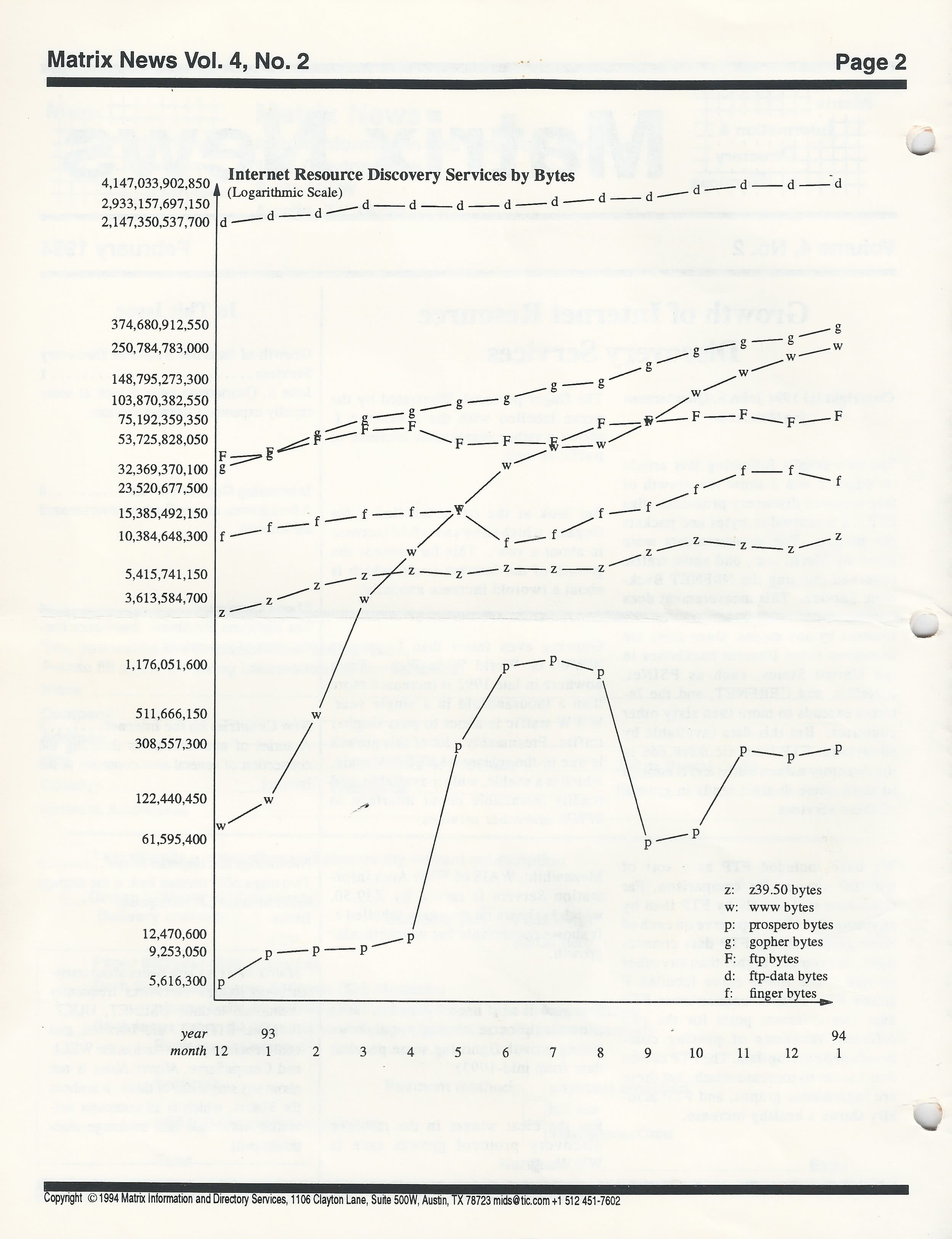
(Shortform addition: the image that fascinated Bezos. This journal graph showed Internet protocols and their volume month by month. w, representing the world wide web, is growing exponentially and eclipsing all other protocols.)
1994: At D.E. Shaw, Bezos has been running the options trading group and its third-market business, an OTC exchange. Shaw recognizes the opportunity of the Internet and appoints Bezos to research it.
- They meet for a few hours each week to brainstorm ideas, and Bezos researches their feasibility afterward. Example ideas that they actually develop include a free email service (developed into Juno) and online stock trading (FarSight Financial, later sold to Merrill Lynch)
They also discuss the “everything store” - an intermediary between customers and manufacturers that sells every type of product worldwide, with unlimited shelf space on the Web.
- They cast predictions of the Internet’s future and how it would lead to a revolutionary shopping experience.
- Bezos envisions the ability to personalize the store to each shopper, giving it a huge advantage over brick-and-mortar retailers.
- Despite the slow current speed of the Internet, Bezos believes everyone would one day use the Internet at high speeds.
- Customers could leave reviews of any product, a more credible version of mail-order catalogues.
- The “everything store” has to start somewhere, so Bezos investigates 20 possible product categories, including software, office supplies, apparel music. He settles on books because they’re pure commodities (so customers know exactly what they’re getting without worrying about product quality), there are only a few distributors to build relationships with (eg Ingram), and there is a large catalog of over 3 million books available, far more than a Barnes & Noble retail store could ever stock, giving an online store an edge.
- Music is a close second, with a catalog too large for any brick and mortar store to stock. But Bezos worries about the concentration of power in 6 major record companies, compared to the 4,200 US book publishers who would find it difficult to gain leverage over the new store.
- They aren’t the first to come up with the idea. Multiple companies already sell books online (like Books.com). Bezos and colleagues try ordering a book. It arrives two weeks later, tattered. It’s clear to them that no one has figured out how to sell books over the Internet.
Spring 1994: Bezos tells D. E. Shaw he plans to leave to create an online bookstore. Shaw is sympathetic (given that he himself left Morgan Stanley to found his firm) but notes that Shaw might compete with Bezos in the future.
- Soon after, Bezos leaves New York for Seattle, a technology hub with a relatively small population, thus not needing to collect state sales tax. His wife MacKenzie is the company’s first accountant.
- He backs the company himself with $10,000 and adds another $84,000 in loans over the next 16 months.
- Shel Kaphan from D. E. Shaw joins Bezos as the company’s first employee and technical steward. His contract requires him to commit to buying $5,000 of stock upon joining.
Biography 2: The Start of Amazon
July 1994: The new company needs a name.
- Bezos registers Cadabra Inc., but this is often confused with “Cadaver.”
- They also like “aard.com” because it regularly arrives at the top of alphabetical website listings, and “relentless.com” for its description of the Amazon team.
- In October, Bezos leafs through A in the dictionary and comes across Amazon. “This is not only the largest river in the world, it’s many times larger than the next biggest river.” They register the URL on Nov 1 1994.
- (Relentless.com still redirects to amazon.com today.)
Early 1995: Bezos’s parents invest $100,000 in Amazon. Bezos tells them there is a 70% chance they would lose it all: “I want you to know what the risks are, because I still want to come home for Thanksgiving if this doesn’t work.”
Spring 1995: Amazon has a beta website and sends links to friends and colleagues. The slogan: “One million titles, consistently low prices.”
- Bare and rudimentary, the website looks uninviting to people who have happily shopped at bookstores. To some, it seems improbable that people would ever want to order books online.
- A former coworker places the first order on April 3, 1995, for “Fluid Concepts and Creative Analogies.” The orders ramp up from there.
- After each purchase, a bell rings on their computers. Within a few weeks, it rings so frequently they turn this alert off.
- For each order, Amazon orders the book from a distributor, paying 50% off list price. The book would arrive, and Amazon would store it in the basement and ship it to the customer.
- Around this time, they also move out of the Bellevue garage into a small office above a Color Tile retail store in the industrial SoDo district. They have a 200-square-foot basement “warehouse.”
June 1995: Amazon adds a review feature. They believe reviews would give them a huge competitive advantage against online bookstores.
July 16, 1995: Amazon goes live, public to all Web users.
- The first week after launch, they take $12,000 in orders and ship $846 worth of books. The next week they take $14,000 in orders and ship $7,000 worth of books.
- There is a large long tail of esoteric books ordered, furthering the belief in the importance of selection. These are books that you could never find in a physical bookstore.
- When the company falls behind in shipments, everyone spends nights in the basement, sitting on the floor packing boxes. Someone makes the (obvious) suggestion of adding packing tables to the warehouse, and Bezos thinks “that was the most brilliant idea I had ever heard in my life.”
- A few weeks later, Jerry Yang and David Filo of Yahoo ask if Amazon would like to be featured on their homepage. They know it’d be like taking a sip through a fire hose, but they decide to accept.
- Popularity begets chaos. Amazon maxes out its line of credit and has no processes to handle returns.
Summer 1995: Bezos wants to raise more money, seeking $1 million from investors each contributing $50k, at a valuation of $5 million.
- Amazon has $139k in assets ($69k in cash), had lost $52k in 1994, and are on track to lose $300k that year.
- Bezos projects $74 million in sales by 2000 if things go moderately well (actual sales in 2000: $1.64 billion). He also predicts moderate profitability (actual net in 2000: $1.4 billion in losses).
- Bezos clearly has grandiose plans for the future, though he doesn’t reveal much of it. He envisions a day when they sell not only books about kayaks but kayaks themselves, subscriptions to kayaking magazines, and reservations for kayaking trips.
- To many potential investors, the business plan doesn’t seem like it’ll work. “If you’re successful, you’re going to need a warehouse the size of the Library of Congress.” It was hard to imagine that Amazon would one day have many warehouses bigger than the Library of Congress.
- Anecdote: a potential investor who likes shopping in bookstores is dubious that online bookstores will take off. One day, he fails to find a book for his son at a local shop, and he changes his mind and invests.
- His parents invest another $145k.
- Bezos uses this money to upgrade servers and hire.
- They start an editorial group, writing descriptions to give the feel of a trustworthy independent bookstore and to help people get comfortable with the idea that there were people on the other side of the screen.
August 9, 1995: Netscape Communications IPOs. The stock jumps from $28 per share to $75. This is one signal of a heated interest in the Internet.
March 1996: Amazon moves to a larger building with a bigger warehouse a few blocks away.
- At this point, revenues are growing 30-40% a month.
May 1996: the Wall Street Journal features Amazon on its front page.
- “Amazon provides a singular case in which the frequently hyped Web is actually changing consumers' lives.” (The added value being an immensely large catalog that no offline retail store could provide.)
- “He is quick to dismiss fears that Amazon could ever spell the end of traditional bookstores. He regularly hangs out at the Elliott Bay Book Co…’We are trying to make the shopping experience just as fun as going to the bookstore,’ he says, ‘but there's some things we can't do.’ “
- (Shortform note: the article mentions reviews for this book, which has reviews from 1995 - a neat gem of Internet history.)
Biography 3: Amazon Grows
June 1996: Amazon raises $8 million from Kleiner Perkins and John Doerr at a valuation of $60 million.
- Kleiner wants to put a junior member on the board, but Bezos requires famous investor Doerr in that position as part of the deal. He believes Doerr’s involvement is a public vote of confidence.
- People observe that this money enables Bezos, making him think bigger and move faster than before. The motto is now “Get Big Fast.” He believes that they are always at threat of a larger player taking away what they have. He also believes the company that gets the lead now would keep it.
- Using this money, Amazon begins hiring executives from other companies, some away from tech companies like Microsoft.
Summer 1996
- Amazon launches its affiliate marketing program, giving an 8% commission for sales referrals.
- They have 150 full-time employees, with fewer than 50 in the warehouse. They move offices again, and soon the warehouse expands to a 93,000 square-foot place.
- Bezos wants Amazon to IPO (just 2 years after founding).
- This enables global branding that solidifies Amazon in customers’ minds.
- It would help compete with Barnes & Noble, which has plans to go online.
Fall 1996
- Amazon releases Similarities, recommendations for new books to buy. It’s based on previous order history and groups similar users together.
Early 1997
- Amazon had $16 million in sales in 1996, compared to $2 billion for Barnes & Noble.
- Amazon continues hiring executives from outside, threatening the status of some early employees like employee #1 Shel Kaphan (who is later indeed sidelined and leaves out of frustration).
- Starbucks proposes a deal to put Amazon next to cash registers in exchange for 10% equity. Starbucks CEO Howard Schultz argues Amazon needs a physical presence, but Bezos disagrees. Bezos was envisioning Starbucks having a much lower 1% equity. The deal doesn’t happen.
- Amazon continue the IPO process, choosing the bankers Deutsche Bank and Frank Quattrone (whose lead analyst was Bill Gurley, now a VC at Benchmark).
- They boast of their “negative operating cycle,” receiving money from customers immediately but paying their distributors every few months. In between, they have capital to fund expansion.
- They boast of a high revenue to fixed cost ratio, meaning a dollar invested in Amazon could provide much better returns than with any physical retailer.
- Bezos keeps mum on some details, like customer acquisition cost and average purchase order, to prevent rivals from following their game plan.
May 15, 1997: Amazon IPOs, raising $54 million at a starting price of $18 per share.
- The widespread attention helps contribute to a growth of 900% in annual revenue.
- Three days before the IPO, Barnes & Noble sues Amazon, alleging false advertising for being “Earth’s Largest Bookstore.” This has a Streisand effect, drawing even more attention to Amazon.
End of 1997: Amazon has $148 million in revenue, up from $16 million in 1996.
Spring 1998: Bezos considers it imperative to expand Amazon’s brand beyond books to become the Everything Store. Amazon begins researching new product categories that have a high number of SKUs (unique products), are underrepresented in physical stores, and can be sent through the mail.
- Music and DVDs were the first targets for Amazon to tackle. Amazon quickly surpasses older tech incumbents CDNow.com and Reel.com.
May 1998: Amazon raises $326 million in junk-bonds to fund expansion.
June 1998: Amazon introduces Amazon Sales Rank, providing exact sales ranks for all books beyond the top 100 bestsellers.
- This causes addictive rank checking for authors and publishers.
1998: In the heat of the Internet boom, Amazon becomes a venture capital investor, investing tens of millions in Drugstore.com, Pets.com, Gear.com, Homegrocer.com, and Kozmo.com.
Summer 1998: Bezos meets with eBay founder Pierre Omidyar and CEO Meg Whitman.
- eBay is growing fast, from $47 million in revenue in 1998 to $225 million in 1999. It threatens to intercept Amazon as the Everything Store.
- eBay’s business model is strong, taking commissions for each sale but none of the hassle of inventory and sending packages. It’s possible that eBay becomes so pervasive it’d obviate fixed-price retailing.
- No partnership is made, but Bezos initiates a secret auctions project to replicate eBay in three months.
December 1998: Henry Blodget at Oppenheimer predicts that Amazon’s stock price would hit $400 per share in the next 12 months.
- It actually hits $400 just three weeks later.
End of 1998: Amazon has $610 million in revenue, up from $148 million in 1997 and $16 million in 1996.
Early 1999: After the success in music and movies, Bezos chooses to expand to toys and electronics.
- Toys prove fundamentally different from previous categories.
- Unlike books and music, no third-party distributors could provide any item and take back unsold inventory. Instead, the toy makers carefully allocate supply to each retailer. For the first time, Amazon has to beg for supply.
- Retailers have to predict in advance what the next holiday’s top toys will be, since most sales occur within a 6-week period. If they’re wrong, they’ll end up with unsold inventory.
- Despite this, Bezos insists on spending $120 million on stocking every toy so customers would never end up disappointed.
- Similarly, electronics proves more difficult; manufacturers view Internet sellers warily as likely to discount their products. Cut off, Amazon turns to gray-market secondary distributors.
February 1999: Amazon raises $1.25 billion in convertible debt at 4.75% (cheap capital at the time).
- It uses capital for acquisitions (IMDB, BookPages, Exchange.com), building five new distribution centers, and partnering with portals like AOL, Yahoo, and MSN to become their exclusive booksellers. Normal deals of this nature usually involve giving the portals equity, but Bezos insists on paying cash.
March 1999: Amazon Auctions (the eBay clone Bezos ordered in 1998) launches to limited success.
- eBay has incredibly strong network effects that Amazon finds hard to penetrate, even despite Amazon offering lower listing fees and free fraud insurance.
- Furthermore, the effort is not full-hearted within the company, having limited promotion - customers can reach Auctions only by clicking on a tab on the Amazon homepage.
Biography 4: Amazon’s Crash and the DotCom Bubble
Spring 1999: Amazon’s stock price falls in half from April to May. Investors are questioning Amazon’s widening losses and its ability to ever reach profitability. Typical critical viewpoints are represented by Barron’s “amazon.bomb” article:
- “Despite all the hoopla surrounding Amazon, Bezos has not really revolutionized the book industry at all. In essence, he is a middleman, and he will likely be outflanked by companies that sell their wares directly to consumers. To begin with, publishing houses themselves could sell their books online.” “What's to stop famous authors from establishing their own Websites to sell their books?”
- “And new technologies promise to cut costs even further by allowing consumers to download books via the Internet. Books can be printed out on traditional computer printers or put into a new notebook-sized computer device that displays books on its screen a page at a time.”
- The article also cites B&N, Borders, CVS, and Wal-mart as threatening juggernauts that would inevitably move online. “Ingram and Barnes & Noble have enough distribution sites to offer overnight delivery at no extra cost to about 80% of the U.S...The best Amazon can offer right now is delivery in three to seven business days, and that's if it has the book in stock.” “Wal-Mart has resources Amazon can’t even dream of.”
(Shortform note: the story, as we know now in insight, is that
- Amazon was a relentless competitor that continuously improved its retail operations, lowered costs, and expanded its constellation of services into home devices like Alexa and streaming video, driving flywheel effects
- the retail incumbents never executed to Amazon’s level, partially because of disrupting its legacy businesses, per classic Innovator’s Dilemma
- new business lines like Amazon Web Services provide earnings to make retail more cost-competitive
- authors have not reached customers directly as ambitiously idealized in 1999
But these legitimate questions illustrate how difficult it is to foresee the future.)
June 1999: with pressures to get the company in order, Bezos agrees to hire a COO, settling on Black and Decker salesman Joe Galli Jr.
- At this time, Bezos is interested in spending more time pursuing other passions like philanthropy, space flight, and raising a family.
- Unfortunately, Galli is largely a failure.
- He tries to order operational rigor and discipline, causing friction with the entrepreneurial employees.
- He is not technical, requiring his emails to be printed to be read and seeing Amazon more as a retail company than a technology company.
- Galli agitated for more authority and wanted to be CEO, while Bezos wants to maintain a firm control over Amazon decisions.
- Galli leaves in July 2000. Bezos realizes he wants to be an active CEO, and Amazon has not had a President or COO since then.
Fall 1999: Amazon is granted a patent for 1-Click purchases.
- Even though Bezos is an advocate for patent reform, he’s determined to exploit the status quo for any possible advantage.
Fall 1999: Amazon introduces the home and kitchen category. Employees remember kitchen knives flying down the conveyor chutes.
- (Shortform note: former Amazon engineer Steve Yegge wrote that in 1999 Bezos told the company that Amazon was dying. “all we sold were books, music and video, and all of them were being digitized and would die soon. Right then and there he predicted the Kindle and iTunes and Amazon Instant Video, none of which emerged until years later. He said that if we didn’t get into hardlines and other businesses, we’d be dead in a few years. He told us we had to be able to sell and ship anything, a live elephant if need be.”)
September 1999: Amazon hires Jeff Wilke as VP of Operations to replace departing Walmart alum Jimmy Wright.
- To fill the logistics division, Wilke hires scientists and engineers rather than retail-distribution vets. He revamps algorithms to match demand to the correct FC based on customer address, location of merchandise in the FCs, cutoff times for shipping, and backlogs.
- Wilke realizes that Amazon’s distribution is much closer to a manufacturing and assembly problem than it is to retail shipping.
- A few years later, the click-to-ship time is as low as 4 hours, down from 3 days when Wilke joined and the industry standard of 12 hours. Fulfillment gives Amazon a competitive edge over rivals, such as eBay.
- (Nowadays Wilke is CEO of Amazon Worldwide Consumer, responsible for all retail operations.)
- Amusing anecdote: in December 1999, a missing pallet of Pokemon Jigglypuffs caused a bottleneck for shipping orders. They found it after 3 stressful days.
End of 1999: Amazon has $1.64 billion in revenue in the year, up from $610 million in 1998. It now has 20 million registered accounts. Employees number 7,600, up from 1,500 in 1998.
- In contrast to Amazon’s smooth operations, incumbents start online operations online barely survive their first holiday season - Toys R Us is investigated by the FTC for unfulfilled promises made to shoppers.
February 2000: Amazon sells $672 million in convertible bonds to overseas investors at 6.9%. Given the bad environment to come, this provides a needed cushion that might have helped Amazon avoid bankruptcy.
March 2000: The Dotcom bubble hits its peak, wavers until August, and then starts trending down.
- Prior to this, Yahoo is valued more than Disney; Amazon more than Sears.
- Investors wake up from the frenzy and start to demand practical fundamentals from internet companies.
- As Amazon stock price falls, employee options fall underwater, causing resentment (after Bezos’s pushes for relentless work) and lack of faith in the company and leadership.
June 2000: Ravi Suria at Lehman Brothers releases a scathing report on Amazon, suggesting “the company will run out of cash within the next four quarters.”
- This contributes to a 20% fall in Amazon’s stock.
- In hindsight, this was incorrect, given Amazon’s near-$1 billion in cash and securities to cover supplier accounts, and its negative-working-capital model.
- However, the risk was that the mere mention of Amazon running out of cash would trigger a self-fulfilling prophecy, scaring away customers and spooking suppliers into requiring immediate payment from Amazon.
- Bezos and Amazon combat this in the press, arguing the analysis is strongly incorrect.
- Internally, they coin the term “milliravi” to indicate a math error of a million dollars or more.
- Regardless, Bezos announces a goal to become profitable by Q4 2001.
July 2000: Harry Potter and the Goblet of Fire is preparing for release. Amazon offers a 40% discount and express delivery so customers will get it on the day it’s released, losing a few dollars per order.
- Despite the short-term losses, it builds goodwill among customers, delivery drivers, and press.
August 2000: Amazon announces a 10-year partnership with Toys R Us, who would become the exclusive toys and baby-products seller on Amazon for the most popular toys. They would also redirect toysrus.com to Amazon.com.
- The idea is for the offline retailer to bring product expertise and relationships with suppliers; in return, Amazon provides the online infrastructure and house inventory in its distribution centers.
- Amazon also benefits by collecting high-margin fees and building its infrastructure to a general platform for many other companies to use.
- Furthering this strategy, in 2001 Amazon signs Borders, Circuit City, Target, Eddie Bauer, and Nordstrom as sellers.
- Despite the profits, Bezos is never fully comfortable with outsourcing the goal of limitless selection to outsiders.
- (Shortform note: In 2005, Toys R Us sues Amazon for breaking its exclusivity agreement and listing other toy retailers. Amazon claims Toys R Us failed to provide a required selection of toys, and that Toys R Us only had exclusivity over the toys it sold. In the long run, partnering with Amazon prevented Toys R Us and other retailers from developing internal capabilities on the Internet.)
September 2000: Blue Origin is registered but stays unknown until 2003, when it begins acquiring land in Texas and reporters investigate.
- Bezos says “it’s premature for Blue to comment on anything because we haven’t done anything worthy of comment.”
November 2000: Amazon launches Marketplace, allowing other sellers to sell on Amazon.
- This comes from reasoning that traffic to Amazon was centered around its definitive, reliable product catalog. If you go to eBay and search for a book, you’ll find dozens of copies of varying condition and price. If you go to Amazon, there’s a single page with a definitive description and price.
- Amazon decides it needs to list sellers’ wares alongside its own products on these definitive pages, not silo the third party sellers in another site like Auctions did.
- This faces backlash from publishers and authors, who argue Amazon is favoring used book sales.
- Internally in Amazon, category managers also dissent, worried about third parties listing cheap wares that would cut into Amazon’s numbers, and about third parties with poor service leading to poor reviews.
- Ultimately, Bezos cares only about broader customer selection, and Marketplace pushes through.
- Later, Marketplace will serve as a valuable way for Amazon to learn how third parties are beating Amazon on pricing, and as a way to list goods that manufacturers refuse to supply Amazon (like Wusthof knives).
December 2000: Bezos meets with Walmart CEO Lee Scott, who espouses the philosophy of using pricing as advertising.
- “We spend only forty basis points on marketing. Most of that goes to newspapers to inform people about what is in our stores. The rest of our marketing dollars we pour into reducing prices. Our marketing strategy is our pricing strategy, which is everyday low pricing.”
End of 2000: Amazon has $2.76 billion in revenue, up from $1.64 billion in 1999.
March 2001: After another Ravi Suria report, Bezos sells shares worth $12 million. The SEC investigates Bezos for insider trading.
- “I don’t care who you are or how much chutzpah you have - it’s not fun picking up the Times and seeing your picture above the fold accused of insider trading. This is one of the things that made Jeff the person he is. That scar does not heal easily.” - CFO Warren Jenson
- Around this time, Amazon cuts 1,300 people (15% of the workforce), some who had been hired just months earlier, and reprices the stock options of employees (exchanging 3 shares at old price for 1 at new price).
- Growth in books appears to be slowing after annual double-digit increases. Amazon workers are afraid Walmart.com would start selling books at a loss to stifle Amazon’s growth. Initially Bezos signs off on increasing prices, until they arrive at a revelation on their business’s key strategy.
Biography 5: Amazon Regains Footing
March 2001: Amazon considers whether distribution is a commodity or a core competency.
- If the former, then it could outsource distribution to a third party. If the latter, it could develop a key competitive advantage, and eventually build a platform to dropship items from manufacturers and distributors.
- They visit a Reno fulfillment center, where they realize their shipping happens in large batches. Workers retrieve items ordered by customers, dump their items to a sorting machine, which rearranges products into customer orders. These pickers work in waves, with the entire shift dumping their orders. The problem is that a slow worker could hold up the entire team.
- Over the following years, Amazon moves away from wave-based picking, allowing individual workers to be controlled by algorithms and shipping orders in small batches. This allows Amazon to make accurate promises on when purchases will arrive.
Spring 2001: Bezos meets Costco founder Jim Sinegal, who changes Bezos’s mind on pricing.
- The Costco model is all about customer loyalty. It doesn’t advertise and earns most gross profit from annual membership fees. “The membership fee is a one-time pain, but it’s reinforced every time customers walk in and see forty-seven-inch televisions that are two hundred dollars less than anyplace else. Customers know they will find really cheap stuff at Costco.”
- Costco then uses its heavy sales volume to negotiate better deals from suppliers. It marks up everything at a standard 14%, not taking excess profits.
- Learning this makes Bezos articulate a clearer strategy: “everyday low prices” aiming to be lower than competitors at all times. If Amazon could stay competitive on price, it could win on unlimited selection and convenience.
- In July 2001, Amazon announces it’s cutting prices of books, music, and videos by 20-30%. Bezos on conference call: “There are two kinds of retailers: those who work to figure how to charge more, and those who work to figure how to charge less, and we’re going to be the second, full stop.”
Later 2001: Amazon senior management has a breakthrough in understanding their business strategy. Jim Collins (author of Good to Great) meets with the exec team offsite and prompts them to consider their flywheel effect:
- Lower prices leads to more customer visits
- More customers increase the volume of sales and attract more third-party sellers
- More third-party sellers increases diversity which increases customers
- More sales means higher return on fixed costs like fulfillment centers and servers
- Higher return means further lower prices
- This makes executives feel like “they finally understand their own business.”
January 2002: Amazon announces Free Super Saver Shipping, for orders above $99.
- This is prompted by free shipping promotions during the 2000 and 2001 holidays, and by surveys showing shipping costs were a major hurdle to ordering online.
- They consider how free shipping can segment customers who are willing to wait a few more days for their order, much like how airlines segment businesspeople from recreational travelers by reducing prices for those willing to stay at destination through Saturday night.
- The slower expectation of shipping lets them pack boxes into spare room in trucks when it happens to be available, reducing expenses.
- Amazon notices that Super Saver makes people order more than they would otherwise.
- They quickly lower the minimum price for Super Saver shipping from $99 to $49, then $25.
January 2002: Amazon reports its first profitable quarter, with net income of $5 million. The stock jumps 25%.
2002-03: As an employer, Amazon has high levels of attrition. Few believe Amazon will become a $600 billion company. Many are tired of Bezos’s insistence on work ethic.
- The editorial team is made obsolete by the automated personalization team (team name: P13N, for PersonalizatioN’s 13 letters).
- The personalization team (P13N) battled the human curation team for product recommendations. They have on their wall: “People forget that John Henry died in the end,” an allusion to the fable of the person who won the contest against a steam-powered machine but died in the end.
- The engineering team has to deal with an aging infrastructure, moving to a service-oriented architecture (Shortform note: see former engineer Steve Yegge’s famous post about platforms).
This is a good point to talk about the general situation of Amazon relative to the tech world. The points below extend back and forward a few years.
- Google’s rise signals a shift toward favoring tech companies, not clever business models and experienced CEOs.
- Google IPOs in August 2004. At this time, the market cap of Amazon is around $18 billion; Google is $35 billion; eBay is $47 billion.
- Despite Bezos’s claims that Amazon is a tech company, it looks merely like an old-fashioned retailer, with no profits.
- Google threatens to disintermediate Amazon - customers might start their shopping trips on Google, not on Amazon. Google is very competent at indexing the Web, and users might search Amazon better through Google than through Amazon itself.
- Also, Google creates a comparative shopping engine, Froogle. And Amazon and eBay now compete for Google search ads, effectively paying a tax to Google.
- Google also competes with Amazon for talent, offering lavish perks and stock options. In comparison, Amazon is still frugal, has a combative culture, and anemic stock growth. Bezos loses two lieutenants:
- Jeff Holden, SVP of worldwide discovery, runs a secret search engine effort competing against A9. Bezos chooses A9, and Holden leaves, feeling betrayed. (Shortform note: as of this writing, Holden is now CPO at Uber.)
- Then Head of A9 Udi Manber leaves for Google in early 2006, getting a very generous offer and joining a world-class team on the world’s largest search problem. Bezos is very upset.
- In this environment, Bezos continues to push for taking risks outside of Amazon’s core business. “There’s only one way out of this predicament, and that is to invent our way out.”
2002: Amazon’s contract with UPS is up for renewal. Amazon has low negotiating leverage - it does little business with competitor Fedex, and the USPS can’t negotiate rates.
- Over 6 months, Amazon integrates with FedEx and increases the volume of packages. It also increases shipment injections with USPS.
- When Wilke threatens to walk from a UPS negotiation, UPS calls his bluff. Wilke makes a call to “turn them off.” Amazon gives UPS zero packages to ship for 72 hours.
- UPS partially calls the bluff, saying they know FedEx is overwhelmed and Amazon can’t keep it up. But they cave and settle on discounted rates.
Biography 6: Amazon’s Relentless Innovation
This period is marked by continuous innovation by Amazon. Many of Amazon’s biggest businesses and features today were developed during this period.
July 2002: Amazon launches Amazon Web Services, a slim shadow of its current form.
- This is inspired by Bezos’s early 2002 meeting with Tim O’Reilly, who suggests building APIs allowing third parties to get data on prices, products, and rankings. “Companies need to think not just what they can get for themselves from new technologies but how they can enable others.” Amazon soon launches these very services.
- Bezos speaks about the importance of becoming a platform at an all-hands.
- Another motivation: Amazon’s project teams need to plead for provisioned infrastructure resources from a central team, which slows down progress.
- Finally, Bezos becomes enamored with the idea of creating primitives - the building blocks of computing - and letting developers create emergently amazing things with it. They brainstorm primitives like storage, bandwidth, processing, messaging, and payments.
- Separate teams then work on services that will eventually become AWS services EC2, SQS, and S3, which will launch in 2006.
October 2003: Amazon launches “Search Inside the Book,” allowing customers to search for text within books.
- This extends “Look inside the book,” which mimics the experience of browsing in a physical bookstore.
- Udi Manber, algorithm expert, leads this charge. Bezos gets the goal of having 100,000 books searchable in the new digital catalog.
- “We had a simple argument for book publishers. Think of two bookstores, one where all the books are shrink-wrapped and one where you can sit as long as you want and read any book you want. Which one do you think will sell more books?”
- Regardless, publishers are hesitant about piracy and drag their feet.
- This furthers Bezos’s vision of the Alexandria Project, a bookstore that stocked every book ever written. (But he’s not alone - in 2002, a Google Books project had already begun, and it’s made public in December 2004.)
April 2004: Amazon releases a search engine at A9.com
- A9.com licenses the Google search index but builds features on top of it.
- Amazon is chagrined that Google might offer better search of Amazon than Amazon itself.
- Ultimately this project fails. Google’s hundreds of engineers outpace Amazon’s dozen, and Amazon finds it can’t build a search on top of a rival’s search index.

Spring 2004: Amazon starts selling jewelry. Bezos believes jewelry is Amazon’s next big opportunity - its products are small, prices are high, shipping is cheap.
- It has challenges: jewelry was difficult to display in high detail online; theft in the fulfillment centers was high; jewelry manufacturers clung to high margin prices and refused to budget.
- They decide to let retailers sell on Marketplace, then watch and learn.
- Bezos bristles at following the standard jewelry practices of high markups. He envisions people buying a bracelet on Amazon for $1,200 and getting it appraised at $2,000.
- They make a big push - they introduce the Diamond Search feature, contract with Paris Hilton for exclusivity, and make public announcements in time with Blue Nile’s quarterly reports.
- Ultimately, it turns out customers still want to go into stores to pick out rings; Amazon quietly de-emphasizes the space.
2004: Engineer Charlie Ward suggests a speedy shipping club.
- Previously, Super Saver Shipping allowed users to self-identify as less time-sensitive customers. Bezos knows this changed customers’ behavior, motivating them to place larger orders and shop in new categories.
- They also now have overnight, 2-, and 3-day shipping for extra fees. Could they turn the faster shipping into a speedy shipping club with a monthly charge?
- Bezos loves the idea and insists it’s now top priority. “This is a big idea.” He wants the program ready in weeks to make the earnings announcement.
- The program could move so fast because it used Amazon’s existing capabilities. The fulfillment centers could already handle expedited shipping. To handle billing, Amazon Europe had built a subscription membership tool for a Netflix clone.
- They price at $79/year, large enough to matter but small enough to try it out. “It was about changing people’s mentality so they wouldn’t shop anywhere else” - just like Costco.
- Their hunches prove right over the years - the instant gratification of free two-day shipping becomes addictive; people want to maximize the benefits of their sunk cost. (Shortform note: now Amazon adds a host of new features to Prime, like Amazon Video and Kindle reading, all to drive the flywheel effect further.)
2004: Amazon creates a skunkworks group called Lab126. The mission is to disrupt Amazon’s retail business with an e-book device.
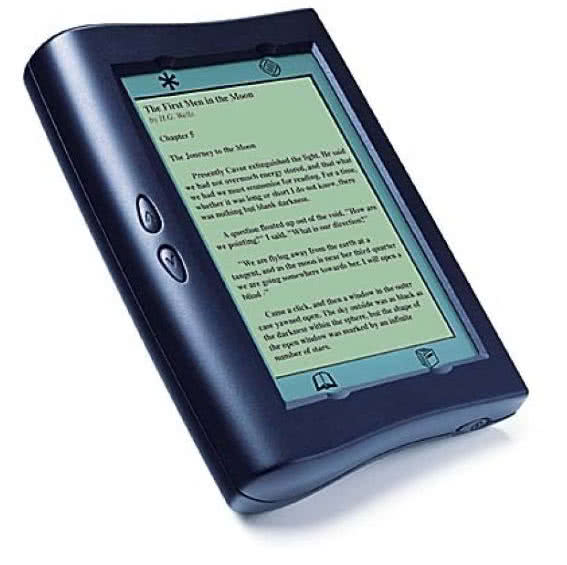
- Brief history of e-readers: In 1997, makers of e-reader Rocketbook (including later Tesla co-founder Martin Eberhard) approaches Amazon for funding. Bezos is impressed but wants exclusivity, to prevent rivals from stealing the future of reading. Parent company NuvoMedia balks and goes to Barnes & Noble instead.
- They sell thousands of devices but tank in the dotcom bubble. It’s said that Rocketbook and other e-books failed because they were ahead of their time. Another contributor to the failure is NuvoMedia selling to Gemstar, which had little interest in developing the devices.
- A picture of the Rocketbook:
- Another motivation for developing an e-reader: In 2003, Apple introduces the iTunes music store, which catapults past Tower Records, Amazon, and Walmart to become the top music retailer in the US.
- Jobs and Amazon had previously discussed a possible partnership where Amazon would sell music to iPod owners, but Jobs insisted on desktop software to provide a seamless experience from purchasing to listening on the player.
- Bezos at first dismisses iTunes, noting that 99 cent songs are unprofitable and used only to increase iPod sales. But as the iPod becomes ubiquitous, Apple owns the digital music retail and starts to explore other digital media like video, and Amazon gets worried.
- Amazon eventually introduces the MP3 store in 2007 with DRM-free music, but Apple negotiates the same agreements and Amazon never catches up in music. People in Amazon attribute their delay in music to Bezos’s complete lack of interest in music, compared to Steve Jobs’s devotion to it. (Bezos loves books far more than music.)
- Now in 2004, Amazon has 74% of sales coming from books, music, and movies. If these transition to digital, Amazon needs to protect itself. It must own e-books the same way Apple controls digital music.
- Bezos declares the new project to build a reading device. Employees are concerned - they had never done hardware before. Bezos dismisses these objections, wanting to control the entire end-to-end experience, as Apple did with the iPod. “We are going to hire our way to having the talent. I absolutely know it’s very hard. We’ll learn how to do it.”
- Bezos appoints Steve Kessel head of the effort, stripping him of his responsibilities in physical book sales. “If you are running both businesses you will never go after the digital opportunity with tenacity. I want you to proceed as if your goal is to put everyone selling physical books out of a job.”
- Bezos has specific objectives in mind:
- Guiding persona: “I’m going to the airport. I need a book to read. I want to enter it into the device and download it right there from my car.”
- A designer says “But you can’t do that.” Bezos: “I’ll decide what I can do. I’ll figure this out and it is not going to be a business model you understand. You are the designers, I want you to design this and I’ll think about the business model.”
- “Kindle has to get out of the way and disappear so you can enter the author’s world.”
- This presents hardware challenges like requiring a physical keyboard and cellular access.
- Guiding persona: “I’m going to the airport. I need a book to read. I want to enter it into the device and download it right there from my car.”
- Bezos wants 100,000 digital titles, with 90% of the NYT bestsellers list.
- Amazon is already in hot water with publishers, leveraging its size to squeeze lower prices from publishers. If any publishers refuse, Amazon shuts off recommendation algorithms for its books and promoting competitors’, cutting sales by up to 40%. Panicked authors then call their agents and publishers. Bezos calls this the Gazelle Project, like a cheetah pursuing a sickly gazelle.
- With the failure of e-books years ago, many publishers are loath to commit to digitizing their books. In music, record labels made the jump to digital because they had to deal with the relentless piracy problem. Book publishers don’t have the same problem. However, some publishers recognize the instant gratification possibility of the Kindle store.
- Amazon execs continuously yell at publishers for not digitizing books quickly enough, trying to meet Bezos’s 100,000 library goal.
- The development work continues from here into 2007, when the Kindle launches.
August 2004: Google IPOs.
August 2005: Amazon releases A9.com Maps, which offers Block View, offering street-level photographs of stores and restaurants.
- (Shortform note: Google announces Street View in 2007.)
Biography 7: Amazon, the Giant
In this period, Amazon’s retail flywheel gains formidable momentum, and its experimental projects start yielding fruit.
August 2005: Bezos meets with Zappos execs (Tony Hsieh, Alfred Lin, Michael Moritz, Nick Swinmurn) and announces the intention of acquiring Zappos.
- Zappos has become synonymous with buying footwear online. It boasts sales growing from $8.6 million in 2001 to $70 million in 2003 and $370 million in 2005.
- Amazon has not done this well in footwear. Zappos has built strong relationships with brands like Nike, which fear Amazon for being a discounter and brand destroyer. Amazon’s website also is not suited for listing variations among a single good - it lists different colors, sizes, and widths all as separate items with separate web pages.
- The cultures between the two companies are somewhat similar.
- Zappos is obsessive about customer experience, promising free 5-7 day delivery and trying to meet 2-day delivery. Customers can return items up to a year after the purchase. Customer center calls can take as long as needed, and customers sometimes enjoy hours-long calls.
- Hsieh believes that everyone should take below-market compensation to work at Zappos because of the great internal culture.
- Amazon execs believe Zappos could be acquired for $500 million, but Bezos imagines paying just a fraction of this.
- Zappos desires to remain independent. Bezos goes to war, building Endless.com as a separate site dedicated to shoes and handbags.
- This is the same time Amazon is spending heavily on the Kindle and AWS, so the board is wary of Amazon spreading itself thin and overspending.
- Amazon CFO: “How much money do you want to spend on this?” Bezos: “How much do you have?”
November 2005: Amazon launches Mechanical Turk, a service allowing hiring of humans to perform low-cost, hard to automate services like image recognition and data categorization.
- The name comes from an 18th century chess-playing automaton that appeared to play chess independently but actually concealed a man inside.
- The service comes from an investment Bezos made in the late 1990s in Cambrian Ventures, an incubator founded by founders of Junglee (which had been acquired by Amazon). The founders patent a method of coordinating groups of people worldwide to offer human intelligence tasks, inspired by Napster and the power of networks. When the company fails, Bezos acquires the patent and develops Mechanical Turk in Amazon.
- As is now typical in Amazon services, before release to public customers, Turk’s first customer is Amazon. Turk is first used internally in Amazon to have humans review book scans and check uploaded product images.
- (Today, Turk is not a huge part of the company, but it’s emblematic of the orthogonal technological innovation Amazon attempts in this period.)
March 2006: Amazon relaunches Amazon Web Services, this time offering S3, SQS, and EC2.
- Andy Jassy, Harvard MBA and anomalously not an engineer, leads the effort. He previously shadowed Bezos, sitting in on every meeting and acting effectively as chief of staff.
- The vision statement: “to enable developers and companies to use Web services to build sophisticated and scalable applications.” Jassy: “We tried to imagine a student in a dorm room who would have at his or her disposal the same infrastructure as the largest companies in the world.”
- The board is skeptical. Doerr: “why would we go into this business” when Amazon is already struggling to hire engineers and needs to expand internationally? Bezos: “Because we need it as well” - thus there will be other companies who have this same need.
- AWS’s business model is novel, allowing customers to pay on-demand for server usage, like a utility. At the time, other server services only allowed for fixed subscriptions regardless of the amount used (eg monthly).
- Bezos wants to charge 10 cents per hour for EC2, even though 15 cents per hour would allow Amazon to break even. Bezos suspects lower prices will repel rivals like Microsoft and Google because it would depress their margins.
- Author Brad Stone argues that AWS “helped lift the entire technology industry out of a prolonged post-dot-com malaise” and that it enlarged the scope of Amazon’s everything store concept. It makes Amazon a confusing target for Walmart and other retailers, since Amazon is no longer just clearly an online retailer to compete with. It clearly puts Amazon in the realm of a technology company.
2006: Amazon launches Fulfillment by Amazon, letting sellers use Amazon’s fulfillment network to store, pack, and ship their products. In other words, Amazon is storing inventory owned by other companies and handling logistics for them.
- “We had built such a good service that people were willing to pay us to use it.” - Wilke team member.
December 2006: Endless.com launches as the Zappos competitor. They compete with Endless on pricing and customer service.
- Endless offers free overnight shipping and free returns, clearly losing money but designed to make Zappos bleed. Zappos matches Amazon’s free overnight shipping.
- Recall that shoe manufacturers were wary of working with Amazon, fearing that they would ruthlessly discount their shoes. Amazon is in an awkward position, trying to undercut Zappos with price while promising brand name companies they won’t cut prices too much.
- Amazon adds a $5 bonus to free overnight shipping.
- Zappos places advertisements on the plastic shoe bins in airport security. Bezos is alarmed: “They are outthinking us!”
- Despite Amazon’s volleys, Zappos grows further up to $1 billion in sales over the next few years, but the financial crisis hits them, making fundraising harder and lowering consumer spending.
April 2007: Amazon announces surprisingly strong Q1 results, with quarterly sales reaching $3 billion, growing 32% YoY compared to ecommerce at 12%. Its stock gains 37% in a week.
- This suggests Amazon is stealing customers from other ecommerce companies and from physical retailers.
- The flywheel effect of Prime and Amazon’s growing power is becoming clearer.
- eBay meanwhile is fading - customers prefer convenience and certainty, not wanting to wait 7 days to figure out if his bid for goods of questionable quality has won. eBay releases its fixed-price product too late. Amazon surpasses eBay’s valuation for the first time in almost a decade, and that year reports more sales than Barnes & Noble and eBay combined.
- Regardless, Bezos drives forward: “to be a $200 billion company, we’ve got to learn how to sell clothes and food” - like Walmart.
November 2007: Bezos introduces the Kindle at a press event, after 3 years of development in Lab126.
- He releases a bombshell: digital versions of books will cost $9.99. He models this after Apple’s 99-cent iTunes song, believing that customers expect to pay less for a non-physical book.
- Publishers are blindsided, not having known about the price beforehand. They feel betrayed, after having partnered with Amazon to digitize their books for months. Physical retailers are scared, believing that customers will abandon physical books for e-books.
- Rightly, they fear Amazon will accrue even more negotiating leverage.
December 2007: The housing crisis causes a wide recession, destroying many retailers while Amazon is gaining momentum
- Circuit City goes bankrupt in 2008. At its peak, it had 700 stores and $12 billion in sales. Then Best Buy and Walmart ushered in self-service shopping and big-box stores. Circuit City is caught flat-footed, with its large, expensive salesforce and being distracted spinning out CarMax and DVD-rental system DIVX.
- Borders goes bankrupt in 2011. Over Amazon’s history, Borders was content to let Amazon run its online business and chose to focus on its physical stores. It perceived Amazon as “just another catalog - a version of Lands’ End.”
- In September 2009, Brad Stones writes “Can Amazon be the Wal-Mart of the Web?” Walmart tries to counter Amazon’s growth, lowering prices on ten new books to $10 each. Amazon matches the price within a few hours. This price pressure would have been terrifying to Amazon 10 years ago - but now Amazon can easily withstand such losses.
February 2008: Amazon sells its DVD-rental services in the UK and Germany to Lovefilm.
- Years earlier, Amazon had watched Netflix and attempted to replicate it in geographies Netflix hadn’t yet entered. But local companies were already there, and the cost to acquire customers was higher than Amazon expected.
- Amazon becomes the largest shareholder in Lovefilm, and watches from the sidelines as Netflix moves away from sending discs in the mail to streaming. (In 2011, more action will happen with Lovefilm.)
July 2009: Amazon announces the acquisition of Zappos for $900 million.
- After a long and painful war of attrition, Zappos ultimately loses.
- Zappos investor Michael Moritz had watched Amazon destroy eToys a decade earlier and knew what it takes to compete with Amazon. Zappos doesn’t have it. “The hiring was too slow, the engineering department was not good enough.” Zappos’s Las Vegas location made recruiting difficult.
- Zappos founders Hsieh and Lin also see that many Zappos employees had lost their wealth in the housing crisis, and the only thing of value they hold is Zappos stock. An exit would give them a payout, so the founders feel emotional pressure to sell at that time.
- In a welcome video to Zappos employees, Bezos records an 8-minute video introducing Amazon. Ironically, he says “we pay attention to what our competitors do, but it’s not where we get our energy or motivation.”
2009: Amazon approaches Quidsi, owner of Diapers.com, and announces they are ready to invest in the childcare market (diapers, formula, strollers) and that Quidsi should think about selling to Amazon. This is the Zappos story, playing out again.
- Quidsi was founded in 2005 by Marc Lore (later founder of Amazon competitor Jet.com) and Vinit Bharara. At the time, e-commerce retailers hadn’t yet approached diapers since the product feels bulky and low-margin.
- Quidsi makes the business work by reducing shipping costs, matching goods to the smallest possible box (with a range of 23 possible sizes) and building warehouses right outside major cities to use cheap ground shipping.
- They watch Amazon closely, calling Bezos “sensei” in private.
- After Quidsi’s rejection of Amazon’s offer, Amazon drops prices by up to 30% on diapers and other baby products. Quidsi changes their prices and watches Amazon move in lockstep, as a result of automated pricing bots.
- Quidsi’s growth slows, and investors are reluctant to invest further. Quidsi founders approach Walmart for acquisition, but the price isn’t high enough.
- In September 2010, they meet with Amazon. While the founders are locked up in that meeting, Amazon announces Amazon Mom in a press release. Diapers become available for under $30 with Amazon’s Subscribe & Save, while costing $45 on Diapers.com.
- Finally, Quidsi waves the white flag. Bezos wants to make sure they don’t lose the deal to Walmart and Amazon offers $540 million.
- Walmart counters at $600 million. Amazon suggests if they take the offer, Amazon will drive diaper prices to zero, destroying Quidsi’s economics and threatening to force the deal with Walmart fall through. They accept and announce the acquisition in November 2010.
- (Shortform note: apparently partially fueled by revenge for Amazon stealing his baby, Marc Lore later founds Jet.com, which is positioned as an Amazon competitor and ultimately sells to Walmart for $3 billion.)
Fall 2009: Two years after the Kindle releases, Amazon commands 90% of the digital reading market and releases the Kindle 2. Publishers are terrified.
- Any publisher that doesn’t follow Amazon’s pricing terms gets cut off in product listings, its wares becoming available only through third-party sellers.
- Two major publishers try to delay e-book releases until months after the hardcover versions come out. Consumers react poorly, giving these titles poor reviews on Amazon. Even without Amazon exerting explicit pressure, its status as the central shopping destination is unbeatable leverage.
- Amazon is experimenting with allowing authors to self-publish their works in Kindle, giving them 70% royalty on sales. Amazon has control over so much of the chain that it can cut out publishers entirely.
- In response to all this, 5 major publishing houses representing a large fraction of books sold - Penguin, Hachette, Macmillan, HarperCollins, and Simon and Schuster - collude with Apple to address Amazon’s $9.99 problem.
- They agree to switch to an agency model, wherein publishers would become retailers and set their own prices (between $13-15) and Apple would act as the broker and get a 30% commission. Apple receives a guarantee that other retailers wouldn’t undercut it on e-book prices.
- In Jan 2010, Apple introduces the iPad and the new e-books.
- Amazon’s countermoves:
- In response, Amazon blocks Macmillan books for a weekend. This attracts the ire of press and customers - directed toward Amazon - and they reluctantly reverse.
- Ironically, the pricing collusion actually raises Kindle profits, since Amazon holds most of the e-book sales and is forced to charge more for e-books. Amazon takes advantage by lowering Kindle device prices to as low as $79.
- Amazon approaches smaller publishers, warning they have insufficient leverage to pull the same move, and threatening to stop carrying their books if they tried.
- Amazon sends a white paper to the FTC and DOJ suggesting there was an illegal conspiracy. The DOJ sues 3 years later, in 2012.
2010-11: Amazon’s size makes it a more attractive target for regulators for sales tax. They battle with states and other retailers to avoid state sales taxes.
- In April 2008, NY state passes legislation to expand the definition of tax nexus to include affiliate websites that took commissions for passing customers to an online retailer, thus making that retailer have a presence in the state. Amazon and Overstock sue, but they lose.
- IL, NC, RI, TX and other states follow the same strategy. In response, Amazon severs ties with affiliates in each state.
- To attack Amazon, Walmart, Target, Sears, and other retailers form a coalition to back a new organization called the Alliance for Main Street Fairness, pushing for the vitality of small retailers. This is ironic given the size of these retailers. But given that the retailers have physical presence in states and are taxed, they believe Amazon has an unfair advantage as an online retailer, and they want to try to hamper Amazon as they can.
- Amazon continues efforts to try to avoid establishing tax nexus, like rigid restrictions on what traveling employees could do in certain states, and setting up fulfillment centers as subsidiaries of Amazon with no revenue. It uses fulfillment centers as leverage to combat state legislation - threatening to close the Texas fulfillment center makes the governor veto the bill; TN delays the bill when Amazon offers to build 3 new fulfillment centers in the state.
- Amazon pushes for a federally controlled state tax (which as of 2018 has still not had meaningful traction).
- Ultimately in 2012, Amazon negotiates accommodations to allow staying tax-free for a few years, in exchange for putting fulfillment centers in each of Texas, South Carolina, Pennsylvania, Tennessee, and California.
- Ever the chess player, Amazon uses this seemingly costly requirement to its strategic advantage - it builds fulfillment centers close to large cities, empowering next- or same-day delivery, AmazonFresh, and Amazon Lockers.
Biography 8: Amazon, the Unstoppable
January 2011: Amazon acquires Lovefilm for around $300 million.
- Amazon had been the largest shareholder in this European Netflix clone.
- In 2010, Lovefilm needed additional capital. Google had planned to acquire both Lovefilm and Netflix in 2009, but the deal fizzled due to opposition from its company Youtube and fears that it would not be able to acquire both.
- Instead of letting it seek additional capital, Amazon strongarms Lovefilm into accepting the acquisition deal. Lovefilm had an option to IPO, but with its large shareholder position, Amazon could effectively veto the IPO. This power also prevents other acquirers from entering a bidding war and makes it a toxic asset to invest further in. After a tough negotiation with Amazon, Lovefilm sells near the bottom of its valuation range.
- Soon after, Amazon unveils Amazon Video for the US, free for Prime members. This is a direct challenge to Netflix, which costs $5-8/mo.
2011: Knifemaker Wusthof decides to end its relationship with Amazon after a torturous relationship. (This is a good place to discuss Amazon’s general friction with manufacturers.)
- Manufacturers cannot enforce retail prices, but they decide which retailers to sell to by setting a MAP (minimum advertised price). This requires retailers to stay above a certain price threshold in their advertisements, or else lose the manufacturer’s business.
- Initially in the mid 2000’s, Amazon abides and becomes Wusthof’s second-largest US seller (after Williams-Sonoma). But then Amazon’s automated pricing bot repeatedly violates Wusthof’s MAP requirements, charging $109 for a $125 knife.
- Amazon believes MAPs are vestigial business practices, used by inefficient companies to protect their margins. It gets around MAP by allowing customers to see the price only after adding to the cart.
- (Shortform note: MAPs may have been a stronger strategic move in the past. Before the Internet reaching consumers was expensive, and companies like Williams-Sonoma became large by controlling the distribution to consumers (eg retail stores or catalogues). Because transactions were costly and there were much fewer suppliers than customers, it was higher leverage for companies to build relationships with suppliers, leaving customers as an afterthought. In turn, suppliers were able to enforce policies like MAPs, because there were few winner-take-all players, and suppliers could play retailers off each other as much as retailers could play suppliers off each other.
- The internet made distribution to customers free, neutralizing the distribution advantage of incumbents. Amazon could now reach customers around the country for nearly no cost, and it used its massive customer relationship to exert unprecedented leverage over suppliers.)
- Wusthof stops supplying Amazon in 2006 and delists itself from Amazon. It returns in 2009, and then terminates with Amazon again in 2011.
- No matter - Amazon can still provide Wusthof goods through its Marketplace, by third-party sellers. The sellers can offer even further discounted goods than Amazon can - possibly the cheapest seller is someone with surplus product or someone diverting goods from the manufacturer’s distribution center.
- Further, Amazon offers its Warehouse Deals, selling refurbished and used products.
- The Marketplace is held in constant competitive tension. Sellers compete against each other to offer the lowest prices, driving down margins. They try to build advantages through exclusives and sourcing hot new products, which Amazon is soon to study and provide itself. “Sellers know they should not be taking the heroin, but they cannot stop taking the heroin,” drawn to Amazon’s massive audience.
Early 2011: Amazon is losing some traction in the book industry.
- Random House, the one holdout major publisher, has also adopted the agency model, neutralizing Amazon’s price advantage.
- Barnes & Noble’s Nook and Apple’s iBookstore eat into Amazon’s e-book share, causing it to fall from 90% in 2010 to 60% in 2012.
- Amazon starts a NY-based publishing imprint, with ambitions to secure bestselling books by big-name authors.
- Bezos’s ambition is to remove the gatekeepers from the industry. No longer should old media gatekeepers decide what the public gets to consume - now anyone should be able to create something and find an audience. He envisions a publishing world that includes just the author, who gets most of the royalties, Amazon, and the reader.
- The book world rejects Amazon’s publishing efforts in an allergic reaction. Barnes & Noble and independent bookstores refuse to stock Amazon’s books. It turns out readers still use bookstores for book discovery, and not stocking Amazon’s books makes a big difference in sales.
- (Shortform note: later, we’ll discuss possible reasons why Amazon’s direct-publishing model didn’t work, and why authors still need the classic publishing houses.)
December 2011: Amazon releases a price-comparison app for smartphones, letting users scan barcodes of products in stores and compare to Amazon’s prices.
- This gets a backlash for spying on competitors’ prices and destroying independent businesses. Amazon risks increasingly being seen as a monolith transferring dollars out of local communities and into its own coffers.
2012: After this media flak, Bezos considers what makes some companies cool and others not.
- Apple, Nike, Disney, Costco, UPS are well-liked. Walmart, Microsoft, Goldman Sachs, ExxonMobil tended to be feared or tolerated. Why?
- He defined some things as not cool: rudeness, defeating tiny guys, close-following.
- Other things are cool: politeness, youth, winning, inventing, defeating bigger guys, conviction, straightforwardness, authenticity, thinking big, reliability.
- Explorers are cool. Conquerors are not cool. Missionaries are cool. Mercenaries are not cool.
- Bezos believes: it’s not enough to be inventive “that pioneering spirit must also come across and be perceivable by the customer base.” (Shortform note: this can explain projects that generate public hype, like drone deliveries and well-funded production of beloved television series like Top Gear.]
March 2012: After a decade of coaxing the press to brand the company as “Amazon.com,” the company rebrands to simply “Amazon.”
April 2012: the DOJ sues Apple and the five publishers of conspiracy to raise e-book prices.
- The five publishers settle. Apple holds out.
- (Shortform note: in March 2016, after several appeals, the Supreme Court declines to hear the case. Apple’s damages are $450 million.)
Fall 2012: Bezos unveils a new line of Kindle Fire tablets and the Kindle Paperwhite.
2012: Amazon has $61 billion in sales.
There are more developments after 2012 in the book and in the real world, but the themes continue:
- Amazon uses its flywheel effect to make retail more compelling to consumers and add more value to Prime - now including free 2- or same-day delivery; Prime Video; Prime Music; Twitch Prime; and Prime Pantry.
- Amazon introduces the Echo in 2014, now arguably the leading smart speaker and personal assistant, even past Google and Apple.
- It expands ambition in food by purchasing Whole Foods in 2017, coming closer to Bezos’s 2007 statement: “to be a $200 billion company, we’ve got to learn how to sell clothes and food.”
- In 2018 Amazon unveils Shipping by Amazon, a delivery service for businesses that rivals UPS and Fedex.
- Stressful, tear-inducing work conditions at Amazon are reported in 2015.
- There are increasing concerns about Amazon’s power and intrusiveness into our everyday life.
- And yet, inexorably the country embraces Amazon, because it’s making an offer we collectively can’t refuse.
Amazon Company Values
Throughout the historical narrative, the book also discusses company values that Jeff Bezos tirelessly emphasized to his team. We’ve compiled the most important company values here, with representative quotes and anecdotes illustrating the value in action.
Customer Obsession
Bezos is known for his relentless focus on customer satisfaction.
“Leaders start with the customer and work backwards. They work vigorously to earn and keep customer trust. Although leaders pay attention to competitors, they obsess over customers.”
- Early in Amazon’s life, a publisher executive is angry at Amazon customer reviews, suggesting Bezos doesn’t understand his business is to sell books, not trash them. Bezos disagrees: “we don’t make money when we sell things. We make money when we help customers make purchase decisions.”
- Bezos edits press releases, speeches, and shareholder letters to remove anything that does not speak simply and positively to customers.
- In 1996, on sharing customer data: “Mr. Bezos knows his customers will erupt in outrage if he turns over their files to other marketers. The Web, he notes, is the ultimate word-of-mouth medium: ‘If someone thinks they are being mistreated by us, they won't tell five people -- they'll tell 5,000.’ “ WSJ
- In 1998, Amazon rolled out a comparison-shopping feature so customers could search for any product, even if Amazon didn’t carry it.
- This was eventually axed since executives disliked having customers leave, but today Amazon still allows ads for outside retailers, wanting to build a reputation as a trustworthy resource for giving customers the best deal.
- Early on, Barnes & Noble was the giant that promised to quash them. Bezos told staff: “You should wake up worried, terrified every morning. But don’t be worried about our competitors because they’re never going to send us any money anyway. Let’s be worried about our customers and stay heads-down focused.”
- In negotiation meetings with Toys R Us in 2000 to become Amazon’s exclusive toy supplier, Bezos made a show of keeping one chair open at the table, “for the customer.”
- New product ideas need to be written in the form of a mock press release, starting with what the customer would see and hear about, and working backwards.
- When a user gets an embarrassing email about sex lubricant, Bezos is willing to shut down the entire profitable email channel. “We can build a $100 billion company without sending out a single fucking e-mail.”
- Amazon uses its massive power to cut better deals with suppliers, hurting those businesses but in the belief that low prices make products more affordable to Americans.
- “Amazon isn’t happening to the book business. The future is happening to the book business.”
Dogfooding Services
Amazon has a history of spinning out services that were initially used only internally, or by dogfooding products that are sold to the public. It believes that if it can build a service that is good enough to satisfy internal Amazon demands, it’ll be good enough for the outside public.
- In 2006, Amazon launches Fulfillment by Amazon: “we had built such a good service that people were willing to pay us to use it.”
- Amazon teams use Mechanical Turk internally to review customer uploaded photos and check Block View images.
- Engineering groups were told to use AWS while the services were still immature.
Huge Long-Term Ambitions
Bezos and Amazon are known for thinking huge and having galaxy-sized ambition. They then execute it with dogged determination and boldness.
“Thinking small is a self-fulfilling prophecy. [In contrast,] leaders create and communicate a bold direction that inspires results. They think differently and look around corners for ways to serve customers.”
- From initiation, Bezos imagined an Everything Store where the entire Earth’s catalogue was accessible to anyone.
- When hiring Walmart distribution exec Jimmy Wright in 1998, Bezos wanted a distribution system 10x larger than it currently was, not just in the US but also the UK and Germany. He wanted a system that “will handle everything but an aircraft carrier.”
- In the toy season in 1999, Bezos insists on spending $120 million to stock every toy imaginable. They eventually end with a lot of surplus inventory.
- When building the AWS S3 service, Bezos said, “this has to scale to infinity with no planned downtime. Infinity!”
- Brad Stone: “the future of [Amazon] becomes easy to predict. The answer to almost every conceivable question is yes.” Will Prime become same-day shipping? Yes. Will Amazon one day run its own delivery? Yes.
- “We are genuinely customer-centric, we are genuinely long-term oriented and we genuinely like to invent. Most companies are not those things. They are focused on the competitor, rather than the customer. They want to work on things that will pay dividends in two or three years, and if they don’t work in two or three years they will move on to something else. And they prefer to be close-followers rather than inventors, because it’s safer. That is why we are different. Very few companies have all of those three elements.”
Boldness
- Bezos: “Physically, I’m a chicken. Mentally, I’m bold.”
- In its first letter to shareholders: “We will make bold rather than timid investment decisions.”
- To eBay and Amazon board member Cook: “We’re going to win, so you probably want to consider whether to stay on the eBay board.”
Speed
- “Speed matters in business. Many decisions and actions are reversible and do not need extensive study. We value calculated risk taking.”
- During the IPO process, Bezos wasn’t allowed to speak to press for 7 weeks. “I can’t believe we have to delay our business by seven years,” magnifying the calendar time by the speed of Internet evolution.
- In 1999, when accounting worried about Amazon’s profitability, Bezos insisted on customer experience and was skeptical of profitability projections. “If you are planning for more than twenty minutes ahead in this kind of environment, you are wasting your time.”
- When developing the Kindle e-reader, Kessel asks Bezos what the deadline for the product would be. Bezos: “You are basically already late.”
Long-term Focus
- Ignoring stock prices. “You don’t feel thirty percent smarter when the stock goes up by thirty percent, so when the goes down you shouldn’t feel thirty percent dumber.”
- The compensation packages spread the signing bonus over 2 years; grant RSUs over 4 years, but 5% at the end of the 1st year, 15% their second year, and 20% every 6 months over the final 2 years. Further grants vest over 2 years and are also backloaded.
- Blue Origin’s motto: Gradatim Ferociter, “step by step, ferociously.” Their coat of arms has tortoises, invoking the story of the tortoise and the hare.
Breaking Away from Tradition
Even among groundbreaking technology companies, Amazon is lauded for its continuous innovation and breakthrough ideas. Powering this is a constant push to rethink how things are done, never accepting the status quo without further questioning.
“Leaders expect and require innovation and invention from their teams and always find ways to simplify. They are externally aware, look for new ideas from everywhere, and are not limited by ‘not invented here.’ As we do new things, we accept that we may be misunderstood for long periods of time.”
- Bezos called Amazon the “unstore,” unbound by traditional retail rules. It had limitless shelf space; personalization for every customer; allowed negative reviews; placed used products right next to new ones.
- At some companies, strategic arguments are based on “doing things as we’ve always done them.” Not at Amazon - if the proposal doesn’t reason from first principles, it’s rejected. People who insist on the “traditional” style of thinking don’t last long.
- In 1997, Bezos wanted to conduct annual reviews of advertising agencies to make them compete for Amazon’s business. An Amazon marketing exec explained the industry didn’t work that way - he didn’t last long.
- In its relationship with suppliers, Amazon considered minimum advertised price (MAP) to be a relic of old business. It violated this by hiding prices in the shopping cart and allowing third-party sellers to list lower prices, leading to a torturous relationship with Wusthof.
- As a company grows larger, it starts viewing its own internal practices as tradition. Bezos dubs this the “institutional no,” or internal resistance to unorthodox moves.
- He asks each director to share an example of the institutional no from her past.
- Longtime CIO Rick Dalzell: “He is bound only by the laws of physics. He can’t change those. Everything else he views as open to discussion.”
- Bezos: “Point of view is worth 80 IQ points.”
Disagree and Commit
- Bezos abhors social cohesion and consensus, preferring to have ideas banged against each other violently to arrive at the truth.
- “Leaders are obligated to respectfully challenge decisions when they disagree, even when doing so is uncomfortable or exhausting.” But “once a decision is determined, they commit wholly.”
Regret Minimization Framework
- On leaving D. E. Shaw in 1994: “I knew when I was eighty I would never think about why I walked away from my 1994 Wall Street Bonus. I knew I might regret not having participated in this thing called the Internet that I thought was going to be a revolutionizing event.”
Frugality
Jeff Bezos is famously frugal. Unlike technology companies that dote lavishly on their employees, Amazon is stingy. It believes that in the cutthroat low-margin world of retail, it needs to push for every possible advantage to reduce prices for customers.
“Frugality breeds resourcefulness, self-sufficiency, and invention. There are no extra points for headcount, budget size, or fixed expense.”
- Amazon’s first office was the garage of Bezos’s Seattle house, with desks made out of $60 doors from Home Depot. The door-desks are still a common office fixture and a symbol of frugality.
- Bezos made employees pay for parking and required all executives to fly coach. When flying on a private plan, he made a point of saying, “The company isn’t paying for this, I am.”
- His lieutenants carry this forward. Author Brad Stone had dinner with a senior Amazon exec, who picked up the bill and tore up the receipt, saying “The company is not paying for this.”
- At their early office building’s coffee stand, Bezos made a show of getting his loyalty card punched and handing his free drink to a colleague.
- When a new hire joins the company, she gets a backpack with a power adapter and laptop dock. When she resigns, she’s asked to hand in all that equipment - including the backpack.
- Bezos drove a Honda Accord in the 2000s and reportedly continues to drive a Honda minivan. Reportedly he was often dropped off by his wife (before their divorce), who also personally delivered their four children to school.
Relentless Work Ethic
- “You can work long, hard, or smart, but at Amazon you can’t choose two out of three.”
- Bezos expects employees to work tirelessly to build a lasting company and increase the value of their ownership stakes.
- At D. E. Shaw, Bezos kept a sleeping bag in his office, “as much a prop as it was actually useful.”
- Bezos refused to subsidize bus passes, not wanting employees to leave work to catch the bus. He’d rather them have cars there so there was no time pressure to go home at the end of the day.
- At an all-hands meeting: “The reason we are here is to get stuff done, that is the top priority. That is the DNA of Amazon. If you can’t excel and put everything into it, this might not be the place for you.”
- “If you’re not good, Jeff will chew you up and spit you out. And if you’re good, he will jump on your back and ride you into the ground.” - Employee
- The media has reported on deplorable fulfillment center conditions. Security monitors workers to discourage stealing; employees have 6 strikes (like calling in sick and arriving late) to be let go; Amazon made clear unionizing was not tolerated; insufficient cooling caused some workers to be hospitalized.
Energy and Conviction
- John Doerr: “I walked into the door and this guy with a boisterous laugh who was just exuding energy comes bounding down the steps. In that moment, I wanted to be in business with Jeff.”
- “He was so convinced that what he was doing was basically the work of God.”
- Bezos on motivation: “I’m very motivated by people counting on me. I like to be counted on.”
Missionary vs Mercenary
- Bezos: “I would take a missionary over a mercenary any day. One of those great paradoxes is that it’s usually the missionaries who end up making more money anyway.”
- Joy Covey, former CFO: “Personal wealth was never discussed or really thought about. I see companies these days where thoughts of exits are foremost in the minds of top management...this value will infect the decision making down to the smallest choice by the most junior employee...Jeff attracted people like me, who really need to work on things they can internalize and adopt as mission, who poured their hearts and souls and best efforts into building Amazon. Jeff’s style always read as completely pure, focused on the best outcomes for Amazon and our customers.”
Discouraging Celebrations
- Early on, Bezos disliked when employees closely tracked the number of daily purchases. When they had its first $5000 order day, Bezos rejected a party: “there are a lot of milestones coming and that’s not the way I want to run things.”
- During their IPO, he asked employees not to over-celebrate the moment or obsess over the stock price.
- In January 2002, when Amazon posts its first profits, a publicist wants to frame some positive news articles. Instead, Bezos wants to frame negative stories like the Amazon.bomb cover, so employees remain scared.
Ability to Dive Deep
Bezos is renowned by his staff for being able to dive into minute details of the business.
“Leaders operate at all levels, stay connected to the details, audit frequently, and are skeptical when metrics and anecdote differ. No task is beneath them.”
- Bezos reportedly has the ability to comment insightfully on topics he has no prior training in.
- In a discussion about algorithms to optimize picker movements, a five-engineer team presented their work over 9 months. Bezos read the paper, said “you’re all wrong,” and started writing on the whiteboard. Said an engineer: “Everything he put down was correct and true.”
- He dove into a distribution problem dealing with batch sizes and packaging, impressing a consulting professor in willing to be there ”with his sleeves rolled up, climbing around the conveyors with all of us.”
- When hiring Udi Manber, an algorithms expert, Bezos asks him to describe a new algorithm he invented. Manber later said: “He not only fully understood it, but did it faster than most people. I did not expect that from a CEO. It would have taken me a month to explain it to most senior Yahoo people.”
- (Shortform note: one of Steve Yegge’s famous posts about Amazon describes Bezos as “so goddamned smart that you have to turn it into a game for him or he’ll be bored and annoyed with you.”
- “For years he’s had armies of people taking care of everything for him. He’s had a general’s view of the industry battlefield for ten years. Not only do you have more time than anyone else, and access to more information than anyone else, you also have this long-term eagle-eye perspective that only a handful of people in the world enjoy. So he’s really, REALLY good at reading presentations.”
- Yegge proposes deleting every 3rd paragraph in your narrative so that Bezos has to fill in the blanks and avoid being bored.)
Retailing Strategy
Virtuous Cycles
- Early on, they believed that the larger the company got, the lower the prices it could exact from book distributors, and the more distribution capacity it could afford.
- In their first shareholder letter: “Market leadership can translate directly to higher revenue, higher profitability, greater capital velocity, and correspondingly stronger returns on invested capital.”
- Later in 2001, meeting with Jim Collins, they come up with a renewed virtuous cycle: lower prices leads to more customer visits, leading to more sales, which leads to better returns on fixed costs, which allows further lowering of prices. More customer visits also led to more third-party sellers, which increases selection and thus increases more customers.
Broad selection
- The early advantage of Amazon was its huge catalog of obscure titles that no physical bookstore could possibly stock.
- Bezos wanted to build confidence in customers that Amazon could stock anything they wanted, making Amazon the first place they’d look.
- In 1999 Bezos had aggressive ideas, like the Alexandria Project (get 2 copies of every book ever printed); and Project Fargo (get one of every product ever manufactured and store it in a distribution center).
- When Amazon expanded to toys in 1999, Bezos insisted on stocking every possible toy and spending $120 million. (They end the year with a huge toy surplus.)
Learning from Partners, then Beating Them
- Amazon Marketplace launched to some concerns about competing with third party sellers who might undercut Amazon. However, Bezos understood that if someone else knew how to sell more cheaply than Amazon, Amazon should let them and figure out how they did it. They did this for jewelry, which was a more complicated category than expected.
- Amazon uses pricing bots that crawl competitors’ prices and adjust Amazon’s prices accordingly.
- (Shortform note: Amazon now manufactures its own branded goods like batteries and USB cables, no doubt fueled by its immense dataset on the bestselling, most profitable goods.)
Branding
Bezos recognizes the power of branding and establishing how Amazon is perceived in the customer’s mind.
- Bezos insisted on reporting of the company as Amazon.com
- He saw the IPO as a global branding event.
Amazon Management Tactics
A number of Amazon’s management practices have become well known. Here is a profile of the ones mentioned in the book.
6-Pagers, Narratives
Bezos dislikes Powerpoint for allowing people to “hide between bullet points” and avoiding complete expression of thoughts. Instead, he requires people to write presentations in prose. New product releases require a mock press release, to start with what the customer would see and work backward. Meetings start with everyone reading the document for 15 minutes.
High Hiring Bars
“Each hire should raise the bar for the next hire, so that the overall talent pool is always improving.”
All participants in the hiring process give one of four ratings: strong no hire, inclined not to hire, inclined to hire, strong hire. A senior interviewer, called a “bar raiser” talks to the candidate last and makes a final judgment on the hire. These are employees who have proven themselves to be intuitive recruiters of talent.
Amazon’s 1994 hiring ad: “You must have experience designing and building large and complex systems, and you should be able to do so in about one-third the time that most competent people think possible.”
Two-Pizza Teams
Employees should be organized into autonomous groups of fewer than ten people, such that they could be fed with two pizzas. Amazon believes larger groups have stifled communication and slow down decision-making.
Stretching the limits of autonomy, Bezos challenged teams to propose its own “fitness function,” a linear combination of metrics that showed its value generation (like rate of marketing email opens * average order size generated). After some backlash in the awkwardness of setting one’s own metrics, Bezos backpedaled on this.
Communication is a Sign of Dysfunction
Bezos likes decentralization, autonomous working units, and independent decision making. He knew that top-down management as in Microsoft slowed decisions and stifled innovation.
Bezos believes teams should figure out how to communicate less, not more. Coordination among people wastes time, and the people closest to a problem should be solving them without discussing them.
Bezos hated seeing TVs mounted in a conference room as signs of clumsy communication. He had them removed and left the mounts hanging for years, “like a warlord leaving the decapitated heads of his enemies as a symbol.”
Around 2003 Bezos stopped having 1-on-1 meetings with his reports, thinking these are more often filled with trivial updates and politics rather than brainstorming and problem solving.
Meeting Cadences
Operating reviews are done twice a year, over the summer and after the holiday season. Teams draw up 6-page documents spelling out their plans for the year ahead. Every doc contains a few tenets at the top, principles that guide the hard decisions.
Once a week on Tuesday, departments meet with managers to review data. The executive team questions every number and asks why things happened.
Once a week on Wednesday, the weekly business review happens run by Wilke. Sixty managers gather to review their departments, talk defects and forecasts.
Bezos doesn’t attend these meetings and doesn’t have 1-on-1s.
Prizes for Embodying Values
Amazon gives physical prizes when employees embody Amazon’s values. These include:
- Bias for action: Just Do It award
- During a 2000 earthquake, as Bezos and execs were huddling under a conference table, someone poked his head out, retrieved his laptop, and checked to see if Amazon.com is still live. Bezos liked this tendency to action.
- People taking action to lower prices for customers: Door-desk prize
Recognizing Employees
Despite his frugality and insistence on work ethic, Bezos recognizes people when they perform.
He has thrown parties for long-lasting lieutenants, like flying friends and family of Shel Kaphan and Rick Dalzell to Hawaii.
When recruiting, he loops in the families of executives, like writing a CFO candidate and his wife a 2-page letter about the impact they could make at this juncture for the Internet.
Consistent Jeffisms
Bezos repeats stories and principles endlessly, leading his staff to call these “Jeffisms.”
This repetition is a calculated strategy. It pounds the drum around the principles that everyone in the company needs to embody.
He often tells stories of Amazon’s early days, everyone shipping books on the floor late at night and barely running the servers off the house’s power.
Bezos’s Temper
Jeff Bezos is well-known for his short temper and willingness to point out when someone has done something dumb. This is less an official company tactic and more a personal trait described often in the book.
- Bezos dislikes when an employee doesn’t have the right answer, tries to bluff the right answer, takes credit for someone else’s work, engages in politics, or shows frailty in the heat of battle.
- In a press conference announcing toy selection, Amazon has tables with piles of merchandise representing a broad selection. Bezos is unsatisfied with the size of the piles: “Do you want to hand this business to our competitors? This is pathetic!”
- In response to an executive who requested business-class flights: “That is not how an owner thinks! That’s the dumbest idea I’ve ever heard.”
- To an exec after a proposal: “If that’s our plan, I don’t like our plan.”
- “Do I need to go down and get the certificate that says I’m CEO of the company to get you to stop challenging me on this?”
- “Are you lazy or just incompetent?”
- “I trust you to run world-class operations and this is another example of how you are letting me down.”
- After reviewing the annual plan from supply-chain team: “I guess supply chain isn’t doing anything interesting next year.
- To a supply-chain team causing software bugs leading to lack of recognizing revenue: “You’re a complete fucking idiot. I have no idea why I hire idiots like you at the company.” (paraphrased)
- To a Kindle 2 presentation team: “I don’t know if you guys don’t have high standards or if you just don’t know what you’re doing.”
- When he gets a personal email of a subpar customer experience, he forwards it to the responsible party, with an ominous “?” single question mark. People know he’s ready to explode, and they rush to solve it and explain how it happened within a few hours.
- In the 2000 holiday season, the VP of customer service assured Bezos the customer phone wait times were under a minute without offering proof. In response, Bezos dialed the service number over speakerphone and fumed as they waited for an unbearable 4.5 minutes.
- His lieutenants have also been characterized as having a short temper.
- Jeff Wilke, now CEO Worldwide Retail, also seems to explode at times. He had daily conference calls with general managers and required them to know daily facts - how many orders had shipped, the number of trucks waiting outside. Once when asked about how many trucks were at the warehouse, a manager seemed to look out the window and started counting “one, two, three…” - Wilke exploded.
- Kal Raman, head of hardline businesses, would yell at buyers if Amazon’s prices were higher than competitors’ or if they ran out of inventory. “Can I have some of what you’re drinking so I can feel good about your business too?” He left within 2 years.
- Bezos has a mission that he wants to see accomplished, and anyone who impedes progress is an obstacle.
- “It may very well be that the absolute intensity of drive and focus is essential and incompatible with all of the nice management thought about consensus and gentle demeanor.” - Joy Covey, former Amazon CFO
- Bezos seems aware of this and reportedly has gotten coaching. In a meeting, he called a team stupid and told them to “come back in a week when you figure out what you’re doing.” Then he took a few steps, froze, and added, “But great work, everyone.”