1-Page Summary
Successful companies who pay attention to what their customers want and invest their resources in what generates the most profits usually continue to succeed. However, when a disruptive innovation shakes up an industry, these normally sound business practices can drive established market leaders to fail. This phenomenon is what Harvard Business School professor and leading expert on business innovation Clayton M. Christensen calls “the innovator’s dilemma.”
In The Innovator’s Dilemma, Christensen first presents a theory to explain why disruptive innovations can cause business practices that normally bring success to bring failure instead, and then offers advice on how to adopt disruptive innovations successfully. Christensen published the first edition of The Innovator’s Dilemma in 1997, during the height of the era’s tech boom. The book was hailed as one of the best business books not only of that year, but ever written, and it was quickly adopted as a resource for CEOs and management leaders.
In this guide, we’ll examine Christensen’s theory and advice, and we’ll contrast it with the perspectives of other experts on the subject, such as Geoffrey Moore, W. Chan Kim, and Renee Mauborgne. Moore is the author of Crossing the Chasm, which addresses the same issue from the perspective of a start-up company trying to displace market leaders with a disruptive innovation. Kim and Mauborgne are the authors of Blue Ocean Strategy, in which they present a strategy for introducing disruptive innovations to reshape the market in ways that make your competitors irrelevant and give your company room to grow.
Why Disruptive Innovations Are Disruptive to Established Companies
To explore Christensen’s theory, we’ll first examine what a disruptive innovation is and the difference between disruptive innovations and sustaining innovations. Then we’ll discuss how these innovations disrupt markets and their characteristics that create problems for established companies.
Disruptive Versus Sustaining Innovations
Christensen defines a “disruptive innovation” as any new product that disrupts the mainstream market. For example, in the early 1900s mechanical tractors took over the draft-horse market. He also calls “disruptive innovation” a “discontinuous” innovation because it causes previous technologies or business practices to be discontinued.
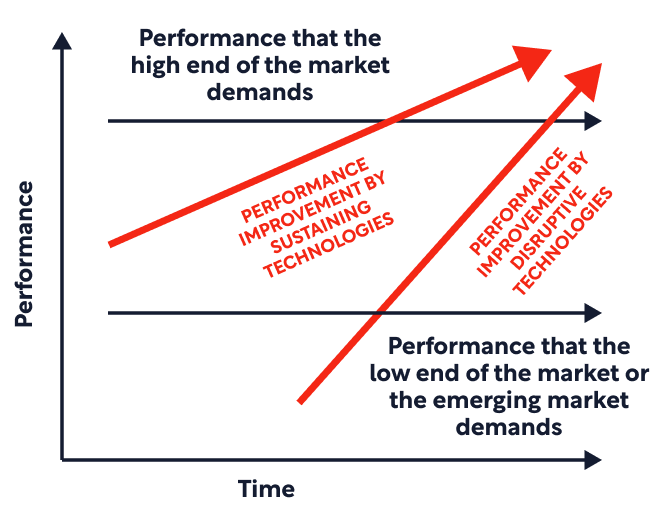
Christensen explains that typically, a disruptive innovation involves a drastically different approach to doing something, which, at first, doesn’t appeal to mainstream customers. Instead, it appeals only to a developing niche of customers with different needs. However, as the new product becomes more refined, its capabilities increase to the point where it offers greater value than traditional options in the mainstream market. At that point, he says, mainstream customers begin adopting it en masse, disrupting the market.
Christensen contrasts disruptive innovations with “sustaining innovations,” which he defines as incremental improvements to a product that don’t alter the market. For example, an early tractor manufacturer might switch from using two-cylinder engines to four-cylinder engines. This makes their tractors more powerful and efficient, but it doesn’t change who buys the tractors or why they buy them. Sustaining innovations are also called “continuous” innovations.
Comparing Definitions of Disruptive Innovation
Geoffrey Moore provides a slightly different definition of the difference between sustaining and disruptive innovations.
According to Moore, a disruptive (or discontinuous) innovation is any new product that requires the customer to change how he uses a product in order to adopt it. For example, a farmer who sells his plow horses and buys a mechanical tractor now has to buy fuel for the tractor instead of feeding hay to his horses. Instead of having a ferrier periodically put new shoes on his horses, he has to have a technician perform maintenance on his tractor. He has to develop new skills and work with different suppliers to make use of the new technology.
Similarly, according to Moore, a sustaining (or continuous) innovation is a product that is improved in some way but doesn’t require the customer to change in order to benefit from the improvement. For example, a farmer who upgrades from a two-cylinder tractor to a four-cylinder tractor can still buy fuel from the same supplier and have it serviced by the same technician.
Thus, to Moore, a disruptive innovation is disruptive to the customer’s life or routine, while to Christensen, a disruptive innovation is disruptive to the market. In principle, these are fundamentally different definitions. Hypothetically, if John Deere introduced an autonomous tractor that required farmers to learn C++ programming, and farmers gradually adopted it without disrupting the market, then Moore would call it a disruptive innovation, while Christensen would call it a sustaining innovation.
How Disruptive Innovations Reshape Markets
Christensen outlines the typical chronology by which disruptive innovations displace established companies:
- Someone invents a disruptive product, forms a start-up company, and begins producing it.
- Established companies evaluate the product and decide it wouldn’t be profitable in their current market, so they don’t pursue it.
- Through trial and error, the start-up finds an emerging market for their product.
- The start-up continues to refine their product. Eventually, its value (capabilities and reliability at its price point) surpasses traditional alternatives, and mainstream customers become interested in it.
- The disruptive product begins to dominate not only the emerging market that formed around it, but also the mainstream market, displacing traditional alternatives.
- Established companies realize that they are losing market share to the disruptive innovation, but by then it’s too late for them to defend their market share, even if they adopt the innovation themselves.
Comparing Chronologies
Christensen presents his chronology of disruptive innovations from the standpoint of a business analyst and advisor to established companies. Moore presents a similar chronology from the standpoint of giving a start-up company a battle plan for conquering the mainstream market. Let’s consider Moore’s chronology and compare it to Christensen’s:
You come up with a revolutionary product. (This is the first step in disruptive innovation according to almost any expert.)
You sell your first few units to curious customers who try it out and corroborate the claim that you’ve created a novel product. These early enthusiasts probably won’t buy enough for you to make much money, but they help you refine the product and get the word out to a broader audience by word of mouth. In Christensen’s chronology, this is step three. His step two says that established companies first reject the new product—a step that Moore, in this chronology, doesn’t address.
You connect with a few ambitious customers who see your product’s future potential. They want to use your product for something specific and have the capital to implement it. You sign a lucrative contract with them to improve and customize your product to meet their needs. A few such contracts make up the bulk of what Moore calls the “early market.” Moore’s “early market” corresponds to Christensen’s “emerging market,” so this step closely corresponds to Christensen’s third step.
You select a single niche application for your product and refine it to provide indisputably better value in that application, allowing you to become the market leader in that niche. This corresponds to the first half of Christensen’s fourth step, though he doesn’t mention niche applications explicitly.
You continue to refine your product and expand into an adjacent niche. Repeat. As you become the market leader in more and more sectors, eventually you dominate the entire mainstream market. This corresponds to the second half of step four and step five of Christensen’s chronology. At this point, Moore’s mission is accomplished, so he doesn’t go on to discuss the fate of the former market leaders that you displaced, as Christensen does in his sixth step.
Problems That Disruptive Innovations Cause for Established Companies
Why don’t established companies just embrace the innovation at step two and reap its benefits, instead of falling behind until step six? Christensen explains that there are a number of reasons established companies rarely adopt disruptive innovations before it’s too late.
1. Disruptive Innovations Get Started in Small Markets
As Christensen points out, it takes a big market to sustain a big company. However, when they first appear, disruptive innovations usually appeal only to a niche market that’s too small to be of interest to large, established companies. Thus, the companies that pursue disruptive innovations tend to be start-ups that are small enough to cater to small markets. If the market grows as the technology matures, the companies have a chance to grow with the market. However, by the time the market gets big enough for big companies to take notice, it may be too late for those larger companies to catch up.
(Shortform note: Marketing experts Al Ries and Jack Trout explain that in any given market, the first company to assume a position of market leadership in the minds of customers usually remains the market leader. Thus, market forces tend to prevent late adopters from claiming much of the market share, even in cases where the disruptive innovation doesn’t involve a significant technological learning curve.)
2. Disruptive Innovations Don’t Appeal to Existing Customers
Christensen explains that when a disruptive innovation first appears, an established company’s customers usually have no interest in it, because its performance characteristics are usually inferior to more mature technologies. Initially, the new innovation doesn’t compete for the same customers that buy the company’s current products. The few customers that it does attract have special interests that the new product uniquely addresses.
The Technology Adoption Life Cycle
Christensen says that the market for disruptive innovations usually starts out as a small, niche market. Others have also studied this phenomenon and developed models to explain it.
Probably the best-known model is the “Diffusion of Innovations,” which was originally developed by two agricultural scientists George Beal and Joe Bohlen. This model was generalized and popularized by Everet Rogers, and then refined by Moore, who called it the “Technology Adoption Life Cycle,” or TALC.
As Moore presents it, the TALC predicts that the market for any disruptive innovation is made up of five groups of people, who become interested in the technology at different stages of its development:
“Techies” or “Innovators” love new technology for its own sake. They buy new products just to try them out and are happy to tinker with things in order to make them work, but they only represent about 2% of the population.
“Early Adopters” or “Visionaries” see emerging technologies as opportunities to gain revolutionary capabilities before anyone else does. They represent about one-sixth of the population.
The “Early Majority” or “Pragmatists” hope to benefit by keeping up with the state of the art, but they only buy proven products from reputable companies. They represent about a third of the population.
The “Late Majority” or “Conservatives” don’t care about keeping up with the latest developments, but they don’t want to be left behind either. They tend to value simplicity, convenience, and affordability over performance. They make up about one-third of the population.
The “Laggards” or “Skeptics” are innately skeptical of anything new. They never buy new technology if they can avoid it. They make up about one-sixth of the population.
Thus, when a disruptive innovation is introduced, the first customers are the “techies,” and so the initial market will be limited to a few percent of the overall population. Meanwhile, the majority of an established company’s customers will be members of the early and late majorities, who don’t become interested until the innovation has been refined and standardized.
3. Disruptive Innovations Can’t Demonstrate Potential Growth
As Christensen points out, most established companies are under pressure to maintain a steady, positive rate of growth to keep their stock prices going up and thereby keep their stockholders happy. Therefore, when investing in a new product, companies are expected to promise substantial growth to justify their investment. However, even if a company recognizes that the market for a disruptive technology may grow as the technology matures, they can’t show their shareholders and investors market data on markets that don’t exist yet. This makes it hard for them to justify investing in innovations, because established companies are used to making strategic decisions based on sound market research.
(Shortform note: Compounding the problem of predicting which innovations may offer long-term growth and which will not is the fact that not every disruptive technology grows to take over the mainstream market. In fact, the majority of disruptive innovations only flourish briefly in an early market made up of techies and early adopters, after which they stagnate and die without making it into the mainstream market.)
4. Disruptive Innovations Require Retooling
Christensen asserts that established companies are often poorly positioned to produce or sell disruptive products because the new innovation takes a different approach, requiring different component parts or manufacturing methods. This, in turn, may require different supply networks. The company’s operations are tailored to its current products and thus are not optimized for new innovation. They may not even be able to accommodate it without an expensive overhaul.
For example, suppose a horse trader wants to start dealing in automobiles. The horse trader already has connections with ranchers and breeders who supply him with wholesale horses, but he’ll need to develop new relationships with automobile manufacturers. He also has stables to keep his horses in, and barns to store hay, but he’ll have to remodel them to store automobiles and spare parts. He currently pays stable hands to feed and water the horses every day, but that won’t be necessary with automobiles, so he’ll have to re-think his daily routines and operating procedures to keep his employees productive.
Retooling for Innovations in Sales Methods
This principle applies to practically all disruptive innovations, not just physical products. In The Challenger Sale, Mathew Dixon and Brent Adamson explain “solution selling,” a disruptive innovation in business-to-business sales: Instead of simply fulfilling purchase orders, you would sell the customer a complete solution customized to their needs.
But this changed the relationship between the customer and the salesperson. Instead of just delivering what the customer ordered, the sales rep had to assume a consultative role, challenging the customer to rethink their operations and showing them how they could benefit from a customized solution.
Dixon and Adamson observed that relatively few sales reps were able to transition to solution selling, because they struggled to mentally retool their role, just like a factory struggling to retool its production lines for a different product.
5. Disruptive Innovations Appear Down-Market of Established Products
Christensen argues that most companies tend to move up-market over time, appealing to increasingly demanding customers, and reaping higher profits from higher-end products as the company gains experience and refines its products. However, disruptive innovations usually start out down-market—they start out relatively simplistic and have to be priced at the lower end of the market spectrum.
(Shortform note: Al Ries and Jack Trout offer additional insight on why disruptive innovations start out down-market. They assert that budget-friendly versions of new innovations tend to sell better, because customers see the technology as unproven. The lower cost reduces the risk of buying it.)
Christensen points out that to adopt the new innovation, a company would have to shift its focus back toward the lower end of the market. This is financially problematic because of the lower profits per unit sold. It’s also culturally problematic, because it’s hard to give up the prestige that you’ve built up and start over.
Cross-Examining Up-Market Mobility
Do companies really tend to drift up-market over time as Christensen says? It makes sense that, as you gain experience with making a particular product, you’ll figure out how to make it better. In principle your product should move up-market as it improves. However, in practice, the marketing concept of positioning makes it difficult to move up-market or down-market.
Your “positioning” is how customers see your product or brand. For example, do they see you as the quality leader in your industry? Or the cheap knock-off? Or the environmentally-friendly option? Or the version made especially for a particular gender, age group, or other demographic?
Marketing experts assert that once customers have established your position on the market landscape, it is very difficult to change their perception of your product or brand. So if you start out selling entry-level products and customers recognize your place in the market, it may be difficult to move up-market, even if your quality improves over time.
What You Can Do to Adopt Disruptive Innovations Successfully
We’ve explained what disruptive innovations are, how they disrupt markets, and why they’re a problem for established companies. Now let’s examine Christensen’s advice on how established companies can overcome these problems.
Christensen’s recommendation is to establish an organization that functions like a small start-up within the parent company. This works because, as we’ve seen, most of the problems that prevent established companies from investing in disruptive innovations are irrelevant to small start-ups.
You can create the organization either as a spin-off of your existing operations, or by acquiring an existing start-up. Either way, Christensen stresses that the new organization must have adequate autonomy to explore and develop disruptive innovations. It will struggle if it has to compete for resources with the company’s sustaining-innovation projects, because it operates in an emerging market where there’s less opportunity for high-volume sales. It may also need to develop supply chains and operating procedures that are incompatible with those of the parent company.
(Shortform note: In Blue Ocean Strategy, W. Chan Kim and Renée Mauborgne argue that emerging markets with less opportunity for high-volume sales are actually the most secure path to eventual high-volume sales, as a company’s best chance to grow and succeed is when it operates in an uncontested market—as it would when introducing a disruptive innovation. They argue that although you may have difficulty in developing new supply chains and operating procedures, as Christensen mentions, your competitors will also. Thus, the challenges you might face as a start-up can end up being your strengths because they delay other players from entering the market.)
Christensen also stresses the importance of budgeting for multiple attempts at marketing the disruptive innovation. Recall that start-ups often have to find the emergent market by trial and error, because there’s no actual data on markets that don’t exist yet, which makes them impossible to accurately forecast. You may have to explore several different applications or niche markets before you find one where the product takes off.
Making Decisions Without Data
Moore echoes Christensen’s observation that emergent markets are hard to forecast because you can’t gather metrics on them yet. However, where Christensen advocates mitigating the uncertainty by budgeting for multiple attempts, Moore suggests using customer characterizations to guide your planning.
Each customer characterization is a description of a hypothetical customer, complete with information about their age, job, goals, and so on. These descriptions should be as realistic and as lifelike as possible. Once you’ve created profiles for the archetypical customers that might want your product, you use them to think through hypothetical purchasing scenarios: What does the customer’s current situation look like without your product? How would having your product solve her current problems? Is the improvement enough to compel her to buy?
By anticipating how each hypothetical customer would behave in each scenario, you can assess which customer would be most likely to buy your product. According to Moore, this method works because your intuition is much better at predicting how a person would respond to a situation than it is at predicting the behavior of abstract entities like markets. And when you’re introducing a disruptive innovation, you have to make decisions based on informed intuition, because you don’t have enough data to make an analytical decision.
Of course, these two methods are not mutually exclusive. When you’re operating in uncharted technological territory, it’s prudent to inform your intuition with customer characterizations and budget for multiple attempts whenever possible.
Managing an Acquired Start-Up (Or Spin-Off)
Like Christensen, business and marketing consultant Regis McKenna points out that collaboration between a large, established company and a small, innovative start-up organization can be beneficial because of their different strengths and capabilities. However, he also points out that their differences can make collaboration difficult, so much so that many attempts at collaboration end in bankruptcy for one or both organizations.
McKenna notes that collaboration can take the form of a joint venture, an acquisition, or any other agreement to work together on something. He doesn’t specifically mention collaboration between a parent company and a start-up-like spin-off organization within the company, but since this relationship is very similar to that of an acquired start-up, we infer that the same problems would apply.
McKenna identifies two keys to effective collaboration between a start-up and an established company:
1. Adequate separation. Both organizations must retain enough autonomy that they each have their own supply lines, customers, and unique culture. He warns that without adequate separation, the culture and resources of the larger organization tend to crowd out those of the smaller start-up, such that the start-up’s strengths are lost.
Christensen mirrors this idea by recommending that a start-up or spin-off have autonomy so that it can explore innovations without influence from the parent company. He also implicitly acknowledges McKenna’s advice by pointing out the problems that established companies have adopting disruptive innovations: Most of these are not a problem for a small start-up, but if the start-up gets absorbed into the established company (or is never sufficiently separate from it) then the established company’s problems will still apply.
2. Adequate communication. While maintaining autonomy, the two organizations also need to communicate enough that they both have a clear understanding of who is responsible for what. McKenna warns that when organizations try to collaborate without adequate communication, important tasks are often left undone because each org assumes the other is taking care of it.
Christensen doesn’t address this, likely because he considered only collaboration between an acquired start-up or a spin-off organization, and doesn’t address collaboration between separate companies. We might infer that collaboration between separate companies more often fails due to inadequate communication, while collaboration between two organizations of the same parent company is more likely to fail due to inadequate separation.
Introduction: Disruptions Make Successful Companies Stumble
Innovations have the potential to upend industries. These kinds of significant innovations—called disruptive innovations—don’t come along very often, but when they do, they change how companies make and market products, the types of customers who buy the products, and how they use the products.
When disruptive technologies emerge, dominant, well-run companies often stumble. These companies tend to use the same sound business judgment that has guided them through previous changes, including:
- Listening to what current customers want
- Providing more and improved versions of what customers want
- Investing in projects that promise the highest returns
However, in the face of disruptive innovations, these strategies don’t produce the same results. This is the innovator’s dilemma: The approaches that lead to success in adopting most innovations lead to failure when confronting disruptive innovations.
This book provides insight for both innovators and established companies’ leaders on how to navigate disruptive innovations. The author takes on two key questions:
- Why do so many successful businesses fail when confronted with disruptive innovations in their industries?
- How can businesses succeed despite the unpredictability of disruptive innovation?
There’s no way to get around the uncertainty of innovation, but you can reduce the uncertainty by understanding the traits of disruptive innovations, effective strategies for adopting them, and how to tell the difference between a disruptive and non-disruptive innovation.
In Part 1, we’ll look at how and why successful, well-managed companies often fail when faced with disruptive technologies. In Part 2, we’ll cover strategies that established companies can use to avoid falling into these common traps, and how the companies can successfully adopt disruptive technologies.
The author was a Harvard Business School professor who developed the theory of disruptive innovation through extensive research, coupled with his experience as a former entrepreneur and management consultant. (Shortform note: This book was originally published during the 1990s tech boom, in which innumerable companies faced disruptions. The Economist named The Innovator’s Dilemma among the six most important business books ever written.)
(In the context of this book, “technology” means any process a company uses to produce its products and services, and “innovation” is anything that causes a technology to change.)
Part 1 | Chapter 1: Customers Discourage Disruptive Products
Typically companies succeed by giving customers what they want—if you keep your customers happy, your profits should stay high. But, as we’ll see, disruptive innovations don’t initially appeal to a company’s current customers.
Customers’ disinterest in disruptive technologies discourages established companies from investing in developing the disruptive products, which leads to the companies’ eventual downfalls. Those companies that fail to adopt the disruptive technologies get the rug pulled out from under them later, when they discover that the disruptive products are taking over their market because the technologies have improved enough to satisfy their customers.
We’ll look at the effect of customers’ influence in the disk drive industry, which experienced an exceptionally rapid pace of change in technological advancements and market structure.
Technology Mudslide Hypothesis in the Disk Drive Industry
Disk drives are responsible for reading and writing data on computers, using the binary system of 1s and 0s. IBM produced the first disk drive in the early 1950s. The drive was called RAMAC, which stood for Random Access Method for Accounting and Control.
Soon, other companies began producing disk drives. By 1976, there was about $1 billion in disk drive production.
Between 1976 and 1995, 129 startups entered the industry. During those two decades, each crop of entrant companies quickly graduated to become established firms, as new innovations disrupted the industry—and brought new generations of entrants—at an accelerated rate. Ultimately, all but 20 of the companies failed.
Some people blamed the high rate of failure on the rapid pace of technological advancement, which far exceeded most other industries. Based on this assumption, the author developed the technology mudslide hypothesis.
The technology mudslide hypothesis stated that keeping up with the breakneck pace of change was like working against a mudslide to climb a hill: It required every ounce of companies’ focus and effort, and pausing even for a minute would mean getting buried.
However, data ultimately debunked this theory. In reality, neither the complexity nor the pace of technological advancement led to companies’ failures—it was the type of technological change that determined companies’ fates. Specifically, established companies failed when confronted with disruptive innovations.
Sustaining vs. Disruptive Innovations
There are two types of technological innovations:
1) Sustaining innovations simply improve upon the performance of the industry’s existing products, thus catering to the established market. This represents the majority of technological advancements in any industry. Most companies that produce goods follow a fairly consistent trajectory of improving their products: They adopt technological advancements as they become available, and they release updated versions of their products with the new improvements.
Some sustaining innovations are simple changes, while others are technologically complex. Regardless, no matter how complicated the change, established companies almost always lead their industries in producing and marketing sustaining innovations.
2) Disruptive innovations disrupt the performance improvement trajectory. These technologies don’t appeal to existing customers—instead, they open up an entirely new market.
Disruptive innovations take many forms: Some are technologically advanced, while others are simple reconfigurations that offer new features. Some disruptive innovations invade markets like wildfire, while others take years or decades to take hold. No matter what the disruptive innovation is, entrant firms—or startups—almost always become the dominant forces in producing and selling it.
We’ll take a closer look at how these two types of changes impacted established and entrant firms in the disk drive industry. In the context of this book, established firms will refer to companies that existed before a given technological change, and entrant firms will refer to companies that started up at the same time the innovation was emerging.
Case Study: Disruptive Innovations in the Disk Drive Industry
There were only a handful of disruptive changes in the disk drive industry, but they caused established firms to crumble. The most significant of these changes was the shrinking of disk drives.
Two of the most important characteristics of disk drives are physical size and capacity. The industry was in a constant push to fit more data capacity on smaller drives.
In the 1970s, the high-capacity 14-inch drive was standard for mainframe computers, the huge machines used by large businesses for processing data and transactions. Between 1978 and 1980, entrant firms introduced a disruptive technology: a smaller, lower-capacity 8-inch drive.
The 8-inch drive didn’t have enough capacity for mainframes, but it was perfect for the emerging market of minicomputers—mid-sized servers used for business, scientific projects, and databases—which were a step down in size and power from mainframe computers.
At first, the 8-inch drives cost more per megabyte of capacity, even though the drive’s total price was lower than the 14-inch drive. The market tolerated the higher price-per-megabyte because it valued the drive’s smaller size.
Over time, 8-inch drive manufacturers improved capacity and reduced costs so much that the 8-inch drives eventually had a lower cost-per-megabyte than the 14-inch drives. Additionally, the 8-inch drives began invading the 14-inch drives’ market: The 8-inch drives’ capacity had increased enough to suit low-end mainframe computers, eventually pushing 14-inch drives out of the low-end mainframe market.
Among 14-inch drive manufacturers, two-thirds never entered the 8-inch drive market—and those that did were two years behind the 8-inch startups. Although the established firms that entered the 8-inch market had products that performed just as well, they couldn’t compete with the entrant firms. Eventually, every 14-inch drive manufacturer failed.
The 14-inch drive manufacturers hesitated or failed to enter the 8-inch market because their mainframe computer customers didn’t want smaller drives. Mainframe computer makers wanted more capacity at a lower cost-per-megabyte, and 8-inch drives couldn’t offer that—at first. Ultimately, listening to their customers led to the 14-inch firms’ demise.
This pattern repeated multiple times in the evolution of the ever-shrinking disk drives.
The 5.25-Inch Drive
When the entrant Seagate Technology created the 5.25-inch drive in 1980, it had a sixth of the megabyte capacity of 8-inch drives and five times the access time (the higher the access time, the slower the computing speed).
Minicomputer manufacturers weren’t interested in the innovation, so Seagate had to find another market. The company turned to the emerging market of personal desktop computers, where the drive’s inferior capacity was less important than its smaller size and lower total price.
As in the transition from 14- to 8-inch drives, the established 8-inch firms that eventually produced 5.25-inch drives were about two years behind entrant firms. And half of 8-inch makers never entered the 5.25-inch market and eventually failed.
As the capacity of the drives increased, they eventually became sufficient for minicomputer and mainframe manufacturers. Again, the disruptive innovation began in an emerging market and eventually invaded the established market.
The 3.5-Inch Drive
The 3.5-inch drive was created by a company called Rodime in 1984, but the technology took off when the firm Conner Peripherals brought it to market in 1987. Similar to previous evolutions, this drive was physically smaller and offered less capacity than existing products.
Conner found a market in new portable and laptop computers, which valued the drive’s smaller size, lighter weight, and decreased power needs.
Seagate—the innovator of the 5.25-inch disk drive, and now an established firm—could have beat Conner to the market, but the company fell into the trap of listening to its customers. In 1985, Seagate’s engineers introduced a 3.5-inch drive prototype to customers, but the desktop computer makers weren’t interested. Seagate’s executives killed the 3.5-inch project because they doubted that the smaller drives would bring in enough revenue to make it worth the investment.
However, after Conner began selling 3.5-inch drives, Seagate revived the project—but instead of targeting the emerging market of laptop manufacturers, Seagate sold the smaller drives to desktop computer makers. Although Seagate had hesitated to invest in the disruptive technology for fear of cannibalizing its existing sales, that’s exactly what happened when the company finally entered the market because it sold the drives to its existing customers.
Seagate’s mistake is a common misstep among companies facing disruptive technologies. To avoid this, established companies should adopt disruptive innovations soon after the technologies emerge, and the companies should target the disruptive products’ emerging markets, instead of trying to tailor them to existing markets.
The 2.5-Inch Drive
In 1989, an entrant firm called Prairietek introduced a 2.5-inch drive and dominated the market. But by the end of 1990, Conner Peripherals produced its own version of the drive and took 95 percent of the market.
In this case, the entrant Prairietek didn’t have the advantage over the established Conner Peripherals because the 2.5-inch drive was a sustaining—not a disruptive—technology. The smaller drive appealed to the same laptop makers that used 3.5-inch drives, so the innovation merely represented a technological improvement.
Throughout the decades of improving disk technology, each round of incumbents allowed themselves to be led astray by their customers’ input. In the next chapter, we’ll talk about why.
Exercise: Identifying Disruptions
Disruptive innovations are all around us. Recognizing them and their impact will help you deal with them in business.
What is one example of a disruptive innovation that has either affected the industry you work in or impacted your daily life?
How did the established market operate before the disruption?
What was the emerging market the disruptive technology initially targeted?
How has the disruptive innovation affected the established market?
Think of the top companies in that industry. Are they established or entrant companies?
Chapter 2: Value Networks
In order to explain why dominant companies often fail in the face of technological change, most experts offer two theories:
- The Organizational Structure Framework: Companies’ organizations, managements, or cultures can’t adapt to radical innovations that require different communication patterns and workflows.
- The Capabilities Viewpoint: Companies develop certain skills and knowledge from producing their existing products, and they stumble when a radically new technology requires a different set of skills and knowledge.
Although these theories help explain many firms’ failures, they don’t address what happened in the disk drive industry, where established firms adopted radically new technologies for various sustaining innovations, but they failed when faced with relatively simple innovations like the 8-inch drive. As we saw in Chapter 1, a major factor determining whether a company adapted to disruptive technologies was whether its customers were interested in the new technology.
A third theory—the theory of value networks—explains how customer input is part of a larger system that determines how companies respond to customer input, set and pursue goals, and react to industry changes, such as disruptive innovations.
Value Networks
Just about every product requires specific component parts—for example, a mainframe computer needs circuit boards, a central processing unit, and disk drives, among other things. Component parts, then, require their own component parts: Disk drives need disks, a motor, and a spindle. While some companies produce their own component parts, most buy them from various suppliers.
This creates a nested network of producers and markets. Each nested network represents a unique value network, because the chain of supply and the products being manufactured determine each component’s value.
There are two metrics that factor into a product’s value in its value network. Let’s look at them in terms of a disk drive in a network producing laptops versus a network producing mainframes:
- Performance attributes: These are the traits that customers value in a product. For laptop manufacturers, the most valued attributes for disk drives are small size, durability, and low power needs. By contrast, mainframe makers value speed, megabyte capacity, and reliability.
- Cost structure: This is determined by a product’s overhead costs, production volume, and price point, and it dictates the gross profit margins manufacturers need to meet. Laptops entail high production volume in low-cost factory settings and distribution to retailers, thus laptop makers need only 15-20 percent gross profit margins to cover overhead. By contrast, mainframes require low-volume, custom manufacturing; direct sales, requiring a sales team; and ongoing tech support for customers, which means mainframe makers need 50-60 percent gross profit margins to cover overhead.
A company’s value network provides the context for the organization’s decisions and actions, including how it approaches innovations. If an innovation affects a product’s attributes or cost in a way that is highly valued within the value network, then the company is more inclined to pursue it.
This framework illustrates why established firms are reluctant to allocate limited resources—including time, money, and personnel—to disruptive innovations, which have low value in both metrics:
- Disruptive innovations don’t have attributes that appeal to existing customers.
- Disruptive innovations promise low profits because they are initially marketable only to small, emerging markets.
The Technology S-Curve Framework
Some businesses use the technology S-curve framework to determine when to adopt innovations—but the S-curve framework only applies to sustaining innovations that replace products within the same value network.
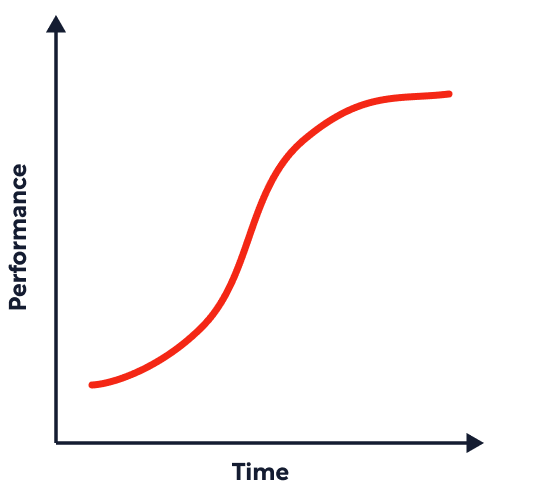
When a technology is first developed, progress is slow and the slope of the S-curve is gradual. Then, the slope steepens as improved understanding and engineering bring rapid progress. Finally, the slope nearly plateaus as technology has been improved and refined so much that progress slows significantly.
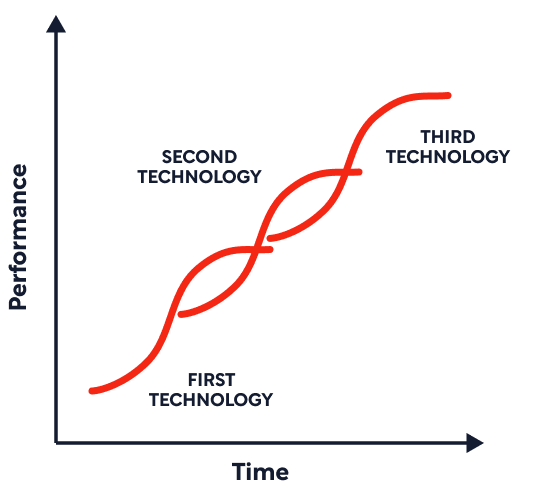
When a new sustaining technology emerges, the S-curves of the old and the new technologies overlap: The new technology is in the early acceleration stages while the old technology begins to plateau. The most successful companies transition from the old to the new technology at the moment that the two curves intersect, shown on the graph. The companies that do this best are the established firms.
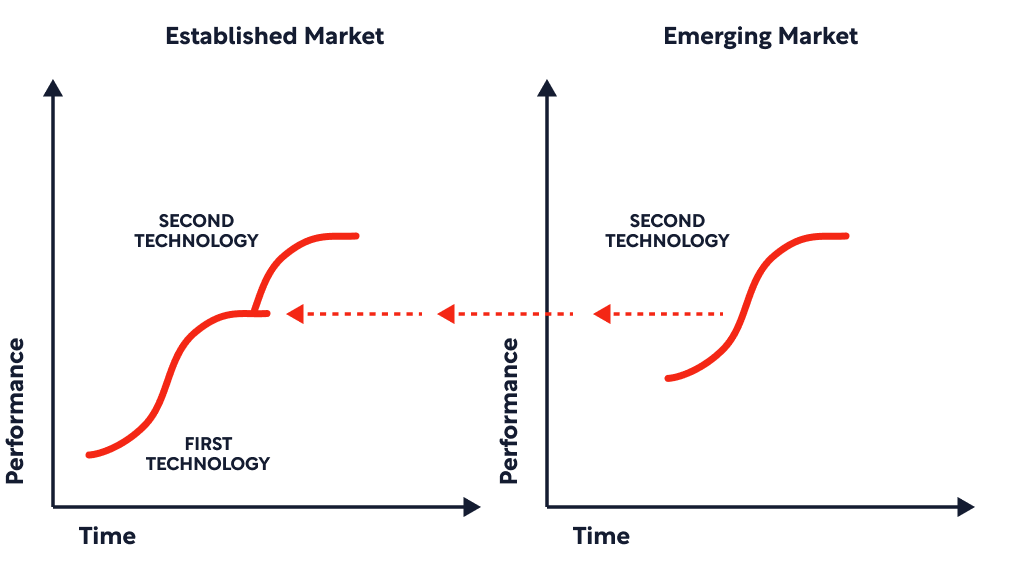
However, when a disruptive technology emerges, its S-curve is on an entirely different graph because, by definition, it serves a different market and exists in a different value network. At a certain point, once the disruptive technology’s performance has improved enough, it may invade the previously established market and replace the old technology, in which case it would look like these graphs.
Case Study: How Value Networks Influenced Seagate
Let’s look at how the 5.25-inch drive innovator Seagate’s value network influenced the company’s decision-making as it confronted the emergence of disruptive 3.5-inch disk drives. The development and spread of the disruptive technology breaks down into six steps:
Step 1: Established Firms Develop the Technology
Established companies often develop disruptive technologies first—though the projects are typically initiated by engineers, not company leaders—and entrants are simply at the forefront of bringing the technology to market.
Example: Seagate was actually among the first firms in the industry to develop 3.5-inch drives, although it wasn’t one of the first to market the drives. Seagate’s engineers had made dozens of prototypes of the 3.5-inch drives by the time company managers finally approved the project. When they got approval, the engineers showed their prototypes to the firm’s marketing team.
Step 2: Firms Gauge Customer Interest
When established firms consider developing a disruptive product, they gauge the existing market’s interest in the new technology. By definition, disruptions aren’t attractive to established customers, and the customers’ negative response typically dissuades companies from proceeding.
In some cases, executives allow disruptive projects to continue past this stage—but a lack of conviction about the product’s potential undercuts the commitment to the project. As a result, in day-to-day situations, time and resources are diverted to other projects.
Example: Seagate’s marketers showed the drives to customers, who weren’t interested in them because the low-capacity drives didn’t meet their needs. Based on customers’ feedback, the marketing team created dreary sales forecasts, and company leaders killed the project.
Step 3: Established Firms Double-Down on Sustaining Innovations
Based on customer input, established firms’ marketing teams not only discourage executives from pursuing disruptive technologies, but they also push for increased effort on sustaining technology to improve existing products.
Example: Seagate compared the market forecasts for 5.25-inch and 3.5-inch drives. The 5.25-inch models with 60-100 MB capacities were projected to bring in 35-40 percent gross profit margins. On the other hand, the 3.5-inch drives had an unknown profit projection—plus, the company’s existing 20 MB-capacity drives brought merely 25-30 percent gross margins. Using these comparisons, Seagate upped production of new-and-improved 5.25-inch models.
Step 4: Startups Form and Find Customers
After leadership at established firms turn away from disruptive projects, frustrated engineers often join entrant firms in pursuing the new technology. The startups face the same struggle as established firms in using the disruptive technology to attract customers in the existing market—but, unlike established firms, the entrants have no other products to fall back on, so they’re forced to find a market. Through trial and error, the startups eventually find the emerging markets for their innovations.
Example: Unhappy with managers’ strategies, employees from Seagate and Miniscribe—the two biggest 5.25-inch drive producers—left the established firms to found Conner Peripherals, which ultimately led the industry in 3.5-inch drives. Conner knew that desktop computer makers wouldn’t buy the 3.5-inch drives, so it hit upon the laptop market. The outlook for the laptop market was unclear, but the company had no choice but to try it.
Step 5: Disruptive Products Invade the Established Market
The disruptive technology’s performance improvement progresses up the S-curve until it reaches a level of sophistication that appeals to the customers that previously rejected it. In addition to dominating in the emerging market, the new technology then invades the old technology’s market.
Example: The capacity improvements for the 3.5-inch drives outpaced what the laptop market needed, and the small drive soon satisfied desktop makers’ needs. With the capacity increase, the 3.5-inch drive’s small size, lower price, and reliability made it more attractive to personal computer makers than the 5.25-inch drives.
Step 6: Established Firms Try to Catch Up
Once the startups begin invading the old technology’s market, established firms make an effort to defend their territory and revive the projects they’d killed in Step 3. However, the established firms discover that the entrants have a competitive advantage.
Since the entrants developed their disruptive products in a lower value network (the emerging market), they created cost structures that made the product profitable at lower gross margins. The entrants bring their lower cost structures to the established market, which allows them to offer lower prices than the established firms, whose organizations are built around higher cost structures.
Example: When Conner Peripherals began selling its 3.5-inch drives to desktop computer makers, Seagate dusted off its 3.5-inch prototypes. Since Seagate had waited until the disruptive 3.5-inch drives invaded the desktop industry before producing its own models, the company simply sold the smaller drives to its existing customers—cannibalizing its own 5.25-inch sales. Seagate never expanded into the laptop market.
Predicting Flash Memory’s Fate
Flash memory was developed in the 1980s and threatened to disrupt the disk drive industry. Initially, flash memory attracted customers outside the computer value network, including makers of heart monitors, cell phones, industrial robots, and modems. (Shortform note: Today, flash memory is ubiquitous and is used in solid-state hard drives, smartphones, USB flash drives, and digital cameras.)
True to any disruptive technology, flash memory had immediate advantages and disadvantages compared to disk drive technology. The advantages included:
- Less than 5 percent of the power consumption of a disk drive with the same capacity
- More durability in harsh conditions
The disadvantages included:
- Significantly higher cost-per-megabyte
- Shorter lifespan
The flash card market brought in $45 million in 1993 and $80 million in 1994—and that was projected to jump to $230 million by 1996.
Would flash memory invade the disk drive value network and upend established firms’ dominance? Here’s how each of the theories we discussed would guide predictions.
1) The Organizational Structure Framework would categorize flash memory as a radical technology. As such, established firms that were set up to facilitate a different workflow and communication structure than flash memory demanded could only develop flash memory products if they created independent entities to lead the effort.
This held true: Seagate bought a 25 percent equity in SunDisk Corporation (which was later renamed SanDisk) to design and develop the flash memory cards.
2) The Capabilities Viewpoint would recognize that, although flash memory used significantly different technology than disk drives, disk drive makers had all the knowledge they needed to succeed. Established firms were experienced in designing technology, buying component parts from suppliers, coordinating products’ assembly, and marketing and selling them. The companies could apply these general capabilities to producing flash memory and competing with startups.
Seagate did, in fact, use its capabilities to go into business with SunDisk, find component suppliers and a manufacturer, and then market the products itself.
3) The Technology S-Curve Framework would note that the rate of improvement of disk drive technology had not yet slowed to a point that the S-curve of the new technology’s progress could intersect with the old technology’s S-curve. That means that disk drives were not yet at risk of being replaced by flash memory.
4) The Value Network Framework would disregard established firms’ organizational structures and capabilities as reliable predictors of whether the firms would be toppled, and it would disregard the S-curve framework because that only applies to sustained technologies. Instead, the Value Network Framework would predict whether established firms would invest in their own flash memory products based on their customers’ interest.
By the mid-1990s, flash memory couldn’t offer computer makers what they needed, so Seagate pulled its few flash products from the market, though it retained its equity in SunDisk.
Outcome of Flash Memory Innovation
The Value Network Framework best predicted established companies’ trajectories in response to flash memory.
Disk drive makers hit a limit on how much they could lower the production cost per drive. Since low-capacity disk drives had the same cost floor as high-capacity drives, disk drive makers focused on producing high-capacity drives (around a gigabyte or more), which better served its customers.
This left an opening for flash memory cards to fill the void in the emerging 10-40 megabyte market. Industry experts predicted that a 40 MB flash card and 40 MB disk drive would be around the same price by the time the book was published in 1997.
(Shortform note: Flash memory eventually improved enough to invade an established market and replace hard disks in laptops. Flash-based solid-state drives (SSDs) are now in top-performing laptops, including the MacBook Pro and Microsoft Surface.
Although Seagate quickly withdrew its flash products from the market, the company made a wise decision in retaining a stake in SunDisk—in fact, it’s a strategy we’ll talk more about in Part 2. SunDisk was eventually renamed SanDisk, and the company is now one of the top eight vendors in the memory card market worldwide.)
Chapter 3: Case Study—The Excavator Industry
To illustrate that the principles and impacts of disruptive innovations are universal, now we’ll take a look at a very different industry: excavators. In contrast to the rapid changes that took hold in the disk drive industry, the disruptive technology we’ll be talking about—hydraulics to replace cable-operated actions—took 20 years to take over the excavator market.
Here’s an overview of the innovations that impacted excavators’ evolution:
- 1837-1920s: The steam shovel was invented. All mechanical earthmoving equipment was powered by steam.
- Early 1920s: Gasoline replaced steam. Gasoline-powered equipment was more powerful, reliable, and affordable than almost any steam shovel, with the exception of the biggest ones. Despite the major technological shift, this was a sustaining innovation because it served the same market—just with improved performance—and 23 out of the 25 biggest steam shovel manufacturers successfully switched to gas excavator production.
- Late 1920s to 1940s: Several other sustaining innovations followed, including diesel power, electric motors, and a design change that gave the excavators increased reach and flexibility.
- 1940s to late 1960s: A disruptive technology emerged—excavators that used hydraulics instead of cables to move the arms and bucket.
When hydraulic excavators hit the industry, they eventually wiped out nearly all the established manufacturers. In the 1950s, there were about 30 established excavator companies. By the 1970s, only four established companies had successfully transitioned to hydraulic excavators, and the industry was led by entrant firms (including companies that are still well-known, such as John Deere and Caterpillar).
Finding an Emerging Market
During the reign of cable excavators, there were three markets:
- General excavation (digging holes for things like basements or canals)
- Sewer and piping (digging long trenches)
- Open pit and strip mining
Each market had unique needs—for example, sewer and piping customers needed narrower buckets to dig trenches, while mining customers needed larger bucket capacity to move dirt efficiently. But overall, cable excavators’ most highly valued performance characteristics were:
- Reach (how far the arm and bucket could extend)
- Bucket capacity (cubic yards of dirt per scoop)
When hydraulic excavators were first developed, they had a fraction of the bucket capacity and reach of cable excavators—insufficient for the needs of any of the cable excavator customers. Hydraulic entrant firms had to find another market, so they adjusted the machines to be mounted on tractors, and they called them backhoes.
Backhoes became the perfect solution for smaller, residential construction jobs. Contractors on these projects previously had to hand-dig narrow ditches for sewer lines, because the job sites and project budgets were too small to bring in full-sized cable excavators. Hydraulic excavators opened the residential construction market to using excavators for the first time, because they offered attributes that cable excavators couldn’t, including:
- Smaller size
- More affordable price
- Narrow buckets that were ideal for digging residential sewer trenches
- Tractor mounts that made them faster and more mobile than traditional excavators on tracks
Not only had hydraulic excavator makers found their market, but they struck it while tract housing construction was booming following World War II and the Korean War.
An Established Firm’s Failed Attempt to Adopt Hydraulics
In 1950, a dominant cable excavator manufacturer, Bucyrus Erie, saw hydraulic excavators’ rise and bought a small hydraulic backhoe company. But instead of entering the emerging residential construction market, Bucyrus created a hydraulic-cable hybrid to market to its existing customers.
The machine, called the Hydrohoe, used hydraulics to guide the shovel into and through the dirt, but it used cables to lift the bucket. The cables enabled the Hydrohoe to lift bigger loads, which Bucyrus thought would make the machine robust enough for its customers. However, the Hydrohoe still didn’t have enough capacity or reach for Bucyrus’s customers, so the product languished on the market for 10 years and the company eventually resumed selling cable excavators.
Hydraulic Excavators Invade the Established Market
Over time, backhoes improved and significantly increased bucket capacity—from ⅜ cubic yard in 1955 to 10 cubic yards in 1974. With improved capacity, hydraulic backhoes ascended into the traditional cable excavator market.
Once hydraulic excavators improved enough to satisfy cable excavators’ customers, the performance attributes that customers valued began to shift. Put another way, now that both models were good enough to get the job done, increased capacity was no longer a competitive advantage.
With their capacity needs satisfied, customers started making buying decisions based on reliability instead of capacity. (We’ll talk more about this concept in Chapter 9.) Hydraulic excavators didn’t carry the risk of having a cable snap while carrying a heavy load, so they began to pull ahead of cable excavators.
At this point, established firms’ businesses started to take a hit. Some firms adapted by developing hybrids like the Hydrohoe, but all of them treated hydraulic technology as a sustaining innovation that could improve their products to market to their existing customers. All but four of the companies ultimately failed.
By contrast, the entrant companies had framed hydraulics as a disruptive technology and targeted an emerging market. In other words, the entrants found a market to match the technology, while the established firms tried to adapt the technology to meet their market. Even though the disruptive technology eventually entered the traditional market, the entrants had certain advantages because they started in the emerging market and expanded upmarket.
During the two decades that the startups were serving the emerging market, the companies developed expertise in designing, improving, and selling the products. By the time they entered the traditional excavator market, that experience gave them an advantage over the established firms.
Excavator Companies Listened to Their Customers—And It Cost Them
Cable excavator manufacturers didn’t fail because hydraulic technology exceeded their capabilities or because they were oblivious about their customers’ needs. Rather, the companies failed because they were tuned into their customers’ needs, and hydraulic excavators didn’t make sense for their customers—and, thus, for their profits. The established companies had to focus their resources on staying competitive in their market.
Ironically, these decisions based on the companies’ survival cost many firms their entire businesses. In the next chapter, we’ll talk about how an organization’s past success creates barriers to adopting disruptive innovations.
Chapter 4: Upward Mobility and Downward Immobility
Successful companies typically focus on growing and moving upmarket with higher-priced products, higher-tier customers, and larger profits. However, this upward mobility makes firms downwardly immobile—it impedes them from adopting disruptive innovations, which always start downmarket.
Barriers to Downward Mobility
Established companies face three key barriers to downward mobility:
- Cost structures that favor seeking higher profit margins upmarket over cutting costs to remain profitable downmarket
- Organizational cultures that pull efforts toward upmarket projects
- The upmarket drift of a company’s customers and competitors
Barrier #1: Cost Structure
As discussed in Chapter 2, organizations develop cost structures that fit their value networks—value networks for higher-priced products require larger gross profit margins to cover higher overhead costs than value networks for lower-priced goods. These cost structures force companies to maintain profit margins to simply stay afloat.
In fact, most companies aim to move to progressively higher-value markets. This is especially true when disruptive technologies invade their markets, because the disruptive products generally enter the low end of the market and gradually climb to higher tiers. For example, when 3.5-inch disk drives ascended from the laptop to the desktop market, Seagate didn’t try to compete—instead, the company increased efforts to improve 5.25-inch drives enough to enter the market for minicomputers.
If an established company wants to invest its limited resources in the small, low-profit market for a disruptive product, company leaders would have to find a way to somehow cut costs. However, a company’s overhead costs include market research, product development, and marketing that’s critical to remaining competitive in its existing market. Most companies find it impossible to bring in enough profits from existing products while also trimming overhead enough to invest in disruptive ones.
Barrier #2: Organizational Culture
A company’s upward or downward mobility is determined by the projects it chooses to invest in, and most companies have processes that steer them toward high-profit projects. Although it may appear that senior managers are responsible for choosing the projects that a company invests in, middle managers actually play a more significant role in this process as gatekeepers.
Middle managers filter the ideas that come from engineers and other employees, carefully deciding which projects they’ll pitch to senior managers. Middle managers want to pitch only projects with a high likelihood of success and profitability—otherwise, they risk taking a hit to their credibilities and careers—and upmarket projects are the surest way to achieve that.
Under normal circumstances, a company’s success depends on having processes like this (formal or de facto) that weed out low-profit projects—otherwise, the company would waste too many resources on projects that don’t provide a return on investment. But these same processes steer companies away from disruptive technologies, making the firms vulnerable to being overtaken by the disruption.
Barrier #3: Upmarket Drift
Often, companies can drift upmarket without making a conscious effort to ascend to the next value network. Companies drift upmarket when their customers are pursuing higher markets, and when their competitors are similarly leaning upmarket to meet customers’ needs.
As companies move upmarket, they create openings in lower value networks for entrants to move in with disruptive products. Let’s look at how this played out in the steel industry.
Case Study: Minimills Disrupted the Steel Industry
In the mid-1960s, steel minimills disrupted the steel industry. As the name suggests, the minimills were simply steel mills at a much smaller scale.
When they emerged, the minimills could only produce lower-quality, lower-cost steel products than the established firms, the integrated steel mills. The only product they could make with the lower-quality steel was reinforcing bars (rebars), which were used to strengthen concrete.
Rebars represented the lowest quality, cost, and profits of any steel products. Additionally, rebar customers were less loyal to manufacturers than customers of any other steel products, because price mattered more than any other attribute. As a result, integrated steel mills didn’t miss the rebar customers that the minimills took from them.
Over time, minimills increased the quality of their steel and invested in equipment to make different products. Minimills subsequently took over the next two highest markets:
- Larger bars, rods, and angle irons
- Structural beams
Paradoxically, integrated steel mills’ profits grew at the same time they were being pushed out of these low markets. Ceding the lowest-profit products to the minimills allowed the integrated mills to invest in high-quality steel products, such as rolled sheet steel, that brought in the biggest profits. As a bonus, the rolled sheet steel market was insulated from minimills’ threat because minimills couldn’t afford the equipment needed to make high-quality sheet steel—but that wouldn’t be true for long.
Thin-Slab Casting Causes Another Disruption
In 1987, the steel industry was disrupted again by a new technology called continuous thin-slab casting, which opened the sheet steel market to minimills. The technology offered a much more efficient way of producing sheet steel at a significantly lower cost than traditional methods, and it made it feasible for minimills to begin producing sheet steel.
However, the quality of thin-slab cast sheet steel was initially too low to appeal to high-end customers, such as car, can, and appliance makers. The steel was only suitable for the low end of the market, for products such as corrugated steel and pipes. Since thin-slab sheet steel would only attract limited customers—and bring in low profits—integrated steel mills didn’t adopt the technology, instead investing in equipment to further improve the quality of their sheet steel for their high-end customers.
Unrestrained by high-end customers and higher cost structures, a minimill called Nucor was the first to adopt the thin-slab casting technology. Within seven years of opening its first thin-slab facility, Nucor had opened a second mill and controlled 7 percent of the sheet steel market in North America.
With time, the technology improved and raised the quality of the sheet steel. (Shortform note:
Eventually, thin-slab casting could produce quality that traditional thick-slab casters couldn’t achieve. By 2017, only nine integrated steel mills were still operating in the U.S., and they produced about one-third of the country’s steel. By contrast, there were more than 100 minimills that produced nearly two-thirds of the country’s steel.)
Part 2 | Chapter 5: Overcoming Resource Dependence
Now that we’ve outlined the factors that cause established firms to fail when confronting disruptive innovations, we’ll talk about how managers can avoid falling into these traps.
Established firms generally struggle to survive disruptive innovations, but if managers understand the governing principles of disruptive technologies, they can weather the storm or, at best, harness them for their success. Companies that don’t know what they’re up against or how to navigate it will almost surely succumb to disruptive technology’s takeover.
Consider this analogy: When humans first attempted to fly, they attached wings to their arms, jumped off of tall objects, and flapped as hard as they could. They soon discovered that the methods that worked for birds didn’t work for humans. However, when they learned about the forces at work—such as gravity and the concepts of drag, lift, and resistance—they were able to harness these principles and eventually take flight.
Through the next five chapters, we’ll explore each of the five principles of disruptive technology, illustrate how they create problems for established companies, and offer solutions to navigating them. The five principles are:
- Customers and investors dictate a company’s resources.
- Small markets can’t keep big companies alive.
- Companies can’t rely on market research for unknown and emerging markets.
- A company’s capabilities in one context are its disabilities in another.
- Customers don’t always want the newest technological advance.
We’ll start by discussing Principle #1 and talking about a few case studies that illustrate how this principle played out in several industries.
Principle #1: Customers and Investors Dictate a Company’s Resources
Although company leaders appear to be in control of an organization’s decisions and direction, the theory of resource dependence states that customers and investors are the primary deciders of a company’s actions. This is because customers and investors provide the resources the company needs to stay in business, so everything the organization does essentially is in an effort to keep them happy.
Problem: Resource Dependence Impedes Disruptive Innovation
Generally, the strategy of satisfying customers and investors is not only effective but also essential to a company’s survival. However, as we talked about, disruptive technologies are inherently unappealing to current customers, and the low profits they offer are also unattractive to investors. Consequently, this approach causes established firms to neglect disruptive innovations until they’ve improved enough to be attractive to current customers—and by then, it’s too late.
The culture that grows out of resource dependence impacts everyone in the company: From the senior managers down to the most junior employees, everyone knows what kinds of work is good for the company and for their personal careers.
Even if a manager decides to take a chance and pursue a disruptive innovation, everyone working on the project needs to believe in it in order for it to be successful. If team members don’t believe in the disruptive project, they make innumerable small day-to-day decisions—such as prioritizing their time toward other assignments—that’ll ultimately starve the project of the effort and attention it needs to succeed.
Solution: Create an Independent Organization
Rather than trying to convince employees to back a project, company leaders can create an independent entity—preferably in a separate physical location—to lead the development and marketing of the disruptive product.
The parent company’s culture and organization are built to succeed in its existing market, but the independent organization needs the separation to be able to develop the culture and cost structure that fit the disruptive innovation.
Principle #1 in the Disk Drive Industry
Let’s look at how three disk drive companies successfully handled Principle #1 when faced with disruptive innovations.
Quantum Corporation Financed Former Employees’ Startup
In the early 1980s, Quantum Corporation was a dominant manufacturer of 8-inch disk drives, which were used in minicomputers. When 5.25-inch drives disrupted the market, the company was nearly four years late to market its own 5.25-inch product.
When Quantum employees saw the next disruption coming, they didn’t want to be behind the curve yet again. The employees left Quantum and formed their own startup to make and sell 3.5-inch drives.
Quantum saw an opportunity: Instead of merely letting the employees walk away, Quantum financed and held 80 percent ownership of the startup, called Plus Development Corporation.
Besides the financial ties, Plus Development was completely independent—from its locations to its executives. The firm had a lot of success, which was a lifesaver to Quantum as the sales of its 8-inch and 5.25-inch drives dissipated over time.
After several years, Quantum bought out Plus Development and basically turned the startup into its main operation. As time went on, Quantum successfully adopted subsequent sustaining technologies and, by 1994, was the largest unit-volume disk drive manufacturer in the world.
Control Data Corporation Relocated Its Disruptive Product Team
Control Data Corporation (CDC) was an industry leader in 14-inch drive production for more than 15 years. When 8-inch drives entered the market, CDC was three years late in producing them—and the 8-inch drives it sold were almost entirely to existing customers.
CDC failed to capitalize on the potential of 8-inch technology and its emerging market because the project didn’t get the time and attention it needed. Instead, the marketers and engineers assigned to the project kept getting pulled away to work on new 14-inch models.
But when 5.25-inch drives arose, CDC took a different approach: The company sent the team assigned to work on 5.25-inch products to a facility in Oklahoma City—far from the company’s primary Minneapolis location. The physical distance allowed the team to put their entire focus on the 5.25-inch project.
CDC’s strategy worked. Although the company was two years behind the industry in introducing its 5.25-inch models, CDC held a decent market share and made a profit off the venture.
Micropolis’ CEO Fought to Launch the Disruptive Product Within the Company
Micropolis was a dominant 8-inch disk drive maker that managed to adopt disruptive 5.25-inch technology without creating a separate entity to lead the effort—but it wasn’t easy.
Micropolis’s CEO put his best engineers on the disruptive project and spent a year and a half fighting against the company’s organizational structure, which was designed to serve its customers in the 8-inch market. The CEO had to put all of his time and attention on the project to ensure that resources weren’t being pulled away.
The effort paid off, and Micropolis successfully transitioned from 8-inch to 5.25-inch drives. To do so, the company had to abandon all of its 8-inch customers—who initially had no use for the 5.25-inch models—and scramble to find 5.25-inch customers to replace the lost profits.
Principle #1 in the Personal Computer Industry
The evolution of disruptive technologies in the computer industry runs parallel to the evolution of disk drive technology, on which computers relied. Established mainframe computer makers were disrupted by the emergence of the minicomputer, which was disrupted by the personal computer, which was disrupted by the laptop.
Two minicomputer makers—Digital Equipment (DEC) and IBM—illustrate two starkly different approaches to confronting the disruptive innovation of personal computers.
DEC marketed personal computer lines four different times between 1983 and 1995, but each time they failed. During each attempt, the company led the personal computer project within its main organization. The problem was that DEC’s established cost structure and value network were incompatible with the value network it needed to enter to be successful in the personal computer market.
By contrast, IBM was successful in its personal computer venture. When IBM launched its personal computer project, it created an independent entity located in Florida, while the company’s main headquarters was in New York. The entity was empowered to take its own approach to creating a cost structure, sourcing component parts, and selling the products, independent of IBM’s main operations.
Principle #1 in the Discount Retail Industry
When discount retail stores began popping up in the 1950s, they caused a huge disruption for department and variety stores by selling nationally known brands at significantly lower prices.
Whereas department and variety stores sold products at about 40 percent of the wholesale price and turned over their inventory four times a year, discount retailers achieved the same profits by marking up the products only 20 percent and turning over inventory eight times a year.
Initially, discount stores sold low-end goods like hardware and small appliances to low-profit customers—namely, blue-collar wives with young kids. However, over time, the discount retailers began offering higher-end goods, such as clothes and home goods.
The two biggest variety store chains in the world—S.S. Kresge and W.F. Woolworth—took significantly different approaches to opening discount stores. The companies’ drastically different outcomes were yet more evidence that one organization can’t sustain two cost structures and cultures.
Kresge made a full transition from variety to discount stores. The company brought on a new CEO, hired a new management team, and steadily closed its existing stores. Through its full commitment to the disruptive innovation, Kresge found success. Its discount stores were called Kmart, and, 10 years after opening, Kmart’s sales were near $3.5 billion.
Woolworth tried to sustain its existing stores while also building its chain of discount stores, Woolco. The same set of managers were tasked with both projects, and the company continued opening new Woolworths at the same rate after opening Woolco as it had before. Ten years after opening, Woolco’s sales were about $0.9 billion. Another 10 years later, the last existing Woolco closed.
Principle #1 in the Ink-Jet Printing Industry
When ink-jet printing was introduced, it disrupted the laser-jet printing market. Although the new printers had lower resolution and higher cost-per-page, they were also smaller and cheaper per unit than the larger, higher-quality laser-jets.
Hewlett-Packard created a new entity and put it in Washington state to create physical and organizational separation from its main business in Idaho. HP executives even allowed the primary and the disruptive businesses to compete against each other in the market. This benefitted HP in multiple ways:
- It continued to earn laser-jet profits while the technology was dominant in its value market.
- It successfully commercialized the disruptive innovation and brought in profits from its ink-jet organization.
- If laser-jet sales declined with improvements in ink-jet capabilities, HP’s strong presence in the ink-jet market would help the company keep its former laser-jet customers.
Although one of HP’s businesses could end up killing the other, the company positioned itself in the best way to ride the transition from old to new technology.
Exercise: Navigating a Disruption
How would you lead your company through a disruptive innovation?
Imagine you’re the leader of an established company and a new innovation is emerging in your industry that threatens your current business. First, how would you determine whether or not it’s disruptive?
Now imagine that you’ve determined that the innovation is disruptive, and you decide that you want to spin-out an independent entity dedicated to the innovation. How do you make the case for investing in a risky, uncertain venture to your skeptical board of directors?
How involved would you be in the independent organization?
How would you ensure the entity was truly independent from the main organization (for example, staffing a dedicated team or putting the operation in a different physical location)?
Chapter 6: Principle #2—Small Markets Can’t Keep Big Companies Alive
Companies typically get bigger the longer they’re in business. While growth equates to success under normal circumstances, it inhibits companies from transitioning to disruptive technologies.
As companies get larger, they need to bring in increasing profits to cover growing costs. The larger a company gets, the less it’s able to spend valuable resources on projects with low profit margins.
Problem: Companies Are Pressured to Perpetually Grow
Most executives feel pressured to continue growing their companies for several reasons:
- The growth rate of a company’s earnings drives its stock prices, which makes investors happy, which puts the company in a good position to access capital. Additionally, employees who have stock options are incentivized to continue working hard when stock prices are growing.
- Growth helps keep top-performing employees in the company, because it creates room for them to move up to higher positions. If the company stagnates or struggles, it risks losing its best employees to other, more successful companies.
- Growing companies can justify investments in new technologies more easily than stagnated companies can.
However, perpetual growth creates a conundrum: The bigger a company gets, the harder it is to continue growing.
For example, if a $40 million company aims to maintain a 20 percent annual growth rate, the goal is much easier to attain in the early years—$8 million the first year, $9.6 million the next year—but the figure quickly climbs. The $8 million growth the company needed in the first year more than doubles by the fifth year and nearly triples by the seventh year. By the time the company is worth $400 million, it needs to bring in $80 million to maintain its growth rate.
The emerging markets for disruptive innovations are too small to support large companies’ growth needs. But if big companies wait until the disruptive technology’s market is established enough to better satisfy their growth needs, they miss the critical window for entry.
Pioneers of Disruptive Innovations Have an Advantage Over Late Adopters
When an innovation emerges in an industry, a company’s decision about whether to lead or follow the trend plays a critical role in its fate.
On one hand, pioneers can reap the rewards of first-mover advantages, which allow the company to build brand recognition and customer loyalty before other firms enter the market. On the other hand, followers can avoid costly missteps by waiting to enter a market until the pioneers have encountered and resolved early issues.
Research shows that companies that pioneer sustaining technology have no early learning advantage or any other substantial benefit over the companies that follow later.
However, companies that pioneer disruptive technology in emerging markets perform significantly better in the mid- to long-term than late adopters. For example, the first disk-drive companies to adopt thin-film technology averaged $1.9 billion in revenues during an 18-year period, while the late-adopting companies averaged only $64.5 million.
Late adopters delayed in order to minimize their market risk—entering an emerging market with an unproven technology—but the tradeoff was increasing their competitive risk—the threat of facing fierce competition if they entered the market later.
Solution: Create a Small, Independent Organization
When large established firms are confronted with this dilemma, they typically take one of three approaches:
- Try to push the emerging market to grow more quickly
- Wait until the market has grown
- Create independent entities to develop and market the disruptive technology, and make sure the entity is small enough to match the size of the market
As we’ll see in the following case studies, the first two strategies are seldom successful. By contrast, the third strategy is the most effective way for a company to tackle a disruptive project.
We talked in the last chapter about the benefits of an established firm creating an independent organization to lead disruptive projects. When a company creates the independent entities, it’s essential that its size fits the small (albeit unknown) market it’s targeting, because:
- Small companies are free of large companies’ high-profit growth obligations.
- Small entities can get excited about small opportunities and victories that would be considered disappointing in the context of a big company, and that enthusiasm is critical to driving motivation to push the project’s progression.
Let’s take a look at examples of companies that have taken each of these three strategies, and the outcomes for each.
Strategy #1: Apple Tried Pushing the PDA Market to Grow
Projects that are perceived to be successful garner more organizational and financial support, which helps them to progress to higher levels of success and profitability. By contrast, projects that are perceived as failures simply languish. To give a disruptive project the best chance of long-term success, a company must assign it to a team and organization small enough to appreciate small victories.
When Apple developed a disruptive personal digital assistant (PDA), instead of taking this approach and assigning the project to a small team, the company tried to make the market bigger. By the time Apple decided to make its PDA, called the Newton, the firm was a $5 billion public company that faced pressure to continue growing. Apple was determined to make the Newton a success.
Apple’s CEO made a huge effort to promote the product and keep resources focused on its development. The company also invested heavily in market research to find out what features customers would want.
However, PDAs were a disruptive technology. Since disruptive technologies offer novel functions, their users don’t know what they want or how they’ll use the products—until they start using them. Disruptive innovations require trial and error before they appeal to a larger customer base, and that takes time. Apple couldn’t effectively shortcut this process with market surveys.
Apple’s impatience cost the company a lot of money on multiple ineffective efforts:
- Extensive market research to try to determine what customers wanted
- Development of complicated technology based on the market research, not on actual usage
- Aggressive marketing to push people to buy the product
The Newton sold 140,000 units in its first two years, which was considered a failure for such a large company. (Shortform note: The Newton had some traction in the medical field, but it lost most of the PDA market when the Palm Pilot was introduced. Steve Jobs had the Newton discontinued in 1998, five years after its release.)
However, failure and success are relative: Fifteen years earlier, Apple sold just 43,000 units of a then-disruptive technology and considered it such a big success for the fledgling company that it went public. The perceived success and failure of the two product launches were relative to the size of the company at the time, when they should’ve been viewed relative to the size of the small, emerging markets.
The Newton may have reached more success if the company had been willing to go through the necessary trial-and-error process to fine-tune the product and find the right market, but leaders couldn’t get past the perception of failure. It’s extremely difficult for company leaders to view a product’s success in the context of the market instead of the context of the company—which is why Apple should have created a smaller, independent organization to develop and launch the Newton.
Strategy #2: Priam Waited to Introduce 5.25-Inch Drives
Large companies that struggle to justify investing valuable resources into disruptive products because of their small markets and low profit margins are often tempted to wait to enter until the market is bigger. However, waiting comes with a risk that the market’s leading companies could develop certain capabilities—such as knowledge or pace of production—and companies that enter later may never catch up.
For example, the 8-inch drive maker Priam was a leader in its minicomputer market, in part because the company developed a two-year production cycle for new products, which matched minicomputer makers’ two-year production cycle. When Priam entered the disruptive 5.25-inch drive market, it maintained its two-year cycle for the new drives.
But Seagate, which entered the 5.25-inch market two years before Priam, had developed a one-year production cycle, which gave the company two advantages:
- Seagate’s one-year cycle matched the production cycles of its customers, desktop computer makers.
- Although Seagate’s 5.25-inch drives were initially far lower quality than Priam’s 8-inch drives, Seagate quickly closed the gap by releasing new-and-improved products twice as often as Priam.
Priam couldn’t keep up, and the company eventually shuttered.
Strategy #3: Assign Small Organizations to Small-Market Projects
When companies assign disruptive projects to small, independent organizations, they can take two approaches:
1) Create an entity or division within the parent company. Control Data Corporation (CDC) took this approach when the company developed its 5.25-inch drives.
CDC’s headquarters was in Minneapolis, but it created a team in Oklahoma City to commercialize the 5.25-inch products. This small organization could get excited about the small orders that were inevitable in the early years of the emerging desktop computer market. The spin-out organization was ultimately a success.
2) Acquire a small company. Allen Bradley Company (AB) went this route when it began producing disruptive electronic programmable motor controllers, which were used in factories that were beginning to automate operations.
AB was an established electromechanical control maker when the disruptive electronic controllers emerged. A year after the first electronic controller hit the market, AB bought two small companies specializing in programmable controllers. Then AB combined them into one organization, which remained separate from AB’s main business. As a result, AB was the only established firm to survive the disruption.
Exercise: Success Is Relative
A company’s profits and achievements are relative to the organization’s overall size and level of success.
If you’ve been with your company for a while, what was a milestone achievement that the company reached during your first year? If you can’t remember specifically, what was the nature of the company’s goals and achievements?
How does that compare with the kinds of goals the company sets and accomplishments it celebrates now?
How would company leaders react now if you pitched a project that would bring the level of success you described in your first answer?
How would you pitch a project like this to managers if it were also tied to a disruptive innovation?
If your company is currently working on a disruptive project, how have company leaders approached this project differently than other projects?
Chapter 7: Principle #3—There’s No Market Research for Unknown Markets
Most companies and managers make strategies, plans, and decisions based on analyses of market trends and projections based on those trends. Using this data, managers make detailed plans for executing new projects.
The problem is that this approach doesn’t work for disruptive technologies, because disruptive products sell to markets that didn’t previously exist, so there are no data to measure past patterns or make projections about future needs.
Exacerbating the problem is the fact that success in disruptive innovations favors companies that move quickly—so companies must act fast, but they have little information to create a plan of action.
Solution: Focus Your Strategy on Learning, Not Executing
To accommodate the inherent lack of information, company leaders confronting disruptive innovations need to make strategies and plans around learning, not executing.
Instead of outlining how to execute the production and launch of a product—as they would in sustaining technologies—managers leading disruptive innovations must acknowledge what they don’t know, identify what data they need, and in what order they need it. This discovery-driven planning prevents companies from committing too many resources before they have adequate information.
Additionally, teams launching disruptive projects should:
- Assume forecasts are wrong. Disruptive markets are unpredictable, meaning that the correct marketing strategies are unknowable. Accept that trial and error is inevitable.
- Plan—and budget—for multiple attempts. It’s almost guaranteed that a company will initially choose the wrong strategy to market a disruptive technology, so managers shouldn’t hedge all their bets on the first attempt. Instead, build flexibility into project strategies and conserve enough resources to adjust the product and the strategy as they learn more about the market.
- Watch customers’ behavior as they begin to use disruptive products. Don’t listen to what customers say they want. Until a disruptive product spends some time on the market, neither companies nor customers know who will use a disruptive product or how they’ll use it.
Now let’s look at some case studies in the disk drive, motorcycle, and microprocessor industries.
Hewlett-Packard Bet Everything on Plan A
In the early 1990s, Hewlett-Packard’s Disk Memory Division (DMD) pitched a 1.3-inch disk drive that they named Kittyhawk.
As a $20 billion company, HP had high profit goals to meet, so executives demanded that the product reach $150 million in revenue within three years. DMD employees were confident they could reach the goal, because they were targeting the emerging market of personal digital assistants (PDAs), and they expected PDAs to boom.
HP worked with PDA makers to determine the capabilities Kittyhawk would need to suit the devices. Many of the PDA makers—including Apple, IBM, and Microsoft—also designed their new products to fit Kittyhawk.
Neither HP nor the PDA makers predicted that the PDA market would largely turn out to be a flop. As we talked about, Apple’s Newton had sales that would’ve excited a small company, but they fell far short of expectations. The same was true across the industry, and Kittyhawk’s sales suffered.
However, a different market for Kittyhawk materialized. HP sold the drives to makers of electronic cameras, miniature cash registers, industrial scanners, and portable Japanese-language word processors.
Then Kittyhawk got an opportunity for redemption: Video game system makers approached HP about using Kittyhawk in their devices, which would’ve been a significant sales boost. But the drive would need to be less robust so it could have a lower price point.
By that point, HP had already invested so many resources into tailoring Kittyhawk to PDAs that executives weren’t willing to spend the time and money on redesigning it to fit the video game system market. They hadn’t expected that it might take multiple iterations of the disruptive product to get it right.
A discovery-driven approach would have kept the Kittyhawk team from betting big on PDAs. Instead of tailoring the drives so specifically to the needs of PDAs, the team could have made the design flexible enough to allow them to easily add or remove features for other customers that emerged. And instead of investing in a high-volume, automated production line, the team could have built smaller production facilities and been open to the possibility of building more later if necessary.
Honda Couldn’t Compete with Harley-Davidson, So It Sold Smaller Bikes
After World War II, Honda produced small, rugged motorbikes called Supercubs in Japan that were popular for businesses making deliveries in crowded urban areas. The bikes became so successful that their annual sales rose from 1,200 in 1949 to 285,000 in 1959.
Company leaders wanted to expand to North America, but they saw no market for the Supercub. Americans favored larger, more powerful motorcycles—like Harley-Davidsons—that were designed for long distances.
Honda designed a motorcycle that fit the American market’s demands, but the product didn’t catch on. Motorcycle dealers were reluctant to sell an unproven product. Among the motorcycles that sold, many developed mechanical issues when faced with the long distances and high speeds American customers demanded. Not only were sales low, but the company was also losing money shipping warrantied replacement bikes from Japan.
At the start of the North American motorcycle project, Honda had sent three employees to Los Angeles to manage American sales, and each had brought his own Supercub to ride around locally. One day, one of the employees—frustrated by the struggling sales—rode his Supercub through the hills near his home to let off steam. He started making a habit of it, and he eventually invited his coworkers to join him with their Supercubs.
Soon, their neighbors wanted to know where they could get their own Supercubs, so the Honda employees special-ordered a few bikes. Over the next few years, the Supercubs gradually expanded this way, but Honda was so focused on trying to sell its motorcycles that it didn’t recognize the growing off-road market for Supercubs. The company even denied a request from Sears to purchase the Supercubs for its outdoor power equipment departments.
Eventually, Honda’s employees in LA realized that the company needed to shift its focus. Instead of trying to enter the American motorcycle market with its inferior long-distance bike, the company needed to develop the emerging off-road market for Supercubs, a product Honda had fine-tuned through years of production.
Traditional management philosophies call for managers to assess unexpected failures, but the key to finding the markets for disruptive technologies is to recognize unexpected successes—that’s how Honda finally caught on to the off-roading market for its Supercub bike. Honda’s first attempt at targeting the North American market was wrong, but its success would depend on how agilely it could pivot to another strategy based on customers’ behaviors.
Serving the Supercub Market
After company leaders got on board, Honda struggled to find dealers to sell the Supercubs—there were simply no retailers that carried anything like it. Eventually, Honda managed to find some sporting goods dealers that would sell the bikes.
Over time, Honda improved the Supercub’s performance while lowering its price and increasing production volume. Honda released bikes with increasing engine power, and the Supercubs started creeping upmarket.
Feeling the competition, Harley-Davidson produced a small motorbike with less power than its traditional products. But the company faced a few obstacles: First, Harley-Davidson had nowhere near Honda’s experience and expertise in producing small bikes.
Second, the dealers that sold Harley-Davidson’s motorcycles didn’t want to sell the smaller bikes, because:
- Bigger, more expensive bikes brought in higher profit margins than the new low-end models.
- The small bikes would jeopardize Harley-Davidson’s image among its loyal customers.
Harley-Davidson’s experience illustrates how established firms can be held captive not just by their customers, but also by fellow members of their value networks (as we talked about in Chapter 2)—in this case, the dealers.
Intel Unknowingly Invested in the Microprocessor
In the 1970s, Intel successfully navigated the rise of disruptive microprocessing technology—though it was not through strategic decision-making by management.
Microprocessors emerged at a time when standard computers relied on complicated circuitry. Although microprocessors had less capacity than standard circuitry, they were also smaller and simpler—typical assets of disruptive products.
Intel first developed the microprocessor for a project with a Japanese calculator manufacturer. After the project was over, Intel bought the patent from the Japanese company. Intel had no plan for marketing the technology, so it just sold it to customers upon request.
Intel was a leader in the dynamic random access memory (DRAM) market, and that’s where the company’s executives focused. However, the personal computer market was emerging, and microprocessors turned out to be perfect for the rising technology.
The company used an automated system to determine how it allocated resources and, unbeknownst to executives, the system saved the company from stumbling in the face of disruptive technology. Microprocessors were earning high gross margins while DRAM’s margins dipped, so the automated system shifted increasing resources to microprocessors. Ultimately, Intel became the leading microprocessor maker in the world.
Intel’s forecasts about the market for microprocessors were completely wrong, and the company’s automated system was its saving grace. After IBM decided to use Intel’s microprocessors as a critical component in IBM’s new personal computer model—which was a major victory for Intel—Intel’s forecasts still didn’t list PCs among the 50 top applications for the microprocessors.
Exercise: Practice Making a Learning-Based Strategy
Use this exercise to practice creating a learning-based strategy for launching a disruptive product.
Describe a possible disruptive product—feasible or far-fetched.
Imagine you’re creating a strategy for developing, producing, and marketing this product. What information do you currently lack regarding how to execute this project?
What is the information you absolutely need to know in order to execute this project?
Of that information, what do you need to know first?
How could you find that information?
Chapter 8: Principle #4—A Company’s Capabilities Determine Its Disabilities
Established firms become successful by developing certain capabilities that help them to efficiently and profitably develop, market, and sell their goods or services. Each company’s capabilities are specific to its product and the value networks.
However, the same characteristics that define a company’s strengths in one context constitute weaknesses in another. In this way, a company’s capabilities and disabilities are two sides of the same coin.
Disruptive innovations require a different context—a different value network, cost structure, and production process—than existing products, which turns established companies’ capabilities into disabilities when confronting disruptive innovations.
Defining Capabilities
Capabilities fall into three categories:
- Resources, such as people, money, technology, knowledge, customers, and relationships with suppliers and distributors. When assessing a company’s capabilities, managers tend to focus primarily on resources.
- Processes, such as patterns of communication, coordination, and decision-making. Processes are the methods by which the company turns resources into output and ensures the goods or services are uniform.
- Values, which dictate how the company and its employees make prioritizing decisions. Values impact how every employee makes decisions, big and small—from how to manage their time to which new projects to take on.
Resources
Resource-based disabilities are the easiest to remedy: You can hire new people, implement new training, bring in new technology, and raise more cash.
Established companies tend to have ample resources. By comparison, entrants typically have few resources, but its people resources—specifically founders, managers, and employees—often constitute their biggest capabilities. A startup’s people are so critical to its early success, that losing just one person can derail the company’s progress.
Processes
Processes ensure that everything from manufacturing to payroll operates in the same way every time, whether the employee performing the task is a new hire or a veteran. Processes can be explicitly defined protocols, or they can be implicitly understood.
Reliable processes are essential to a successful business, but they become major disabilities in the face of disruptions—since they’re meant to prevent change, processes themselves are very difficult to change.
While the visible processes relating to customer service, production, and development are important, the processes that most significantly determine a company’s capabilities or disabilities are the subtler processes that influence investment decision-making, such as market research methodology and how the company creates budgets and strategies. These background processes have a powerful effect on resource allocation, and they are especially difficult to change.
Entrants have the flexibility to develop processes that meet the needs of the disruptive technology and its market, unlike established firms, which are already entrenched in their established processes.
Values
Values inherently reflect a company’s cost structure, because they influence a company’s decision-making about what kind of projects to prioritize. If a company’s cost structure requires high gross margins, then its values influence investments in projects that promise large profits—which impede the company from investing in disruptive innovations.
Values influence which projects executives pursue, which tasks employees prioritize, and which products the sales team pushes. For example, if a company’s cost structure requires 40 percent profit margins to cover overhead costs, achieving those profit margins is a company value; executives reject projects expected to bring less than a 40 percent profit margin, employees prioritize tasks that support high-earning projects, and salespeople emphasize products that typically earn that profit margin.
Values are difficult to change on a whim, but, as a company grows, its values naturally evolve.
As a company targets higher-end customers, it often adds features to its products, which, in turn, adds to the company’s overhead cost. Increased overhead changes the cost structure, which changes the values. This value change constitutes a major disability in adopting disruptive technologies, because they offer low initial revenues.
Startups’ values naturally reflect the cost structure that the disruptive product and its market demand.
Processes + Values = Culture
While startups initially rely on their people resources to find success, over time, the young companies develop processes and values that maintain and improve upon that success.
Essentially, processes and values put certain aspects of the business on autopilot, so that the company has the capacity to use its resources to develop new products and updates. Startups that fail to shift their capabilities from their resources to processes and values burn out because they can’t keep up with new products and updates while maintaining a standard of quality.
When a company’s processes and values are so deeply ingrained in its managers and employees that they can carry out their jobs more or less autonomously, those processes and values have become the company’s culture. Effective company culture is key to maintaining quality and consistency as a company grows larger. However, when it comes to confronting disruptive innovations, disabilities that are rooted in a company’s culture are the most difficult to change.
Solution: Create Capabilities in an Independent Organization
When a company considers adopting a disruptive innovation, managers must assess whether the company has the capabilities to do so. If it doesn’t, they have three options:
- Try to make changes within the company to create the necessary capabilities
- Buy a smaller company to take on the project
- Spin off a separate organization that has autonomy from the main company to establish its own processes and values
Let’s look at the pros and cons of each option in more detail.
Option #1: Create Capabilities
A company’s leaders might be tempted to try altering the company’s assets to create new capabilities, but this method is extremely difficult.
It’s relatively simple to resolve resource disabilities, but companies’ disabilities are often in their processes and values, and those are much more difficult to change.
Two factors make processes particularly difficult to change:
- A company’s structures are often built around enabling its own processes and impeding other processes. Communication flows, management structures, workflows, and other organizational pillars can make implementing a new process unfeasible.
- Company leaders and employees may be reluctant to replace processes that have consistently worked to make the company successful.
Given the difficulty of changing processes, companies may attempt one of two alternatives:
- Forcing existing processes to support the disruptive innovation. However, one set of processes simply can’t fit two different types of business models (the established and the disruptive).
- Creating a second set of processes to support its disruptive business. This approach can only work if a team is assigned specifically to that project and those processes, and the team remains separate from the company’s other processes.
Option #2: Acquire a Company
Instead of fighting against a company’s existing culture in order to make the significant changes necessary, it’s easier and more effective to acquire an existing company that already has the capabilities to adopt the disruptive technology.
When a company acquires another firm, managers must be clear about which capabilities the acquired firm offers. Identifying whether the acquired company brings necessary resources, processes, or values helps determine how to structure the new organization.
For example, if the acquired company has valuable processes and values that the parent company needs for the disruptive project, the acquired company shouldn’t be integrated into the parent company. If the acquired company is integrated, its processes and values will simply dissolve into the parent company’s existing processes. Instead, the parent company should let the acquired company operate independently, and the parent company should merely contribute additional resources to the acquired company.
On the other hand, if a company chooses to acquire another firm because of that firm’s resources—such as money, people, or relationships with suppliers—the parent company should integrate the acquired firm. In this case, the parent company’s processes and values are better suited for the project, so the acquired company simply boosts the parent company with its resources.
Option #3: Spin-Out Organization
Instead of acquiring another firm, a company can spin out an independent entity from its own organization. As we talked about in Chapter 5, this entity must have the separation and autonomy to develop its own processes and values.
The parent company can simply support the spin-out organization with resources, as long as the spin-out doesn’t have to compete for those resources against the parent company’s existing projects. If the disruptive organization is forced to compete, it will always lose to the higher-profit products.
For a spin-out organization to be successful, it needs the full support and attention of the parent company’s chief executive. The CEO can ensure that the entity is allowed the independence it needs to create its own processes and values, and that the entity is getting adequate resources to succeed.
Determining the Team/Organizational Structure for a Disruptive Project
When a manager evaluates her company’s capabilities and disabilities in order to take on a new project, it’s critical that she chooses the right team organization to manage it.
These are the most effective organizational structures based on capabilities:
- The values are compatible, but not the processes: If the project is a sustaining technology—meaning it fits the company’s values—but it’s radical enough to require new processes, the project can be executed within the company. However, it needs a heavyweight team, which has the autonomy to create new workflows and patterns of communication that become processes specific to that team. Heavyweight team members must each act as a sort of general manager to make decisions that are in the best interest of the project.
- The values and processes are both compatible: This project can be executed within the company by a functional or lightweight team, which simply has a project manager overseeing the project.
- Neither the values nor processes are compatible: If the project is disruptive, it’s incompatible with the company’s values as well as its processes. This kind of project requires a spin-out or acquired entity managed by a heavyweight team.
- The processes are compatible, but not the values: If the project fits the company’s existing processes, but not its values, because the innovation requires a different cost structure, there are two options: First, the project could be executed within the company, as long as company leaders ensure that the project develops independent budgeting and management processes. Second, the project could be carried out in a spin-out or acquired organization.
Digital Equipment Corporation’s Values and Processes Caused Its Failure
Digital Equipment Corporation (DEC) was a major minicomputer maker from the 1960s to the 1980s, but the company failed to adapt when personal computers disrupted the industry.
Let’s look at each of the sources of capabilities and disabilities to see why DEC struggled.
1) Resources: DEC had ample resources—including money, competent engineers, and advanced technology—to transition to the personal computer market.
2) Processes: DEC’s processes were tailored to the minicomputer market, which became disabilities in the personal computer market. DEC designed and manufactured many custom components for their minicomputers, which they sold directly to customers. As a result of this highly detailed and hands-on process, the company turned out a new product every two to three years.
Personal computers required very different processes. The market and cost structure demanded that computer makers order components from suppliers, manufacture the computers in high-volume assembly lines, and sell the products via retailers. Additionally, companies had to turn around new products once or twice a year.
3) Values: DEC’ valued projects that brought in 50 percent gross margins or higher. Its processes and the nature of the minicomputer market created high overhead costs that required high gross margins. However, personal computers didn’t fit that cost structure, making DEC’s values a disability.
Chapter 9: Principle #5—Customers Don’t Always Want the Newest Technology
As we’ve mentioned, technology often advances more rapidly than customers’ demand for bigger, better, faster products. When companies aren’t in tune with their customers’ needs, they continually update their products with new features and performance improvements—and the prices reflect the upgrades. This gap between technology performance and customer demand is called performance oversupply. Customers don’t always want the very best; they just want good enough to get the job done.
The problem for established companies is that performance oversupply creates an opening for disruptive technology to forge a place in the market. Disruptive products that meet customers’ needs and offer lower prices, convenience, and more simplicity can edge existing products—and established firms—out of the market.
The Evolution of Product Life Cycles
Technology oversupply triggers products to enter the next phase in their life cycles. Each phase is characterized by the primary reason customers choose one product over another. The phases include:
- Functionality: Which product does the job best?
- Reliability: Which product does the job most consistently?
- Convenience: Which product is easiest to buy and use?
- Price: Which product is the most affordable?
Once products satisfy the needs of the current life cycle phase, the product evolves to the next phase.
For example, the 3.5-inch disk drive followed close to this model. By the time the drive’s capacity had increased enough to meet the needs of the desktop computer market, the 5.25-inch drives offered almost three times the capacity customers needed. When 3.5-inch drives became good enough, desktop makers suddenly had a choice between the two drives.
Until that point, capacity—in other words, functionality—had been the main priority. But once both drives met desktop makers’ capacity needs, the 3.5-inch drives’ smaller size attracted the computer makers, because it allowed them to make smaller computers. Within four years of hitting the market, 3.5-inch drives captured 60 percent of drive sales.
After 3.5-inch drives had gotten as small as desktop makers needed them to be, the focus shifted to the drives’ reliability, and finally to price. At this point, the 3.5-inch drives became a commodity, meaning the product had gone through all four phases of its life cycle.
How Disruptive Innovations Impact Product Life Cycles
Although uncertainties are inherent in developing disruptive products, companies can make more informed decisions by understanding product life cycles and how they’re impacted by disruptive innovations.
In addition to performance oversupply, there are two aspects of disruptive technologies that impact product life cycles:
1) The features that make the disruptive innovation unattractive in the existing market are precisely what make it attractive in the emerging market. For example, the Hydrohoe excavator’s small bucket capacity was unappealing to traditional excavation contractors, but it was perfect for a new market of homebuilders who needed to dig narrow trenches.
Established companies often fail because they frame disruptive innovations as technological challenges, because they get stuck on the product’s functionality. Established companies tend to think that they must improve the new technology until it meets the existing market’s needs.
By contrast, entrant companies succeed because they look beyond functionality alone, understanding that other attributes in the product life cycle attract customers, as well. Startups frame disruptive technologies as a marketing challenge—they simply have to find the right market to fit the product.
2) Disruptive products are typically more reliable, convenient, simple, and affordable than existing products—falling into later stages of the product life cycle—because established companies often fall into the trap of continually improving products to target higher-tier markets. For example, HP’s disruptive effort failed with the 1.3-inch Kittyhawk drive because the company tricked it out with features and functionality to fit PDAs, but it wasn’t simple or affordable enough to meet the needs of the video-game market that emerged.
Solution: Three Options for Companies Facing Performance Oversupply
Companies that may be facing performance oversupply should evaluate how the technology and customers’ needs will likely progress.
Is the technology likely to continue advancing, or will it soon be plateauing on the S-curve? And will customers have a need for additional improvements, or are there limitations for how they can use the technology? For example, car makers may be able to make engines more powerful, but drivers still have to abide by speed limits.
By assessing these two trajectories, managers can determine the likelihood of performance oversupply. Companies that face performance oversupply have three options:
- Climb upmarket, continually adopting sustaining technologies and pursuing higher-tier customers, while leaving lower-tier customers open for disruptive innovations. This is the course most companies take.
- Keep pace with customers, meeting their needs even as their focus shifts from functionality to reliability to convenience to price. This is difficult to do successfully, for reasons we’ve talked about throughout this summary (for example, companies’ processes and values impede them from producing lower-cost products).
- Leverage marketing to make customers want higher-performing products. However, it’s unclear how long a company can sustain this approach before a lower-tier disruptive product invades the market.
Any of these strategies can work if a company executes it with a clear understanding of the trajectories of its customers’ needs and of the technological advancements.
Case Studies
Performance oversupply is straightforward in theory, but it requires managers to be acutely tuned into their customers and the market as a whole.
Throughout a product’s existence up to that point, the managers have maintained success by asking the same question: How can we make this product perform better? Managers must recognize when that is no longer the most important question.
We’ll look at two companies that succeeded by not making functionality their top priority.
Intuit’s Simple Software Disrupted the Market
The company Intuit exploited performance oversupply in the financial software market. Intuit disrupted the market with Quicken for personal finances and Quickbooks for small business accounting. Both products were far easier and more convenient to use than competing products.
Existing financial software was robust, capable of producing detailed reports and analyses—but the individuals and small-business owners using the software didn’t need (and often didn’t know how to use) that level of sophistication. The performance oversupply made space for Intuit to take over, and Quickbooks dominated 70 percent of the market within two years of its debut.
Over time, the company maintained its dominance by making the software increasingly simple and convenient—not by adding features. Engineers took their cues from watching how customers used the software, and identifying aspects that might be confusing, instead of acting on the results of market surveys and expert analyses.
Convenience Eclipsed Quality in the Insulin Market
In a far different market, two companies took vastly different approaches to disrupting the market for insulin, which diabetics use to stabilize their blood sugar.
Insulin manufacturer Eli Lilly and Company spent decades leading the industry. The company continually made sustaining innovations by increasing the purity of insulin, which was extracted from cows’ and pigs’ pancreases. By 1980, Eli Lilly reduced the impurities to .02 percent of the levels in 1925.
However, the tiny amount of impurities that remained caused a negative reaction in a small portion of users. To resolve this, Eli Lilly invested nearly $1 billion in developing 100 percent pure insulin. But when the company introduced its product, which cost 25 percent more than competing products, sales were disappointing. It turned out that most of the market was satisfied with slightly impure insulin.
Around the same time, a smaller company, called Novo, introduced a truly disruptive product in the market: insulin pens. These pens made taking insulin much easier and faster than the existing technology. Although the pens cost 30 percent more than other insulin products, sales soared.
The reason Novo’s innovation outperformed Eli Lilly’s may seem clear in retrospect—the pens made the daily task of taking insulin far easier for all customers, while the purer insulin simply reduced the risk to a small number of customers. However, in the midst of things, it’s difficult for executives to have the clarity to recognize when a product is entering the next phase of its life cycle.
Exercise: Product Life Cycles
Your purchasing decisions reveal where a product is in its life cycle.
What was the last big purchase you made?
What was your primary reason for choosing the product you bought over its competitors? Was it based on performance, reliability, convenience, or price?
If you’ve bought a product like this in the past (for example, if this was a replacement or upgrade), on which attribute did you base that purchase?
Chapter 10: Putting the Principles to Practice
Now that you understand the principles of disruptive technologies and how to successfully adopt them, what does the process look like in a real situation?
We’ll go through the six steps of how a car-making company could apply these concepts when confronting the disruptive technology of electric vehicles.
Step 1: Is the Technology Disruptive?
First, the manager needs to determine whether electric cars are truly disruptive to the automotive industry, by predicting the trajectory of market demands compared to the trajectory of electric cars’ performance improvements.
Here’s a look at car buyers’ demands, and how electric vehicles stack up:
- Buyers want a cruising range (distance between refuelings) of 125 to 150 miles. Electric cars offer 50 to 80 miles.
- Buyers want 0 to 60 miles-per-hour acceleration in under 10 seconds. Electric cars can do it in almost 20 seconds.
- Buyers want a large number of options among makes and models. Electric cars only offer a small variety.
Although electric cars can’t deliver on customers’ demands now, the manager must look at whether car buyers’ demands will continue to exceed electric cars’ performance.
Based on traffic laws, demographics, and other factors, car buyers’ demands will most likely stay about the same over time. But electric cars’ performance is likely to improve enough to eventually meet buyers’ demands. This means that electric cars are almost certainly disruptive.
Step 2: Identify a Potential Market
Having confirmed that she’s dealing with a disruptive technology, the manager can use that information as she searches for a market for electric cars.
Most likely, it’ll take a few attempts to hit on the right market, but the manager can use three principles we’ve discussed to guide her search:
- By definition, disruptive technologies don’t appeal to the mainstream market initially, so the manager needs to find a potential emerging market where electric cars could gain traction. She should look for potential customers who are attracted to the low cruising range and low acceleration that make electric cars unappealing to mainstream customers.
- Because she doesn’t yet know who her buyers will be, market research and customer surveys will inevitably be inaccurate. She must expect a trial-and-error process, through which both the company and the customers will figure out the best use for electric cars.
- Since disruptive technologies come with so many unknowns, the business plan must be centered around learning, not executing. The manager must identify what information she’s missing, which information is most important to find out, and in what order.
Step 3: Create a Product Development Strategy
How can the manager create a viable strategy for an unknown market?
First, she can understand how performance oversupply triggers products to shift into the next phase of their product life cycles—and that this process typically creates an opening for simpler, more convenient, and more affordable disruptive technologies to take over the low end of the market. In the car industry, customers’ demand for higher speeds and longer cruising ranges will give way to prioritizing reliability and convenience. This gives the manager a sense of what attributes she can emphasize.
Second, she can ensure that the electric cars are designed in a way that they can be easily and cheaply modified to fit a new market. Knowing that the first market she targets will probably be wrong, the manager must conserve resources for second and third iterations.
Third, the manager needs to develop a product that is affordable. Since electric cars’ functionality will be far behind gas-powered cars, electric cars must make up for it in price, as well as simplicity and convenience.
Step 4: Develop a Technology Strategy
The technology strategy may consist of reconfiguring existing components and proven technologies. However, the manager needs to avoid hinging her product on any major technological advancements.
Many established carmakers insist that electric cars won’t be viable until there are significant improvements to their batteries. However, the batteries are only an obstacle in the context of mainstream customers’ demands. The established companies are making the mistake of trying to fit the disruptive product to the existing market.
In order to be successful, this manager must find customers for whom the battery’s limitation is a nonissue.
Step 5: Develop a Distribution Strategy
When it comes to selling disruptive products, distributors—in this case, car dealers—typically face the same constraints as established companies. Distributors’ business models are developed around existing products and profit margins, and diverting from those models threatens their businesses.
Most car dealerships are likely to be reluctant to sell cars that bring lower profits and that don’t appeal to mainstream customers. Just as the manager needs to find a new market for her electric vehicles, she needs to find a new network of distributors to sell to that market.
Step 6: Determine Organizational Structure
With a general plan on how to move forward, the manager now needs to decide how to structure the team that will execute this project.
Considering that electric cars are a disruptive product, and all that entails—including a different cost structure and processes than the main company has for its gas-powered vehicles—the best options are to either spin-out an independent division or company, or to acquire a small company. As we’ve talked about, this separate entity needs to be small enough that small profit margins can support its overhead costs and small enough to get excited about orders and achievements that would be disappointing in the main company.
The parent company should support this entity with resources, and the independent organization should never have to compete for resources against the company’s gas-powered vehicles. However, the organization heading up the electric cars project should have a budget that’s still tight enough to push the team to turn a profit quickly.
As we’ve seen, disruptive innovations can cause companies to fail despite—and even because of—prudent business practices, such as listening to customers and pursuing high-profit markets.
However, leaders of established companies can find hope in the fact that solving the innovator’s dilemma isn’t a matter of working harder or making smarter decisions. Successfully navigating a disruption in your industry is simply a matter of understanding when you’re confronting a disruptive technology and how to handle it.