1-Page Summary
Many of us have difficulty keeping our homes tidy because we were never taught how. But tidying is a simple act, and there are actually only a few reasons why we have difficulty tidying. People who can’t tidy fall into three categories: they can’t get rid of things, they can’t organize things, or a combination of both--most of us fall into the last category.
In this 1-page summary we share a high level overview of the KonMari method, but if it’s unclear, there are many more details on how exactly to implement these steps in the full summary.
Tidying, at a High Level
The basic process is to discard first, then organize what’s left.
Most people tidy by going through a small portion of objects first, usually by convenience, and then trying to put that small portion away before they start on everything else. Think of a desk: you go through the stuff on top of your desk, discard whatever you don’t need anymore, and then immediately try to put what’s left in the drawers--but then you find the drawers are full and cluttered, because you haven’t gone through everything first, so you give up and the clutter remains.
The KonMari process helps you avoid these stopping points. Don’t do it little by little, do your whole house in one go (as much as you can depending on your schedule--it’s fine if it takes up to 6 months). And go by category, not by room.
For each category, gather all the items together in a giant pile, discard first, then organize what’s left.
Here’s the correct order that makes things mentally easier:
- Clothes
- Books
- Papers
- Komono (miscellany)
- Sentimental items
For each category, go through every single item like so:
- Pick it up.
- Ask yourself, does this item spark joy?
- If it does, keep it.
- If it doesn’t, thank it for everything it’s done for you. Then move it to the discard/donate pile.
After you’ve discarded items in a certain category, then you can move on to organizing what’s left in that category. When you organize, keep your storage as simple as possible: use what your home already has, as opposed to buying a lot of complicated storage solutions that ultimately end up cluttering your space more.
Ideally, you should be able to see everything you own at a glance and get whatever you need easily. Vertical storage is better than horizontal storage to accomplish this, like books upright on a bookshelf instead of stacked on top of each other--it’s much easier to see all your books and take a single book out when they’re organized vertically.
Tidying for Each Category
Clothing
If you have a lot of clothes or want a more organized approach, break it down into subcategories: tops, bottoms, hanging clothes, socks, undergarments, bags, accessories, event-specific clothing like swimsuits, and shoes.
There are 2 major categories of clothes people have difficulty dealing with: 1) clothes they bought but never wore, and 2) clothes they hope to fit into one day.
- For clothes you bought but never wore: thank them for teaching you that you don’t like to wear that style of clothing, and discard them.
- For clothes you hope to fit into one day: clothes that you can’t wear right now are useless to you unless you’re on the verge of being able to wear them and actively working toward that goal. Thank them for motivating you to get in better shape, discard them, and buy clothes that fit you in your current size and spark joy.
Folding and storing vertically is better than hanging in terms of storage. The goal for folding is to make the smallest, smoothest, simplest rectangle that can stand up on its own. (Shortform note: There are much more detailed instructions in Chapter 5.)
Some clothes need to be hung, like suits and dresses, and these should be grouped by category.
Books
Take all your books off their shelves and out of any piles they’re already in. If you have a lot of books, you can break them down into these subcategories: general books you read for pleasure, practical books you use for reference, visual books like photography or art books, and magazines.
Don’t read any books as you sort through them to discard. This will cloud your judgement.
Many people have difficulty in this category, specifically with books they still intend to read, and books they think they’ll reread again. Keep only your hall-of-fame books.
- If you haven’t read it yet and you didn’t just buy it, you’re probably not going to read it, so you should discard it. If, once it’s gone, you forget about it, then you were right to discard. If you find yourself still wanting to read it, go buy another copy and actually read it this time.
- There are very few books we actually reread. This is where the hall of fame idea is helpful. If it goes in your hall of fame and sparks joy every time you read it, keep it. If you liked it but would probably never read it again, discard it.
Papers
The general rule is to discard all papers.
There are only 3 categories you should keep: 1) papers you need to deal with, 2) papers you need for a limited amount of time such as warranties, and 3) papers you need indefinitely such as marriage certificates and insurance policies.
Many people keep things like utility bills or credit card statements. These should be looked at upon receipt to make sure there aren’t any issues, put in the “need to deal with” category to pay the bills, and then discarded.
Many people also have difficulty discarding lecture notes, since they don’t want to lose this information. But we usually put into practice information we’ve learned that’s helpful to us--so if you’re not actively using the information in those papers, you probably don’t need it.
Have 1 place or container for each of the three keep categories, and don’t bother with any further storage. The goal is to discard enough papers that it isn’t a hassle to go through everything you have to find what you need.
Komono, or miscellany
This category contains: CDs/DVDs, skin and bath products, gifts, valuables like passports and credit cards, hobby items, electrical appliances and cords, household equipment and supplies, kitchen goods and utensils, and small items like knick knacks and spare change.
This category encompasses a lot of stuff, but it’s also the category that contributes the most to clutter. Don’t surround yourself with things that you don’t use and don’t bring you joy.
Go in order from personal items to communal items (the order above roughly goes in the right sequence).
Sentimental items
This category includes any item whose primary value is emotional: cards, letters, gifts, photos, objects from your childhood or your children’s younger years, etc.
Save this category for last, because it is the hardest to discard and store.
- Sentimental items are rare, which makes it difficult for us to let go of them, and they usually involve someone else, which can often make us feel guilty for discarding them.
- Going through the rest of the process first will help you hone your sense of joy and your ability to decide what to keep and what to discard, which will make this category easier to work through.
Two major areas of difficulty in this category are photos and gifts.
- For photos: remember that you don’t need a photo of every second from every vacation or event. Keep only the best handful of photos from every memory and discard the rest. Then put all your photos into albums so you can easily access them and view them when you want to.
- For gifts: gifts are intended to convey affection from the giver to the receiver. They do this when we receive them. You may feel guilty for getting rid of a gift that someone gave you, but 1) the gift has already served its purpose, and 2) the giver wanted to bring joy to your life, so they wouldn’t want you holding on to something that doesn’t bring you joy.
Keep the things that spark joy, but be wary of living too much in the past and not appreciating the present or making room for the future. You’ll always have important memories in your mind. If you wouldn’t remember it without the physical reminder, it probably wasn’t an event worth remembering.
The Lasting Mindset from Tidying
If you learn how to tidy correctly, you can transform your home and change how you live your everyday life and perceive of belongings.
But discarding things and organizing what’s left can help us improve more than just our space:
- Dialoguing with ourselves throughout this process hones our sense of intuition.
- Deciding what to keep or discard hones our ability to make decisions confidently.
- Keeping only objects that spark joy hones our ability to experience joy, and creates more joy in our lives.
- Completing this process can even bring us back to big-picture life things that are important to us.
This process will help you live a more content life--letting go is more important to achieve contentment than adding. The less you have, the more you can appreciate the things that surround you daily.
Chapter 1: Tidying
Why Can’t I Tidy?
We tidy a space only to have it cluttered again in no time. What are we doing wrong?
We can’t do things if we’re not taught how. Tidying is something we’re supposed to know how to do, yet we’re never exposed to actual techniques.
- There aren’t classes on it. Even Home Ec covers cooking and sewing, but not tidying.
- Recipes are passed down through generations, but does your family have a time-honored tidying method? Probably not.
- Did your parents teach you how to tidy, or did they just demand you do it?
- “Experience” doesn’t make a difference. Kondo has clients who are seasoned homemakers and clients who are young people newly on their own--and usually the experienced homemakers have more bad habits to break down and relearn.
Some guides will tell you to find the right tidying method to suit your personality, but this overcomplicates the act. Tidying is simple: you should be able to put things away when you aren’t using them, and this means you can’t have more things than storage space. There’s no personality to it.
People who can’t tidy fall into only 3 different categories:
- They can’t discard items they don’t use or need, so their house becomes cluttered.
- They can’t put items away after using them, so everything stays out and clutters the space.
- Or they’re a combination of those two--90% of people fall into this last category.
The KonMari method is one method for everybody, but you’ll still ultimately do this in your own way according to your personality.
Some people feel like their family members keep them from being tidy. But getting annoyed or angry at family members for not being tidy actually suggests we need to tidy. Tidy your own spaces first and be prepared to see a change occur in those around you.
- Once you start dealing with your own excess, it’ll create a chain reaction and inspire others around you to do the same.
- Once your own spaces are tidy, you’ll probably tidy communal spaces without a second thought when necessary, and you won’t feel resentful towards others because you’ll know all your possessions are organized.
Lastly, many of us only find ourselves tidying as a form of procrastination. You have a big test tomorrow, but instead of studying, you clean your desk. Why? The brain wants to study and put things in order, but the clutter around you pulls focus. Once you take the test, you don’t feel the need to tidy anymore, no matter how messy your desk still is. This kind of tidying is only standing in for a psychological tidying that needs to take place.
Tidying is a habit, and habits reflect our mindset. We all have habits we want to change, but we can’t change habits without changing the way we think. Tidying requires technique, but the KonMari technique is a mindset, and only by having the proper mindset can you tidy to the greatest success.
Why Should I Tidy?
Marie Kondo believes tidying is magic because, if done right, it can transform your whole life: a dramatic reorganization of our home can lead to dramatic changes in other areas.
It’s a lasting mindset: she’s one of the most sought-after organizer gurus in the world, and she’s never had a repeat customer. If her clients finish the program, they keep their houses tidy without rebounding.
The best tools for maximum organization are awareness and values. Being aware of your ideal lifestyle and knowing the values you want to align your life with are more important than any ability to sort objects.
This might sound serious, but tidying is fun! You’re learning about yourself, assessing your belongings, and working to create a home and lifestyle that’s exactly what you want it to be. By tweaking your mindset, you can be the master of significant change in your own home and life.
The way we achieve the right mindset is by following the right technique.
Chapter 2: The Big-Picture Process
Tidying is really just the sum of two physical acts: 1) deciding whether you want to keep something, and then 2) deciding where to put it. If you do these two simple things the right way, you can actually achieve perfection in your home.
Here’s the KonMari method, at the highest level:
- Get all your belongings in a single category (eg clothing) across your entire home, and put them in one pile in the same room.
- Pick up each individual item, and decide whether to keep or discard it.
- For the items you keep, organize them effectively.
- Move on to the next category (eg books).
KonMari goes through five categories in specific order: Clothing, Books, Papers, Miscellany, and Sentimental Items. As we’ll explain later, this saves the hardest emotional items to discard for last.
This sounds easy, but in practice you’ll find it hard to discard items and to confront how much stuff you have (which is why you own more stuff than you need right now).
The rest of this summary is about how to execute these steps effectively. You’ll learn how to get over the psychological hurdles that prevent you from tidying to the most effective extent.
Here’s what to expect:
- In this chapter, we’ll discuss the overall process and mindset.
- In chapters 3 and 4, we’ll discuss general principles of discarding and organizing that apply to all categories. We'll discuss common psychological barriers you might face.
- Then we'll have a chapter on each of the five categories, to deal with issues specific to that category.
Ikki Ni - In One Go
Ikki ni, in Japanese, means in one go, and this is an important facet of the process: do it all in one go.
In the KonMari method, tidying “all in one go” means:
- Taking all your items of a category in your entire house and putting it in one pile, instead of going closet by closet or room by room.
- Sorting through the whole pile, picking up each item and deciding what to keep and what to discard.
- Organizing what you keep in the storage space available to you.
Ideally, you’d discard and organize a whole category, start to finish, in one sitting, and then do categories back to back as soon as possible.
But most of us have jobs and responsibilities that prevent us from tidying this way, so “in one go” really means powering through the process as much as you can in the time you have available to do it.
- Kondo advises that “all in one go” can still mean the process takes you up to 6 months total, tidying when you have the long stretches necessary to do so. But it’s only 6 months out of your whole life to get your space in order and make a change that will affect the rest of your life positively.
A lot of organization advice says that you can make tidying easier by doing a little bit at a time. But this doesn’t make it easier, it makes it harder, and it makes you more likely to rebound back into clutter.
- Doing it little by little makes us feel like we’re organizing, when in reality we’re just doing things halfway and unfinished.
- If we tidy just a little bit every day, we’ll be tidying for the rest of our lives, and who wants to do that?
- It’s easy to lose momentum this way, and it takes more energy over a longer period of time.
- This is why it’s better to do it as a marathon: tidy up in one go. This makes sure you finish the job completely, which prevents you from rebounding.
The kind of big-picture tidying Kondo talks about shouldn’t be done every day. She views this kind of tidying as a special event. Special event tidying should be done in a short amount of time while your spirits are high, while daily tidying should consist of putting the things you use back where they go. Only once you’ve completed the special event task can you actually do the daily tidying effectively and without much effort.
Tidying all in one go helps you see the most dramatic results fastest--and this is the easiest way to change your mindset. You’ll know what it feels like to have a house that’s totally organized to your own standards, and you’ll be surrounded by objects that make you happy. Why would you ever want to go back to a cluttered life after that?
Go by Category
This is a fatal mistake most people make while tidying: going by room instead of by category.
Most of us have similar items in different locations, like coats in a coat closet in the hall and clothes in a dresser in the bedroom. If we tidy by room, we end up doing the same kind of work over and over--this can lead to burnout.
Tidying by category lets us do one kind of work in totality, no matter where the objects are in your space. Plus, most of us have no idea how much stuff we own, so tidying by category is the wake up call we need.
- For example, for clothing, you’ll put every single item of clothing you own on your bed. You’re going to be floored by the volume of clothes you have, and you’d never realize that if you tidied by room.
The correct sequence of categories: clothes, books, papers, komono/miscellany, mementos. In each category, gather all the items together at once, discard first, then organize what’s left.
Going in the correct sequence speeds up the process and makes it easier in 3 ways:
- It allows you to go from easier categories to harder categories, not only psychologically but in terms of storage as well.
- It helps you refine your ability to choose what to keep as you go along.
- It helps build good habits before you get to communal areas and shared objects or sentimental stuff that can be difficult to discard.
Do not start with mementos. Don’t even think about sentimental items until everything else has been sorted. If you discover one as you go through other categories, put it aside immediately.
- They cloud our judgement and are the hardest things to make decisions about.
- Because they’re rare and can’t be replaced, we resist throwing them away.
- This is also usually a big category, and will take too much energy out of us before we’ve streamlined our discarding system.
Look Within
Tidying is kind of like meditating--it’s an internal dialogue. You commune with yourself, deciding what things spark joy and what things don’t. Your belongings serve as a medium to get you in touch with yourself.
Because of this, Kondo recommends the ideal environment to tidy in:
- Tidy in quiet. If you do it with distractions like music or TV, you won’t be able to hear your own thoughts as clearly, or you’ll be influenced by the outside noise.
- Tidy in the morning. The fresh air clears your mind and your ability to make decisions is sharper than late at night--it’s easier to dialogue with yourself.
Before you start, Kondo also recommends visualizing what you want your life to look like.
- What’s your goal? Why’d you want to read this book? You have to have some idea of wanting to tidy your space for this book to appeal to you. What do you hope to gain by tidying?
- You need more specific goals than “I don’t want to be messy” or “I want to be tidy.” These are too broad to help you achieve a space that’s yours.
- One client wanted a more “feminine” lifestyle. Kondo asked what that meant. The client answered in very vivid terms that she wanted a home as tidy as a hotel, nothing obstructing the line of sight, a pink bedspread with a white antique lamp. She’d come home from work, have a bath, do some aromatherapy, and listen to classical music while doing yoga and drinking tea, and then fall asleep with “a feeling of unhurried spaciousness.” Look at how specific that visualization is!
- If you’re having difficulty, use interior magazines or look at homes on the internet to help you think about what you want your own space to be like.
Once you’ve thought about some of the aesthetic specifics, you’ve got to think about the WHY behind all those things. Keep diving deeper into the whys behind what you want. Why do you want to do aromatherapy and drink tea? Probably because you want to relax. Why do you want to relax? And so on.
Eventually, you’ll find that all your answers lead you to a simple realization: whatever we want, we want it because we want to be happy. That’s one of everyone’s primary internal goals.
Once you realize this, you’ll start to look at your possessions differently, mainly asking if they bring you happiness, or spark joy.
Exercise: Visualizing Your Life
Use this exercise to help you visualize what your ideal home looks and feels like.
What would your ideal space look and feel like? If you’re having trouble answering, try focusing on a specific room instead: what would your ideal bedroom look and feel like? Remember, the more specific you can be, the better.
Visualizing ideal routines can also help us determine how we want our space to look and feel. Imagine you’ve just finished a long day at work: what would your ideal routine be after you finally get home?
Now write down what you would need in your space to make that routine happen. (For example, if you want to meditate after a long day, you might need floor space and an uncluttered room. If you want to get home and be creative, you might want a more eclectic space with interesting objects that get your brain going.) What kind of space does your routine speak to, and what would you need to make it happen?
Chapter 3: Discarding
Now that we’ve covered the high-level process, let’s break down the first phase of discarding into more detail.
For every category, once you have everything in one pile, you’ve got to discard first, all at once, completely. You can’t start putting things away until you’ve finished discarding. It might sound intense, but this is going to be the key to tidying effectively.
Pull out all the items from one category from anywhere in your home. Then, at your pile, pick each item up and ask if it sparks joy. Then start a keep pile and a discard pile. Remember to go in the correct order of categories.
Do not let any item slip by when you gather by category. When starting with clothing, get ALL your clothes. After you’ve finished discarding your clothes and organized what was left, move on to your books and take out ALL your books.
- It may seem like forgetting an item here or there won’t be a big deal, but if you let yourself slip, you won’t be able to assess all your things at once, and it’ll become much harder to stay on track and sense whether things spark joy or not.
This raises an important question: what standard should you use to decide what to keep and what to get rid of?
Belongings are valuable for 3 different reasons: 1) they’re functional, 2) they contain information, or 3) we have an emotional attachment to them. These are also the 3 reasons that make it hard for us to get rid of something.
The KonMari method focuses on joy as the primary reason to keep something, but let’s look at a few other philosophies on discarding objects first and their pitfalls.
Common Methods of Discarding
Functionality is one of the primary categories we use to discard--it’s easy to get rid of something when it breaks down or doesn’t work anymore. However, when functionality is the primary reason we keep something, we end up with a lot of things that are useful or might be useful in the future--but that we really don’t like. We’re more prone to use things when we like them, and we’re less likely to actually use something that’s functional if we don’t like it.
Sometimes people discard things that have fallen out of fashion. This will help you stay on trend, but fashion is fickle, cyclical, and personal: it changes constantly, things come back into fashion, and everyone’s got their own individual style. If you use this to get rid of things, you can end up discarding things you like and still get use out of, creating regret down the line and losing your sense of identity.
Some tidying experts give very specific criteria for discarding things: “get rid of it if you haven’t used it for a year,” “if you’re unsure put it away and wait 6 months to see if you miss it,” “you should only have X number of sweaters for the perfect seasonal wardrobe.”
However, what works for someone else might not work for you. Similar to fashion, following rules that are too rigid or too specific might also cause you to get rid of things that you like based on someone else’s preferences.
Kondo tells of a time in her life when she was fed up with tidying. She kept getting rid of stuff according to other guidelines, but her room still felt messy and cluttered. A voice in her head spoke up: look more closely at what is there. This led Kondo to the realization that when we focus only on throwing things away, that’s when we become unhappy. Instead, we should be looking more closely at what is there in our homes, and choosing what we want to keep.
Does It Spark Joy?
When you pick up each item in your hands, ask, “Does this spark joy?” If it does, keep it. If it doesn’t, discard it. This is the simplest way to approach your belongings.
How to know when something sparks joy: it usually happens immediately. We handle something with care, our eyes light up, and we feel a warmth in our hearts and a smile on our face.
- Pick up something you know you love, and see how it feels. This is the feeling you want everything around you to spark. If everything around you sparked joy, you’d be happier--everywhere you looked would bring a smile to your face.
When something doesn’t bring us joy, we usually pause and look at something for longer, turn our heads, frown. Our faces are tight, and we feel more confusion inside than joy.
Using your joy as the deciding factor will help avoid the pitfalls of the previous section.
It’s a subtle difference, but approaching it this way will turn it into a positive experience (identifying what gives you joy and choosing that) instead of a negative one (getting rid of things).
You should feel a spark of joy when you touch an item--this is a surefire sign that you should keep it. But remember that there might be totally rational reasons that you need to keep something that doesn’t spark joy--something like necessary medications that keep you alive and healthy.
- (Shortform note: You obviously shouldn’t discard things that you absolutely need, like medications, even if they don’t spark joy. For instance, a lot of critical book reviewers mentioned having work clothes that they needed but didn’t spark joy. If you have a uniform you can’t change, you need to keep that uniform. But if you have a dress code and therefore have some freedom in terms of what you wear, wouldn’t it be better to find work clothes that do spark joy?)
Encountering Resistance
Sometimes we find ourselves resistant to the idea of throwing something away, even if it doesn’t necessarily spark joy and we don’t absolutely need it. Here are some of the most common mental blocks, and how to deal with them.
If you encounter something that makes you resist discarding it: remember how you came to own this object. When did you get it, and why, and what meaning did it have for you then? Ask yourself if this object has a real purpose in your life now. Chances are the answer is no, and this object has already fulfilled its purpose in your life.
Sometimes objects come into our lives to teach us that we didn’t like this thing, or didn’t need it, or that it gave us joy to purchase it but not to use it. These are still valuable lessons.
- Every object has a role to play in your life, even if that role is to reveal that actually you don’t like that style of clothing, even though you really thought you did--why else would you not have worn it?
Our unwillingness to discard something usually indicates either an attachment to the past or anxiety about the future. We all want to remember our past and we all want a stable future--but when we let attachment to the past or anxiety about our future dictate our decisions, we focus on everything but the present.
- If you discover, through tidying, that you have a deep attachment to the past, it’s probably affecting other areas of your life, like your job and your relationships. Same goes for anxiety about the future.
- There are only three ways to deal with your belongings: do it now, do it sometime, or avoid it until you die. It’s better to face things now, if we can, so that we don’t have to deal with them later.
Getting rid of things we don’t need anymore isn’t shameful or a waste. Just because you give a home to a lot of objects doesn’t mean you’re taking care of them. It really means the opposite: you have too many things to take care of any of them.
- The more we take care of things, the longer they last, they happier they make us. The less we take care of things, the more things fall apart around us, and the more frustrated we feel with our surroundings.
- Concentrate your care on fewer things that really mean a lot to you.
Discarding with joy and gratitude can help ease the guilt of getting rid of things. As you discard something, thank it for everything it’s done for you.
- The people who are the most content report regularly practicing gratitude, and here’s an opportunity. You will feel more refreshed and clear-headed when you do this.
- It’s a celebration for things to be let go of. It means they served their purpose and can move on. Think of discarding as a joyful ceremony that releases these things.
You might think you need everything you have to survive, but you really don’t. Many of us live in societies where we’re surrounded by far more than we’d ever need to survive, so we begin to lose sight of how much we need to be comfortable. But as you go through this tidying process, you’ll reach a point where you know exactly how much you personally need.
- Kondo calls this the “just-right click point.” Once you discover it, you’ll never own more than you need--you’ll always live in this just-right target area.
- The click-point differs from person to person--don’t use guides that give you a certain number of clothes or books that you’re supposed to have. Go through those things and decide for yourself.
Reducing what you own rekindles your relationship to what’s left over, and going through this process helps you identify exactly what you need and love.
Family Households
There are two major rules for families working together on the tidying process:
- Don’t let your family see what you’re discarding.
- Don’t force your discards on your other family members.
Discarding results in a lot of garbage. Parents or spouses might get worried about how much you’re throwing away, if you’ll have enough to get by on if you get rid of all that stuff. They also might have a personal attachment to the things you’re getting rid of--often because they gave it to you. This will make them feel bad or cause them to keep it instead of you.
- You can save them from both feeling bad and acquiring more items that don’t spark joy for them by keeping them away from your discard piles. It’s considerate to them and will be better for you.
If you’re getting rid of something that another family member wants or can use it or receives joy from, give it to them--this makes sense economically and will give you the satisfaction of giving someone a gift.
But often we force things on other family members. Parents give their discards to their kids, or older siblings give younger siblings their hand-me-downs--whether they want them or not.
- It isn’t fair for you to take things that don’t spark joy for you and force them on someone else. You’ll just be adding to their pile of stuff that doesn’t spark joy, and you’ll complicate the issue by presenting it as a gift, which might make them feel guilty getting rid of it.
Exercise: Sparking Joy
It can be tough to understand what something “sparking joy” really feels like. Use this exercise to help pinpoint what it feels like to you, and use it to remind yourself what joy feels like once you start tidying.
Grab something that you know you love. (If you’re a clothes person who loves to get dressed, grab your favorite item of clothing. If you’re a book reader with a personal library, pull out an all-time favorite book. If you love to cook, pick an item you love using.) Whatever the item is, find it, pick it up, and hold it in your hands. Write down what you love about the item, and how it feels to hold it.
Most of us own things we don’t like, or that don’t spark joy. If you’ve got something in your house that you already know doesn’t spark joy, pick it up, hold it, and write down what that feels like. Bonus: write down why it doesn’t spark joy in you.
Chapter 4: Organizing
For a given category, you’ve made it through the discarding phase. Now your task is to find a place for each remaining thing, and put each thing in its place.
It may seem like this will take a long time, but it won’t take as long as discarding. You’ve only got to find a spot for each item once. Items without designated spots are much more likely to end up all over the place, causing you to rebound back into clutter.
When you are deciding what to keep or discard, ask your heart. But when it comes time to decide where to put things, ask your house. Your home has enough space to contain the things you need--the trick is to learn how to store everything properly.
Common Mistakes in Organizing
Many people think they organize to “go with the flow of their house”--that the layout of their house determines what goes where. But if you look at their organization and the subsequent flow, it’s actually not determined by the house or anything other than where they’ve decided to store things.
Flow doesn’t determine where we store things. Instead,where we store things dictates the flow of our daily lives.
For example, a lot of people put a long, thin table near the front door as a place to put mail, keys, and anything they either need when they leave the house or want to put down immediately upon coming home. But then mail tends to pile up on this table, because it’s not actually an effective place to put mail that needs to be opened--it’s just the easiest place to drop it. The house didn’t force them to use the hallway as a space for mail--the storage method the homeowners chose determined where the mail ends up.
People often end up putting things in places where it’s easiest to access them fastest. This is a trap, and a surefire way to clutter your house up. When we keep things at arm’s length, that’s usually where they end up staying, and suddenly your house is covered in things always an arm’s length away.
- The average home isn’t large enough for it to be much of a hassle to organize things more simply. If it only takes you 10-20 seconds to walk from one end of your house to another, is that really too much time to walk somewhere to get something?
- Tidying is about putting things away, not taking things out. Storage should decrease the effort needed to put things away, not the effort needed to take them out.
How to Store Things
The more general you are in your sorting, the easier it will be to find what you need.
Since you’ve already discarded according to category, now all you have to do is store those things near each other. Don’t scatter storage throughout your house. Keeping categories together will be the simplest way of keeping track of what you have, accessing what you need where you need it, and not rebounding.
- For instance, many people keep their clothes in a bedroom closet, coats in a different closet, towels and sheets in a linen closet, kitchen towels under the sink--minor separate categories in different places. Then, they have to do mental work to remember where every one of those categories are. This is how we forget what we have--we spread it around our house.
- Instead, organize everything by general type: cloth-like things together, paper-like things together, electrical-like things together. This takes a lot of the stress and mental work out of organizing. Ideally, you could keep your clothes, your coats, and maybe even your sheets and all your towels in a single closet--most likely your bedroom closet--for the easiest general organization. (Shortform note: Wouldn’t this also make putting laundry away much easier?)
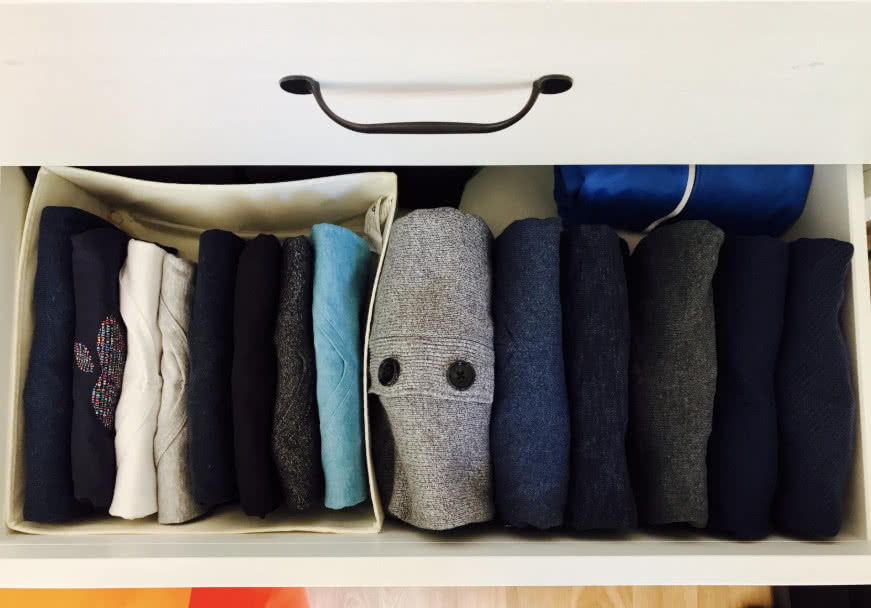
The best storage should let you see exactly what you have at a glance, without too much effort. To that end, vertical storage is better than horizontal storage.
- Piles can be endlessly added to--you can always stack more things on top of each other. Infinite storage is bad for organization, and great for clutter. Conversely, vertical storage runs out. You’ll know when you’ve accumulated too much stuff because you won’t have space for it.
- But piling things also puts a lot of strain on the things at the bottom, and will cause them to deteriorate faster. Also, when things end up on the bottom of piles, that’s usually when we stop using them, either because they’re harder to get to, or because they don’t spark joy and we use them less frequently, so they ended up there.
We’ll talk more about storage for each category later, but here’s what vertical storage looks like for clothes. When you pull out a drawer, items are shown vertically, so you can see all the items at once:
Avoid Alternative Storage
Don’t turn to alternative storage solutions--extra sets of drawers, tiered shelving units, containers that open up into many smaller drawers and containers. If you need additional storage options, you probably haven’t discarded successfully. Complicated things won’t help you out in the long run, they’ll just make it more difficult to access what you need and assess how much you have.
Most storage fixes are hideaways for belongings we don’t need.
- A lot of storage just moves the mess around. It might look prettier, but your space is still cluttered, just with storage solutions instead of individual objects.
- What happens once your storage solutions get full? You just buy more storage options or stuff spills out into other areas.
You don’t need anything fancy, and you usually don’t need to buy anything. Cabinets, closets, drawers, and boxes or similar containers are your friend.
- Kondo’s fond of shoeboxes. Use the bigger bottom part to divide your underwear from your socks. Use the thinner top in your kitchen drawers to keep your utensils from sliding all over the place. Use them in the bathroom to organize shampoos. Use them in the kitchen to organize spices or grains or snacks.
- (Shortform note: If you don’t have shoe boxes, try going to a local shoe store and seeing if they have empty ones you can take for free.)
- Other good boxes for organizing smaller items are business card boxes and Apple boxes for phones and music players.
- Items that take up a lot of floorspace can be put in your closet instead of out in space.
- If you have a big, open closet without much internal organization, you can get storage units that go inside the closet. Even things as simple as bookshelves can be put in your closet to help you maximize what gets stored in there.
Don’t buy storage options before you’ve finished going through the whole process. Use all your available space first and then you’ll know exactly what you still need.
Family Households
If there are multiple people in your home, each person should organize their own stuff by category first. Then you can tackle shared stuff in communal spaces.
If you do have multiple members in a household, make sure everyone has their own personal space to store things. Ideally, everyone in your household would have a single spot where they keep all their belongings. Once storage spaces get spread out over the house, clutter is more likely to happen.
Giving everyone their own individual storage space will make them happy and give them autonomy. This is especially useful advice for parents. You might think it’s better for you to pick where your child’s stuff goes, and for you to organize it. But if you want to teach your child how to be tidy on their own, you’ve got to give them their own space, let them organize it, and allow them to maintain it. They’ll want to keep it clean if it’s their space and their responsibility--if you do it for them, they won’t have any incentive.
Your space should be your sanctuary. It should be tailored to you, and give you the peace and comfort of a tidy space. That goes for everybody.
Labels
You may feel tempted to label things in your house so you know what’s inside, or you may leave the labels on items you bring into your home without thinking twice.
But having words in sight all the time--even if it’s just words on our deodorant, for example--can create a buzz in our minds. Words, after all, are information, and if we’re surrounded by unnecessary information, our brains are still going to be processing it whether we’re conscious of it or not.
Avoid labeling things. The less stuff you have, the more you’ll remember what you do have--this is why discarding is so important. Then, your storage should let you see everything in one place at a glance, which removes the need for labeling--this is why organizing is so important.
- Remove as many labels as you can, from your storage boxes and items, and this will calm your mind down, and give it a break from processing.
The noise of written information actually increases the more you decrease the objects around you. The neater your home is, the more this unnecessary information will stick out.
Chapter 5: Clothing
Now that we’ve discussed the big-picture process and the general principles of discarding and organizing, the next 5 chapters will focus on the individual categories (in the correct order!). Each chapter will address discarding first, then organizing. The first category is clothing.
Kondo breaks this category down into subcategories:
- Tops--shirts, sweaters
- Bottoms--pants, skirts, shorts
- Clothes to hang--jackets, coats, suits, dresses
- Socks
- Undergarments
- Bags--handbags, messenger bags
- Accessories--scarves, belts, hats, jewelry
- Clothes for specific events--swimsuits, uniforms, kimonos
- Shoes
If you have a lot of clothes, you can also use these subcategories to help you tackle smaller portions one at a time.
Discarding
Gather all your clothes from all over your home and put them in one place, on your bed or on your bedroom floor. When you think you’ve finished, ask yourself if there could be anything else hiding anywhere else.
- Kondo gives her clients a rule: if they find another item of clothing after they’ve gathered everything and sorted through it, that item immediately gets discarded--you didn’t even remember you owned it!
Don’t be alarmed by how much you have--everyone has way more than they think. From Kondo’s experience, the average number of clothing items people own is 160.
Then go through all your clothing, item by item, picking each one up and asking if it sparks joy. If it does, it goes in the keep pile. If it doesn’t, it goes in the discard pile. Remember to thank anything you discard.
- You can start a maybe pile, but try to keep this small. Remember you should feel the answer to whether something sparks joy immediately, and you shouldn’t keep things that don’t spark joy. If you hesitate, chances are high you should discard it. Revisit this pile after you’ve gone through the rest of your clothes and have a better sense of what sparks joy and what doesn’t.
- If you’re having trouble, start with off-season clothes. Because you don’t need these in the immediate future, it’s much easier to be in tune with what sparks joy and what doesn’t. Ask yourself if you’d wear this item right now if the temperature suddenly changed. If the answer is yes, keep it. If the answer is no, or “well...” then put it in the discard/donate pile.
If your clothing doesn’t spark joy, don’t just turn it into loungewear. You should still wear things at home that spark joy, not castoffs that at best spark no feelings in you and at worst spark the same negative feelings that kept you from wearing them out of the house. Free up the space and get yourself some nice loungewear, made by companies that specialize in loungewear.
You may worry you won’t have enough clothes to wear if you only keep what sparks joy. But by keeping only what sparks joy, you’ll end up with exactly the amount of clothing you need, or you’ll know exactly what to buy to fill out your newly sparse wardrobe.
Organizing
(Shortform note: The book has a lot of suggestions for organizing clothes. Try to apply the large ideas, but if a specific recommendation is way too tiresome for the reward, then it’s ok to skip it.)
We generally have two ways of organizing our clothing: folding items to go into drawers, or hanging items in a closet. It might seem like the two options are equally as efficient, but folding is a more effective way to organize your clothing (as long as it’s not clothing that demands to be hung, like collared shirts or dresses--we’ll cover that in the next section).
- Hanging might seem like an easier option to help keep things tidy, but actually having a lot of hanging clothes is one reason why our closets are bursting. Not to mention, when our closets are packed with hanging clothes, getting anything in and out is difficult and creates more mess.
Folding
Neatly folding your clothes will help you solve even the most annoying storage problem. Folding has a number of other benefits too:
- Folding an item of clothing is your opportunity to thank it for providing you support and protection.
- Folding allows you to notice your clothes and their condition in detail.
- As you smooth a piece of clothing out, you touch it with your hands and your energy transfers into it.
- Healing in Japanese is te-ate, literally translating to “apply hands.” Touch has power--children are comforted when their parents stroke their heads or hug them, and massages by an actual person are more effective than sitting in a massage chair. Likewise, folding can have a positive effect on our clothes.
First, visualize what your drawers will look like after you’ve folded everything. The goal should be to see every item of clothing in the drawer at a glance, and be able to grab something easily without messing everything else up.
The key to achieving that goal is vertical storage instead of horizontal. This allows you to access your clothing easier, without having to mess up a pile to get to an item on the bottom.
- You might think this means there are more wrinkles in your clothes, but that isn’t the case. Wrinkling has to do with pressure--if you fold correctly, your clothes will be folded up but the fabric will be taut, and it won’t cause your clothes to wrinkle.
- When clothes are folded in a pile, the pile puts pressure on the clothes, and this is actually what causes them to wrinkle--but we’ll be avoiding this by going for vertical storage instead of horizontal.
How to fold correctly: fold every item of clothing into a simple, smooth rectangle that can stand up on its own.
- First, fold both sides of the garment towards the center--fold the left side of your shirt towards the center, then the right side, and then fold the sleeves in whatever way creates a long rectangle.
- Then, pick up one small end of the rectangle and fold it to the other small end, leaving a small gap.
- Finally, repeat the step above, folding the garment into smaller halves or thirds.
- (Shortform note: It can be hard to understand this folding concept through reading. Here’s the master herself showing you how to fold a number of common clothing items.)
- Every item of clothing will need a different number of folds to get it into the right shape. It may take some experimentation to find that sweet spot. Keep adjusting the height of the folds until you find the exact right amount for the specific piece of clothing.
- Heavier items of clothing will need less folds to make them stand up. Thinner items of clothing will need more folds to give them the structure to stand.
Hanging
Folding is a better storage solution, but some items of clothing need to be hung, such as dresses, suits, coats, jackets, and any clothing with structure that makes it hard to fold, such as collared shirts.
The basic rule of thumb is hang clothes by category, with categories side by side. Have a suit section, a dress section, a jacket section.
You can also organize your closet so that the items rise to the right. Lines that rise up to the right make us feel more comfortable, and they create a lighter feeling in us when we see them.
- Put heavier, longer items of clothing on the left side of your closet, and lighter, shorter items on the right. The order might go: coats, dresses, jackets, pants, skirts, blouses.
Socks and Stockings
Don’t ever tie up your stockings, and don’t ball up your socks.
- Balling your socks up--where we put two socks together and then fold the top of one sock over both--ruins the elastic in your socks over time. And if, like Kondo and the Japanese religion of Shinto, you believe that all inanimate objects have souls and feelings, being balled up and thrown on top of each other in a drawer is a horrible existence for your socks.
To fold socks:
- To start with, unball all your socks!
- First, place one sock on top of the other. Fold in half, then again in halves or thirds.
- For low-cut socks, you only need to fold them twice.
- Ankle socks, fold three times.
- Knee socks or higher, fold four to six times.
- You can fold the socks in accordance with the height of the drawer they’re in.
- Then store the socks standing up on edge, with the swirls of the folds visible on top.
- Folded this way, socks will take up a fraction of the space they used to.
To fold stockings:
- Fold them in half lengthwise so the toes are touching. Then fold the rectangle in half widthwise. Then fold it into thirds and make sure the toes are on the inside and not the outside of the folds and that the waistband protrudes a little from the top. Then roll the stockings up to the waistband.
- The waistband should be on the outside if you’ve done it correctly. The stockings should be stable and firm, like a sushi roll.
- Fold knee-high stockings the same way. For thicker tights, don’t fold into thirds, fold into halves.
- When you arrange stockings in the drawer, the swirl of the roll should be facing upwards.
- A shoebox is a great internal divider for stockings in a big drawer. This will help them not slip out and unroll.
Seasonal Clothing
Kondo doesn’t go in for seasonal storage. It’s an outdated custom that was more necessary before we had temperature controlled indoors.
If you want to keep your clothes as neat and tidy as possible and keep only clothes that spark joy, you should aim to keep all of your clothes in your closet all year round.
- This prevents you from forgetting what you have and buying off-season clothes that you don’t need.
Don’t over-categorize your clothes by season--categorize by material of clothing, all cotton together, all wool together, cotton-like and wool-like close to each of those respective categories. Again, this will save you from forgetting what you have.
If you really don’t have enough space, try storing only purely seasonal items away first: swimsuits, sun hats, gloves, heavy scarves.
- Most people store off-season clothing in plastic bins--these are the worst storage units because they become a hassle to open up, and then we never see the contents. Plus, usually, stuff gets put on top of plastic bins like this, and then it takes too much effort to get into them.
- Kondo recommends purchasing a set of drawers if you have so much off-season clothing you need a storage solution. You can store your clothes in here using the principles we already covered, and then they’re easy to access and easy to see.
Bags
The best way to store your bags is in other bags.
- Yes, this contradicts the goal of seeing everything in a category at a single glance, but it vastly reduces the space bags take up, helps your bags keep their shape since they’re filled, and makes it easier to access them faster than some other methods of bag storage.
Store bags in similar bags to further reduce the hassle. For example, make a leather bag stash, putting each bag in the next largest bag, like nesting dolls.
Kondo’s rule is to try not to keep more than 2 bags in any 1 bag, meaning the maximum number of bags in a single stash is 3.
And, if you want to go hardcore, empty your bag every day.
- Kondo unpacks her bag at the end of every day, though she does admit that sometimes, when she’s very busy and knows she’s just going to use the same things the very next morning, she’ll leave her purse packed.
- It’s much easier to forget you have something if you leave it in your bag all the time--this is how we end up with a million lip balms in every location.
- You can just as easily find a single place to store items you put in your bag every day, like a box somewhere in your room that contains your wallet, keys, train pass, and similar items, or make room in the corner of a drawer.
Bulk Items
People often buy things in bulk, including clothing, because they think it’s cheaper.
But if you think of your home as a storage space--one you pay for every month in rent or mortgage--then it’s not necessarily cheaper to store bulk items. You’re paying for these things to take up space.
Plus, you might think keeping bulk items wrapped, packaged, and tagged keeps them newer until you need them--but in reality, they’d be even newer if you didn’t buy them in bulk, but bought them from the store every time you ran out.
These things just take up space. You don’t actually need these bulk items right now, and the packaging makes it feel less like your space and more like a store.
- Your items should feel like they belong to you--otherwise, chances are high you won’t end up using them, and they’ll just become something you need to discard down the line.
Chapter 6: Books
Books are deceptively hard to discard in. Unless damaged, books are always functional. Even if we’ve read them, they always contain information. And many of us who own books have emotional attachments to them. If you remember, these are the 3 reasons we keep items, and 3 reasons we find it difficult to get rid of items--so you can see why this category gives people trouble.
This is also the only category without the discard/organize divide. This information is entirely about discarding. Organizing books is relatively straightforward: arrange them vertically on shelves. Some people put their books in horizontal piles--we’ve covered why that’s a worse way to organize anything. Books may be the only category that people don’t need help organizing.
The problem most people run into is that they have too many books to store, which is why discarding is the primary focus of this chapter.
As with clothes, take all your books off the shelves, and put them in a pile on the floor.
- It might seem easier to pick what to discard if the books are neatly arranged on a shelf. But, if you do it this way, you’re skipping one of the fundamental stages we already covered: holding each item in your hands, one by one.
- Even if you have books in neat piles on the floor already, bring all the books into one place to sort through them. This lets you see your total number of objects in any given category, and this, as we’ve discussed, can be a wake up call about how many things you own.
Break the books down into categories if you have a lot:
- General, books you read for pleasure
- Practical, books you use for reference, like cookbooks
- Visual, books such as photography collections or art books
- Magazines
Do not read books as you sort them--simply hold the book in your hand and see if you feel a thrill of joy upon holding it. Reading will cloud your judgement and take your brain out of the tidying zone.
If you haven’t read it yet, you’re probably not going to. Discard it. This will be the true test of how passionate you are about it.
- If you don’t think about it after you get rid of the book, then you didn’t really want to read it.
- If, after you discard the book, you want it so badly you’d be willing to run out and get a new copy, do so and actually read it this time.
Most of us are also not going to reread many books again. We might have a small number of favorites that we actually return to time after time, but we keep way more books we’ve already read than we’ll actually return to. Keep only your hall-of-fame books.
(Shortform note: Kondo’s gotten a lot of criticism from the book community. We’ll clear some misconceptions up.
- Remember, she’s only encouraging you to discard what no longer sparks joy. She’s not telling you to get rid of all your books. Instead, make sure all the books you keep spark joy for you.
- She’s not telling you to throw your books away. Donate them to your local library or second-hand store so someone else can enjoy them.
- The decision to discard or keep books--or anything else in your house--is ultimately up to you. Kondo pushes us to analyze our relationship to the objects in our lives, and for even the most dedicated book lover, it will still be beneficial for you to do this--even if you don’t discard a single book.)
Chapter 7: Papers
Papers are essentially any mail or documents that we receive, notes we take in school or outside classes, or manuals and instructions that come with appliances or electronics.
Remember, this category doesn’t include things like love letters or special cards--those are mementos, and go in the last category. And it doesn’t include any books or magazines, but it does include newspapers.
Discarding
General rule of thumb: discard all papers. This takes a lot of the guesswork out!
Here’s a few subcategories people commonly end up holding on to:
- Lecture, class, or conference materials
- Ironically, the more notes you have from seminars or lectures, the less you’re actually putting that information into practice. Perhaps holding on to the notes is the exact thing that keeps you from putting the information into practice. The notes become a crutch--you’ve got the information written down, why would you need to remember it or practice it?
- Credit card statements, utility bills, used checkbooks, and pay slips
- Once you check the content of these items, you don’t need them unless there is an issue, so discard them. Some people think they might need these down the line in a court case to prove where they spent their money. This is unlikely, but nowadays, you can get all your statements online should this ever arise.
- Warranties and manuals for appliances
- Warranties are documents with an end date--save them while they’re active, get rid of them once they aren’t.
- Ditch the manuals. Read the ones you’re worried about needing, and then ditch those. You can find the manuals online, take these items into shops if they’re having problems, or call stores to have repair people come take a look at them.
- Cards
- Don’t save greeting cards unless you need the addresses on them, in which case you can save just one most recent card with the address, or record the addresses somewhere.
- You don’t need to feel guilty about getting rid of cards that someone sent you. Each card fulfills its purpose the moment it reaches you and you read it for the first time--you are reminded that someone was thinking of you. You probably won’t go through old cards just to remind yourself of that feeling.
Organizing
There are 3 categories of papers you might need to keep:
- Papers you’re currently using
- Papers you need for a limited period of time
- Papers that must be kept indefinitely
Papers you do decide to keep should be further categorized into two groups:
- Papers to save, such as birth and marriage certificates, current leases, vet papers, and insurance policies.
- Papers to deal with, such as letters that need responses, forms to be filled out, or newspapers you’re (actually!) going to read.
Put papers that you need to deal with in a special place that contains ONLY these papers. Kondo suggests using a vertical organizer and putting papers in it without separating them.
- Even Marie Kondo has never successfully and totally emptied her “needs attention” box, but that’s the goal. They should eventually be attended to, and anything you don’t need after that should be discarded, while anything you need to keep turns into the next category.
Papers you need get divided into two subcategories: infrequently and frequently used.
- You don’t have to put a lot of energy into storing the few papers you have to keep but use infrequently, such as insurance policies or warranties. Since you don’t access them often, put them all into a single clear folder without further categorization.
- Papers that you use more frequently might be things like newspaper clippings or seminar outlines. These you could put into the clear plastic pages of a file folder.
- Papers like this aren’t really all that necessary, and it’s easy for this category to get out of hand. Reduce the volume as much as possible to organize them most efficiently.
So you really only need 3 simple places to store each of these 3 paper categories, and you don’t need to waste time organizing them into smaller categories.
Chapter 8: Komono, or Miscellany
Here are the categories that fall under komono:
- CDs and DVDs
- Skin care products
- Makeup
- Accessories
- Valuables like credit cards, passports, medical cards
- If you have a lot of items related to a particular hobby, like skiing, include them here
- Electrical equipment and appliances like cameras, cords, anything electric
- Household equipment like stationery and sewing kits
- Household supplies like detergent, medicine, tissues
- Kitchen goods and food supplies like spatulas, dishes, pots
- Any other small categories like tchotchkes, figurines, spare change
Look at the order of that list: it’s an intentional order that goes from more personal items to more communal items.
- If you live alone, you don’t need to worry about this distinction, but if you live with people, then the order becomes useful. When you get to this category, use this order for maximum efficiency--it’s easier to calibrate what sparks joy for you alone before you try to work with another person to discard items you share.
Many of the items in this category are things we keep “just because.” This results in many odds and ends that take up space and clutter our homes.
Discarding
Here are some common areas of difficulty in this category:
- Gifts
- The purpose of a present is to be received, and to convey the giver’s feelings of affection. A gift accomplishes these 2 things at the very moment it’s given, but then a lot of us end up keeping gifts someone gave us that we don’t use or even like. Don’t do this. Thank it for the joy it gave you when you first received it, and discard it.
- Cosmetic samples
- These products are smaller sized and consequently have shorter shelf lives. You don’t want to use expired cosmetics when you’re traveling! Trash them. Get reusable travel sized bottles instead.
- Electronic packaging
- Many people save boxes in this category thinking it will make the electronic more valuable if they want to sell it one day, and for some items, it might. But if you think of your home as storage space that costs money to maintain, do you think having the box for that electronic will recoup all the money you paid in the years you let it take up space?
- Exception: we mentioned that Apple boxes and similar quality boxes make great organizers, so you might save some of these to use as organizing tools.
- Cords
- If you don’t know what a cord is for, you probably don’t need it. Keep the cords you can immediately identify and discard the rest. A tangle of cords just makes it harder to find the one you need.
- Broken appliances.
- If it’s broken, discard it.
- If you’re worried about disposing of appliances responsibly, look into your local waste management company to see if they do special pick-ups or have a list of what items to recycle.
- If you don’t want the money you spent on it to go to waste, see if you have an active warranty on it, or look into getting it repaired. Otherwise, thank it for its service as you discard it.
- Spare bedding
- If you host friends and family a lot, you might need more spare bedding than other people. But if you have visitors once or twice a year at most, you really only need one set of spare bedding. Bedding that’s stored away for too long gets musty, and that’s not how you want to treat your guests.
- Spare buttons
- Discard these. If you really want to keep the spare buttons, sew them into the lining of the garment right when you get it. If you lose a button, you can always go to the local craft store to find a similar one. Most people, if they lose a button, either keep wearing the garment without replacing it or leave the garment in their closet never to be worn again--even if they have the spare buttons.
- Health craze products
- These usually cost a lot of money, which makes us less likely to want to discard them. But let them go if you don’t use them and they don’t spark joy. Thank them for their service--if you actually used them, or if they just gave you a thrill when you bought them--and then discard them with the satisfaction that they’re helping you get healthier right now by allowing you to get rid of them.
- Freebies
- Pens with school names, post-its from a doctor’s office, a keychain that you got at a game--unless you’re using these and they bring you joy, discard them. You didn’t purchase them and you don’t need them.
- Spare change
- Take it to the bank or put it in your wallet. It’s real money and it can buy you things. Don’t let it accumulate in bowls and containers in various surfaces, and don’t put it in a piggybank or a plastic bag. Chances are you’ll just let it accumulate and then never take it to the bank because it’ll be too heavy or too much of a hassle.
- Stockpiles
- Many people keep things they use all the time on hand in their homes, sometimes in extremely high numbers. Hundreds of rolls of toilet paper, 10 back-up shampoos, pairs of socks still wrapped in their plastic.
- You don’t need all these stockpiles--you won’t die if you run out of toilet paper. Give your stockpiles to friends who can use it right now, recycle it, or take it to a charitable donation center.
- You might think this is a waste of money--you’ll need toilet paper one day in the future, of course, so why not keep it? But these stockpiles take up valuable real estate in your home.
- While you might think they spark joy at the idea of always being prepared, they actually speak to an anxiety about not being prepared. Let these things go.
Organizing
Kondo doesn’t go into too much detail on how to store many of these items. She mostly reinforces the principles already covered:
- Whenever possible, go for vertical storage.
- She even stores carrots in her fridge vertically, by putting them upright in the egg holders in her kitchen door. (Shortform note: remember, just apply the principles that make the most sense to you.)
- Remember that good storage should show you everything you have in one glance.
- Keep your storage as simple as possible. Don’t buy complicated storage solutions. Shoe box bottoms could go into cabinets to vertically store things all together and give you easy access to them just by pulling the box out, while shoe box tops can go into utensil drawers to serve as dividers and keep things from sliding around.
Bathroom and Kitchen Storage
Kondo doesn’t keep anything in her shower. Yeah, you read that right.
While this may seem extreme, she has good reason for doing so. In keeping with the idea that it doesn’t take much more effort to get things out of their storage space, she keeps shampoos and similar items in a cupboard close to her shower.
- This makes it easier to clean the shower regularly, since you don’t have to take everything out, and it keeps your shower stuff from getting scummy and mildewy. Grab your shampoo and bring it in with you, then dry it off after you’re done and put it back in the cupboard.
She doesn’t keep her sponge in her kitchen sink, either. She stores detergent and sponges in the cabinet below the sink.
- This allows the sponge to actually dry out between uses instead of getting wet every time you run the faucet, which makes the sponge last longer without getting musty and mildewy. You can also squeeze your sponge out after every use and hang it on a hook above the sink, where it’ll stay dry.
Kondo also puts her dishes out in the sunlight to dry them, instead of having a drying rack. She has a veranda where she can do this, so you might not have this option. But sunlight is a great, natural disinfectant, and it gets dishes out of your way as they dry instead of taking up counter space.
One common thing people do in kitchens is keep their basic cooking stuff right by the stove--oil, salt, pepper, and other seasonings. Don’t do this. It takes up counter space, and these things get coated in oil spray and food as you cook on the stove.
- You probably have cabinets next to and on top of your stove, and usually there are small drawers right next to the stove to keep things in. Use these immediate storage solutions.
Miscellany Drawers
Don’t worry too much about organizing these drawers more than you have to. If you, for instance, put all your stationery items in one drawer, as you continue to use these items, the ones you use more frequently will naturally end up towards the front of the drawer, easier to access, while the items you use less frequently will move towards the back of the drawer.
Chapter 9: Sentimental Items
Sentimental items, mementos, keepsakes--these are usually reminders of times or people that gave us great joy. But think about the most important moments in your life--would you forget these moments if you didn’t have a physical object to remind you of them? Probably not.
Too many keepsakes might suggest that you’re living in the past, and not appreciating the present or thinking about the future.
When we handle each item from our past and decide what to keep and what to discard, we ultimately end up processing our past and putting it in order. If you hide these things away, your past can become an unseen weight that prevents you from being fully present.
Discarding
These are some common kinds of keepsakes, and how to approach them:
- Letters
- A letter fulfills its purpose the second it is received. Think about the letters you’ve written in your life: do you remember what was said? Probably not. Keep only the ones that actually spark joy, and that you might read over in the future. Discard the rest.
- Gifts
- We covered this briefly in the komono section, but it bears repeating in this context. Gifts are meant to convey that the giver feels affection for us, and they accomplish this the moment we receive them. You shouldn’t keep a gift as a memento just because someone gave it to you, you should keep it because it sparks joy. If it doesn’t, thank it for doing its job of letting you know the person cares, and discard or donate it.
- If you feel guilty, you can think of it this way: if you can donate the gift, you’re turning the affection someone felt for you into something that will spark joy for someone else in the world--you’re spreading joy!
- But even if you can’t donate it, the person who gave it to you wanted to bring joy into your life--thank the object for conveying the giver’s affection, and thank the giver in your mind for understanding that some things bring us more joy when we let them go than when we keep them.
- Photos
- A good rule of thumb regarding photos is to cherish who you are now.
- Leave photos for last when you do this category. Looking at old photos will pull us in all sorts of directions--remembering past versions of ourselves, dredging up old loves and old burns--and it’ll make harder for you to discern what sparks joy for you right now in the present.
- We keep photos to remind us of specific times or events. But we probably only need a handful of photos per time or event, not entire albums dedicated to one thing.
- Many of us have photos lying around, tucked into books, or loose in a box. Kondo notes that photographs seem to turn up in envelopes along with letters that accompanied them. Put these loose photos in one place whenever you find them.
- You might think your photo albums are safe from the KonMari method, but they aren’t. How do you sort photos? The same way we’ve sorted everything else: one by one, taking each one in our hands. Yes, including albums. Take all the photos out and then go through them one by one.
- You’ll find that a lot of photos you kept through the years end up being unexciting photos of scenery, or images that you couldn’t place outside of the album. Discard these. Discard any photos that don’t spark joy. Thank the discards for the joy they gave you when you took them, and let them go.
Organizing
Again, Kondo doesn’t go into too much detail about how to store these items, so turn to the general principles of organization once you finish discarding.
A lot of people keep sentimental items hidden away in boxes in their closets--but this of course makes it easier to forget what’s in there, and prevents you from appreciating these objects that bring you joy. Ideally, you’ll have cleared up enough space throughout your house from discarding that you should have space to display some of these mementos, or at least access them easier.
For instance, once you’ve gone through all your photos, put them in albums and put them out on a shelf. Don’t let them sit loose in boxes or other storage units. When you’re older, you’ll appreciate being able to easily pull an album down and flip through photos that give you joy--and if you tidy successfully, you can appreciate them right now.
A Personal Shrine
This section is catered specifically to Kondo’s Japanese audience, as it addresses what to do with shrine charms that you collect, but it can be applicable to other audiences and other items.
The top of a bookcase is a great place to make a personal shrine. Pick your favorite, most joyful mementos and knickknacks, and create a small, personal altar in your home. This is in direct keeping with turning your home into a place of joy, your own sacred space, and filling it with positive energy.
You can also decorate the insides of your closets to make your space more personal, especially if you have things you might be embarrassed to have out where other people can see them. Fill your closet with your secret delights, and feel the rush of joy every time you open your closet.
The Ultimate Storage Shortcut
Many people, especially in America, have boxes of sentimental items in storage at their parents’ house. Some people even send stuff to their parents’ house if they don’t have space for it.
Your parents’ house is not extra storage for you--if you treat it that way, you undercut your ability to discard. We almost never retrieve the boxes we leave at our parents’ homes--they sit there, unopened, taking up space in that house instead of ours. Don’t do that to your parents.
Sometimes, parents even leave their children’s rooms untouched long after their kids have become adults and live permanently in other places. This, too, should be avoided. Turning their room into a shrine prevents you from appreciating them for the adults they are now, and from moving into the next chapter of your life without kids in the house.
- Of course you can keep mementos from your children’s early years, but put these in the sentimental items category and go through them item by item. You don’t need every single drawing they did in kindergarten, and you must ask yourself if you even remember these items are here until it’s time to throw them away. If you don’t, you don’t need them--you’ve got the memories in your head.
Chapter 10: The Psychological Benefits of Tidying
Now you’ve learned why we should undertake this, how to discard and organize, and how to make your way through all the categories--you’ve learned to tidy! Tidying is a simple process through which we restore the complex balance between ourselves, the things we own, and the home we live in.
A major takeaway of this book is to appreciate the things you surround yourself with daily. These things support you and provide service, and most of us don’t treat our possessions with a lot of respect.
Actively appreciating your belongings will not only give you a deeper sense of gratitude, which is proven to be connected with a healthier and happier mindset, but it will also increase the longevity and usefulness of your belongings.
- Kondo draws from the Japanese religion of Shinto, and believes that objects have spirits and emotions. So, in her view, every time you stuff a balled up pair of socks into a drawer, you might as well be treating a human that way.
- But you don’t have to believe that belongings have spirits to see this benefit--the more you appreciate your belongings, the more you’ll take care of them, the longer they’ll last.
- Kondo greets her house every day when she comes home, and she says thank you to everything she uses over the course of a day. You can do this silently in your mind if you feel uncomfortable saying it loud.
Once you tidy, you’ll spend less energy finding things, you’ll be able to relax more knowing everything’s in order, you’ll appreciate your belongings, and you’ll only be surrounded by items that spark joy.
And the process of discarding things and organizing what’s left can help us improve more than just our space:
- Dialoguing with ourselves throughout this process hones our sense of intuition.
- Deciding what to keep or discard hones our ability to make decisions confidently,
- Keeping only objects that spark joy hones our ability to experience joy, and works to bring more joy to our lives.
- Completing this process can even bring us back to big-picture life things that are important to us.
- A client had been working in IT for years when she went through the KonMari process. Once she’d whittled her home down to items that sparked joy, she realized that all her books were about social welfare, specifically in regards to childcare. And this client used to be a volunteer babysitter long before she entered IT--she’d just forgotten about this passion over the course of daily life. After doing the KonMari method, she quit her job and started a childcare company.
Letting go is more important than adding. Yes, this rule applies to tidying, but it’s a good rule for life. Many of us add things to our lives constantly, but still don’t feel happier. If we’d focus instead on letting go of things--both tangible things, like possessions, as well as intangible things, like grudges, trauma, and fears--we’d all feel a deeper sense of happiness.
This is not to say that clients haven’t occasionally regretted getting rid of something--it definitely happens. But you can take pride in knowing you made the choice yourself--you were in control of the situation. This is why it’s crucial to be the one who decides what goes and what stays--if someone else makes you throw something out or makes you feel like you should, you’ll be resentful towards them for forcing your hand. With this method, you have to take responsibility, both for getting rid of something and then for recognizing that you need it again.
- It’ll take less effort to discover you need something, which will decrease your stress levels. If you discover something’s gone that you need, you don’t have to waste time worrying if it’s somewhere else in the house--you can immediately jump to solving the problem and filling the gap.
- When you realize you can survive with fewer belongings, this frees you from feeling like you need things to survive.
Your body might respond to this tidying process--Kondo noticed most of her clients experienced physical symptoms while going through her course. Getting rid of possessions that don’t spark joy is essentially like detoxing, and you might find that your body detoxes alongside your house.
- Some of Kondo’s clients get stomach problems, some people break out, and some people get sick--but these things pass quickly, and Kondo notes that the clients are healthier afterwards.
- The same way that our bodies respond to stress, they will also respond to new feelings of calm and contentment. When we get rid of excess clothing, we might slim down; when we get rid of excess books and papers, our minds might be clearer; when we clean up our body products, our bathrooms get cleaner, and so does our skin.
Now you know how to tidy, so why not do it now? Put your house in order all at once, and be done with it. Make room in your life to focus less on all the stuff around you, and more on all the things and people that bring you joy.
Exercise: Noticing the Magic
Everyone that successfully goes through Marie Kondo’s process has a major revelation about their habits, their spaces, and their lifestyle. Go through the tidying process, then complete this exercise. Then come back to your answers if your space ever starts to feel cluttered again to remind yourself of the impact tidying had.
What’s one thing you learned or noticed throughout the tidying process that surprised you? It can be a good surprise, or a not-so-good surprise--both have value.
If it was a positive thing, or something you’d like to continue feeling in your life, write about how you can apply it to other areas in your life, like your job or your relationships. If it was a negative thing, or something you’d like to work on improving, write about some non-tidying changes you could make to help you continue to improve.